Pronunciation Workshop Reference
German Alphabet Letter Names and When to Write ß or ss
Straight answer
German uses the same 26 letters as English, plus four more: ä, ö, ü and ß. Deutsch im Blick counts them that way, as 26 plus 4. Start out loud now with the first three names: A, B, C. Say them as /ʔaː/, /beː/, /tseː/, three times, then look away and say them again. This page gives most names, the ones that trip up English speakers, when to write ß, and a week of practice that ends with spelling names aloud.
The English trap
Deutsch im Blick says learners often misread ß as a capital B. It isn't one. It's a letter of its own, called Eszett or scharfes S, and it sounds a lot like English s.
Say this today
Wie buchstabiert man Ihren Nachnamen?
How do you spell your family name?
What are the German letter names?
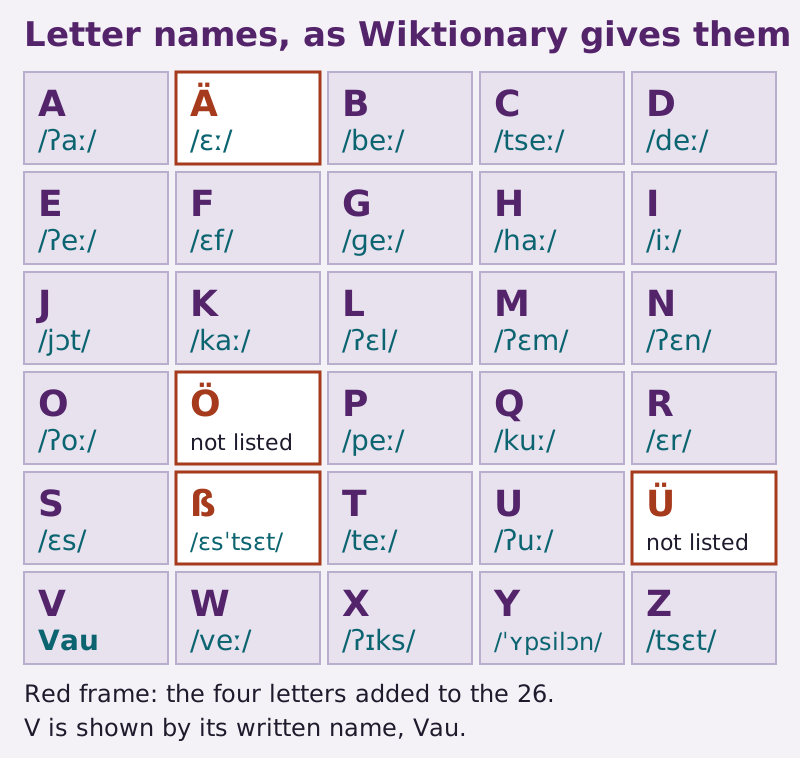
The names below come from Wiktionary, written in IPA. To hear them, Deutsch im Blick has a recording of the whole alphabet with sample words for each letter. This page hasn't checked that recording letter by letter, so use it to get the sounds in your ear, not as a test.
"German letter names, A to Z with Ä, Ö, Ü and ß" from Conversation Mile (https://conversationmile.com/pronunciation/german-alphabet/). CC BY 4.0 (creativecommons.org/licenses/by/4.0)
A few notes on the chart:
- The ʔ at the start of some names is part of Wiktionary's transcription. Listen to the recording for how those names begin.
- V is written by its name, Vau, which is how Wiktionary spells it.
- Ä: Wiktionary's entry for the letter gives its own vowel, /ɛː/, and also "A Umlaut," among other ways to say it.
- Ö and Ü have no name listed in the sources this page used. Saying the vowel itself, the way Wiktionary names Ä, is this site's House routine. For how to round your lips for those vowels, see German pronunciation, and listen to the alphabet recording linked above. A tutor can tell you what they say.
- ß is called Eszett or scharfes S.
Say the chart in rows of five. Read a row, cover it, and say it back.
Which letter names don't match English?
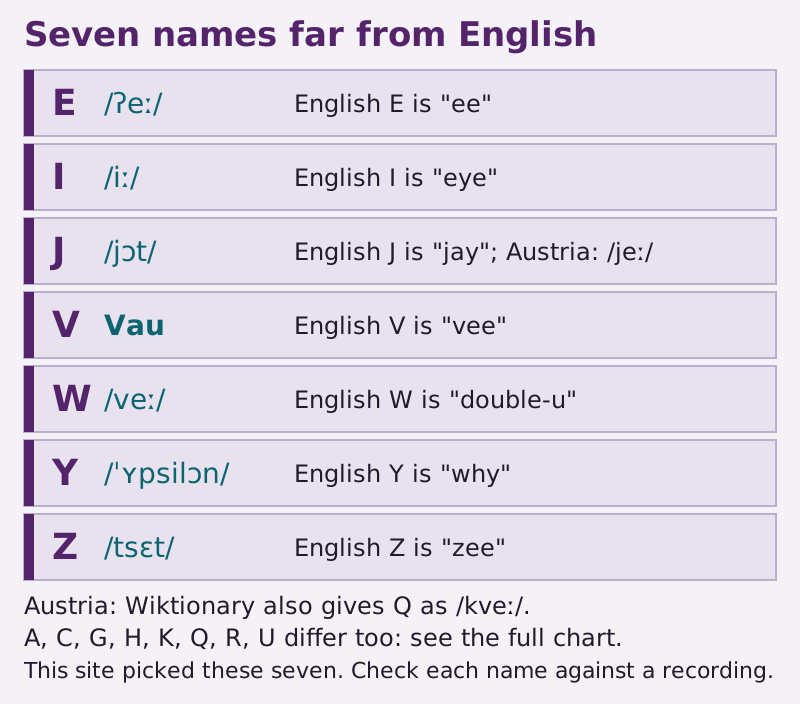
This site picked seven that are far from the English name of the same letter. Say those most often. They aren't the only ones: A, C, G, H, K, Q, R and U differ from English too, so check every name against the chart above.
"German letter names that differ from the English names of the same letters" from Conversation Mile (https://conversationmile.com/pronunciation/german-alphabet/). CC BY 4.0 (creativecommons.org/licenses/by/4.0)
| Letter | German name | English name |
|---|---|---|
| E | /ʔeː/ | "ee" |
| I | /iː/ | "eye" |
| J | /jɔt/ | "jay" |
| V | Vau | "vee" |
| W | /veː/ | "double-u" |
| Y | /ˈʏpsilɔn/ | "why" |
| Z | /tsɛt/ | "zee" |
E and I are the pair to watch. Spell a word that has both, like Brief, using the German names from the chart, and keep them apart: B, R, I, E, F.
Where it varies: Wiktionary gives J as /jeː/ and Q as /kveː/ in Austria. If you're learning for Austria, use those two.
The names are not the same as the sounds the letters make in words. W is named /veː/, and Deutsch im Blick says German w also sounds like English v, but V is named Vau and in most cases sounds like f. Deutsch im Blick notes there are exceptions, so look up a word with v before you say it. For the sounds, see German pronunciation.
How do Ä, Ö, Ü and ß work in writing?
Each one is its own letter. Deutsch im Blick says umlauts can change a word's meaning, as in schon (already) and schön (pretty), so don't drop the dots. If a computer program or an e-mail server can't handle them, it says to write ae, oe, ue in their place.
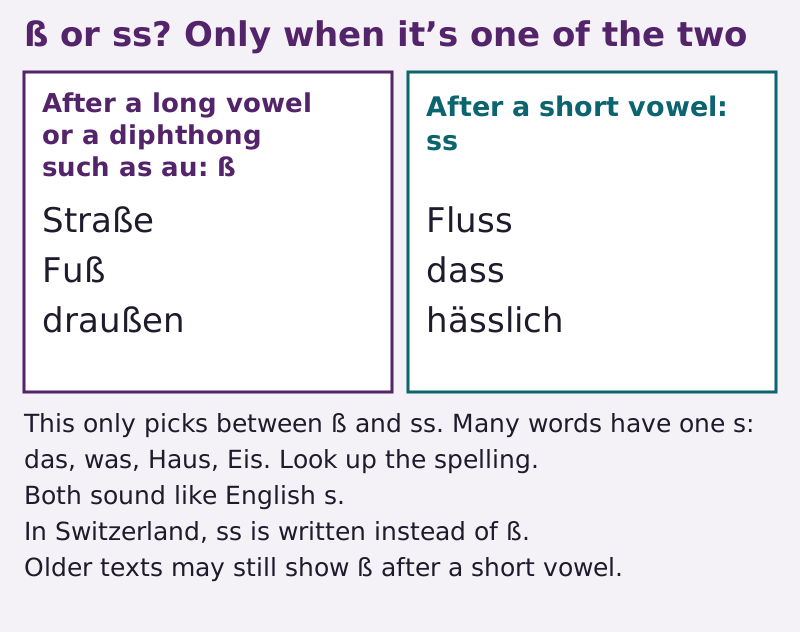
ß is where spelling gets tricky. Deutsch im Blick says it sounds a lot like English s. Grimm Grammar gives the rule from the 1996 spelling reform: after a long vowel or a diphthong, write ß. After a short vowel, write ss. That rule only picks between ß and ss. It doesn't turn every s into one of them. Wiktionary spells das and was with one s after a short vowel, and Haus and Eis with one s after a diphthong. Das and dass are two different words. So when you're unsure, look the word up.
"When German writes ß and when it writes ss" from Conversation Mile (https://conversationmile.com/pronunciation/german-alphabet/). CC BY 4.0 (creativecommons.org/licenses/by/4.0)
Say these three, and listen for the vowel before the s:
- Ich gehe zu Fuß. (Corpus translation: I will go on foot. Gehe is present tense.) Wiktionary gives Fuß a long u, /fuːs/.
- Draußen ist es dunkel. (It's dark outside.) The ß follows au.
- Der Fluss ist breit. (The river is wide.) Wiktionary gives Fluss a short u, /flʊs/.
Three more limits. In Switzerland, Deutsch im Blick says, you write ss instead of ß. Older texts still use ß after short vowels: daß for today's dass, or ißt for isst. And a capital form, ẞ, exists. Wiktionary calls it uncommon and says it turns up in some text set in all capitals. Deutsch im Blick says ß only comes in lowercase, which is older advice.
How do you spell a word out loud?
Say each letter's name, one at a time. Two questions you'll hear: Wie schreibt man das? (How do you spell it?) and Kannst du es buchstabieren? (Can you spell it?) Say both now.
German writes every noun with a capital letter, Grimm Grammar notes, so a noun always starts with a capital when you spell it. Fluss starts with a capital F.
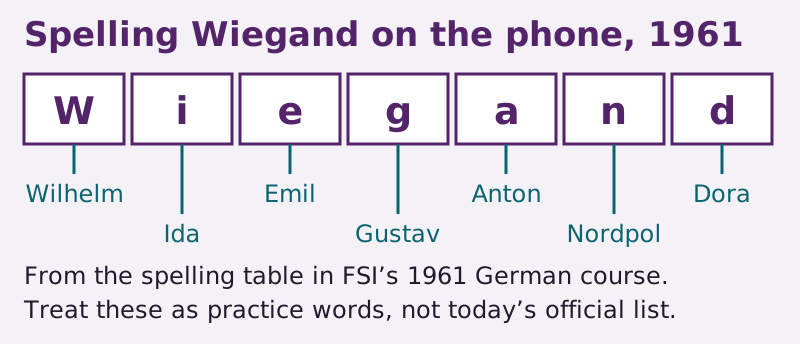
On the phone, letters get lost. The Foreign Service Institute's 1961 German course gives a spelling table with a word for each letter, and it spells the name Wiegand this way:
"Spelling a name with words, from a 1961 course" from Conversation Mile (https://conversationmile.com/pronunciation/german-alphabet/). CC BY 4.0 (creativecommons.org/licenses/by/4.0)
The table has words for Ä, Ö, Ü, Ch and Sch too, and none for ß. It's from 1961, so treat its words as practice, not as the list someone on a German phone line uses today. This page didn't check a current list. The same course also has a list of names to spell, among them Prokosch, Qualitz, Vechta, Marxgrün and Räderloh. They're useful because they hit the hard names: Q, V, X and the umlauts.
How does the week run?
One part of the alphabet a day, then spelling. The order and the minutes are this site's House routine, untested with learners. The timer runs only while you're saying something.
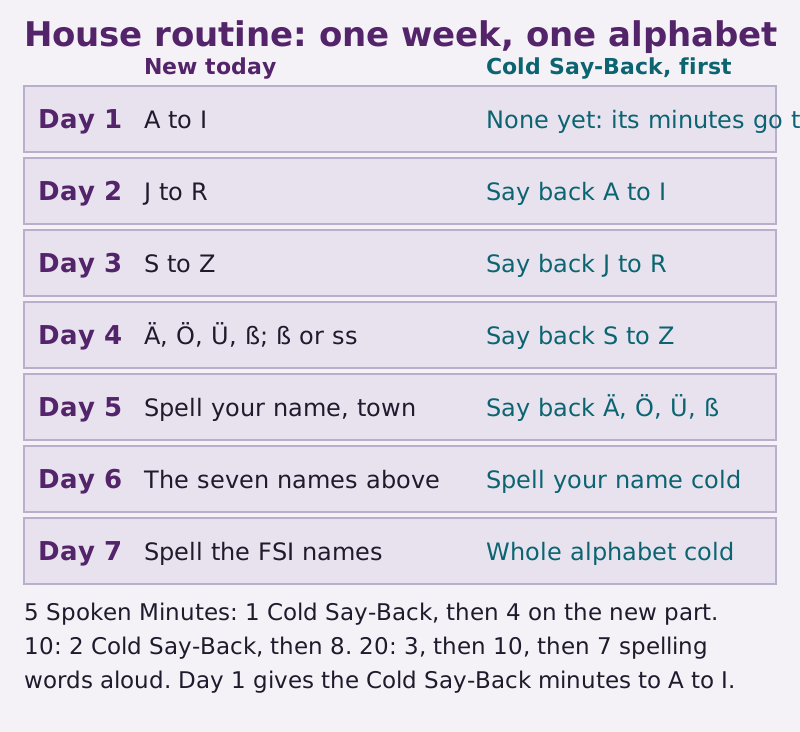
"A one-week plan for saying the German alphabet aloud" from Conversation Mile (https://conversationmile.com/pronunciation/german-alphabet/). CC BY 4.0 (creativecommons.org/licenses/by/4.0)
| Daily amount | Cold Say-Back, first | New part | Spelling aloud |
|---|---|---|---|
| 5 | 1 | 4 | None |
| 10 | 2 | 8 | None |
| 20 | 3 | 10 | 7 |
Each day opens with a Cold Say-Back with nothing in front of you, then a check: yesterday's letters on days 2 to 5, your name spelled cold on day 6, and the whole alphabet on day 7, as in the picture. Day 1 has nothing to say back, so those minutes go to the new letters.
Spend the last 7 of a 20-minute day spelling words from this page out loud, letter by letter. If you're following how to learn German instead, letters come every few days, and on 5 or 10 Spoken Minutes you take two of the four letter steps at once: A to I with J to R, then S to Z with Ä, Ö, Ü and ß. Days 5 to 7 still go one at a time.
On day 5, spell your own name and your town. Then ask yourself the question a stranger would: Wie buchstabiert man Ihren Nachnamen? (How do you spell your family name?) Answer it out loud.
Log the minutes in the Mile Log. Once the names come easily, move to the sounds with the minimal pairs tool, and see how to learn German for where the alphabet fits in your first two weeks.
Tomorrow, before you look at anything, say A to I out loud from memory as your Cold Say-Back. Then check them against the chart, especially E and I. Spelling your family name comes on day 5.
Sources
- Abrams, Zsuzsanna, and others. "Kapitel 1: Aussprache, Das Alphabet." Deutsch im Blick, COERLL, University of Texas at Austin, 2017 Open. Read: The alphabet section of Chapter 1, in the PDF (k_01.pdf, pp. 43-44) and on the web page, which has a recording of the alphabet and of sample words. The recordings were not listened to.. License: CC BY 4.0.
- Abrams, Zsuzsanna, and others. "Kapitel 2: Der Umlaut." Deutsch im Blick, COERLL, University of Texas at Austin, 2017 Open. Read: The pronunciation section of the chapter (pp. 96-97).. License: CC BY 4.0.
- Abrams, Zsuzsanna, and others. "Kapitel 3: Beachtenswerte deutsche Konsonanten." Deutsch im Blick, COERLL, University of Texas at Austin, 2017 Open. Read: The pronunciation section of the chapter (pp. 143-145).. License: CC BY 4.0.
- Grimm Grammar. "Miscellaneous: Rechtschreibreform." Grimm Grammar, COERLL, University of Texas at Austin Open. Read: Full page, without the dialogs' audio.. License: CC BY 4.0.
- Grimm Grammar. "Nouns: Substantive." Grimm Grammar, COERLL, University of Texas at Austin Open. Read: Full page.. License: CC BY 4.0.
- Foreign Service Institute. German Basic Course, Units 1-12. U.S. Department of State, 1961 Open. Read: Unit 6, pp. 140-141: the telephone dialog spelling Wiegand, the Buchstabier-Tafel, and the list of names to spell. Checked against the page image. A course from 1961..
- Wiktionary contributors. German entries for the letters A to Z, Ä, Ö, Ü, ß and ẞ, and for Fuß, Fluss, das, was, Haus and Eis. Wiktionary, as distributed by kaikki.org Open. Read: The pronunciation lines and senses of each letter entry, and the pronunciation lines of Fuß, Fluss, das, was, Haus and Eis.. License: CC BY-SA 4.0.
- Tatoeba. Sentence collection, downloaded exports. Tatoeba Open. Read: Each sentence on this page and its linked English read one by one. Authors are credited under Sentence credits.. License: CC BY 2.0 FR.
Sentence credits
- Wie buchstabiert man Ihren Nachnamen? Tatoeba sentence 638851 by al_ex_an_der; English by CK. CC BY 2.0 FR.
- Ich gehe zu Fuß. Tatoeba sentence 182037 by MUIRIEL; English by CK. CC BY 2.0 FR.
- Draußen ist es dunkel. Tatoeba sentence 1341911 by Esperantostern; English by CK. CC BY 2.0 FR.
- Der Fluss ist breit. Tatoeba sentence 1314898 by Pfirsichbaeumchen; English by CK. CC BY 2.0 FR.
- Wie schreibt man das? Tatoeba sentence 1473634 by Pfirsichbaeumchen; English by rafael8243. CC BY 2.0 FR.
- Kannst du es buchstabieren? Tatoeba sentence 3006093 by al_ex_an_der; English by patgfisher. CC BY 2.0 FR.
Next stops
Cite this page
German Alphabet Letter Names and When to Write ß or ss. Conversation Mile, 2026-11-10. https://conversationmile.com/pronunciation/german-alphabet/
Corrections
No corrections on this page. Spotted a language error? Please tell this site.