Pronunciation Workshop How-to
Spanish Pronunciation Starts With Five Steady Vowels
Straight answer
Spanish has five vowel sounds, and each stays short and steady from start to finish. Keep every vowel that way and say this now: Las rosas son rojas. Fix the vowels and the r first, then the small consonant habits below. Many consonants change by region, so this page says where. It has no recordings yet, so the last section points you to places to hear real speakers.
The English trap
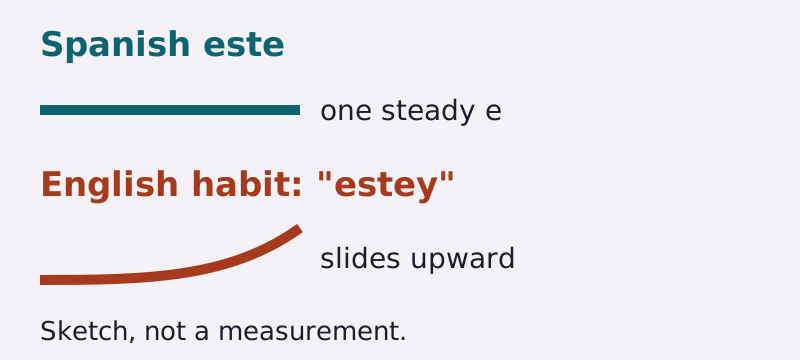
¿Cómo suena? lists what English speakers carry over: stretching vowels, sliding e and o into a glide so este becomes estey, relaxed lips, and the weak schwa vowel, which standard Spanish doesn't have.
Say this today
Las rosas son rojas.
The roses are red.
How do you keep the five vowels steady?
The five are a, e, i, o, u. ¿Cómo suena?, an open university phonetics book, says they're short, pure and stable, and that each one gets pronounced. American English has 13 vowel sounds by its count, so your mouth has habits to drop.
"A steady vowel and a sliding one" from Conversation Mile (https://conversationmile.com/pronunciation/spanish-pronunciation/). CC BY 4.0 (creativecommons.org/licenses/by/4.0)
These are four of the English habits it lists. Say each word the Spanish way.
| Word | The English habit | The fix |
|---|---|---|
| este | "estey," with a slide | Stop on the e; don't let your mouth move |
| pan | "paaan," too long | Keep it short |
| universidad | "yuniversidad," a y before the u | Start right on the u |
| Any word | Loose lips | Keep your lips firm |
Try it. Say este with a hand under your jaw and feel for any movement at the end. The hand check is a House routine. Now say El perro es negro. and hold every vowel steady.
Andalusian speech in the south of Spain is a real exception. ¿Cómo suena? says it has seven vowel sounds, with vowels that can change to match each other.
Why do weak syllables matter so much?
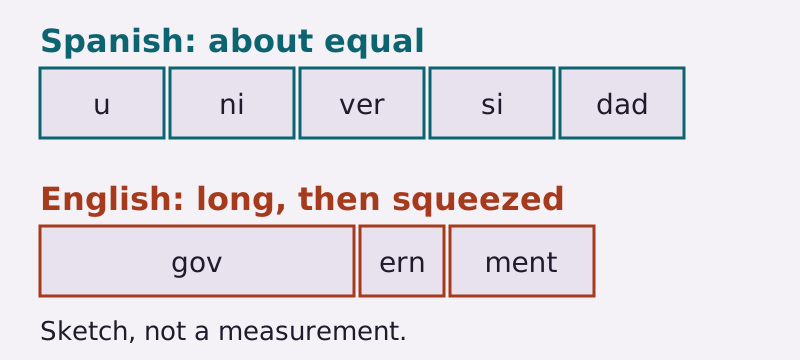
In English, unstressed syllables shrink until the vowel is barely there. In Spanish they keep their full vowel. ¿Cómo suena? says stressed and unstressed syllables last about the same, and that Spanish rhythm follows syllables while English rhythm follows stress.
"Syllable length in Spanish and English" from Conversation Mile (https://conversationmile.com/pronunciation/spanish-pronunciation/). CC BY 4.0 (creativecommons.org/licenses/by/4.0)
Tap each syllable on the table as you say u-ni-ver-si-dad. Give each tap the same length.
Stress still changes words. FSI's course pairs peso, a unit of money, with pesó, "he weighed," and libro, "book," with libró, "he freed." Most Spanish words stress the last or second-to-last syllable. A word ending in a vowel, n or s normally stresses the second-to-last; other words normally stress the last. A written accent marks the exceptions and shows you where to put the stress. ¿Cómo suena? adds that a word stressed on the third syllable from the end always has one, as in zoológico.
Words also run together. ¿Cómo suena? hears gran amigo as one long word, gra-na-mi-go, because a consonant between vowels joins the vowel after it. Say Ven acá, nena. as ve-na-cá and then the last word. A final weak o can also close toward u before another vowel, as in Hablo español.
What does the Spanish r do?
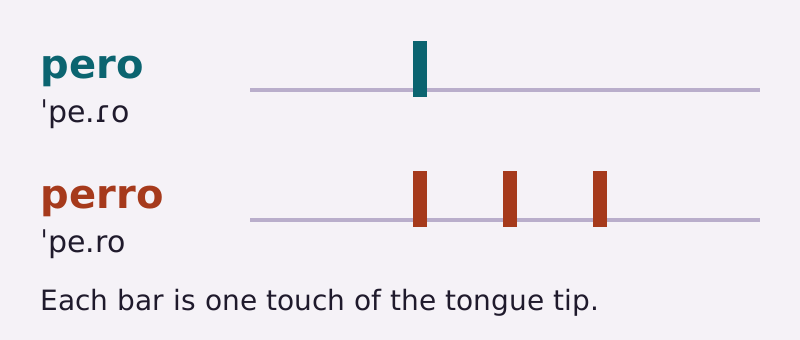
Spanish has two r sounds, and swapping them can change the word. The tap touches the ridge behind your teeth once with the tip of your tongue. The trill touches it several times. ¿Cómo suena? counts three; FSI just calls it a rapid trill.
"One touch in pero, several in perro" from Conversation Mile (https://conversationmile.com/pronunciation/spanish-pronunciation/). CC BY 4.0 (creativecommons.org/licenses/by/4.0)
Say pero (ˈpe.ɾo), "but," then perro (ˈpe.ro), "dog." Another pair is ahora, "now," and ahorra, "saves." Now both at once: ¡Pero qué enorme perro!
You probably have the tap already. FSI says it's very close to the t or d sound in American English Betty, better, or waiter. Say "Betty" fast, then say pero with that same flick. FSI is blunt about the English r, though: it doesn't transfer. ¿Cómo suena? says the English r never touches the ridge and the tongue sits lower and looser.
| Which r | Where it goes | Word |
|---|---|---|
| Trill | Written rr | burrito |
| Trill | Start of a word | rojo |
| Trill | After n, l or s | enredar, alrededores, Israel |
| Tap | One r between vowels | mira |
| Tap | After a consonant in the same syllable | francés, alacrán |
| Usually tap | End of a syllable; a trill there adds emphasis | puerta |
Here's a sentence with both, from ¿Cómo suena?: Quiero caminar en el barrio con mi perro de pelo rubio. It means "I want to walk around the neighborhood with my blond-haired dog." If the trill won't come yet, the page on rolling your r breaks it down.
The trill differs by place too. ¿Cómo suena? describes a more relaxed version in Costa Rica that doesn't touch the ridge, and one made far back in the mouth in Puerto Rico.
Which consonants need less air?
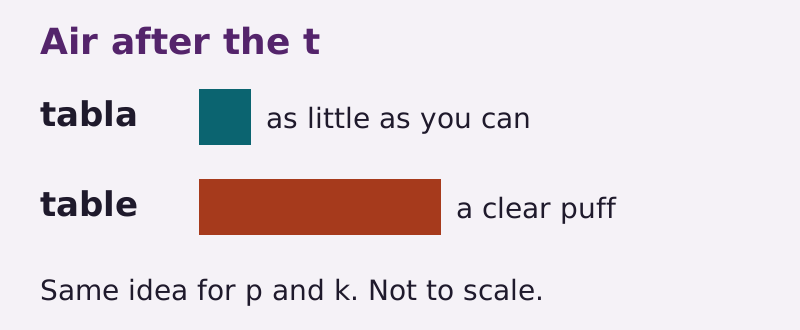
Hold your hand in front of your mouth and say "table." You'll feel a puff. English adds that air after p, t and k at the start of a syllable. Spanish keeps it to a minimum, and ¿Cómo suena? says the sounds are tense.
"Air after t in tabla and table" from Conversation Mile (https://conversationmile.com/pronunciation/spanish-pronunciation/). CC BY 4.0 (creativecommons.org/licenses/by/4.0)
English already has the sound you need. The p in "Spanish" and the k in "ski" come with almost no air, so copy those. Spanish t also moves forward: your tongue tip goes to your upper front teeth. Say Tengo tiempo. with your hand up. You shouldn't feel much.
The Spanish l is firm too. English has a dark, back-of-the-mouth l at the end of "ball," and ¿Cómo suena? says the l in "lake" comes closer to Spanish. Say alto with the l of "lake," and don't stretch the vowel before it.
Why do b, d and g go soft?
These three letters each have two sounds, and the sounds around them decide which. For g, that means g before a, o, u or a consonant. Before e or i, g makes the jota sound, covered below. After a pause or a nasal sound (m, n), you stop the air completely. After a vowel or most other consonants, you let air keep moving, so the sound comes out softer. The d also stays hard after l, as in caldo.
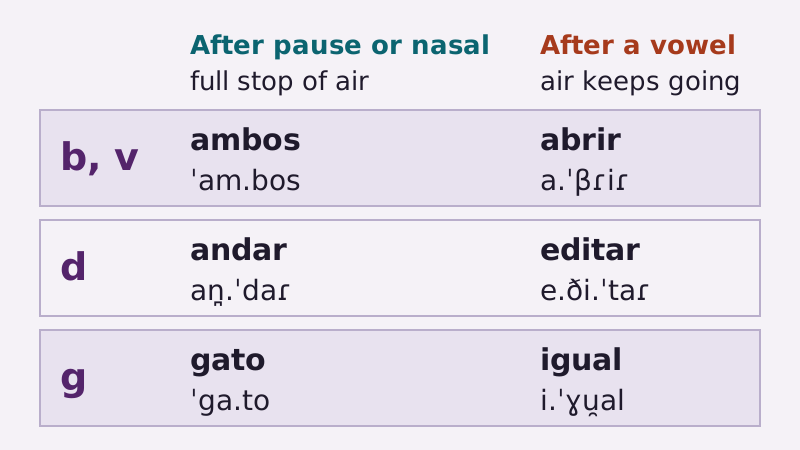
"Hard and soft b, d and g" from Conversation Mile (https://conversationmile.com/pronunciation/spanish-pronunciation/). CC BY 4.0 (creativecommons.org/licenses/by/4.0)
Spanish d is made at your upper front teeth, not on the ridge behind them, ¿Cómo suena? notes. Say andar with the tongue tip touching those teeth. Then say editar, and for its d bring the tip close to the teeth without stopping the air. Last, say verdad, where ¿Cómo suena? makes both d sounds soft. In standard Spanish, b and v have no difference in sound at all, so vivo starts with the same sound as bien.
A few spellings to learn along the way. The letter h doesn't show up in ¿Cómo suena?'s transcriptions: ahora is a.ˈo.ɾa. That silence doesn't apply to ch, which is a sound of its own, close to the ch in English "chance," as in chica. The u in queso and guerra is silent. Spanish j, and g before e or i, make the sound in mejor and general, and FSI warns that it's not the English h. The alphabet week goes through the letters one by one.
Which sounds change by region?
Pick the accent of the people you plan to talk to, and don't call the others wrong. ¿Cómo suena? says features like these vary from person to person and that sounding different doesn't make someone's Spanish bad.
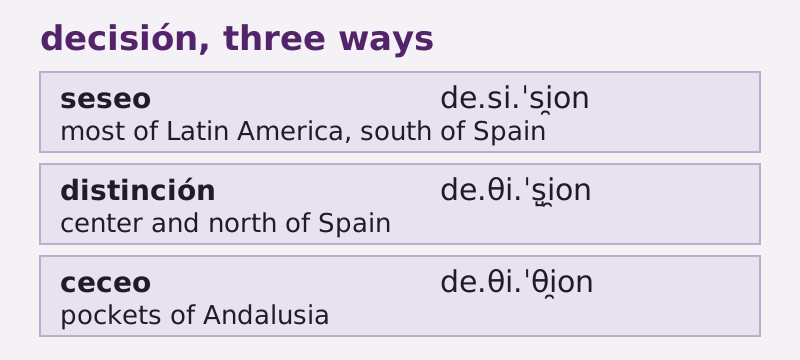
"Three regional pronunciations of decisión" from Conversation Mile (https://conversationmile.com/pronunciation/spanish-pronunciation/). CC BY 4.0 (creativecommons.org/licenses/by/4.0)
C, z and s. In most of Latin America and the south of Spain, these all come out as s; that's called seseo. In the center and north of Spain, c before e or i and z sound like the th in "thin," while s stays s. FSI says you can ignore that split if you'll speak with people from the Americas. Try both versions: José está cocinando la sopa con zanahorias y va a estar listo a las diez. (José is cooking the soup with carrots, and he'll be ready at ten.)
Ll and y. Many speakers make these one sound, called yeísmo: Dame la llave. ¿Cómo suena? says it's most used in the Americas and in Andalusia. It places a separate ll sound mainly in rural areas of the center and north of Spain, and in some parts of the Andes. In Argentina and Uruguay, the same letters often sound like the s in "measure" or the sh in "show."
| Feature | Where the source puts it | What you hear |
|---|---|---|
| Yeísmo | Americas, Andalusia | ll and y alike |
| Separate ll | Mainly rural areas of the center and north of Spain; parts of the Andes | ll and y differ |
| ʒ or ʃ | Argentina, Uruguay | "measure" or "show" sound |
Weak final s. In Atlantic and Caribbean speech and some South American dialects, an s at the end of a syllable may become a breath like h or drop out. So estás can lose both of its s sounds. FSI adds that this differs by country and that an s at the start of a syllable never turns into h. You'll hear this long before you need to copy it.
The jota. ¿Cómo suena? says Spain's j is made farther back with more friction, and the Latin American one is softer.
What do you do in the first weeks?
Spend your first two weeks on the vowels and the r. After that, take the other fixes one at a time, in the order of this page. Count the work in Spoken Minutes, and start each day with a Cold Say-Back on yesterday's words, before you look at anything.
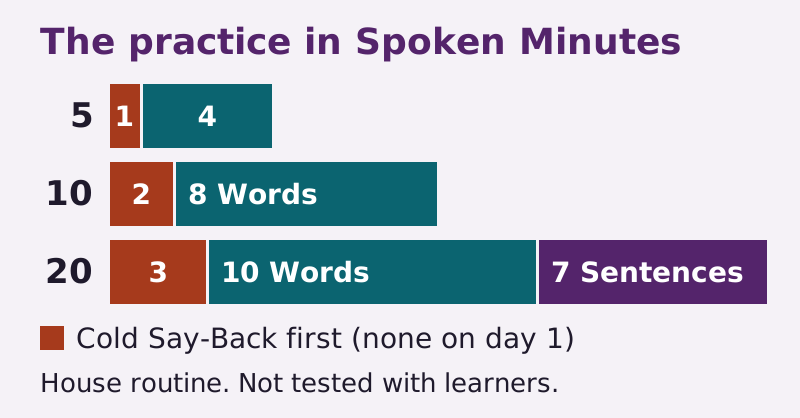
"How pronunciation practice fills 5, 10 or 20 Spoken Minutes" from Conversation Mile (https://conversationmile.com/pronunciation/spanish-pronunciation/). CC BY 4.0 (creativecommons.org/licenses/by/4.0)
On a 5-minute day, spend 1 minute on the Cold Say-Back and 4 on words for your current fix. On a 10-minute day, it's 2 and 8. On a 20-minute day, it's 3, then 10 on words and 7 on whole sentences. Day 1 has nothing to say back yet, so all of it goes to the words. The order and the split are this site's House routine, untested with learners.
Record yourself once in the sentences part, and listen for vowels that slide. Log the minutes in your Mile Log, and use the minimal pairs tool when you want to test one contrast. If you're at the very start, the Spanish starting plan shows how this fits with your first words, and ser vs estar gives you sentences to practice on.
To hear it. This site has no recordings for this page yet. ¿Cómo suena? links a video on the vowels and a bank of dialect videos. This page hasn't checked those videos sound by sound, so don't take any one clip as the model for a fix here.
Tomorrow, with no notes, run a Cold Say-Back: say pero, perro and "the roses are red" in Spanish, with short vowels and firm lips. That's the review for day 2. After that, say back the words from whichever fix you worked on the day before.
What this rests on
Checked against
- Five vowel sounds, short and steady, with no schwa; what English speakers carry over Source 2
- Words linked in speech, roughly equal syllables, final o closing up, seven vowels in Andalusian speech Source 3
- Most words stress the last or second-to-last syllable; how written accents work; words stressed third from the end always carry one Source 1
- A written accent puts the stress on that syllable Source 13
- The silent u in queso and guerra Source 11
- Stress changing the word, as in peso and pesó Source 14
- Tap and trill, where each one goes, pero and perro, Costa Rica and Puerto Rico Source 6
- The tap is close to the American t in Betty, the trill is rapid, and English r doesn't transfer Source 15
- Little air after p, t and k; t at the teeth; ch as one sound, close to English chance Source 4
- Hard and soft b, d and g; Spanish d made at the teeth; both d sounds of verdad soft; b and v alike; ll and y across regions Source 5
- A tense l, not the dark l of English ball Source 7
- Seseo as the most common form in Latin America and the south of Spain, distinción and ceceo; j and g before e or i, with a softer jota in Latin America Source 8
- Lleísmo mainly in rural areas of the center and north of Spain, and the stronger jota there Source 9
- Weakened final s, and regional features varying from person to person without being wrong Source 10
House routine
- The order of the fixes, vowels and r in the first two weeks, the 5, 10 and 20 Spoken Minute splits with the Cold Say-Back first, recording yourself, and the jaw, hand and tapping checks
Sources
- Escudero, Barreca and Carbone. ¿Cómo suena? Fonética y fonología del español, Módulo 3: Tildes. SUNY Create OER, 2021 Open. Read: The whole module text; embedded videos not watched. License: CC BY 4.0.
- Escudero, Barreca and Carbone. ¿Cómo suena? Fonética y fonología del español, Módulo 4: Las vocales. SUNY Create OER, 2021 Open. Read: The whole module text; embedded videos not watched. License: CC BY 4.0.
- Escudero, Barreca and Carbone. ¿Cómo suena? Fonética y fonología del español, Módulo 6: Vocales en contacto y el ritmo. SUNY Create OER, 2021 Open. Read: The whole module text; embedded videos not watched. License: CC BY 4.0.
- Escudero, Barreca and Carbone. ¿Cómo suena? Fonética y fonología del español, Módulo 9: Las consonantes africadas y los fonemas oclusivos sordos. SUNY Create OER, 2021 Open. Read: The whole module text; embedded videos not watched. License: CC BY 4.0.
- Escudero, Barreca and Carbone. ¿Cómo suena? Fonética y fonología del español, Módulo 11: Los sonidos obstruyentes sonoros. SUNY Create OER, 2021 Open. Read: The whole module text; embedded videos not watched. License: CC BY 4.0.
- Escudero, Barreca and Carbone. ¿Cómo suena? Fonética y fonología del español, Módulo 12: Las consonantes vibrantes. SUNY Create OER, 2021 Open. Read: The whole module text; embedded videos not watched. License: CC BY 4.0.
- Escudero, Barreca and Carbone. ¿Cómo suena? Fonética y fonología del español, Módulo 13: La consonante lateral. SUNY Create OER, 2021 Open. Read: The whole module text; embedded videos not watched. License: CC BY 4.0.
- Escudero, Barreca and Carbone. ¿Cómo suena? Fonética y fonología del español, Módulo 14: Las consonantes fricativas. SUNY Create OER, 2021 Open. Read: The whole module text; embedded videos not watched. License: CC BY 4.0.
- Escudero, Barreca and Carbone. ¿Cómo suena? Fonética y fonología del español, Módulo 16: Rasgos del español peninsular. SUNY Create OER, 2021 Open. Read: The whole module text; embedded videos not watched. License: CC BY 4.0.
- Escudero, Barreca and Carbone. ¿Cómo suena? Fonética y fonología del español, Módulo 17: Rasgos del español latinoamericano. SUNY Create OER, 2021 Open. Read: The whole module text; embedded videos not watched. License: CC BY 4.0.
- Escudero, Barreca and Carbone. ¿Cómo suena? Fonética y fonología del español, Módulo 5: La sílaba y las consonantes 'yod' y 'wau'. SUNY Create OER, 2021 Open. Read: The section on silent u only. License: CC BY 4.0.
- Escudero, Barreca and Carbone. ¿Cómo suena? Fonética y fonología del español, Banco de dialectos. SUNY Create OER, 2021 Open. Read: The page text; the linked videos not watched. License: CC BY 4.0.
- Brown, Escudero, Montoya and Small. ¡Chévere! Introductory Spanish I, 1.5: Vocabulario, El alfabeto. SUNY Oneonta via OER SUNY Open. Read: The whole page. License: CC BY 4.0.
- Stockwell, Bowen and Silva-Fuenzalida. Spanish Basic Course: Units 1-15, Unit 1, sections 1.21 and 1.22. Foreign Service Institute, U.S. Department of State, 1961 printing (first printed 1957) Open. Read: Parts of those sections, from a scanned copy with some unreadable characters.
- Stockwell, Bowen and Silva-Fuenzalida. Spanish Basic Course: Units 1-15, Unit 2, sections 2.23 and 2.27. Foreign Service Institute, U.S. Department of State, 1961 printing (first printed 1957) Open. Read: Parts of those sections, from a scanned copy with some unreadable characters.
Sentence credits
- Las rosas son rojas. Tatoeba sentence 3185659 by marcelostockle; English by marauder016. CC BY 2.0 FR.
- El perro es negro. Tatoeba sentence 3958282 by senryakun; English by senryakun. CC BY 2.0 FR.
- Ven acá, nena. Tatoeba sentence 5266737 by ecorralest101; English by espamatics. CC BY 2.0 FR.
- Hablo español. Tatoeba sentence 2011085 by Shishir; English by Betsemes. CC BY 2.0 FR.
- ¡Pero qué enorme perro! Tatoeba sentence 1241416 by marcelostockle; English by fliegster. CC BY 2.0 FR.
- Quiero caminar en el barrio con mi perro de pelo rubio. ¿Cómo suena?, Módulo 12. CC BY 4.0.
- Tengo tiempo. Tatoeba sentence 4859590 by cueyayotl; English by CK. CC BY 2.0 FR.
- José está cocinando la sopa con zanahorias y va a estar listo a las diez. ¿Cómo suena?, Módulo 14. CC BY 4.0.
- Dame la llave. Tatoeba sentence 511460 by Shishir; English by CM. CC BY 2.0 FR.
Next stops
Cite this page
Spanish Pronunciation Starts With Five Steady Vowels. Conversation Mile, 2026-11-10. https://conversationmile.com/pronunciation/spanish-pronunciation/
Corrections
No corrections on this page. Spotted a language error? Please tell this site.