Your First 90 Days Plan
How to Learn German Without Starting From Case Tables
Straight answer
Start German with sounds, nouns said with der, die or das, and short sentences. Case tables can wait. Say this out loud now: Ich lerne Deutsch. (I study German.) Look away and say it again. This page covers what's particular to German in your first two weeks. The day-by-day structure lives on the main plan page. Leaving the tables for later is this site's choice, not a rule from a textbook.
The English trap
English calls any object "it." Grimm Grammar warns English speakers not to reach for es for every thing: German picks er, sie or es by the noun's gender, so a key, der Schlüssel, is er.
Say this today
Ich lerne Deutsch.
I study German.
What goes into your first two weeks?
The same three jobs as any language, filled with German. They take turns. If you pick German, the planner on the main plan page, under "Lay out your 90 days," lays out the dates.
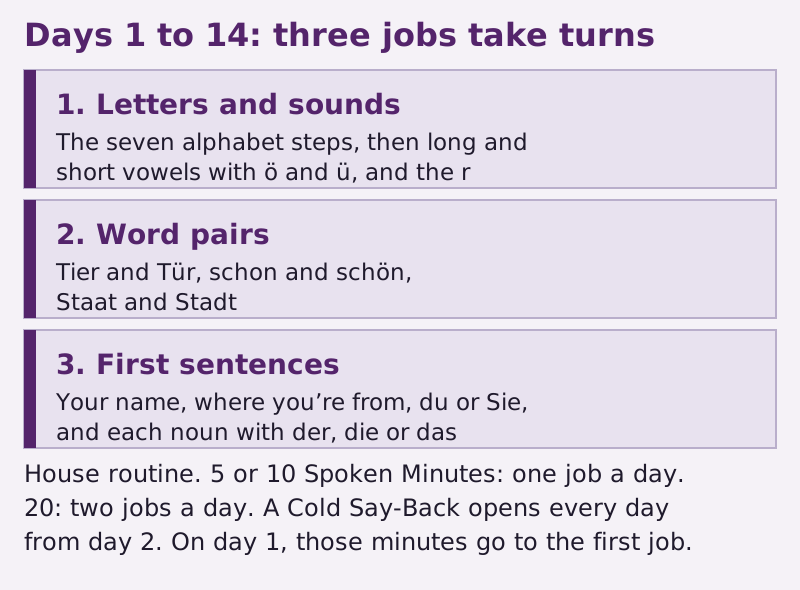
"The three jobs of the first two weeks, filled with German" from Conversation Mile (https://conversationmile.com/start/how-to-learn-german/). CC BY 4.0 (creativecommons.org/licenses/by/4.0)
| Daily amount | Cold Say-Back, first | First job | Second job |
|---|---|---|---|
| 5 | 1 | 4 | None |
| 10 | 2 | 8 | None |
| 20 | 3 | 10 | 7 |
These splits are a House routine, untested with learners. Each day opens with a Cold Say-Back: say something from an earlier day with nothing in front of you, then check it. Day 1 has nothing to say back, so those minutes go to the first job. Log the minutes in the Mile Log.
Here's how the first days could run at 10 Spoken Minutes. Day 1 is letters and sounds: the first two alphabet steps, A to I and then J to R. It gets all 10 minutes, since there's nothing to say back yet. Day 2 opens with 2 minutes saying those letters from memory. Then you spend 8 on one word pair, Tier and Tür, each word alone and then both. Day 3 opens with 2 minutes on that pair, cold, then 8 on first sentences: your name, where you're from, and the same question with du and with Sie. Day 4 opens with 2 minutes on day 3's questions, cold, then 8 on the next two alphabet steps: S to Z, then Ä, Ö, Ü and ß, with when to write ß or ss.
For the letters, the German alphabet week gives seven steps. Here, on 20 Spoken Minutes, take the next step each time a letters day comes around. On 5 or 10 Spoken Minutes, letters days come less often, so take two of the four letter steps on each one: A to I with J to R, then S to Z with Ä, Ö, Ü and ß, including when to write ß or ss. The spelling steps after that go one at a time.
If you're learning Spanish or French instead, their first weeks have their own pages: Spanish and French.
Which sounds should you fix first?
The vowels, ö and ü among them, and the r. That order is this site's House routine.
Deutsch im Blick takes the standard German of Germany as its model, and notes that Austria and Switzerland each have a standard of their own. This page follows it. If you're learning for Vienna or Zurich, copy the speakers there.
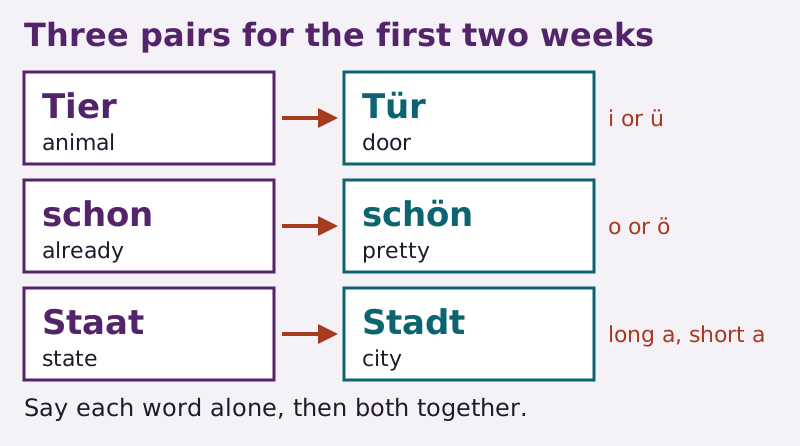
"Three German word pairs where one sound changes the word" from Conversation Mile (https://conversationmile.com/start/how-to-learn-german/). CC BY 4.0 (creativecommons.org/licenses/by/4.0)
Each pair differs by one vowel, so they make a good second job. The 1961 FSI course drills Tier (animal) against Tür (door), and Staat (state) against Stadt (city). Deutsch im Blick pairs schon (already) with schön (pretty). Say each word alone, then the two together. In Staat the a is long, and in Stadt it's short.
How to round your lips for ö and ü, and what the German r does, is on the German pronunciation page. It covers the two kinds of ch and the final consonants too, but those can come after the first two weeks. For more pairs, use the minimal pairs tool. This page has no recordings, and neither does the pronunciation page, which links to places where you can hear German speakers.
Why say every noun with der, die or das?
Because the article is part of the word you'll need. Grimm Grammar says every German noun has a gender, shown by der, die or das, and that you should learn it the way you learn the plural, with the noun. It calls knowing the gender the biggest trick to the cases. So the habit you build now pays off later.
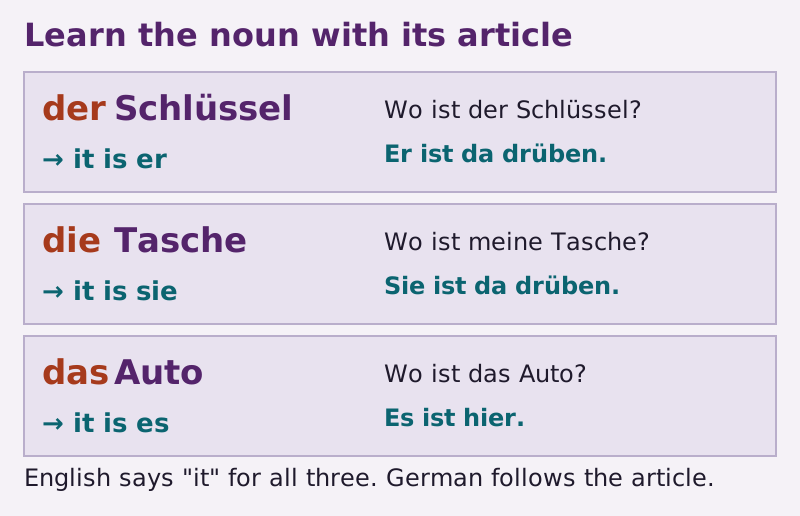
"A German noun learned with its article, and the pronoun that follows" from Conversation Mile (https://conversationmile.com/start/how-to-learn-german/). CC BY 4.0 (creativecommons.org/licenses/by/4.0)
The gender also decides the word for "it." Grimm warns English speakers not to use es for every thing, because German picks er, sie or es by the noun. Say these three short exchanges out loud:
- Wo ist der Schlüssel? (Where's the key?) Er ist da drüben. (It's just over there.)
- Wo ist meine Tasche? (Where's my bag?) Sie ist da drüben. (It's just over there.)
- Wo ist das Auto? (Where's the car?) Es ist hier. (It's here.)
All three answers mean "it." For things like these, only the article tells you which one to say. People can work differently, as the der, die, das page explains, so this drill uses things.
One more help: Grimm notes that German writes every noun with a capital letter. When you read, the capitals in the middle of a sentence are the first place to look for nouns. Names have capitals too, and not every capitalized word is said with an article, as Kanada below shows. How to make the articles stick is on the der, die, das page.
Should you say du or Sie?
You need both from the first week, because the question changes with them. Grimm Grammar gives three words for "you." Du is the informal one for a single person, and Grimm keeps it for friends, young people, children and pets. Ihr is informal too, for more than one person. Sie is the formal one, for one person or several.
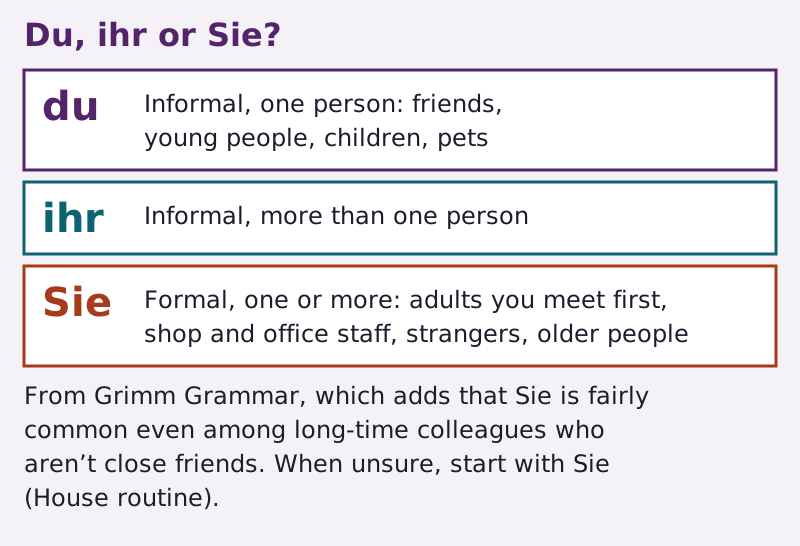
"When German uses du, ihr and Sie" from Conversation Mile (https://conversationmile.com/start/how-to-learn-german/). CC BY 4.0 (creativecommons.org/licenses/by/4.0)
Grimm lists Sie for adults you meet for the first time, people in shops and offices, strangers and anyone older than you. It adds that Sie is fairly common even between long-time colleagues who aren't close friends. When you aren't sure, this site's House routine is to start with Sie.
Say each question in both forms, then answer it:
| With du | With Sie | Your answer |
|---|---|---|
| Wie heißt du? What is your name? | Wie heißen Sie? What is your name? | Ich heiße Tom. My name's Tom. |
| Woher kommst du? Where do you come from? | Woher kommen Sie? Where do you come from? | Ich komme aus Kanada. I'm from Canada. |
| Sprichst du Englisch? Do you speak English? | Sprechen Sie Englisch? Do you speak English? | Ich spreche Englisch. I speak English. |
Put your own name in the answers. Swap in your country only if it works like Kanada, with no article.
Wiktionary marks some country names as usually said with an article, such as die USA, die Schweiz and die Türkei, and then the line changes. For the USA it's Ich komme aus den USA, explained further down. Don't copy that den onto other countries. If your country takes an article, or you aren't sure, keep Kanada for now and learn your own line whole from a source or a tutor first.
Then run the questions twice: once as if a friend asked, with du, and once as if a stranger at a desk asked, with Sie. Answer each one before you move on. Notice that the verb changes too: heißt goes with du, and heißen with Sie. Leave ihr questions for later.
The verb lookup shows every form of a verb when you need one.
Where does the verb go?
In a statement, second. Grimm Grammar calls that the most common place for the verb that carries the ending. When something else comes first, the verb still holds second place.
The two lines below say the same thing. Only the order changes. The English under each is the corpus translation, and Wiktionary gives Fußball as soccer. Say this pair:
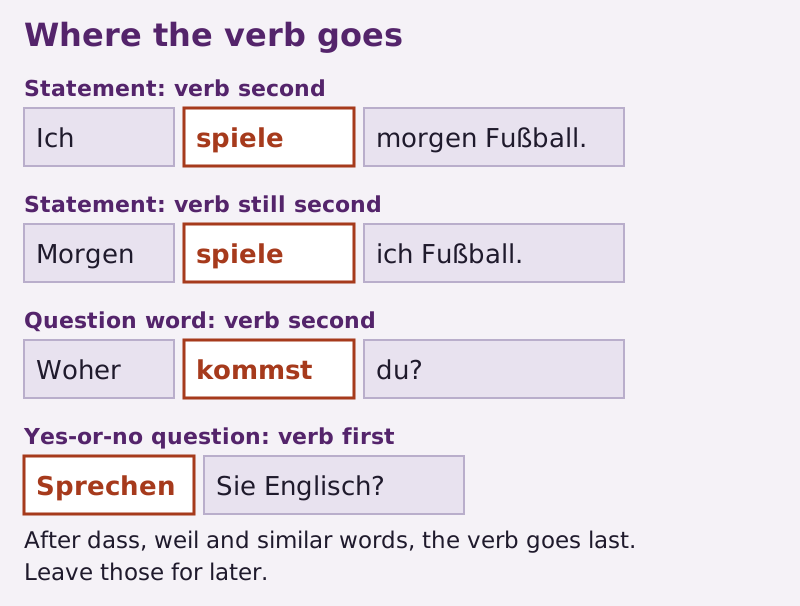
"The verb comes second in a German statement" from Conversation Mile (https://conversationmile.com/start/how-to-learn-german/). CC BY 4.0 (creativecommons.org/licenses/by/4.0)
- Ich spiele morgen Fußball. (I'm playing football tomorrow.)
- Morgen spiele ich Fußball. (Same meaning. Corpus translation: I will play football tomorrow.)
Spiele stays in second place both times. In the second one, ich comes after it. After a question word such as woher, the verb is second too, as in Woher kommst du?
The rule has limits. Grimm lists them. In a yes-or-no question the verb comes first, as in Sprechen Sie Englisch? Commands start with the verb as well. After words such as dass (that) and weil (because), the verb goes to the end of that part of the sentence.
Those longer sentences can wait. For now, keep your sentences short enough that the verb-last rule doesn't come up. Yes-or-no questions and commands still start with the verb.
What can wait until later?
The tables. This site's House routine keeps four things out of your first two weeks.
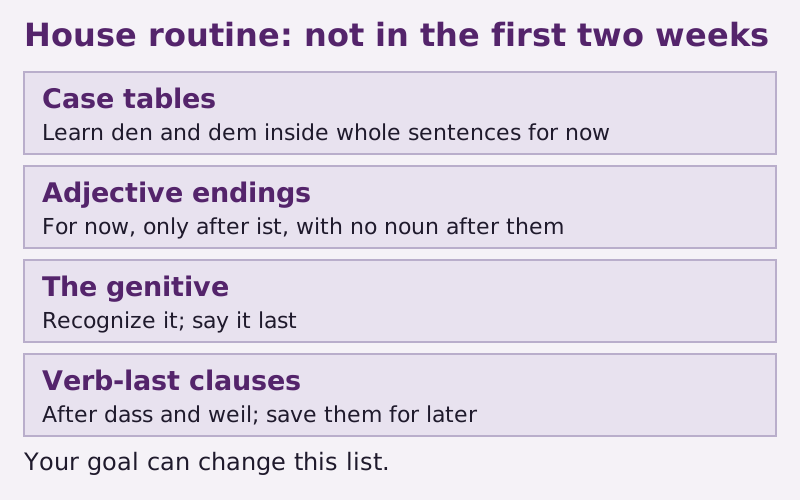
"What a German beginner can leave alone in the first two weeks" from Conversation Mile (https://conversationmile.com/start/how-to-learn-german/). CC BY 4.0 (creativecommons.org/licenses/by/4.0)
- Case tables. You'll still meet case forms from day one. In Ich komme aus den USA. (I am from the USA.), Grimm Grammar puts aus with the dative, and den here is the dative plural article. Den has other jobs too, such as den Tisch on the der, die, das page; the cases page sorts them out. Learn that line as a whole sentence for now. The German cases page explains why it's den when you're ready.
- Adjective endings. Grimm puts the endings on adjectives that come in front of a noun. Its examples after sein (to be), such as "the woman was very sick," have none. So for now, say an adjective after ist only when no noun follows it. If a noun comes after the adjective, the adjective is in front of that noun and needs an ending, so leave that kind of line for later. Adjective endings cover it.
- The genitive. Grimm says it's fading in speech, where the dative is taking its place, but you'll still see it in writing. Recognize it when you meet it and practice it last.
- Verb-last sentences after dass and weil, as above.
Leaving these out isn't a claim that they don't matter. Some tables do need memorizing later, and the case and adjective pages give ways to do that. If you need to read German for work, or you have an exam coming, your list will look different.
Tomorrow, before you look at anything, do a Cold Say-Back on what you worked on today. If that was this page, say Ich lerne Deutsch from memory, then check it here. If there's time left, add Schlüssel with its article. When the time is up, stop.
What this rests on
Checked against
- The standard German of Germany as the model for sounds, with Austria and Switzerland each having their own standard Source 1
- Schon and schön as a pair where the umlaut changes the word Source 2
- Tier and Tür, and Staat and Stadt, as practice pairs Source 3
- Every German noun written with a capital letter Source 4
- Every noun having a gender shown by der, die or das, to be learned with the noun like its plural Source 5
- Knowing a noun's gender as the biggest trick for the cases Source 6
- Aus taking the dative, and the plural article den in the dative Source 7
- The genitive fading in speech but still met in writing Source 8
- Er, sie and es for things by gender, and when to use du, ihr and Sie Source 9
- The verb second in statements and after question words, first in yes-or-no questions and commands, and last after words like dass and weil Source 10
- Adjective endings on adjectives in front of a noun, and adjectives after sein in the examples Source 11
- Kanada with no article; die USA, die Schweiz and die Türkei usually said with one; Fußball meaning soccer Source 12
- All German example sentences Source 13
House routine
- Which German items fill the three jobs of days 1 to 14, the three word pairs chosen, and taking the alphabet steps on letters days, two at a time on 5 or 10 Spoken Minutes
- Starting with Sie when unsure, swapping in only a country with no article, and leaving ihr questions for later
- Fixing the vowels, ö and ü among them, and the r first
- Day 1 has nothing to say back, so its Cold Say-Back minutes go to the day's job
- Leaving case tables, adjective endings, the genitive and verb-last clauses out of the first two weeks
- The 5, 10 and 20 Spoken Minute splits with the Cold Say-Back first, one job a day on 5 or 10 and two on 20
Sources
- Abrams, Zsuzsanna, and others. "Kapitel 1: Aussprache." Deutsch im Blick, COERLL, University of Texas at Austin, 2017 Open. Read: The opening of the pronunciation section (p. 43).. License: CC BY 4.0.
- Abrams, Zsuzsanna, and others. "Kapitel 2: Der Umlaut." Deutsch im Blick, COERLL, University of Texas at Austin, 2017 Open. Read: The pronunciation section of the chapter (pp. 96-97).. License: CC BY 4.0.
- Foreign Service Institute. German Basic Course, Units 1-12. U.S. Department of State, 1961 Open. Read: Notes on Pronunciation in Unit 1 (p. 7, Practice 2) and Unit 2 (p. 30, Practice 1). A course from 1961, used here for word pairs, not sentences..
- Grimm Grammar. "Nouns: Substantive." Grimm Grammar, COERLL, University of Texas at Austin Open. Read: Full page.. License: CC BY 4.0.
- Grimm Grammar. "Nouns: Genus der Substantive." Grimm Grammar, COERLL, University of Texas at Austin Open. Read: Full page, without the exercise.. License: CC BY 4.0.
- Grimm Grammar. "Cases: Der Nominativ." Grimm Grammar, COERLL, University of Texas at Austin Open. Read: Full page, without the exercises' answers (copy read for batch 1, reread 2026-11-10).. License: CC BY 4.0.
- Grimm Grammar. "Cases: Der Dativ." Grimm Grammar, COERLL, University of Texas at Austin Open. Read: Page text down to the verb list (copy read for batch 1, reread 2026-11-10).. License: CC BY 4.0.
- Grimm Grammar. "Cases: Fälle." Grimm Grammar, COERLL, University of Texas at Austin Open. Read: Full page (copy read for batch 1, reread 2026-11-10).. License: CC BY 4.0.
- Grimm Grammar. "Pronouns: Personalpronomen im Nominativ." Grimm Grammar, COERLL, University of Texas at Austin Open. Read: Full page, without the exercise.. License: CC BY 4.0.
- Grimm Grammar. "Conjunctions: Wortstellung." Grimm Grammar, COERLL, University of Texas at Austin Open. Read: Sections on the verb in second, first and clause-final position.. License: CC BY 4.0.
- Grimm Grammar. "Adjectives: Adjektive." Grimm Grammar, COERLL, University of Texas at Austin Open. Read: Sections I and III (attributive and predicate adjectives, the three kinds of endings).. License: CC BY 4.0.
- Wiktionary contributors. German entries for Kanada, USA, Schweiz, Türkei and Fußball. Wiktionary, as distributed by kaikki.org Open. Read: The headword lines of Kanada, USA, Schweiz and Türkei, and the senses of Fußball.. License: CC BY-SA 4.0.
- Tatoeba. Sentence collection, downloaded exports. Tatoeba Open. Read: Each sentence on this page and its linked English read one by one. Authors are credited under Sentence credits.. License: CC BY 2.0 FR.
Sentence credits
- Ich lerne Deutsch. Tatoeba sentence 3685927 by Pfirsichbaeumchen; English by Ricardo14. CC BY 2.0 FR.
- Wo ist der Schlüssel? Tatoeba sentence 8240955 by Luiaard; English by CK. CC BY 2.0 FR.
- Er ist da drüben. Tatoeba sentence 6099711 by al_ex_an_der; English by CK. CC BY 2.0 FR.
- Wo ist meine Tasche? Tatoeba sentence 3702348 by Pfirsichbaeumchen; English by CK. CC BY 2.0 FR.
- Sie ist da drüben. Tatoeba sentence 6099712 by al_ex_an_der; English by CK. CC BY 2.0 FR.
- Wo ist das Auto? Tatoeba sentence 6641003 by Felixjp; English by CK. CC BY 2.0 FR.
- Es ist hier. Tatoeba sentence 5284084 by bonny37; English by CK. CC BY 2.0 FR.
- Wie heißt du? Tatoeba sentence 451378 by MUIRIEL; English by frpzzd. CC BY 2.0 FR.
- Wie heißen Sie? Tatoeba sentence 439763 by xtofu80; English by frpzzd. CC BY 2.0 FR.
- Ich heiße Tom. Tatoeba sentence 1935119 by Pfirsichbaeumchen; English by CK. CC BY 2.0 FR.
- Woher kommst du? Tatoeba sentence 378034 by MUIRIEL; English by CK. CC BY 2.0 FR.
- Woher kommen Sie? Tatoeba sentence 414182 by xtofu80; English by CK. CC BY 2.0 FR.
- Ich komme aus Kanada. Tatoeba sentence 829805 by Pfirsichbaeumchen; English by CN. CC BY 2.0 FR.
- Sprichst du Englisch? Tatoeba sentence 376088 by MUIRIEL; English by saeb. CC BY 2.0 FR.
- Sprechen Sie Englisch? Tatoeba sentence 343081 by MUIRIEL; English by saeb. CC BY 2.0 FR.
- Ich spreche Englisch. Tatoeba sentence 3278681 by Pfirsichbaeumchen; English by gleki. CC BY 2.0 FR.
- Ich spiele morgen Fußball. Tatoeba sentence 2570226 by Pfirsichbaeumchen; English by sundown. CC BY 2.0 FR.
- Morgen spiele ich Fußball. Tatoeba sentence 1852697 by Zaghawa; English by jesuisunmonstre. CC BY 2.0 FR.
- Ich komme aus den USA. Tatoeba sentence 1879762 by Asma; English by Asma. CC BY 2.0 FR.
Next stops
Cite this page
How to Learn German Without Starting From Case Tables. Conversation Mile, 2026-11-10. https://conversationmile.com/start/how-to-learn-german/
Corrections
No corrections on this page. Spotted a language error? Please tell this site.