Pronunciation Workshop How-to
German Pronunciation: Ch, Umlauts, and Final Consonants
Straight answer
Start with the vowels, ö and ü among them, and the r. Then take the two kinds of ch and the letters that fool English readers, such as a final d, a w or a z. Say this out loud now, slowly: Ich wünsche dir einen schönen Tag! (I hope you have a nice day.) It holds an ich-sound, an ü, an ö, and the g of Tag, which comes out as k.
The English trap
English lets b, d and g keep buzzing at the end of a word, as in "had" and "beg." FSI's German course says nothing like that exists in German, where final stops are always voiceless.
Say this today
Ich wünsche dir einen schönen Tag!
I hope you have a nice day.
This page follows the standard German of Germany, and it marks regional differences where its sources do. It has no recordings of its own, so use the links below to hear each sound.
Which sounds should you practice first?
Go in this order. Spend your first two weeks on rows 1 to 3, the vowels and the r, then take one row at a time. The order is this site's House routine, because a start has to be somewhere. FSI's 1961 course gives one warning for all of it: don't expect German letters to carry the sounds you know from English.
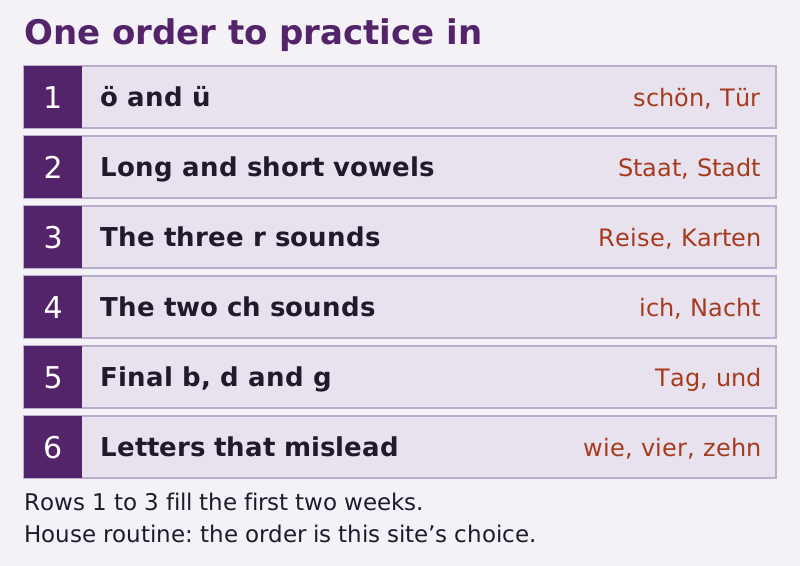
"A practice order for German sounds" from Conversation Mile (https://conversationmile.com/pronunciation/german-pronunciation/). CC BY 4.0 (creativecommons.org/licenses/by/4.0)
This page has no audio. To hear German speakers, try the pronunciation pages of Deutsch im Blick, which have audio for umlauts, consonants such as w and z, r and ch and final consonants. Some single words on Wiktionary have recordings too. This page hasn't checked those recordings sound by sound, so use them to get used to the sounds, not as a test.
How do you make ö and ü?
FSI gives a recipe you can do without a teacher. Put your tongue where it goes for German e, then round your lips, and you get ö. For ü, start from the tongue of German i and round the same way. Keep the tongue still while the lips change (House routine).
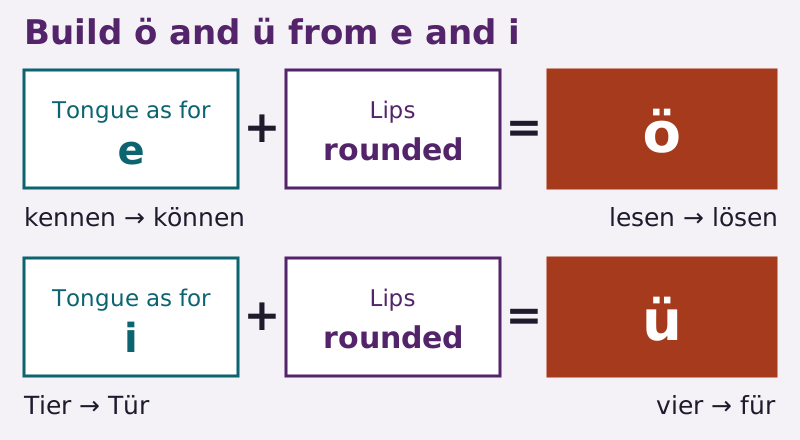
"How to build the German ö and ü" from Conversation Mile (https://conversationmile.com/pronunciation/german-pronunciation/). CC BY 4.0 (creativecommons.org/licenses/by/4.0)
Try each pair out loud, plain word first.
| Plain | Rounded | Why it matters |
|---|---|---|
| kennen /ˈkɛnən/ | können /ˈkœnən/ | "to know" and "can" |
| Tier | Tür | "animal" and "door" |
| lesen | lösen | "to read" and "to solve" |
Umlauts can also change a word's meaning. Deutsch im Blick pairs schon /ʃoːn/ (already) with schön /ʃøːn/ (pretty), and zahlen (to pay) with zählen (to count). A keyboard without these letters can use ae, oe, ue.
Say these: Sind sie Brüder? (Are they brothers?) and Das Wetter ist schön. (The weather is beautiful.)
Should a German vowel stay still?
Yes, on the long ones. FSI compares English "gate" with German geht. Your tongue moves during the English vowel and stays in one place during the German one. So hold the vowel steady to its end. Then practice length, because it can be all that separates two words.
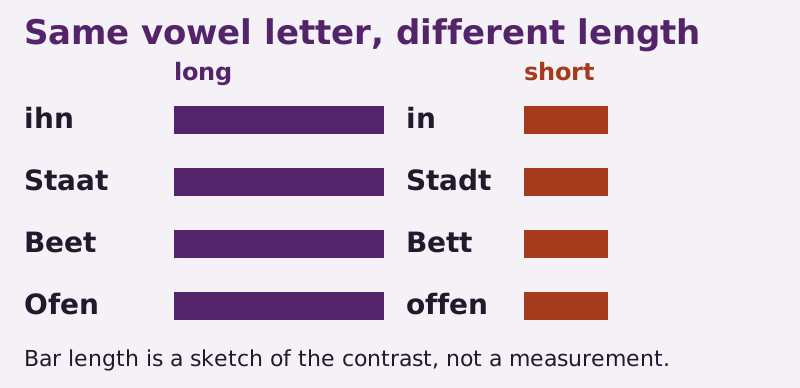
"Long and short vowel pairs in German" from Conversation Mile (https://conversationmile.com/pronunciation/german-pronunciation/). CC BY 4.0 (creativecommons.org/licenses/by/4.0)
Spelling gives hints, not rules. FSI says short vowels are usually followed by two or more consonants, and long vowels usually by one. It also says these spellings always mean a long vowel: ie, ih, eh, ee, ah, aa, oh, oo, uh, öh, üh. Treat that as a strong hint too. Wiktionary gives a long ie in vier but a short i in vierzehn and vierzig.
Which ch do you use?
Look at what comes right before it. Deutsch im Blick puts front vowels and consonants on one side and a, o and u on the other. FSI's drills put au with the back group.
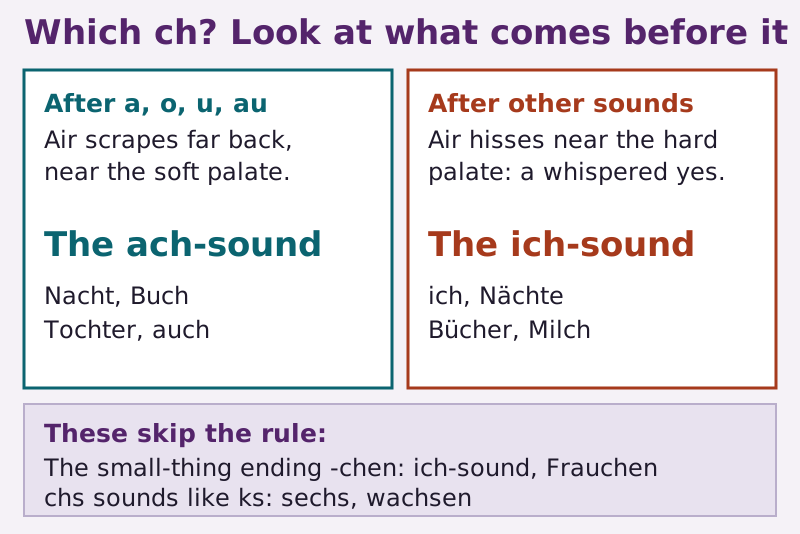
"Choosing between the two German ch sounds" from Conversation Mile (https://conversationmile.com/pronunciation/german-pronunciation/). CC BY 4.0 (creativecommons.org/licenses/by/4.0)
| Sound | How to find it | Pairs to say |
|---|---|---|
| Ich-sound, /ç/ | Whisper "yes" and stretch the start: "yyyes." Whisper "Hugh" the same way. Keep that air noise. | Nächte /ˈnɛçtə/, Bücher /ˈbyːçɐ/, Töchter /ˈtœçtɐ/, euch |
| Ach-sound, /x/ | Say "knock." Now lower the back of your tongue a little, so some air gets through in place of the stop. | Nacht /naxt/, Buch /buːx/, Tochter /ˈtɔx.tɐ/, auch |
Read the last column across as pairs, so you hear the change.
A few spellings don't follow the vowel before them. Wiktionary gives a plain ks for chs, as in sechs and wachsen. The ending -chen, which makes a small version of something, takes the ich-sound even after au, as in Frauchen. Kuchen (cake) isn't that ending. Wiktionary gives it the ach-sound.
Two words that start with ch, China and Chemie, get the ich-sound in the standard. Wiktionary gives China a k in Austria, southern Germany and Switzerland, and Chemie a k in Austria and Bavaria. That's a note on those two words, not a rule for every word that starts with ch.
FSI also singles out ch against k as a hard contrast, and it drills pairs such as Akt and acht, so try those too. Keep the air moving on the ch.
Now say a sentence with both sounds: Ich konnte die ganze Nacht nicht schlafen. (I couldn't sleep all night.) Then a shorter one: Ich möchte nicht tanzen. (I don't feel like dancing.) Or a long ü before an ich-sound: Bücher kennen keine Grenzen. (Books have no borders.)
Where it varies: the ending -ig splits by region. Wiktionary gives König as /ˈkøː.nɪç/, with /ˈkøː.nɪk/ for Austria and southern Germany. The two course books differ the same way: FSI drills König with the ich-sound, and Deutsch im Blick lists billig with a final k. That ich-sound or k only comes at the end. Add an ending that starts with a vowel and the g is a plain g again: Wiktionary gives Könige as /ˈkøː.nɪ.ɡə/. In Swiss German dialects, Deutsch im Blick says ch stays the back sound everywhere, so ich sounds different there.
What happens to b, d and g at the end?
They lose their voice. At the end of a word or syllable, b comes out as p, d as t, and g as k. The ending -ig is the exception. In the German of Germany this page follows, it takes the ich-sound, as in König, and Austria and southern Germany say k, as the ch section shows. Deutsch im Blick suggests a test: put your hand on your throat, say b and then p, and feel the buzz stop.
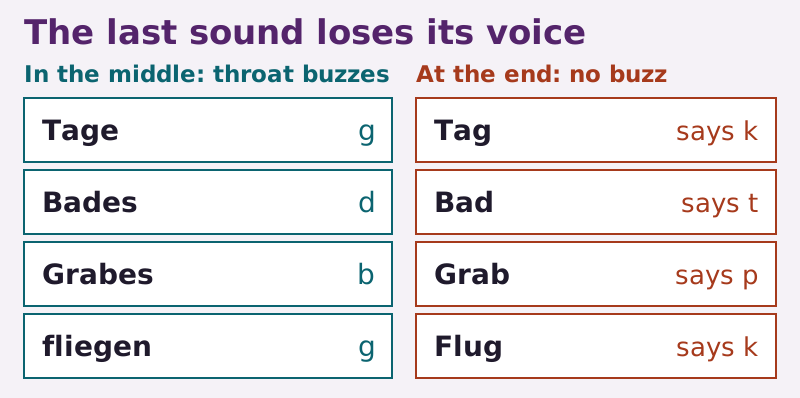
"Voiced consonants in the middle of a German word and voiceless at the end" from Conversation Mile (https://conversationmile.com/pronunciation/german-pronunciation/). CC BY 4.0 (creativecommons.org/licenses/by/4.0)
Compare Tage /ˈtaːɡə/ (days) with Tag /taːk/ (day). FSI adds that this also happens in the middle of words, right before a voiceless sound, so gibt says "gip-t" and bleibt says "bleip-t." The final s stays voiceless too. Spelling won't warn you, since the d in und looks like any other d.
Say this one and listen for a t at the end of Hund and und, and a k at the end of weg: Der Hund trank Wasser und ging weg. (The dog drank water and went away.) Trank is spelled with a k anyway, and ging ends in the ng sound below, with no k. FSI points out one more English habit to drop. The ng in Finger is a single sound, with no g after it, like English "singer" and not "finger."
What is the German r doing?
It depends on where it sits, how fast the speaker talks, and where the speaker is from. Deutsch im Blick describes three versions in standard German.
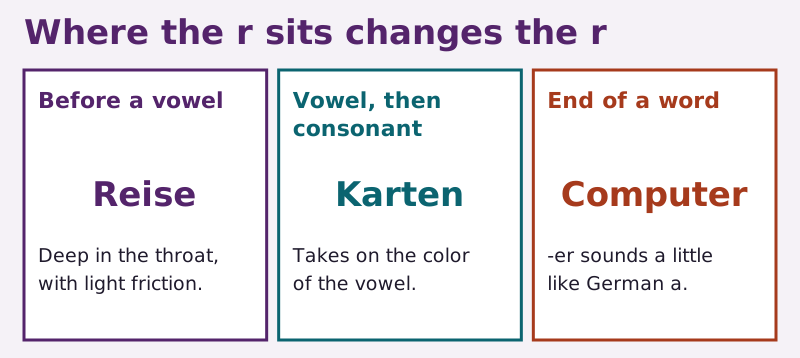
"Three ways the German r sounds, by position" from Conversation Mile (https://conversationmile.com/pronunciation/german-pronunciation/). CC BY 4.0 (creativecommons.org/licenses/by/4.0)
| Where | What you hear | Say |
|---|---|---|
| Start of a word, or after a consonant | Deep in the throat, like a light gargle | Reise, Freunde |
| Between a vowel and a consonant | Takes on the vowel before it, and can nearly vanish in fast speech | Karten, Garten |
| In a final -er | Close to a German a | Computer, Oper |
FSI describes the first one as slight friction between the back of the tongue and the soft palate, close to the sound in nach. It says the r after a vowel doesn't sound like an English r. Keep it light. If your throat feels scratchy, stop for the day.
For clusters like the one in drei, FSI suggests putting in a vowel first, "darei," then shrinking the vowel away. Try Ich reise oft. (I travel often.) and then Mein Vater ist im Garten. (My father's in the garden.), which has two r types in a row.
Where it varies: Deutsch im Blick notes that Swiss German uses a rolled r, with the tongue touching the roof of the mouth. If you plan to live somewhere specific, copy the speakers there.
Which letters mislead English readers?
These look friendly and aren't. Say each word in the figure, then the sentences below.
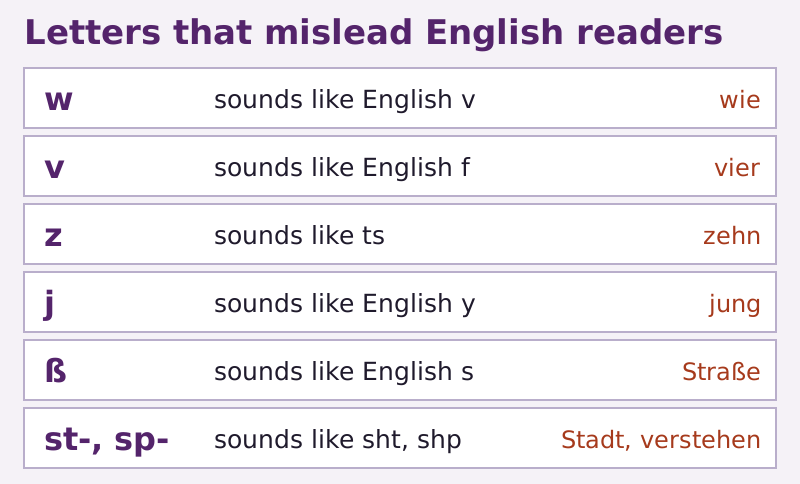
"German letters that do not sound the way English readers expect" from Conversation Mile (https://conversationmile.com/pronunciation/german-pronunciation/). CC BY 4.0 (creativecommons.org/licenses/by/4.0)
| Letter | Watch for |
|---|---|
| w, v | Pairs such as Wetter and Vetter, or wie /viː/ and Vieh /fiː/. Some v words keep an English v: Vase, Vokal, Vulkan. |
| z | Also tz, as in sitzen. Deutsch im Blick warns that an English z sounds foreign. |
| s | Like English z before a vowel, as in Suppe, though Wiktionary gives an s in lesen for Austria. Like sh in st and sp at the start of a word or a word part, as in verstehen, and in sch, where FSI asks for rounder lips than English. |
| ß | Like English s, as in Straße. In Switzerland it's written ss. |
| kn | Say both letters: Knie. |
Try Es hat vier Wochen gedauert. (It took four weeks.), Das wird mindestens zehn Minuten dauern. (It'll take at least ten minutes.), Die Straße ist ziemlich holprig. (The road is fairly bumpy.) and Die Stadt schlief. (The town slept.)
How do you practice this each day?
Pick one row from the order at the top and stay on it for the day. On day 1 there's nothing to say back yet, so those minutes go to word pairs. The splits are a House routine, untested with learners, and the timer runs only while you're making sound. Log the minutes in the Mile Log.
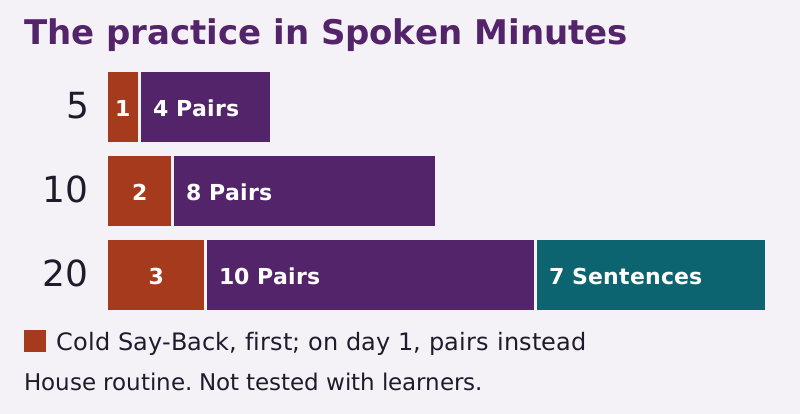
"How German sound practice fills 5, 10 or 20 Spoken Minutes" from Conversation Mile (https://conversationmile.com/pronunciation/german-pronunciation/). CC BY 4.0 (creativecommons.org/licenses/by/4.0)
Use the minimal pairs tool for more word pairs, and the German alphabet week if the letter names still trip you up. When single words feel steady, say along with short audio. German cases gives you more sentences, and how to learn German shows where sounds fit in your first two weeks.
Tomorrow, before you listen to anything, do a Cold Say-Back: say schon, schön, Nacht, Nächte, Tage, Tag from memory. Then check yourself against this page: which ch goes after which vowel, where a final g turns into k, and why -ig doesn't.
What this rests on
Checked against
- Building ö and ü from the tongue position of e and i with rounded lips Source 7
- Umlauts changing a word's meaning, and writing ae, oe, ue Source 2
- Steady long vowels, long and short pairs, and the spelling hints, which FSI says always mean a long vowel Source 7
- Which vowels and consonants come before each ch, and where each one is made Source 4
- St and sp sounding like sht and shp at the start of a word or of a part of a compound Source 3
- The whispered yes and Hugh, the knock trick, and the ch and k contrasts Source 7
- Final b, d and g losing their voice, and the hand on the throat Source 5
- The three r sounds and what changes them Source 4
- Standard German of Germany as the model Source 1
- Swiss German r and ch Source 6
- The letters ß, s, z, v, w, j and the v and w pairs Source 3
- IPA for the words shown, the final sound of König in Austria and southern Germany, g again in Könige, ks in sechs and wachsen, the ich-sound in the diminutive -chen, the ach-sound in Kuchen, the ich-sound and regional k in China and Chemie, the short i in vierzehn and vierzig, sht in verstehen, the final sounds of Hund, und and weg, and the s of lesen in Austria Source 8
- All German example sentences Source 9
House routine
- The order of practice with the vowels and the r in the first two weeks, which words to pair up in each drill, keeping the tongue still while the lips round, and keeping it light
- The 5, 10 and 20 Spoken Minute splits with the Cold Say-Back first, and checking it against this page's rules
Sources
- Abrams, Zsuzsanna, and others. "Kapitel 1: Aussprache." Deutsch im Blick, COERLL, University of Texas at Austin, 2017 Open. Read: The pronunciation section of the chapter.. License: CC BY 4.0.
- Abrams, Zsuzsanna, and others. "Kapitel 2: Der Umlaut." Deutsch im Blick, COERLL, University of Texas at Austin, 2017 Open. Read: The pronunciation section of the chapter.. License: CC BY 4.0.
- Abrams, Zsuzsanna, and others. "Kapitel 3: Beachtenswerte deutsche Konsonanten." Deutsch im Blick, COERLL, University of Texas at Austin, 2017 Open. Read: The pronunciation section of the chapter.. License: CC BY 4.0.
- Abrams, Zsuzsanna, and others. "Kapitel 4: Das R und das Ch." Deutsch im Blick, COERLL, University of Texas at Austin, 2017 Open. Read: The pronunciation section of the chapter.. License: CC BY 4.0.
- Abrams, Zsuzsanna, and others. "Kapitel 6: Die Auslautverhärtung." Deutsch im Blick, COERLL, University of Texas at Austin, 2017 Open. Read: Most of the pronunciation section of the chapter.. License: CC BY 4.0.
- Abrams, Zsuzsanna, and others. "Kapitel 8: Schweizerdeutsch." Deutsch im Blick, COERLL, University of Texas at Austin, 2017 Open. Read: The opening of the pronunciation section, with its table of dialect features.. License: CC BY 4.0.
- Foreign Service Institute. German Basic Course, Units 1-12. U.S. Department of State, 1961 Open. Read: Notes on Pronunciation in Units 1 to 5, 7 and 8 (pp. 6-8, 30-32, 56-57, 89-90, 115-116, 171-172, 201-202). A course from 1961 for U.S. government staff, with a teacher in the room..
- Wiktionary contributors. German entries for the words on this page. Wiktionary, as distributed by kaikki.org Open. Read: The pronunciation lines of each word shown with IPA on this page, and of König, Könige, wenig, wenige, sechs, wachsen, Frauchen, -chen, Kuchen, China, Chemie, vier, vierzehn, vierzig, verstehen, Hund, und and weg.. License: CC BY-SA 4.0.
- Tatoeba. Sentence collection, downloaded exports. Tatoeba Open. Read: Each sentence on this page and its linked English read one by one. Authors are credited under Sentence credits.. License: CC BY 2.0 FR.
Sentence credits
- Ich wünsche dir einen schönen Tag! Tatoeba sentence 8634515 by Melang; English by sundown. CC BY 2.0 FR.
- Sind sie Brüder? Tatoeba sentence 3758797 by Jens_Odo; English by CK. CC BY 2.0 FR.
- Das Wetter ist schön. Tatoeba sentence 985820 by Valodnieks; English by CM. CC BY 2.0 FR.
- Ich konnte die ganze Nacht nicht schlafen. Tatoeba sentence 672275 by Zaghawa; English by CK. CC BY 2.0 FR.
- Ich möchte nicht tanzen. Tatoeba sentence 2755481 by Pfirsichbaeumchen; English by CK. CC BY 2.0 FR.
- Bücher kennen keine Grenzen. Tatoeba sentence 3753186 by Esperantostern; English by rul. CC BY 2.0 FR.
- Der Hund trank Wasser und ging weg. Tatoeba sentence 2008184 by Zaghawa; English by ExponentialYoghurt. CC BY 2.0 FR.
- Ich reise oft. Tatoeba sentence 533839 by al_ex_an_der; English by FeuDRenais. CC BY 2.0 FR.
- Mein Vater ist im Garten. Tatoeba sentence 742975 by Dejo; English by CM. CC BY 2.0 FR.
- Es hat vier Wochen gedauert. Tatoeba sentence 11802019 by Pfirsichbaeumchen; English by Amastan. CC BY 2.0 FR.
- Das wird mindestens zehn Minuten dauern. Tatoeba sentence 1067188 by Hans07; English by sundown. CC BY 2.0 FR.
- Die Straße ist ziemlich holprig. Tatoeba sentence 12166006 by mhr; English by sundown. CC BY 2.0 FR.
- Die Stadt schlief. Tatoeba sentence 752480 by Manfredo; English by sundown. CC BY 2.0 FR.
Next stops
Cite this page
German Pronunciation: Ch, Umlauts, and Final Consonants. Conversation Mile, 2026-11-10. https://conversationmile.com/pronunciation/german-pronunciation/
Corrections
No corrections on this page. Spotted a language error? Please tell this site.