Words That Stick How-to
How to Memorize Vocabulary You Can Say Later
Straight answer
Put each new word in a short sentence, and say that sentence from memory the next day. Try it now with one line. Say Tengo hambre. in Spanish, J'ai faim. in French, or Ich habe Hunger. in German. Each one says that you're hungry. Say yours twice, then look away and say it once more.
Tomorrow you'll test it cold. That test is the Cold Say-Back, and this page is where this site defines it. The rules and counts below are a House routine: this site's choice, untested with learners.
What is a Cold Say-Back?
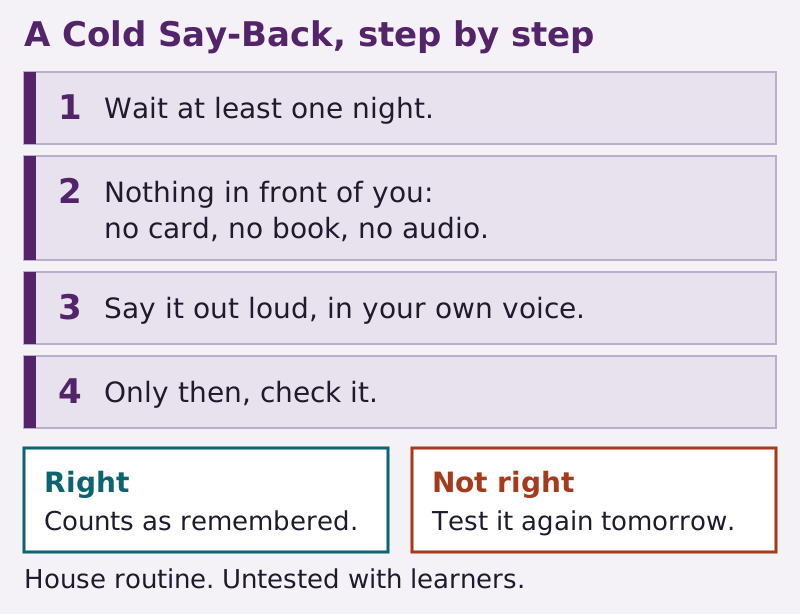
It's a test with nothing to look at. You say a sentence or a rule in your own voice. Only then do you check it. In your first two weeks, when you have few sentences, a word pair or a sound works too.
"The four steps of a Cold Say-Back" from Conversation Mile (https://conversationmile.com/vocabulary/how-to-memorize-vocabulary/). CC BY 4.0 (creativecommons.org/licenses/by/4.0)
The full rules:
- Wait at least one night. A sentence from this morning can't be tested this evening.
- Nothing in front of you. No card, no book, no audio.
- Say it out loud. Use your own voice, not a voice in your head.
- Then check it. If you got it right, count that sentence as remembered. If not, test it again tomorrow.
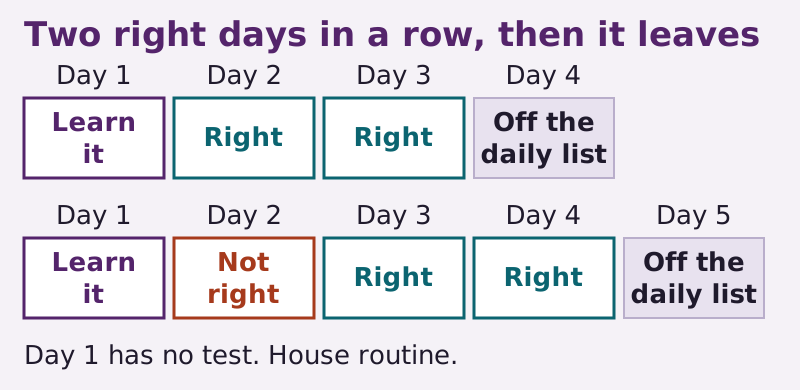
- Two right days in a row, and it leaves your daily list.
"Remembered" means you could say it that day. It doesn't promise that you'll still have it next year, and this page doesn't claim that.
Why test a sentence and not a single word?
A sentence is what you'll need when you talk. A word on its own leaves you to build the rest on the spot. So when you meet a new word, find a short sentence that holds it, and learn the sentence.
| Word you want | A sentence that holds it |
|---|---|
| llave (key) | Dame la llave. Give me the key. |
| café (coffee) | Me gusta el café. I like coffee. |
| café (coffee) | J'aime le café. I like coffee. |
| Bahnhof (station) | Wo ist der Bahnhof? Where is the railroad station? |
Anki's user manual makes a similar suggestion for language learners. It advises against long lists of words and toward seeing each word used in a sentence. That's the manual's advice, not a study.
In German, the sentence also carries the word in front of the noun, so der comes along with Bahnhof. That habit is the heart of learning each noun with its article. The word in front can change in other sentences, as German cases explains, so learn the noun with the article you'd find in a dictionary, as on the der, die, das page.
Keep the sentence short enough to say in one breath (House routine). Sentence mining shows where to find good ones, and the first 1,000 words gives you common words to start from. In your first two weeks, a pair from the minimal pairs tool can be the thing you say back.
What counts as cold?
Cold means you start from nothing. The table shows where the line falls.
| Cold | Not cold |
|---|---|
| The next morning, before you open anything | An hour after you studied it |
| Eyes off every card and page | A quick look at the first word |
| Said out loud | Run through in your head |
| Checked after you've said it | Checked while you're saying it |
If you glanced at the card, it wasn't cold. Check it anyway, and test it again tomorrow.
Be strict about "right." Anki's manual has a related line for its Again button: an answer that's only partly right, and that would fail in real life, counts as a fail. This site's line is stricter (House routine): if one word or one ending came out wrong, it's not right, and the sentence comes back tomorrow.
Check against the source: the page, transcript or written line the sentence came from. Don't check against your memory of it, since that's the thing being tested. If your own copy doesn't match the source, count it as not right, fix the copy and test it again tomorrow.
When does a sentence leave your daily list?
After two right days in a row. A miss starts the count again.
"When a sentence leaves the daily Cold Say-Back list" from Conversation Mile (https://conversationmile.com/vocabulary/how-to-memorize-vocabulary/). CC BY 4.0 (creativecommons.org/licenses/by/4.0)
Leaving the daily list doesn't mean it's gone for good. If you keep sentence cards, it stays in that stack. The Anki page shows how to make those cards and how to say them out loud.
Two days is this site's number. It helps keep the daily list short.
What does a week of this look like?
Say you start a Spanish list on Monday. Here's how two sentences might move through it.
| Day | Cold Say-Back, first thing | What happens |
|---|---|---|
| Monday | Nothing yet | You learn Dame la llave and Me gusta el café |
| Tuesday | Both | The key line is right. The coffee line comes out with one word missing, so it's not right |
| Wednesday | Both | Both right. The key line has two right days and leaves the list |
| Thursday | The coffee line | Right again, two days in a row. It leaves too |
On Tuesday, one missing word made the coffee line "not right." That's the strict check from above at work. It's also why the coffee line stayed a day longer.
Keep the list somewhere you won't see it by accident before you speak, such as a page you flip open only after you've said each line. A short list on paper is enough. Next to each sentence, mark the days it came out right, so you can see when two marks sit side by side (House routine).
New sentences join the list on the day after you learn them. So the list grows by what you add and shrinks by what leaves.
How many minutes does it take?
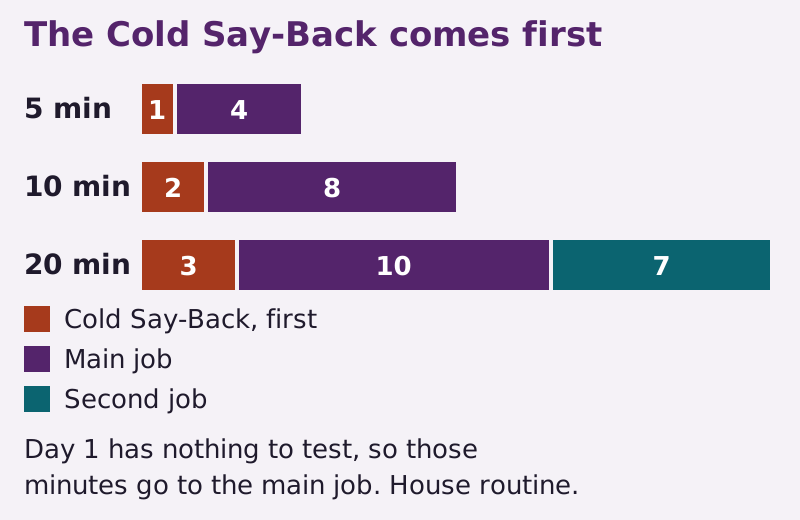
Very few. The Cold Say-Back opens the day, before anything else, and it takes 1, 2 or 3 minutes.
"Where the Cold Say-Back sits in 5, 10 or 20 Spoken Minutes" from Conversation Mile (https://conversationmile.com/vocabulary/how-to-memorize-vocabulary/). CC BY 4.0 (creativecommons.org/licenses/by/4.0)
| Daily amount | Cold Say-Back, first | Main job | Second job |
|---|---|---|---|
| 5 | 1 | 4 | None |
| 10 | 2 | 8 | None |
| 20 | 3 | 10 | 7 |
One minute fits a line or two. When the time is up, stop. Lines you didn't reach stay on the list.
Next time, go in this order (House routine): lines that came out wrong, then lines that were right once and need a second right day, then the ones you didn't reach, then the newest. A line that was right once but didn't get tested today hasn't had its second day, so it stays on the list.
The list stays short only while most lines come out right two days in a row, since that's when they leave it. Each test also tells you which lines still need work.
Day 1 has nothing to test yet, so the Cold Say-Back minutes go to the main job. The 90-day plan shows what the main job is on each day.
The timer runs while you're saying a line, and it stops while you check your list. The shadowing page has the full rules for that count, and the Mile Log keeps it.
After a long break, start with a Cold Say-Back on a few old lines. Any line you can't say goes back on your daily list. Then carry on from where you stopped.
Tomorrow, before you look at anything, say your hungry sentence from the top of this page. Say it out loud, once. Then come back here and check it.
What this rests on
Checked against
House routine
- Counting one wrong word or one wrong ending as not right, stricter than the manual
- The Cold Say-Back: at least one night, nothing in front of you, out loud before you check, right counts as remembered, wrong comes back tomorrow
- Two right days in a row to leave the daily list, and word pairs or sounds in the first two weeks
- Keeping each new word inside a short sentence you can say in one breath
- The 1, 2 and 3 minute Cold Say-Back at the start of 5, 10 and 20 Spoken Minutes, with none on day 1
- Starting with a Cold Say-Back after a long break and putting back what you can't say
- The order for the next Cold Say-Back: wrong lines, then lines needing a second right day, then lines not reached, then the newest; stopping when the time is up
Sources
- Anki contributors. "Adding/Editing." Anki Manual Open. Read: The Effective Learning section.. License: CC BY-SA 4.0.
- Anki contributors. "Studying." Anki Manual Open. Read: The Answer Buttons section.. License: CC BY-SA 4.0.
- Tatoeba. Sentence collection, downloaded exports. Tatoeba Open. Read: Each sentence on this page and its linked English read one by one. Authors are credited under Sentence credits.. License: CC BY 2.0 FR.
Sentence credits
- Tengo hambre. Tatoeba sentence 3349210 by andrmene; English by CK. CC BY 2.0 FR.
- J'ai faim. Tatoeba sentence 4323367 by gillux; English by CK. CC BY 2.0 FR.
- Ich habe Hunger. Tatoeba sentence 2095976 by freddy1; English by CK. CC BY 2.0 FR.
- Dame la llave. Tatoeba sentence 511460 by Shishir; English by CM. CC BY 2.0 FR.
- Me gusta el café. Tatoeba sentence 2002085 by Shishir; English by robbieheslop. CC BY 2.0 FR.
- J'aime le café. Tatoeba sentence 916677 by Scott; English by robbieheslop. CC BY 2.0 FR.
- Wo ist der Bahnhof? Tatoeba sentence 544538 by jakov; English by CM. CC BY 2.0 FR.
Next stops
Cite this page
How to Memorize Vocabulary You Can Say Later. Conversation Mile, 2026-11-10. https://conversationmile.com/vocabulary/how-to-memorize-vocabulary/
Corrections
No corrections on this page. Spotted a language error? Please tell this site.