Minimal Pairs for Spanish, French, and German
Straight answer
A minimal pair is two words that differ in a single sound, so swapping that sound changes the meaning. Say this Spanish pair aloud now: pero, meaning "but," then perro, meaning "dog." In the first, the tip of your tongue taps once. In the second, it taps several times. If they came out the same, that's what the list above is for. Pick a language and a sound, and work through the pairs.
Find a pair and say it
The picker needs JavaScript. Every pair is listed here.
| Language | Sound | First word | Second word | Where to feel it |
|---|---|---|---|---|
| Spanish | Tap r or trilled rr | pero /ˈpeɾo/ | perro /ˈpero/ | First word: but. Second word: dog. For the first, the tip of your tongue touches the ridge behind your top teeth once. For the second, it touches again and again; ¿Cómo suena? counts three touches. No recording for this pair yet. Look up pero · Look up perro |
| Spanish | Tap r or trilled rr | ahora /aˈoɾa/ | ahorra /aˈora/ | First word: now. Second word: saves, as in she saves. One touch for the first, several for the second, as in the row above. No recording for this pair yet. Look up ahora · Look up ahorra |
| Spanish | Tap r or trilled rr | caro /ˈkaɾo/ | carro /ˈkaro/ | First word: expensive. Second word: cart, and car in parts of Latin America. A single r between vowels gets one touch. A written rr gets the trill. No recording for this pair yet. Look up caro · Look up carro |
| Spanish | Stress | peso /ˈpeso/ | pesó /peˈso/ | First word: weight, and also the peso as money. Second word: he or she weighed. The sounds stay the same. The stress moves from the first syllable to the last, and the written accent shows where. No recording for this pair yet. Look up peso · Look up pesó |
| Spanish | z or s (northern and central Spain) | casa /ˈkasa/ | caza /ˈkaθa/ | First word: house. Second word: hunting, or a hunt. This pair only works with distinción, used in the center and north of Spain, where z sounds like the th in thin and s stays s. In most of Latin America and the south of Spain the two words sound the same; that's called seseo, and Wiktionary lists that way of saying caza too. No recording for this pair yet. Look up casa · Look up caza |
| French | u or ou | vu /vy/ | vous /vu/ | First word: seen. Second word: you. For the first, round your lips as if to blow out a candle and say ee. The second is the ou sound. Swap them and the word changes. No recording for this pair yet. Look up vu · Look up vous |
| French | u or ou | pue /py/ | poux /pu/ | First word: stinks. Second word: lice. The same lips and the same ou as the row above. No recording for this pair yet. Look up pue · Look up poux |
| French | u or i | lu /ly/ | lit /li/ | First word: read, as in have read. Second word: bed. Both keep an ee tongue. Round your lips for the first one only. No recording for this pair yet. Look up lu · Look up lit |
| French | on or an | son /sɔ̃/ | sang /sɑ̃/ | First word: sound. Second word: blood. Both vowels are nasal, and no n is said in either word. Round your mouth for the first. No recording for this pair yet. Look up son · Look up sang |
| French | on or an | ton /tɔ̃/ | temps /tɑ̃/ | First word: your, and also tone. Second word: time, and also weather. The same contrast as the row above. No recording for this pair yet. Look up ton · Look up temps |
| French | in or an | vin /vɛ̃/ | vent /vɑ̃/ | First word: wine. Second word: wind. For the first, open your mouth as if you were about to smile. Both vowels are nasal. No recording for this pair yet. Look up vin · Look up vent |
| French | Nasal vowel or a said n | bon /bɔ̃/ | bonne /bɔn/ | First word: good, with a masculine noun. Second word: good, with a feminine noun. The first has a nasal vowel and no n. In the second the n is said and the vowel is not nasal, so this is a near pair: more than one sound changes. No recording for this pair yet. Look up bon · Look up bonne |
| French | Nasal vowel or a said n | plein /plɛ̃/ | pleine /plɛn/ | First word: full, with a masculine noun. Second word: full, with a feminine noun. The same pattern as the row above, and also a near pair. No recording for this pair yet. Look up plein · Look up pleine |
| German | o or ö | schon /ʃoːn/ | schön /ʃøːn/ | First word: already. Second word: beautiful. The umlaut moves the vowel to the front of your mouth. Both vowels are long. No recording for this pair yet. Look up schon · Look up schön |
| German | u or ü | Bruder /ˈbruːdɐ/ | Brüder /ˈbʁyːdɐ/ | First word: brother. Second word: brothers. Only the vowel changes. The r looks different because the two dictionary entries write it with different symbols. No recording for this pair yet. Look up Bruder · Look up Brüder |
| German | a or ä | zahlen /ˈtsaːlən/ | zählen /ˈtsɛːlən/ | First word: to pay. Second word: to count. Both vowels are long. Wiktionary also lists a way of saying the second word with [eː]. No recording for this pair yet. Look up zahlen · Look up zählen |
| German | a or ä | fallen /ˈfalən/ | fällen /ˈfɛlən/ | First word: to fall. Second word: to fell, as in cutting down a tree. Both vowels are short. No recording for this pair yet. Look up fallen · Look up fällen |
| German | v or w | Vieh /fiː/ | wie /viː/ | First word: livestock. Second word: how. In these words German v sounds like English f, and German w sounds like English v. No recording for this pair yet. Look up Vieh · Look up wie |
| German | v or w | Vetter /ˈfɛtər/ | Wetter /ˈvɛtər/ | First word: a male cousin. Second word: weather. The same contrast as the row above. No recording for this pair yet. Look up Vetter · Look up Wetter |
How do you work through a pair?
Say each word on its own, then the two together, then test yourself on which one you said.
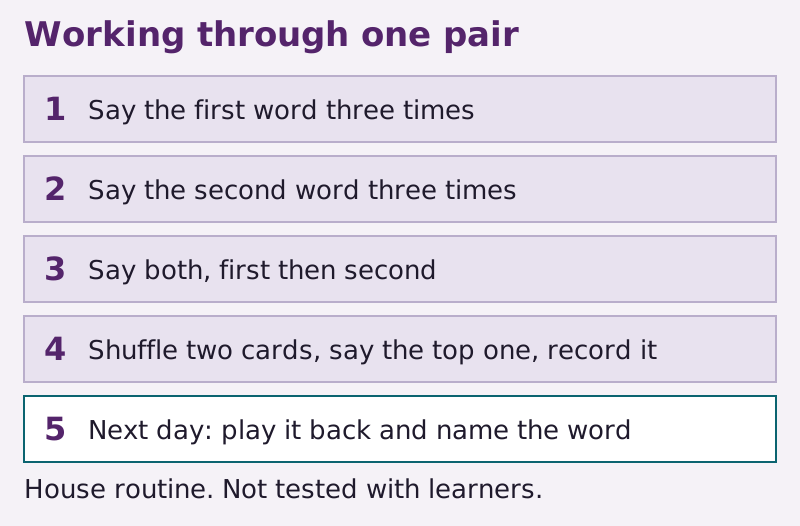
"How to work through one minimal pair" from Conversation Mile (https://conversationmile.com/pronunciation/minimal-pairs/). CC BY 4.0 (creativecommons.org/licenses/by/4.0)
- Say the first word three times, slowly, following the hint.
- Say the second word three times.
- Say both, first then second, so the difference sits side by side.
- Write each word on a card, shuffle the two, and say the one on top while recording.
- The next day, play the recording before you look at the card. Name the word you hear, then check.
These steps are a House routine, this site's own choice, not tested with learners. Step 5 tests your ear a night later, much as a Cold Say-Back tests your memory. A recording only plays back what you said, so it can't judge whether the two words sounded different. It does let you test your ear.
Early on, one pair a day is enough. In the 90-day plan, minimal pairs are one of three jobs that take turns on days 1 to 14, with vowels and the r first. For a sound that also needs whole sentences, take it to shadowing.
What's in the list?
Nineteen pairs for Spanish, French and German. Norwegian isn't here yet. To keep the whole list, with the IPA and the hints, download it as a CSV file About this table Data: IPA (except ahorra and pleine, which follow the textbooks below) and word meanings from Wiktionary (https://en.wiktionary.org/), CC BY-SA 4.0 (https://creativecommons.org/licenses/by-sa/4.0/), via Wiktextract and kaikki.org (extract of 2026-10-30), read 2026-11-10. Changes: the transcriptions are copied without slashes; meanings are shortened into the hint column.; Pairs and sound descriptions follow ¿Cómo suena? (Escudero, Barreca and Carbone, SUNY Create OER), FREN 140: Basic French Pronunciation (Carrasco and Zahedi, Palomar College, LibreTexts) and Deutsch im Blick (Abrams and others, COERLL, University of Texas at Austin), each CC BY 4.0 (https://creativecommons.org/licenses/by/4.0/). The peso and pesó pair and the th comparison follow the FSI Spanish Basic Course, a U.S. government publication..
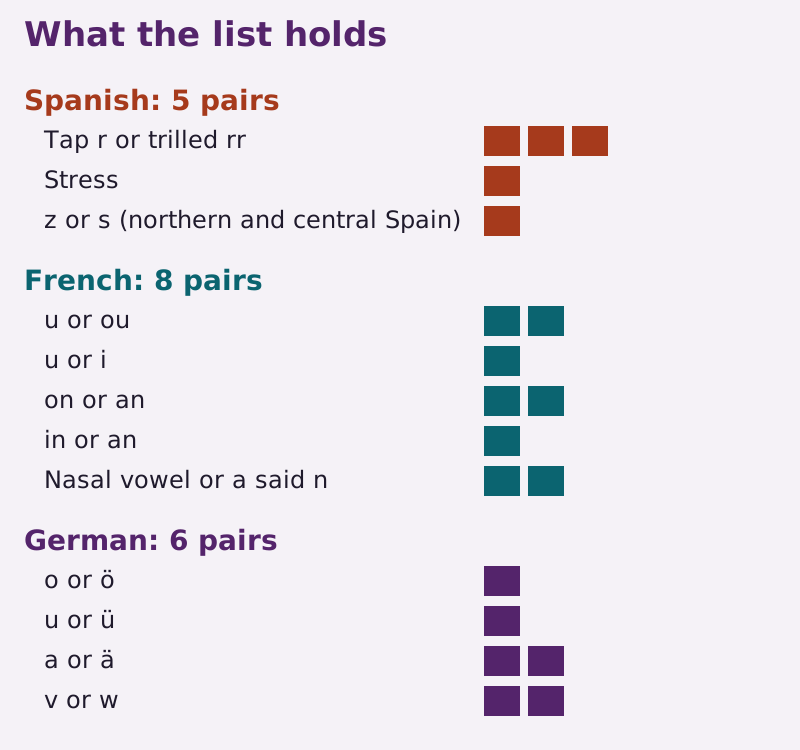
"The sound contrasts in the minimal pairs list, by language" from Conversation Mile (https://conversationmile.com/pronunciation/minimal-pairs/). CC BY 4.0 (creativecommons.org/licenses/by/4.0)
Spanish. The tap and the trill, from the open phonetics textbook ¿Cómo suena?, which counts one touch of the tongue for the tap and three for the trill. A written rr gets the trill, and a single r between vowels gets the tap. A single r at the start of a word, as in rojo, or after n, l or s, as in enredar, alrededores and Israel, gets the trill too. One pair is about stress: peso and pesó have the same sounds, but the stress moves, and the written accent marks the stressed syllable. One more pair, casa and caza, only works in the center and north of Spain, where z sounds like the th in "thin." That's called distinción. In most of Latin America and the south of Spain, the two words sound the same. That's called seseo. The r page has more on the trill, and the Spanish pronunciation page covers how the r varies by region.
French. The u of vu against the ou of vous, u against i, and three nasal vowels, from the open textbook FREN 140: Basic French Pronunciation. In Parisian French, FREN 140 says, un and in now sound the same, while the south of France and Québec keep them apart. That's why this list has no un pair. Two rows are near pairs and say so: bon and bonne, and plein and pleine, differ in more than one sound. The first word has a nasal vowel and no n. The second has a vowel that isn't nasal, followed by an n you say. See French pronunciation and the nasal vowels page.
German. Umlauts and the letters v and w, from the open textbook Deutsch im Blick. It describes the umlaut as moving a vowel from the back of your mouth to the front, as in schon and schön. In words like Vieh, German v sounds like English f, and the w in wie sounds like English v. A few words keep a v sound for the letter v, such as Vase. The German pronunciation page covers the rest.
Why are there no recordings?
This site hasn't yet found and checked recordings it can use. Each pair says so, and links to its two Wiktionary entries instead.
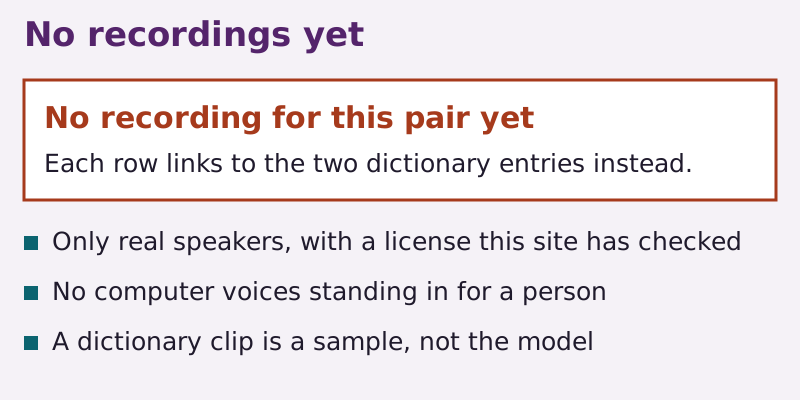
"Why the minimal pairs have no recordings yet" from Conversation Mile (https://conversationmile.com/pronunciation/minimal-pairs/). CC BY 4.0 (creativecommons.org/licenses/by/4.0)
Recordings will be added only from real speakers, and only with a license this site has checked file by file. Computer voices won't stand in for a person. Some Wiktionary entries have audio of their own, which no one here has listened to or checked. Use those clips to hear the sound, but don't treat any single clip as the one right way to say it.
Where does each row come from?
Each row has three parts. Each part has a source.
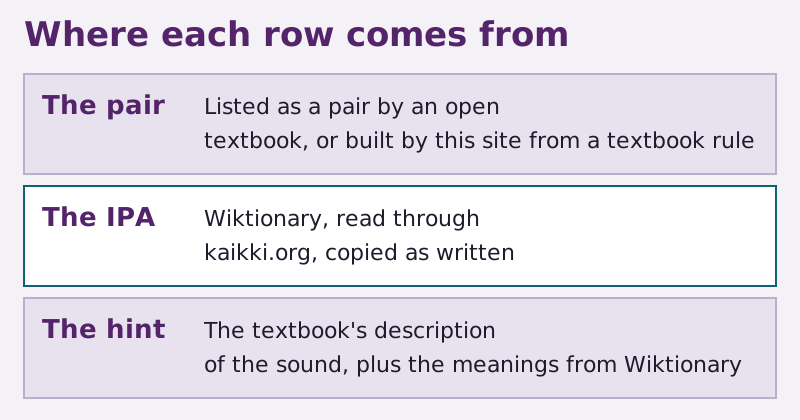
"Where each part of a minimal pairs row comes from" from Conversation Mile (https://conversationmile.com/pronunciation/minimal-pairs/). CC BY 4.0 (creativecommons.org/licenses/by/4.0)
The pair. Most pairs appear as pairs in the textbooks above. Six were put together by this site from a textbook's rule. For those six, the textbook describes the sounds but doesn't list the pair: caro and carro, casa and caza, the French lu and lit, plus three French nasal pairs, son and sang, ton and temps, and vin and vent.
The IPA. IPA is the International Phonetic Alphabet. Each word's IPA comes from Wiktionary, read through kaikki.org, and is copied as written. That's why Bruder shows ˈbruːdɐ and Brüder shows ˈbʁyːdɐ: the two entries write the r with different symbols. Only the vowel changes between them. Two forms had no IPA in the dictionary data, so they follow the textbook instead: ahorra from ¿Cómo suena? and pleine from FREN 140's rule.
The hint. It gives both meanings and what the textbook says about the sound. Where a hint says "say ee" or "round your lips," it repeats the textbook's own instruction.
Tomorrow morning, do a Cold Say-Back on one pair before you play yesterday's recording: say both words from memory, without the list, then check them against the hint. Play the recording for step 5 after that. The Cold Say-Back page explains the rule.
Sources
- Escudero, Barreca and Carbone. ¿Cómo suena? Fonética y fonología del español, Módulo 12: Las consonantes vibrantes. SUNY Create OER, 2021 Open. Read: The whole module text; embedded videos not watched. License: CC BY 4.0.
- Escudero, Barreca and Carbone. ¿Cómo suena? Fonética y fonología del español, Módulo 3: Tildes. SUNY Create OER, 2021 Open. Read: The steps for finding the stressed syllable and placing the written accent. License: CC BY 4.0.
- Escudero, Barreca and Carbone. ¿Cómo suena? Fonética y fonología del español, Módulo 14: Las consonantes fricativas. SUNY Create OER, 2021 Open. Read: The whole module text; embedded videos not watched. License: CC BY 4.0.
- Stockwell, Bowen and Silva-Fuenzalida. Spanish Basic Course: Units 1-15, Unit 1, sections 1.21 and 1.22. Foreign Service Institute, U.S. Department of State, 1961 printing (first printed 1957) Open. Read: The list of word pairs that differ only in stress, from a scanned copy with some unreadable characters.
- Stockwell, Bowen and Silva-Fuenzalida. Spanish Basic Course: Units 1-15, Unit 2, sections 2.23 and 2.27. Foreign Service Institute, U.S. Department of State, 1961 printing (first printed 1957) Open. Read: Parts of those sections, from a scanned copy with some unreadable characters.
- Carrasco, William, and Shahrzad Zahedi. "8.4: The Challenging Vowel U." FREN 140: Basic French Pronunciation, Palomar College, LibreTexts Open. Read: The whole page; audio not played. License: CC BY 4.0.
- Carrasco, William, and Shahrzad Zahedi. "10.1: Nasal Vowels - Introduction." FREN 140: Basic French Pronunciation, Palomar College, LibreTexts Open. Read: The whole page, including the video transcript and French Around the World; audio and video not played. License: CC BY 4.0.
- Carrasco, William, and Shahrzad Zahedi. "10.2: The Vowel [ɑ̃] - AN, EN, AM, EM." FREN 140: Basic French Pronunciation, Palomar College, LibreTexts Open. Read: The whole page; audio not played. License: CC BY 4.0.
- Carrasco, William, and Shahrzad Zahedi. "10.3: The Vowel [ɔ̃] - ON, OM." FREN 140: Basic French Pronunciation, Palomar College, LibreTexts Open. Read: The whole page; audio not played. License: CC BY 4.0.
- Carrasco, William, and Shahrzad Zahedi. "10.4: The Vowel [ɛ̃] - IN, IM, YM, YN, AIN, EIN, AIM, EIM and [œ̃] - UN, UM." FREN 140: Basic French Pronunciation, Palomar College, LibreTexts Open. Read: The whole page; audio not played. License: CC BY 4.0.
- Abrams, Zsuzsanna, and others. "Kapitel 2: Der Umlaut." Deutsch im Blick, COERLL, University of Texas at Austin, 2017 Open. Read: The pronunciation section of the chapter, and the matching Aussprache web page. License: CC BY 4.0.
- Abrams, Zsuzsanna, and others. "Kapitel 3: Beachtenswerte deutsche Konsonanten." Deutsch im Blick, COERLL, University of Texas at Austin, 2017 Open. Read: The pronunciation section of the chapter, and the matching Aussprache web page. License: CC BY 4.0.
- Wiktionary contributors. Entries for each word in the list. Wiktionary, via Wiktextract and kaikki.org Open. Read: The pronunciation and first senses of each entry, from the local kaikki files. License: CC BY-SA 4.0.
Next stops
Cite this page
Minimal Pairs for Spanish, French, and German. Conversation Mile, 2026-11-10. https://conversationmile.com/pronunciation/minimal-pairs/
Corrections
No corrections on this page. Spotted a language error? Please tell this site.