Pronunciation Workshop How-to
How to Roll Your R: What Your Tongue Has to Do
Straight answer
Spanish has two r sounds: a tap that touches once and a trill that touches several times. The trill is the rolled one. Say these two words out loud now: pero, "but," and perro, "dog." If they came out the same, this page is for you. You'll find the tap first, since FSI's course says English already has a sound very much like it, and then work toward the trill in small steps.
The English trap
FSI's Spanish course (1961 printing) says the Spanish r sounds don't even vaguely resemble most English r sounds, and that carrying the English r over won't work. ¿Cómo suena? adds that the English r never touches the ridge behind the teeth.
Say this today
Tengo tres perros.
I have three dogs.
What is the difference between the tap and the trill?
Both sounds use the tip of your tongue against the ridge behind your upper front teeth. ¿Cómo suena?, an open university phonetics book, defines the tap as one touch and the trill as three touches in a row. FSI's Spanish course just calls the trill a rapid trill of the tongue tip, without a count.
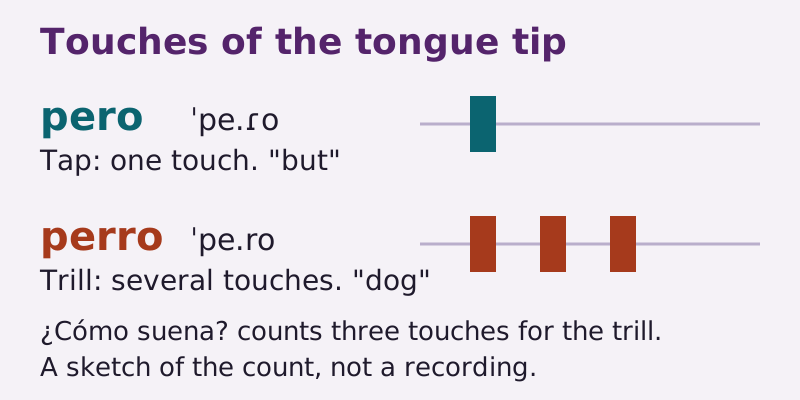
"One touch for the tap, several for the trill" from Conversation Mile (https://conversationmile.com/pronunciation/how-to-roll-your-r/). CC BY 4.0 (creativecommons.org/licenses/by/4.0)
The difference matters because it can change the word. ¿Cómo suena? gives pero (ˈpe.ɾo) against perro (ˈpe.ro), and ahora, "now," against ahorra, "he or she saves." The h in both is silent, so those two differ only in the middle r. Say this sentence, with a tap in tres and a trill in perros: Tengo tres perros.
Where does your tongue go?
Your tongue tip goes up to the ridge just behind your upper front teeth. ¿Cómo suena? says Spanish keeps the tongue tense for both r sounds, and flatter than it is for English.
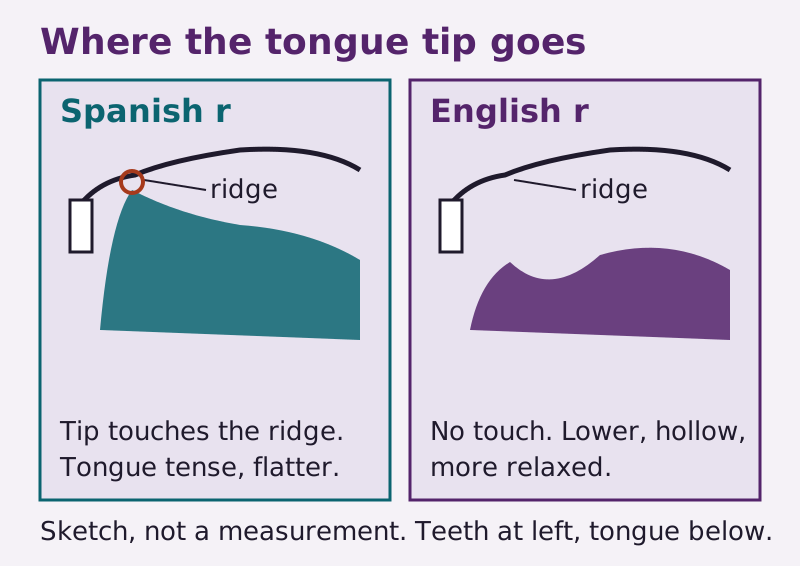
"The tongue tip for the Spanish r and the English r" from Conversation Mile (https://conversationmile.com/pronunciation/how-to-roll-your-r/). CC BY 4.0 (creativecommons.org/licenses/by/4.0)
The English r works the other way. The same book says it never touches that ridge, and that the tongue sits lower, hollowed and looser. So the fix is a different place and a firmer tongue, not a better English r.
Find the ridge now. Put your tongue tip behind your top front teeth and slide it back a little, onto the bump. That's where both Spanish r sounds happen.
How do you find the tap?
Start from a sound you already make. FSI says the Spanish tap is very much like the t or d sound in English words such as "Betty," "better" or "waiter."
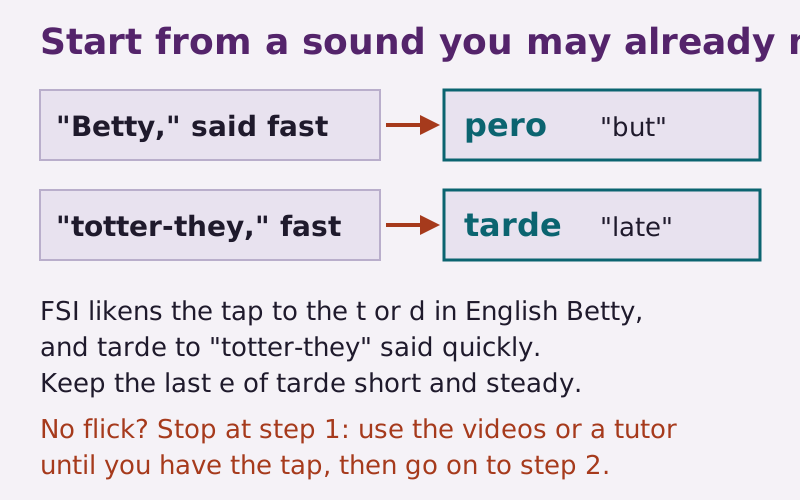
"From Betty to pero, and from totter-they to tarde" from Conversation Mile (https://conversationmile.com/pronunciation/how-to-roll-your-r/). CC BY 4.0 (creativecommons.org/licenses/by/4.0)
Say "Betty" fast three times. Notice the quick flick in the middle. Now say pero with that same flick. If your "Betty" has a crisp t with no flick, stop at step 1 below: use the videos or a tutor mentioned further down until you can hear and make the tap, then go on to step 2. Don't jump straight to the trill. Keep the vowels short and steady, as the Spanish pronunciation page explains.
FSI gives a second trick for an r before another consonant. Tarde, "late," will tend to sound like "tar day." Say "totter-they" quickly instead, and you come close. Keep the last vowel a short, steady e, though, not the slide of "they." Try it in a sentence, with the tap in tarde: Lo siento, llegué tarde.
Which r goes where?
The trill has a short list of places. Most other single r's take the tap, and at the end of a syllable the tap is usual but a trill is possible. The rules below come from ¿Cómo suena?, and they cover the common cases, not every word. There's one exception after the list.
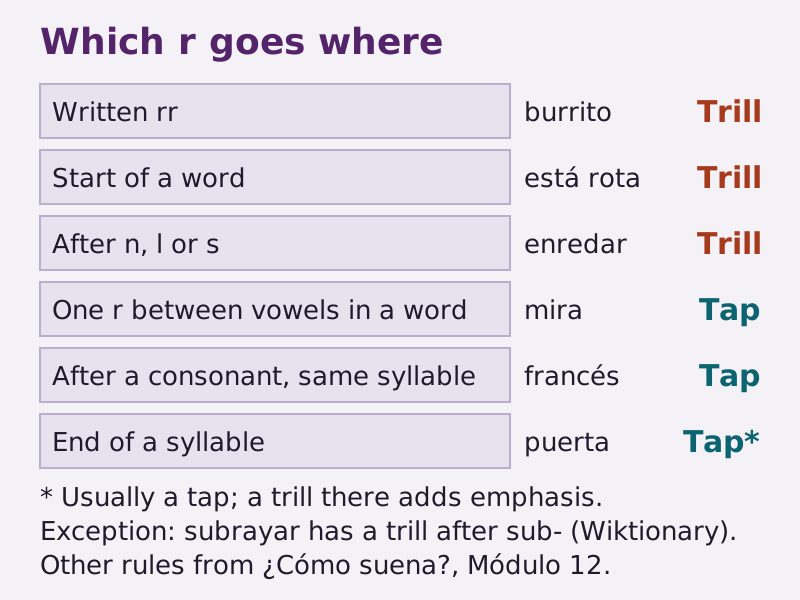
"Where Spanish uses the trill and where it uses the tap" from Conversation Mile (https://conversationmile.com/pronunciation/how-to-roll-your-r/). CC BY 4.0 (creativecommons.org/licenses/by/4.0)
Use the trill:
- For a written rr, as in burrito.
- At the start of a word, as in rojo, "red."
- After n, l or s, as in enredar, alrededores and Israel. The spelling shows only one r there, so watch for these. Only that r gets the trill. The last r of enredar ends a syllable, so it's usually a tap, and the r in -dores of alrededores sits between vowels, so it's a tap.
The tap goes on one r between vowels inside a word, as in mira, and right after a consonant in the same syllable, as in francés. At the end of a syllable, as in puerta, speakers may use either, but the book says standard Spanish strongly prefers the tap there. A trill in that spot adds emphasis or feeling. A word that starts with r keeps its trill even when the word before it ends in a vowel, as rota does after está in a sentence further down.
The exception: in subrayar, "to underline," Wiktionary gives a trill after the b, where sub-, "under," joins rayar, even though the b isn't n, l or s. Its last r, at the end of the word, is a tap in Wiktionary's pronunciation. If a word starts with a prefix like sub- and the next part begins with r, check a dictionary's pronunciation before you choose the tap.
Say this one: Pásame el bolígrafo rojo. The r in bolígrafo follows a g in the same syllable, so it's a tap. Rojo starts with r, so it's a trill. For the rest of the alphabet, the alphabet week goes letter by letter.
How do you practice the trill?
FSI says the trill can usually be learned only by careful imitation. This page has no recordings, so it can't give you that. It can give you an order to try things in, gently.
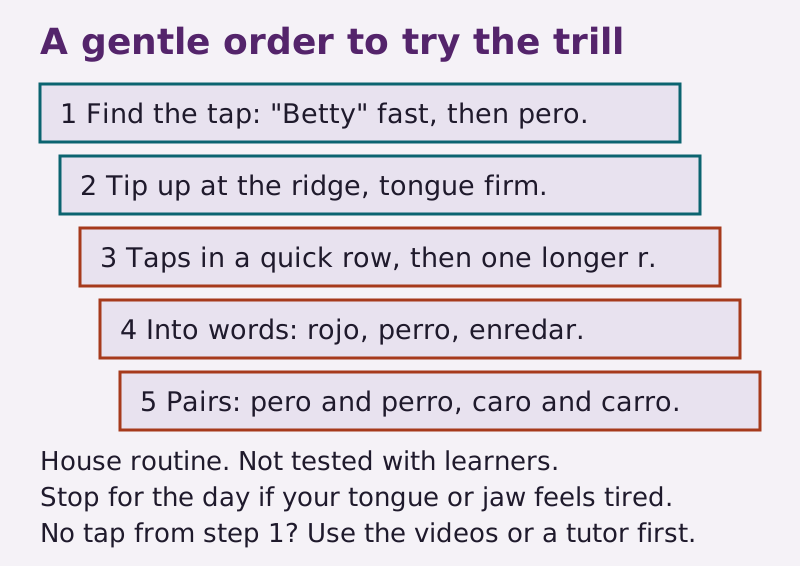
"An order to try the trill in" from Conversation Mile (https://conversationmile.com/pronunciation/how-to-roll-your-r/). CC BY 4.0 (creativecommons.org/licenses/by/4.0)
- Find the tap. Say "Betty" fast, then pero. If no tap comes, stop here and use the videos or a tutor below before going on.
- Set the place. Tongue tip up at the ridge, tongue firm.
- Make a row. Say the tap several times in a quick row. Then try to let them run together into one longer r.
- Put it in words. Try rojo, then perro, then enredar, with the trill only on its first r: El perro ladra. The r in ladra follows a d in the same syllable, so it's a tap.
- Test it in pairs. Say each pair below and listen for the change.
These steps are this site's House routine. The sources don't describe them, and they won't work for everyone. Keep every try gentle. If your tongue or jaw feels tired, stop for the day.
To hear real speakers, ¿Cómo suena? has videos on its r page. This page hasn't checked those clips one by one. A tutor can also listen to your r and tell you which one came out.
Which pairs test your r?
These pairs differ only in the r. In ahora and ahorra, the h is silent in both, so the r is still the only difference. If you swap a tap for a trill, you've said a different word.
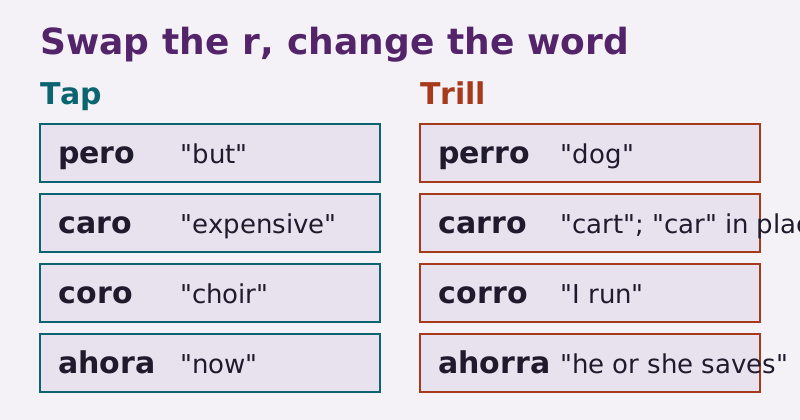
"Pairs where the r changes the word" from Conversation Mile (https://conversationmile.com/pronunciation/how-to-roll-your-r/). CC BY 4.0 (creativecommons.org/licenses/by/4.0)
| Tap | Trill |
|---|---|
| pero, "but" | perro, "dog" |
| caro, "expensive" | carro, "cart," or "car" in some countries |
| coro, "choir" | corro, "I run" |
| ahora, "now" | ahorra, "he or she saves" |
Wiktionary gives "cart" as the first meaning of carro, and labels the "car" meaning as used especially in Central America, the Caribbean, Colombia, Peru, Ecuador, Venezuela and Mexico. So you might hear No tengo carro. for "I don't have a car." Now say the expensive one: Es caro. Then try both r sounds at once: ¡Pero qué enorme perro!
The minimal pairs tool has more pairs like these when you want to test one contrast.
Does everyone roll the r the same way?
No. ¿Cómo suena? describes two regional trills, and both appear only where standard Spanish has a trill. They replace the trill, not the tap. The book doesn't describe what happens to other r sounds in those places, so listen to local speakers for that.
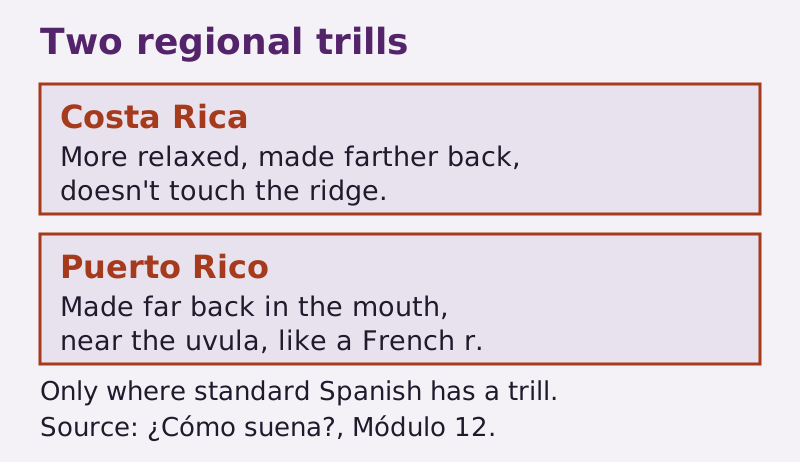
"Regional trills in Costa Rica and Puerto Rico" from Conversation Mile (https://conversationmile.com/pronunciation/how-to-roll-your-r/). CC BY 4.0 (creativecommons.org/licenses/by/4.0)
In Costa Rica, the book says, the trill can be more relaxed and made farther back than the ridge, without touching it, so it sounds more like a hiss than a trill. In Puerto Rico, it can be made far back in the mouth, near the uvula, much like a French r. If you'll talk mostly with people from one of those places, listen to how they do it. The book describes these as regional ways of speaking. It doesn't offer them as a learner's shortcut, and neither does this page.
How do you fit it into a day?
The r shares one job with the vowels and the letter names in your first two weeks. If you're following the Spanish starting plan, that job is its Sounds turn, and the plan splits it. The vowels and the r come first, and the alphabet rows come after them. In the vowels-and-r part, do the five vowels first, then the tap and the trill, about half the time each. That's about 1 minute on the r on a 5-minute day and 2 on a 10-minute day. Once the alphabet rows are done, after day 10, the whole Sounds turn goes to the vowels and the r. Don't add a separate schedule.
If you're not on the plan, use the minutes below. Count only the time you're saying things out loud, in Spoken Minutes.
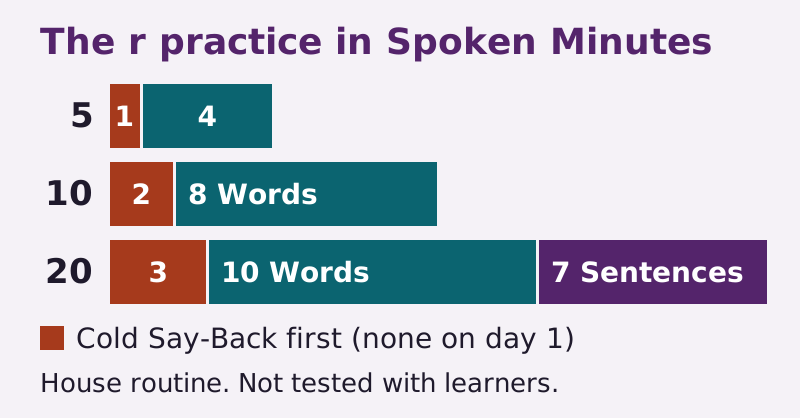
"How the r practice fills 5, 10 or 20 Spoken Minutes" from Conversation Mile (https://conversationmile.com/pronunciation/how-to-roll-your-r/). CC BY 4.0 (creativecommons.org/licenses/by/4.0)
On a 5-minute day, spend 1 minute on yesterday's Cold Say-Back and 4 on the steps and pairs. On a 10-minute day, it's 2 and 8. On a 20-minute day, it's 3, then 10 on words and pairs, and 7 on whole sentences. Day 1 has nothing to say back yet, so those minutes go to the words and pairs. The split is this site's House routine, untested with learners. Add the minutes to your Mile Log.
For the sentence part, use these two from ¿Cómo suena?. In the first, barrio, perro and rubio take the trill, quiero takes the tap, and caminar, with its r at the end, usually does too: Quiero caminar en el barrio con mi perro de pelo rubio. (I want to walk around the neighborhood with my blond-haired dog.) In the second, rota takes the trill, and pierna and dolor have their r at the end of a syllable, where the tap is usual: Mi pierna está rota y tengo mucho dolor. (My leg is broken and I'm in a lot of pain.)
Tomorrow, before you look at anything, do a Cold Say-Back: say pero and perro, then "I have three dogs" in Spanish. Then say which r each word needed, and check this page.
What this rests on
Checked against
- The tap and the trill, three touches for the trill by this book's count, pero and perro, ahora and ahorra Source 1
- The tongue tip at the ridge, a tense and flatter tongue, and an English r that doesn't touch Source 1
- Where each r goes, the choice at the end of a syllable, and the Costa Rica and Puerto Rico trills Source 1
- The tap close to the t in English Betty, tarde close to totter-they said fast, and the trill usually learned by careful imitation Source 2
- The meanings of caro, carro, coro and corro, where carro means a car, and the trill in subrayar Source 3
House routine
- The five steps for trying the trill, stopping when your tongue or jaw is tired, and sharing the Sounds turn with the vowels and the alphabet rows in the first two weeks, vowels and r first and the rows after, about half of the vowels-and-r time going to the r
- The 5, 10 and 20 Spoken Minute splits with the Cold Say-Back first, and day 1 with no Cold Say-Back and its minutes going to the words and pairs
Sources
- Escudero, Barreca and Carbone. ¿Cómo suena? Fonética y fonología del español, Módulo 12: Las consonantes vibrantes. SUNY Create OER, 2021 Open. Read: The whole module text, including the practice words and sentences; embedded videos not watched. License: CC BY 4.0.
- Stockwell, Bowen and Silva-Fuenzalida. Spanish Basic Course: Units 1-15, Unit 2, section 2.23 and its drills. Foreign Service Institute, U.S. Department of State, 1961 printing (first printed 1957) Open. Read: Section 2.23 and drills 2.23.1 to 2.23.3, from a scanned copy with some unreadable characters.
- Wiktionary contributors. Spanish entries for the words on this page. Wiktionary, as distributed by kaikki.org Open. Read: The pronunciation lines and senses of pero, perro, caro, carro, coro, corro, ahora, ahorra, tarde, rojo and subrayar (pronunciation and etymology), including the regional label on the car sense of carro.. License: CC BY-SA 4.0.
Sentence credits
- Tengo tres perros. Tatoeba sentence 509943 by Shishir; English by CK. CC BY 2.0 FR.
- Lo siento, llegué tarde. Tatoeba sentence 7304080 by ProfessorAntonnio; English by Bond21. CC BY 2.0 FR.
- Pásame el bolígrafo rojo. Tatoeba sentence 7276564 by arh; English by kaesekaiser. CC BY 2.0 FR.
- El perro ladra. Tatoeba sentence 1908647 by Shishir; English by Amastan. CC BY 2.0 FR.
- No tengo carro. Tatoeba sentence 8258428 by crispander; English by CK. CC BY 2.0 FR.
- Es caro. Tatoeba sentence 9443921 by ignacio; English by CK. CC BY 2.0 FR.
- ¡Pero qué enorme perro! Tatoeba sentence 1241416 by marcelostockle; English by fliegster. CC BY 2.0 FR.
- Quiero caminar en el barrio con mi perro de pelo rubio. ¿Cómo suena?, Módulo 12. CC BY 4.0.
- Mi pierna está rota y tengo mucho dolor. ¿Cómo suena?, Módulo 12. CC BY 4.0.
Next stops
Cite this page
How to Roll Your R: What Your Tongue Has to Do. Conversation Mile, 2026-11-10. https://conversationmile.com/pronunciation/how-to-roll-your-r/
Corrections
No corrections on this page. Spotted a language error? Please tell this site.