Speaking & Input Routines How-to
Comprehensible Input as a Daily Menu, Not a Theory
Straight answer
Comprehensible input, on this page, means listening or reading you can mostly follow. Here it's a menu, not a theory. You pick something, take it in, and then say three things about it out loud.
Start with the line you'll use most. Say it now in your language, twice, then look away and say it again: He entendido casi todo. in Spanish, J'ai presque tout compris. in French, or Ich habe fast alles verstanden! in German. All three mean "I understood almost everything."
This page doesn't go into the research on input. Every step and number here is a House routine, untested with learners.
How do you know you can mostly follow it?
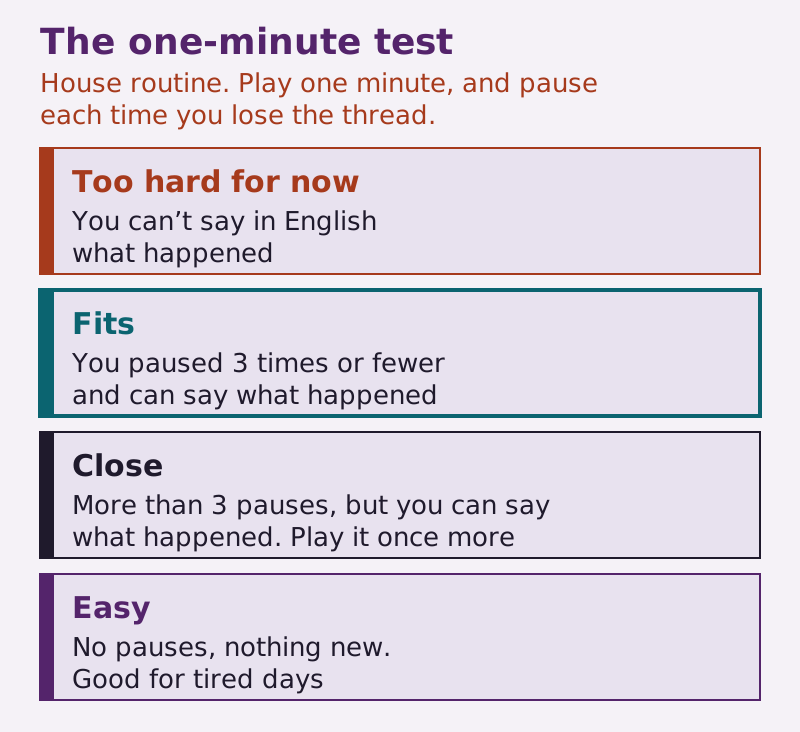
Run a one-minute test, with subtitles off. Play the first minute and pause each time you lose the thread. Then try to say, in English, what happened. That English summary is only for the test and stays off the timer.
"A one-minute test for input you can mostly follow" from Conversation Mile (https://conversationmile.com/routines/comprehensible-input/). CC BY 4.0 (creativecommons.org/licenses/by/4.0)
- Fits: you paused three times or fewer, and you can say what happened. Use it.
- Close: you paused more than three times, but you can still say what happened. Play the same minute once more and test again with the same line: three pauses or fewer, and you can say what happened. If it passes, it fits. If not, treat it as too hard for now.
- Too hard for now: you can't say what happened, however few times you paused. Try the changes at the end of this page, then test again with subtitles off. If you still can't, save it for a later month.
- Easy: you never paused and nothing was new. It still has a use, covered below.
The cutoff of three pauses is a House routine, not a measured line. You don't need every word. The question is whether you kept hold of what was going on.
Say you play a short clip of someone describing a trip to the market, and you pause twice: once at a list of vegetables, once at a joke you didn't get. You can still say in English that she went to the market, bought too much and walked home in the rain. That clip fits, even with a missed joke and a few unknown vegetables.
For reading, do the same with one paragraph. Mark each spot where you lost the thread, then say what the paragraph was about.
What goes on the menu?
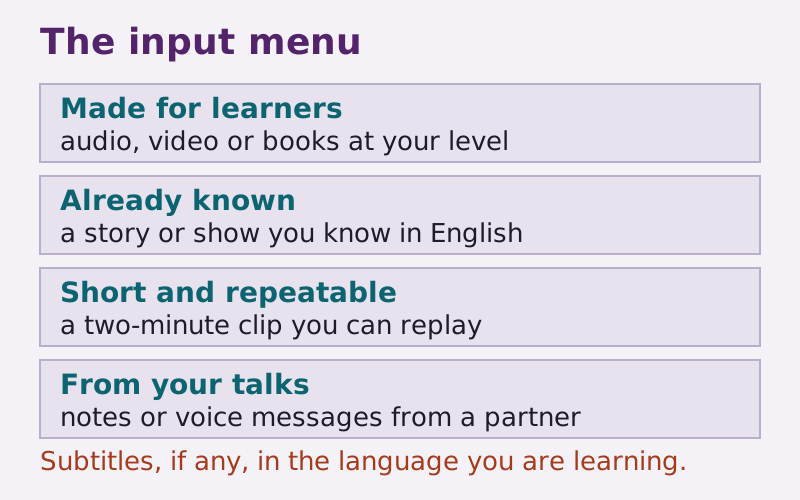
Anything that passes the test. This site starts with these four kinds (House routine). It isn't a ranking.
"Four kinds of input to choose from" from Conversation Mile (https://conversationmile.com/routines/comprehensible-input/). CC BY 4.0 (creativecommons.org/licenses/by/4.0)
- Made for learners. Audio, video or short books written for people at your stage. Run the one-minute test anyway, since a label like "beginner" can mean anything.
- Something you already know. A story or a show you've seen in English. You already know what happens, so you can listen for the words. That also makes the test easy to pass, so for this kind, check too that you can repeat one line you just heard. If you can't, treat it as too hard.
- Short and repeatable. A clip of about two minutes you can play several times. Long material is fine once short clips feel easy.
- From your own talks. A voice message or a note from a tutor or exchange partner, about things you actually discussed. The tutor agenda has a slot for asking for one.
Keep subtitles off for the one-minute test. After it passes, you can set them to the language you're learning, not to English. You're there to match the sound to the words.
If a clip comes with a transcript, listen first and read it after, then listen once more. Reading first turns the test into a reading test, and the listening can seem easier than it is. This page doesn't rank apps, channels or courses, and the menu works with whatever you can find for free.
How do you turn input into speaking?
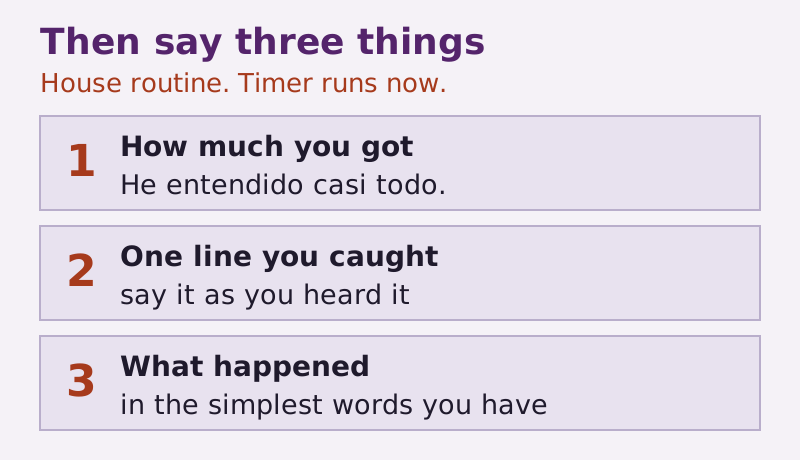
Stop after each clip or page and say three things out loud. The timer was off while you listened. It runs again now.
"Three things to say after a clip" from Conversation Mile (https://conversationmile.com/routines/comprehensible-input/). CC BY 4.0 (creativecommons.org/licenses/by/4.0)
- How much you got. Say the line from the top of this page when you got almost all of it. If parts got away from you, skip to the next two. If the clip lost you, it didn't pass the test, so go back to the menu.
- One line you caught. Say a phrase you heard, as close to how you heard it as you can. If it's worth keeping, mine it, but only after you've matched it to a transcript, subtitles, or a line a tutor or partner wrote down for you. Your own transcription doesn't count. Until then it doesn't go on your daily list or a card.
- What happened. Who did what, in the simplest words you have in the language you're learning. Say all three in that language. If you slip into English, the timer stops until you're back. Short and plain is fine. If you don't know a word, say it another way and note the gap.
The third one will have mistakes, and that's expected. You're describing, not copying a model sentence, so don't turn it into a card until a person has checked it. Write down the gaps after the timer stops. Look up single words, and ask a tutor or partner to check any sentence you want to keep.
How much time does it take?
Input and speaking sit on different clocks. Listening and reading on their own never count as Spoken Minutes. Only what you say in the language you're learning counts, and the shadowing page has the full rules for the timer. Take in as much as you like.
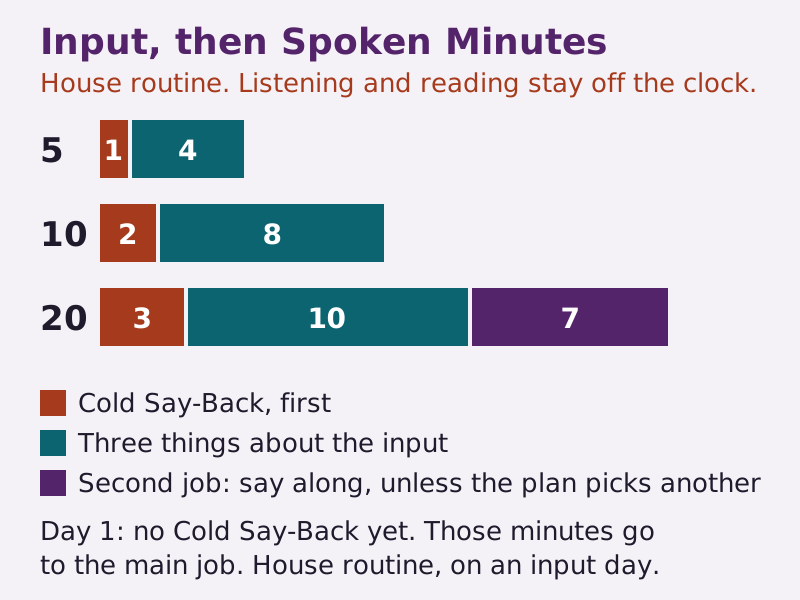
On a day when input is your job in the plan, split the Spoken Minutes this way, as a House routine:
"How input fits 5, 10 or 20 Spoken Minutes" from Conversation Mile (https://conversationmile.com/routines/comprehensible-input/). CC BY 4.0 (creativecommons.org/licenses/by/4.0)
| Daily amount | Cold Say-Back, first | Three things about the input | Second job (saying along, unless the plan picks another) |
|---|---|---|---|
| 5 | 1 | 4 | None |
| 10 | 2 | 8 | None |
| 20 | 3 | 10 | 7 |
The day opens with a Cold Say-Back: say something from an earlier day without looking, then check it. On day 1 there's nothing to say back yet, so those minutes go to the main job. A round of three things can be short, so take a second clip, or play the same one again and say three new things. On 20, pick a few seconds from the clip and say it along with the speaker, unless the plan gives that day a different second job.
In the 90-day plan, this is the main new work from day 46 on. You can start sooner if you like.
Log the minutes in the Mile Log, not the listening time. A long podcast with nothing said afterward adds nothing to the log. That's on purpose: the log records speaking.
What if it's too hard or too easy?
Change the input before you give up on it. These moves are a House routine too.
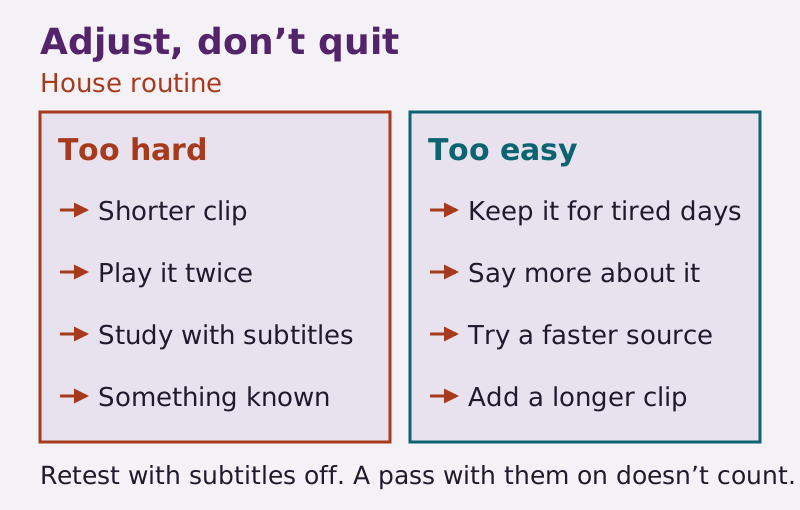
"What to change when input is too hard or too easy" from Conversation Mile (https://conversationmile.com/routines/comprehensible-input/). CC BY 4.0 (creativecommons.org/licenses/by/4.0)
| Too hard | Too easy |
|---|---|
| Cut it to a shorter clip | Keep it for tired days |
| Play it twice before you test | Say five things instead of three |
| Study it with subtitles in the language, then retest with them off | Try a faster source on the same topic |
| Switch to a story you already know | Move up to longer clips |
Every retest runs with subtitles off. A pass with them on doesn't count.
Easy input is not wasted. On a tired day, it's the material that still gets you talking. If nothing you can find passes the test, use speaking practice alone for a few days and test again later.
Tomorrow, before you open anything, do a Cold Say-Back: say the line for "I understood almost everything" in your language, from memory. Then check it against this page.
What this rests on
Checked against
- The three sentences for saying how much you understood Source 1
House routine
- What comprehensible input means on this page: listening or reading you can mostly follow
- The one-minute test, its cutoff of three pauses, and playing a close minute once more
- Starting with the four kinds of input on the menu, subtitles in the language you're learning, and reading a transcript after listening
- Saying three things after each piece of input, with the timer off while you listen or read, and having a person check a sentence before it becomes a card
- The 5, 10 and 20 Spoken Minute splits with the Cold Say-Back first
- What to change when input is too hard or too easy
- Running every one-minute test and retest with subtitles off, saying all three things in the language you're learning, and treating known stories as too hard if you can't repeat a line
Sources
- Tatoeba. Sentence collection, downloaded exports. Tatoeba Open. Read: The three sentences on this page and their linked English read one by one. Authors are credited under Sentence credits.. License: CC BY 2.0 FR.
Sentence credits
- He entendido casi todo. Tatoeba sentence 6688541 by arh; English by CK. CC BY 2.0 FR.
- J'ai presque tout compris. Tatoeba sentence 4686101 by sacredceltic; English by CK. CC BY 2.0 FR.
- Ich habe fast alles verstanden! Tatoeba sentence 1422877 by enteka; English by CK. CC BY 2.0 FR.
Next stops
Cite this page
Comprehensible Input as a Daily Menu, Not a Theory. Conversation Mile, 2026-11-10. https://conversationmile.com/routines/comprehensible-input/
Corrections
No corrections on this page. Spotted a language error? Please tell this site.