Speaking & Input Routines How-to
Shadowing Technique: Speak Along With Ten Seconds of Audio
Straight answer
Shadowing means saying a short clip out loud along with the speaker, a step behind them. Try the idea now, with no audio at all. Read one of these lines aloud twice, then look away and say it once: Repite después de mí. in Spanish, Répète après moi. in French, or Sprich mir nach! in German. All three mean "Repeat after me." Shadowing does the same job, except the voice you follow comes from a recording. This page also sets out the Spoken Minute, the unit this site uses to count speaking time.
What is shadowing?
You play a recording and speak with it, a moment behind, copying the words, the speed and the tune of the voice as closely as you can. You don't wait for the speaker to finish a sentence, the way you would in listen and repeat. Your voice overlaps theirs.
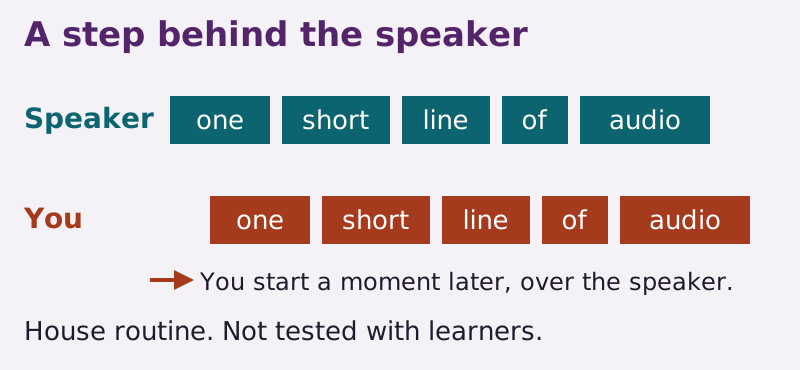
"Shadowing: speaking along with a recording, a moment behind" from Conversation Mile (https://conversationmile.com/routines/shadowing/). CC BY 4.0 (creativecommons.org/licenses/by/4.0)
A 2025 article by Daniela Feistritzer says the method was first used in attention research and speech therapy, and later in interpreter training, where people practice listening and speaking at the same time. That article also looks at research on how well it works. This page doesn't. It only lays out one way to fit shadowing into your day.
This site's version uses very short clips, about ten seconds long, or one or two sentences. A short clip lets you play it many times in a few minutes. That length is a House routine, chosen by this site and not tested with learners.
How do Spoken Minutes count?
These are the full rules. Every other page on this site points here.
- The timer runs only while you make sounds in the language. Shadowing, reading aloud, talking to yourself and answering a recording all count.
- The timer stops while you listen, watch, read, tap through an app or look something up.
- A conversation counts half for its whole length, since about half of it is listening. In a language exchange, only the half in your new language counts, and that half counts half.
- It's an estimate. You don't need to time it to the second.
- The count shows that you did the work. It doesn't show your level, and no number of minutes stands for a level.
Twenty Spoken Minutes make one mile. The Mile Log adds them up for you. Both units are this site's own.
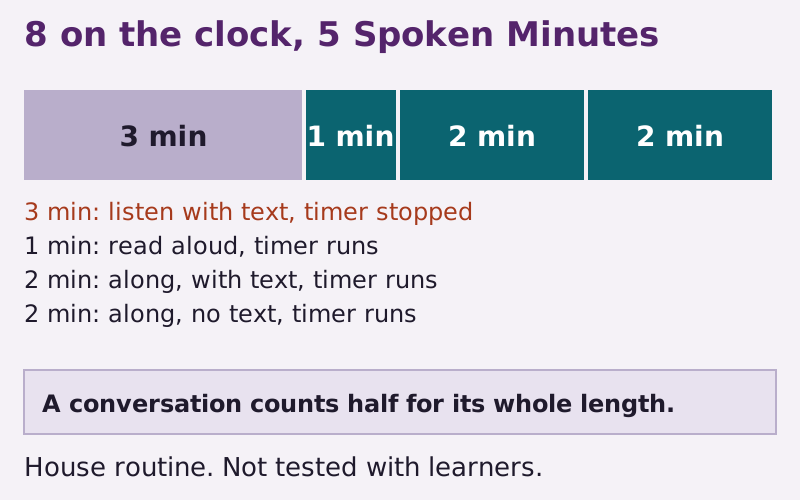
"Which minutes of a shadowing session count as Spoken Minutes" from Conversation Mile (https://conversationmile.com/routines/shadowing/). CC BY 4.0 (creativecommons.org/licenses/by/4.0)
Say you spend 3 minutes listening to a clip with its text, then 5 minutes saying it. That's 5 Spoken Minutes, even though 8 went by on the clock. The listening still matters. It just isn't what this count records. For practice with no recording at all, see speaking practice alone.
What audio should you use?
This site has no recordings of its own sentences, so the audio comes from you. Textbook audio, a podcast made for learners or a short video with subtitles in the language can all work. Before you pick one, check four things.
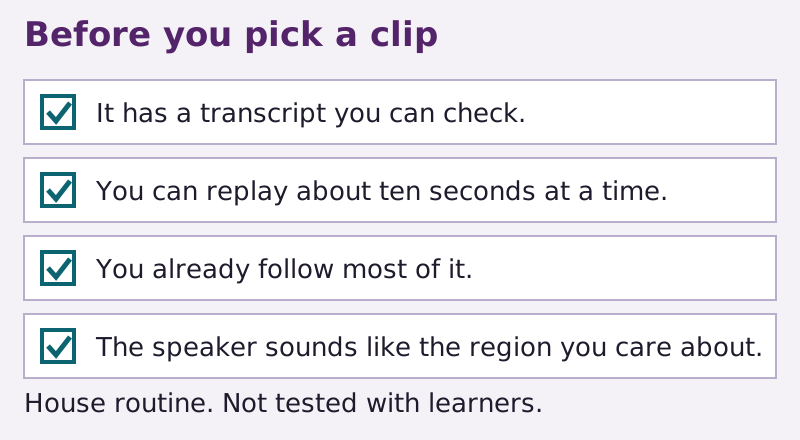
"Four things to look for in a shadowing clip" from Conversation Mile (https://conversationmile.com/routines/shadowing/). CC BY 4.0 (creativecommons.org/licenses/by/4.0)
- A transcript. You need to see what's said, or you'll copy sounds you can't check. The text has to match the audio word for word. If it doesn't, pick another clip.
- Easy replay. You'll play the same ten seconds many times.
- Mostly familiar. If half the words are new, you're decoding, not shadowing. The input menu helps you find the right level.
- The right region. Accents differ from place to place. The Spanish pronunciation page lists some of the differences you'll hear in Spanish. For French and German, this site's pages describe the standard language, so a speaker of the standard is the safe choice unless you already have a region in mind.
If you can't find audio today, read a text aloud instead. That still counts as Spoken Minutes, but it isn't shadowing.
How do you shadow one clip?
Take one clip of about ten seconds and work through five steps.
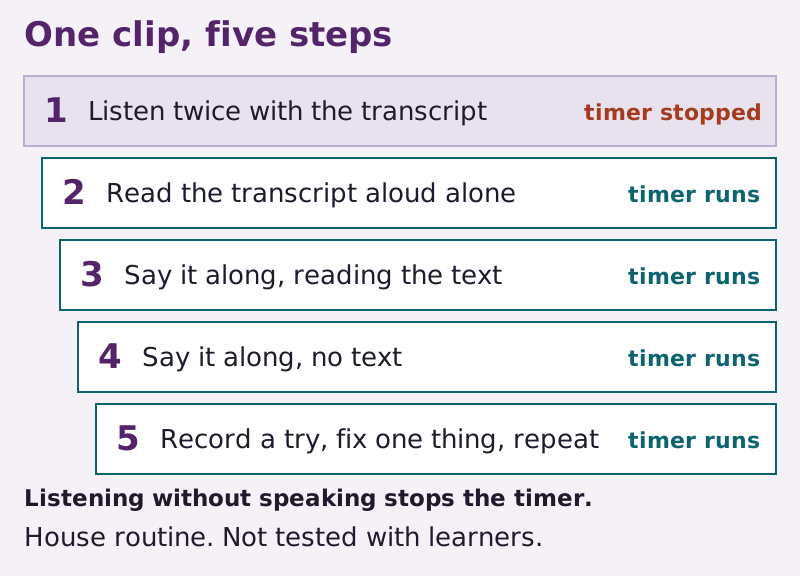
"The five steps for shadowing one clip" from Conversation Mile (https://conversationmile.com/routines/shadowing/). CC BY 4.0 (creativecommons.org/licenses/by/4.0)
- Listen twice with the transcript. Don't speak yet. The timer is off.
- Read the transcript aloud on your own, slowly, until no word trips you.
- Play the clip and say it along with the speaker, reading the text. Mumbling is fine the first few times.
- Play it again and say it along with no text. Keep your eyes off the page.
- Record one try and play it right after the original. Pick one thing that differs, such as a vowel or the place where the voice goes up, and run the clip again. The timer stops while you only listen, to the clip or to your recording.
For step 5, one sound at a time is plenty. If the difference is a single sound, the minimal pairs tool may have a pair for it.
Move to a new clip once you can say this one along with the speaker, without the text and without falling behind.
How does shadowing fit a 5, 10 or 20 minute day?
Use the same splits as the rest of this site. Each day opens with a Cold Say-Back: you say something from at least a night ago, with nothing in front of you, and only then check it.
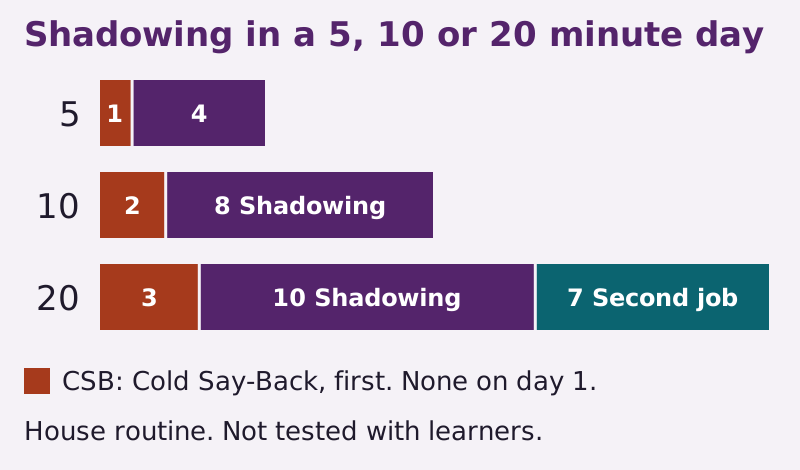
"How shadowing fits a 5, 10 or 20 Spoken Minute day" from Conversation Mile (https://conversationmile.com/routines/shadowing/). CC BY 4.0 (creativecommons.org/licenses/by/4.0)
| Daily amount | Cold Say-Back, first | Shadowing | Second job |
|---|---|---|---|
| 5 | 1 | 4 | None |
| 10 | 2 | 8 | None |
| 20 | 3 | 10 | 7 |
On day 1 there's nothing to test yet, so those minutes go to shadowing. The listening in step 1 sits outside the timer, so a 5-minute day takes longer than 5 minutes on the clock.
In the 90-day plan, short audio clips are one of three jobs that take turns on days 15 to 45. On a 20-minute day, the second job can be sentence cards or a run through old cards.
What if you can't keep up?
Falling behind is normal with a new clip. Make the job smaller instead of going silent.
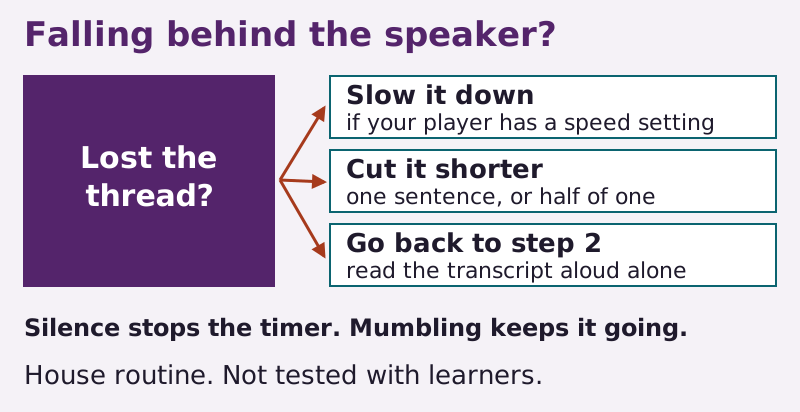
"What to do when you fall behind the speaker" from Conversation Mile (https://conversationmile.com/routines/shadowing/). CC BY 4.0 (creativecommons.org/licenses/by/4.0)
- Slow it down if your player has a speed setting.
- Cut it shorter. One sentence is enough, or half of one.
- Go back to step 2 and read the transcript aloud alone until it's smooth.
Mumbling along still counts. If you've gone quiet and you're only listening, stop the timer until you speak again.
You can also run one clip as a warm-up before a language exchange.
Tomorrow, before you press play, do a Cold Say-Back: say the first line of today's clip from memory. Then play the clip and check it.
What this rests on
Checked against
House routine
- What counts as a Spoken Minute, conversations counting half, only your own half of a language exchange counting, and 20 Spoken Minutes as 1 mile
- Clips of about ten seconds, the four things to look for in a clip, and a transcript that matches the audio word for word
- The five steps for one clip, and moving on once you can say it along without the text and without falling behind
- The 5, 10 and 20 Spoken Minute days, with the Cold Say-Back first
- Slowing the clip, cutting it shorter or going back to reading it aloud when you fall behind
Sources
- Feistritzer, Daniela. "Shadowing as a Language Learning Method: Theory, Research, and Practical Applications." Nordic Journal of Language Teaching and Learning 13, no. 2 (2025) Open. Read: The article page and its abstract. License: CC BY-NC 4.0.
- Tatoeba. Sentence collection, downloaded exports. Tatoeba Open. Read: The three sentences on this page and their linked English, read one by one. Authors are credited under Sentence credits.. License: CC BY 2.0 FR.
Sentence credits
- Repite después de mí. Tatoeba sentence 1715770 by marcelostockle; English by CK. CC BY 2.0 FR.
- Répète après moi. Tatoeba sentence 5389939 by pititnatole; English by CK. CC BY 2.0 FR.
- Sprich mir nach! Tatoeba sentence 642981 by Manfredo; English by CK. CC BY 2.0 FR.
Next stops
Cite this page
Shadowing Technique: Speak Along With Ten Seconds of Audio. Conversation Mile, 2026-11-10. https://conversationmile.com/routines/shadowing/
Corrections
No corrections on this page. Spotted a language error? Please tell this site.