Speaking & Input Routines How-to
Speaking Practice Alone When Nobody Is Listening
Straight answer
You can practice speaking with nobody around by saying, out loud, what you're doing right now. Start with something small. If you're making tea, say it: Estoy preparando té. in Spanish, Je prépare le thé. in French, or Ich mache Tee. in German. Each one means "I'm making tea." Say it once while looking, then once without. This page gives four more ways to talk alone and one way to check yourself without a listener.
What counts as speaking practice alone?
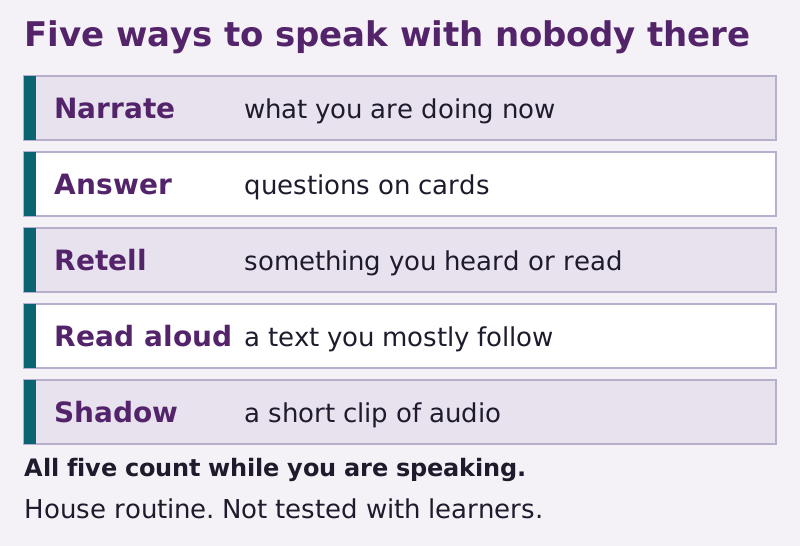
Anything you say out loud in the language. Five ways work with no one else around.
"Five ways to practice speaking alone" from Conversation Mile (https://conversationmile.com/routines/speaking-practice-alone/). CC BY 4.0 (creativecommons.org/licenses/by/4.0)
- Narrate what you're doing as you do it.
- Answer questions written on cards.
- Retell something you heard or read, in your own words.
- Read aloud from a text you mostly follow.
- Shadow a short clip, saying it along with the speaker. The shadowing page has the steps.
All five count as Spoken Minutes, the unit this site uses for time spent speaking. The timer runs only while you're making sounds in the language. The shadowing page has the full rules, and the Mile Log keeps the total.
Retelling needs something to retell. A podcast episode or a short article you mostly understood works well, and the input menu helps you pick one. Listen or read once, close it, and say the main points in three sentences. Then open it again and see what you left out.
The listening and reading sit outside the timer. Only the retelling counts. Don't drill a retelling. If you want to keep one of its lines, check it first, the way the next section describes.
Reading aloud is the easiest of the five to start, because the words are already there. Read a paragraph slowly once, then again at a normal pace. If you stumble, go back to the start of that sentence rather than the start of the paragraph. When a paragraph goes smoothly twice, look up from the page and say its last sentence without reading it.
How do you narrate what you're doing?
Keep the sentences short, and keep going. Say what you're doing, then what you'll do next. Here's a second line to try, for when you sit down: Estoy leyendo un libro., Je lis un livre. or Ich lese ein Buch., all meaning "I'm reading a book."
"What to do when a word is missing while you narrate" from Conversation Mile (https://conversationmile.com/routines/speaking-practice-alone/). CC BY 4.0 (creativecommons.org/licenses/by/4.0)
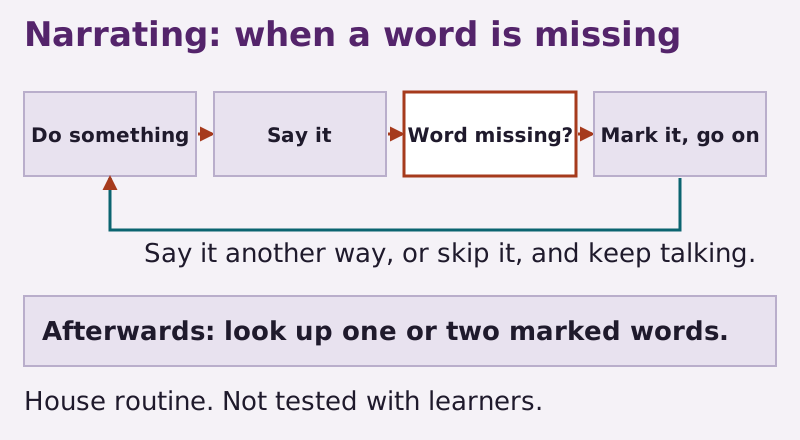
You'll hit words you don't have. Don't stop to look them up. Make a tick on a piece of paper, say it another way or skip it, and keep talking. When you're done, look up one or two of the words you marked, not all of them.
A sentence you build yourself can be wrong, and you don't want to repeat a wrong one every day. Before a new line of your own goes into daily use, check it. A dictionary entry with an example, a sentence from sentence mining or your tutor can all do that. The lines on this page come from Tatoeba, an open sentence collection, and each has a number you can look up there.
How do you answer questions when nobody asks?
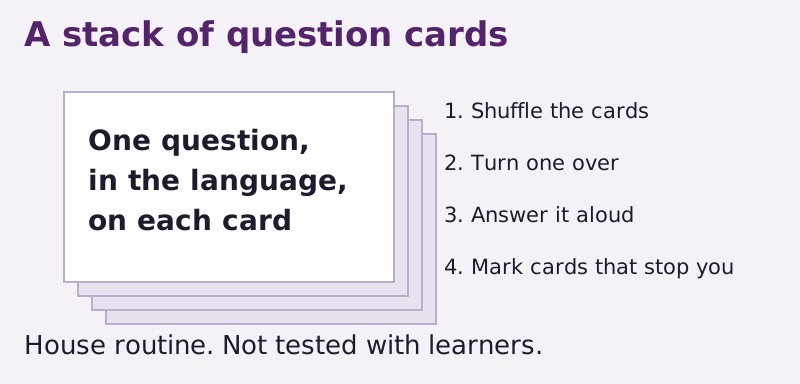
Write the questions yourself, on cards, in the language. Take them from your textbook, from a lesson or from a list your tutor gives you.
"Answering question cards aloud" from Conversation Mile (https://conversationmile.com/routines/speaking-practice-alone/). CC BY 4.0 (creativecommons.org/licenses/by/4.0)
Shuffle the stack and turn one card over. Answer it aloud in two or three sentences, then turn the next. If a card stops you, mark it. That card is now a small job for your next session, or a question to take to a tutor lesson.
Keep the stack small, around ten cards, and add a new card only when an old one stops being hard.
Start with questions about your own life, such as your work, your town and your weekend. You'll need those answers again in your first real conversation. Your answers are sentences you built, so check each one before you practice it often or take it to that conversation. A card that gets easy means you can say the answer. It doesn't mean the answer is right.
How do you check yourself without a listener?
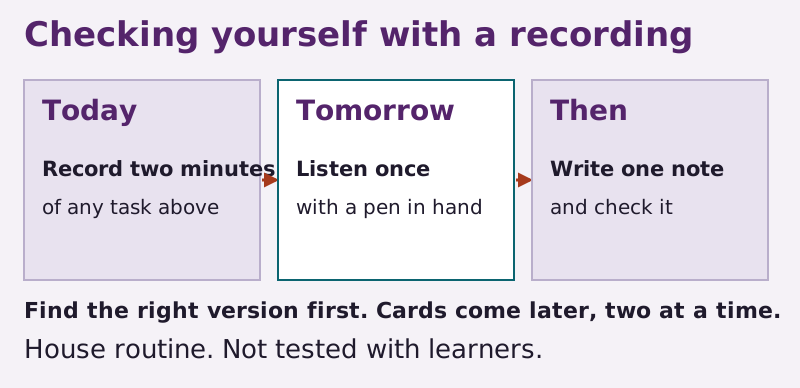
Record yourself. You don't need to listen the same day.
"Checking your own speaking with a recording" from Conversation Mile (https://conversationmile.com/routines/speaking-practice-alone/). CC BY 4.0 (creativecommons.org/licenses/by/4.0)
Pick any task above and record two minutes. The next day, listen once with a pen in hand. Write down one thing only: a word you searched for, a sentence you started three times, or a sound that came out wrong.
Then find the right version, in a dictionary example or from your tutor, and add it to a list. If you can't find it, leave it off. If the note is about a sound, take it to the minimal pairs tool or step 5 of shadowing instead.
On a day your plan has you write cards, take two lines from that list. The Anki page shows how to set them up.
One note a day is enough.
How much should you do each day?
Use the same splits as the rest of this site. Each day starts with a Cold Say-Back: say something from at least a night ago, with nothing in front of you, then check it.
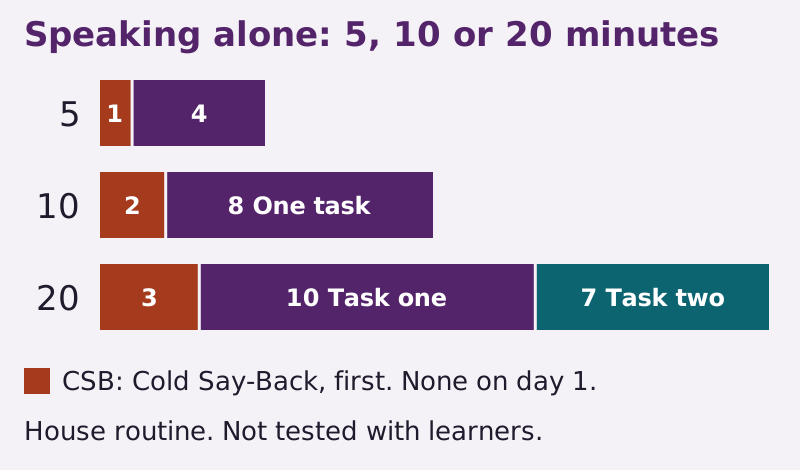
"How speaking alone fits a 5, 10 or 20 Spoken Minute day" from Conversation Mile (https://conversationmile.com/routines/speaking-practice-alone/). CC BY 4.0 (creativecommons.org/licenses/by/4.0)
| Daily amount | Cold Say-Back, first | First task | Second task |
|---|---|---|---|
| 5 | 1 | 4 | None |
| 10 | 2 | 8 | None |
| 20 | 3 | 10 | 7 |
Pick one task from the five for the main block. On a 20-minute day, a second task fills the last 7 minutes. On day 1 there's nothing to test yet, so the Cold Say-Back minutes go to the first task.
Practicing alone is also the fallback in the 90-day plan. If you can't find anyone by day 30, the first conversation day, practice alone that day and keep looking for a language exchange partner or a tutor.
Where can you talk out loud?
Anywhere you don't feel watched. Pick the place before you pick the task.
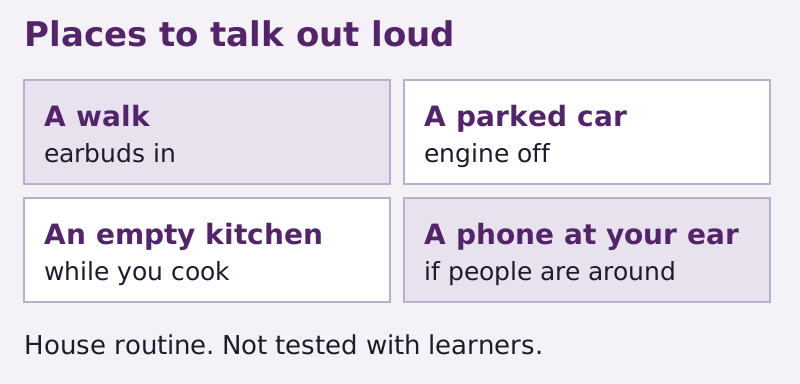
"Places to practice speaking out loud" from Conversation Mile (https://conversationmile.com/routines/speaking-practice-alone/). CC BY 4.0 (creativecommons.org/licenses/by/4.0)
A walk works, with earbuds in. So does a parked car, or a kitchen while you cook, which hands you plenty to narrate. If other people are around, hold your phone to your ear, so it looks like a call.
Short stretches add up too. Three minutes of narrating while the kettle boils still go in your log, and the split above can come in two or three pieces across the day, as long as the Cold Say-Back comes first.
Tomorrow, before anything else, do a Cold Say-Back: say the tea line and the book line from memory. Then check both against this page.
What this rests on
Checked against
- The lines for making tea and reading a book Source 1
House routine
- The five ways to speak alone, and all of them counting as Spoken Minutes while you speak
- Marking a missing word and talking around it, then looking up one or two words afterwards
- Checking a new sentence of your own, including card answers and retold lines, before you say it often
- Question cards, about ten at a time, answered aloud in random order
- Retelling in three sentences, and reading a paragraph aloud twice before saying its last sentence from memory
- Splitting the day's minutes into two or three pieces, with the Cold Say-Back first
- Recording two minutes, listening the next day, checking one note and keeping it for a day when you write cards
- The 5, 10 and 20 Spoken Minute days, with the Cold Say-Back first
- Practicing alone on day 30 if no partner is found
Sources
- Tatoeba. Sentence collection, downloaded exports. Tatoeba Open. Read: The six sentences on this page and their linked English, read one by one. Authors are credited under Sentence credits.. License: CC BY 2.0 FR.
Sentence credits
- Estoy preparando té. Tatoeba sentence 2269736 by marcelostockle; English by CK. CC BY 2.0 FR.
- Je prépare le thé. Tatoeba sentence 2269510 by MartinShadock; English by CK. CC BY 2.0 FR.
- Ich mache Tee. Tatoeba sentence 11526442 by Pfirsichbaeumchen; English by CK. CC BY 2.0 FR.
- Estoy leyendo un libro. Tatoeba sentence 801656 by Espi; English by CK. CC BY 2.0 FR.
- Je lis un livre. Tatoeba sentence 2818955 by bleton; English by CK. CC BY 2.0 FR.
- Ich lese ein Buch. Tatoeba sentence 3098226 by Valodnieks; English by CK. CC BY 2.0 FR.
Next stops
Cite this page
Speaking Practice Alone When Nobody Is Listening. Conversation Mile, 2026-11-10. https://conversationmile.com/routines/speaking-practice-alone/
Corrections
No corrections on this page. Spotted a language error? Please tell this site.