Words That Stick How-to
Sentence Mining: Keep the Sentence, Not the Word
Straight answer
Sentence mining means saving the whole sentence a new word came in, not the word alone. Then you say that sentence out loud until it comes easily. Try one now, in the language you're learning: Tengo dieciocho años. (I am eighteen years old.) in Spanish, J'ai soif. (I'm thirsty.) in French, or Ich warte auf das Frühstück. (I'm waiting for breakfast.) in German. Say yours twice, then look away and say it once more.
Each one shows something a word list wouldn't: Spanish says an age with tener, French says thirst with avoir, and German puts auf after warten. There's no open textbook definition of the method to point to, so everything on this page about how to do it is a House routine, untested with learners.
What does a sentence keep that a word drops?
The words around it. A word list gives you one word and one English gloss. A sentence also shows which verb goes with it, which small word follows it, and how it sounds in a real line.
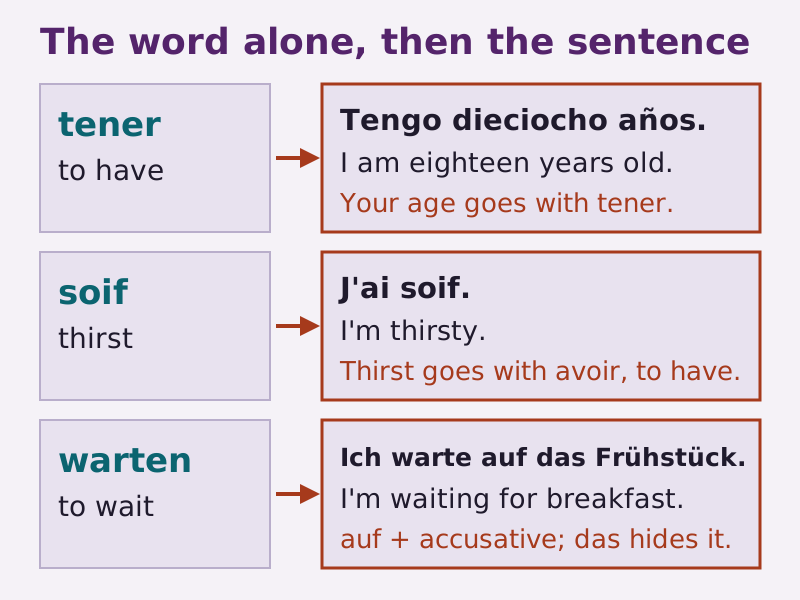
"What a sentence keeps that a single word drops" from Conversation Mile (https://conversationmile.com/vocabulary/sentence-mining/). CC BY 4.0 (creativecommons.org/licenses/by/4.0)
Look at three cases. Wiktionary lists each of these uses.
| Word alone | In a sentence | What the sentence adds |
|---|---|---|
| Spanish tener, to have | Tengo dieciocho años. I am eighteen years old. | Your age goes with tener. |
| French soif, thirst | J'ai soif. I'm thirsty. | Thirst goes with avoir, to have. |
| German warten, to wait | Ich warte auf das Frühstück. I'm waiting for breakfast. | "Waiting for" takes auf with the accusative. You can't see that in das Frühstück, so leave the sentence as it is. |
In each one, the word you'd look up is the easy part. What you need in order to say it sits next to it, and the sentence hands it to you ready to say.
When you save one of these, underline the part that was new to you, so you know what the sentence is there to teach. Say the line in your language aloud again, and point at the word that would trip you up: tengo, j'ai or auf. Say it exactly as printed. Don't swap in your own age or a different breakfast: a new number or noun can change other words in the line, and the section on which sentences to keep says what to do instead.
Where do the sentences come from?
From three places. All of them are things you're already doing, or can start today.
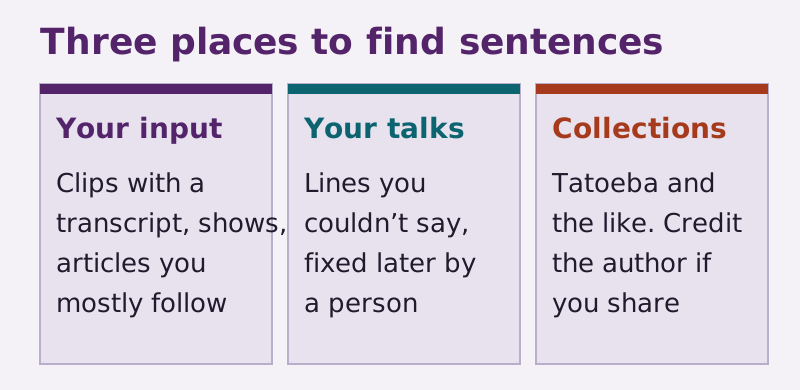
"Where mined sentences come from" from Conversation Mile (https://conversationmile.com/vocabulary/sentence-mining/). CC BY 4.0 (creativecommons.org/licenses/by/4.0)
- Your own input. When a clip or an article you can mostly follow has a line with one new thing in it, copy the line from the text: the article itself, a transcript, or subtitles in the language you're learning. Don't copy a line by ear. If there's no text to copy from, ask someone to write the line down for you before you keep it. The input menu covers how to pick that material.
- Your conversations. Keep paper nearby during a talk with a tutor or partner. Write down what you wanted to say and couldn't. Afterward, ask the person you talked to, or a tutor, to write the right version down for you. A dictionary can give you a missing word, but it can't check a whole sentence you put together yourself. The tutor agenda leaves room in each lesson to ask.
- Open sentence collections. Tatoeba is a free collection of sentences with translations, added by its members. Most examples on this site come from it, with each author credited. Start from common words, such as the ones in the first 1,000 words, and search for short sentences that use them.
If you plan to share Tatoeba sentences, read the license first. Its terms say text sentences are under CC BY 2.0 FR by default, and the one condition is that you name the author. Some sentences are also under CC0. A translation is a separate sentence with its own author, and the downloads list a name for each one. Recordings work differently. Each recorder picks a license, and the downloads page says a recording with a blank license field can't be used outside Tatoeba. When you pass a sentence on, the terms make carrying the license and the author's name your job.
Which sentences are worth keeping?
Fewer than you'd think. A pile of hard sentences is just a word list with extra steps. Before you save one, run five questions. This check is a House routine.
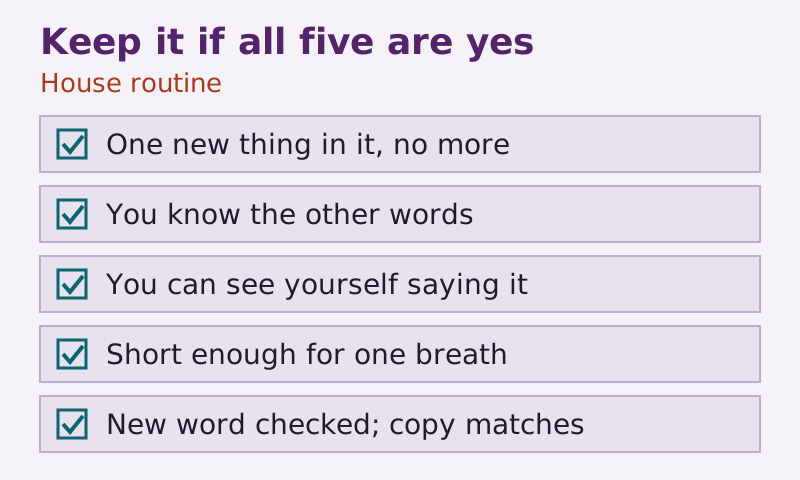
"Five questions before you keep a sentence" from Conversation Mile (https://conversationmile.com/vocabulary/sentence-mining/). CC BY 4.0 (creativecommons.org/licenses/by/4.0)
- Does it have one new thing in it, and no more? A new word, or a known word used a new way. Two new things make it hard to tell what you're practicing.
- Do you know every other word? If not, it belongs to a later week.
- Can you see yourself saying it? Lines about your own day beat lines from a crime drama.
- Is it short enough for one breath? About a dozen words or fewer is this site's limit.
- Did you check the new word, and does your copy match? Tatoeba's sentences come from its members, and any source can have a slip. Look up the new word and confirm the sentence uses it the way you think. Then compare your copy with where it came from, word for word.
If any answer is no, skip that line. You'll meet the word again in a better one.
Keep the sentence exactly as you found it. It's tempting to swap in your own age or your own breakfast, but one changed word can force changes elsewhere in the line, such as a different word form or article, and the page or person you took it from hasn't checked your version. If you want a version about yourself, ask a tutor or a partner to write it down for you, then copy their line.
On a day when card writing comes around, keep two new sentences, the same count the 90-day plan uses for sentence cards. On 5 or 10 Spoken Minutes, that's about every third day. That number is a House routine.
You can mine more on a weekend. Keep the extras on paper, and move at most two onto cards on each card-writing day, so new cards don't pile up (see the Anki page).
What do you do with a sentence once you keep it?
Put it on a card, then say it. Writing the card sits outside the timer, and only saying it out loud counts.
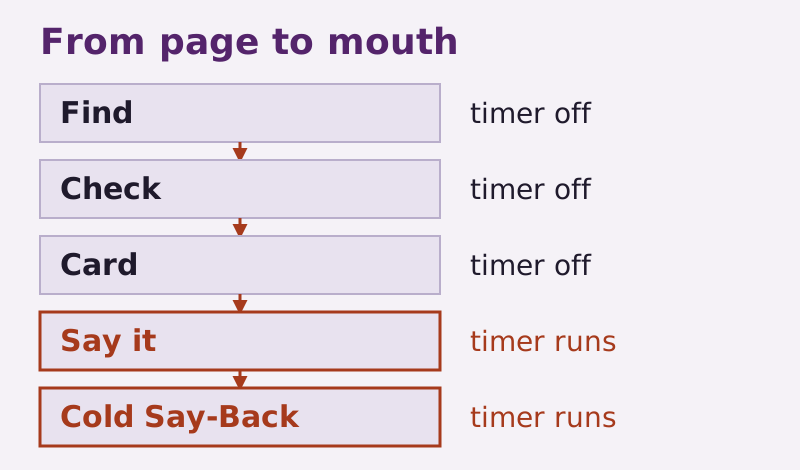
"Which steps of sentence mining count as Spoken Minutes" from Conversation Mile (https://conversationmile.com/vocabulary/sentence-mining/). CC BY 4.0 (creativecommons.org/licenses/by/4.0)
The Anki page shows how to set up a sentence card. You don't need that app, and a paper card works too.
Saying the sentence is where your time goes. The timer runs only while you speak, and the shadowing page has the full rules for counting Spoken Minutes. Read the line once, look away, and say the whole thing. Then say it again without the card. If the sentence came from audio, play that part and say it along with the speaker.
The next morning, test it with a Cold Say-Back: say it from memory before you look, then check. That page explains when a sentence can leave your daily list.
How does mining fit into a day?
Finding sentences happens whenever you read or listen. On a day when sentences are your job in the 90-day plan, saying them fills your Spoken Minutes, split this way, as a House routine:
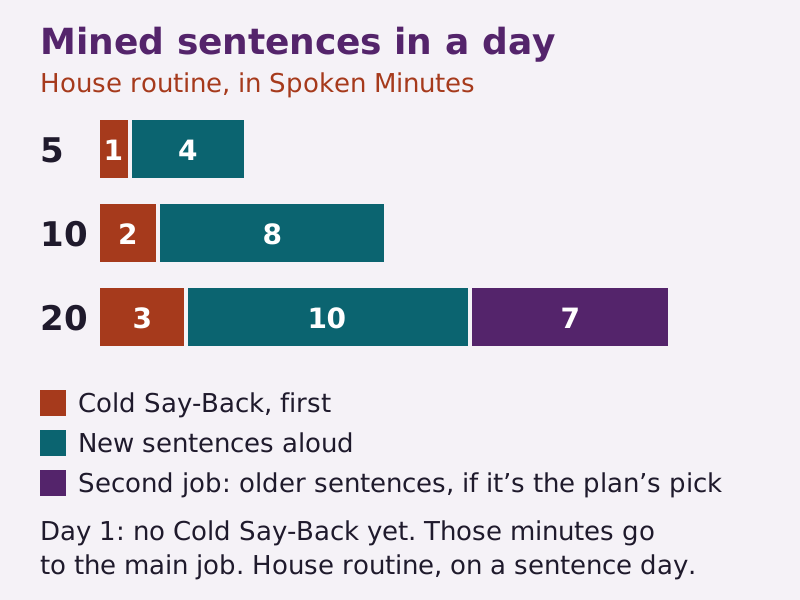
"How mined sentences fill 5, 10 or 20 Spoken Minutes" from Conversation Mile (https://conversationmile.com/vocabulary/sentence-mining/). CC BY 4.0 (creativecommons.org/licenses/by/4.0)
| Daily amount | Cold Say-Back, first | New sentences aloud | Second job (older sentences if the plan picks them) |
|---|---|---|---|
| 5 | 1 | 4 | None |
| 10 | 2 | 8 | None |
| 20 | 3 | 10 | 7 |
On day 1 there's nothing to say back yet, so those minutes go to new sentences. The 7 minutes on 20 go to older sentences only when they're the day's other job in the plan. Otherwise, do that other job.
Two sentences won't fill four minutes on one pass. Go around them again: say each one, look away, say it again, and then say both in a row.
Log the minutes in the Mile Log. Twenty Spoken Minutes make one mile, and a mile is a record of what you did, not a level.
Tomorrow, before you open anything, do a Cold Say-Back on the line you said at the top of this page, in your language. If you kept a sentence today, test that one too. Then check.
What this rests on
Checked against
- Tener used for age, avoir soif for being thirsty, and warten taking auf with the accusative Source 1
- Tatoeba sentences under CC BY 2.0 FR by default with the author's name as the one condition, some under CC0, audio under each recorder's own terms, and the reuser carrying the license and name Source 2
- All example sentences Source 3
House routine
- What sentence mining means on this site, the three places to look, and the five questions before keeping a sentence
- Practicing only the line in your language, keeping a found sentence unchanged, getting any fixed or personal line written down by a person, copying lines from a transcript or subtitles rather than by ear, getting conversation lines fixed by a person, underlining the new part, and asking a person for a version about yourself
- One breath, about a dozen words or fewer, as the length limit, checking the new word in a dictionary, and checking the copy word for word against where it came from
- Two new sentences on a day when card writing comes around, and going around them again to fill the minutes
- The 5, 10 and 20 Spoken Minute splits with the Cold Say-Back first
Sources
- Wiktionary contributors. Entries for tener (Spanish), avoir soif (French) and warten (German). Wiktionary, as distributed by kaikki.org Open. Read: The senses of the three entries.. License: CC BY-SA 4.0.
- Tatoeba. "Terms of use," sections 6.2 to 6.5, and the Downloads page. Tatoeba Open. Read: Section 6 of the terms in full, and the license and file-format notes on the Downloads page..
- Tatoeba. Sentence collection, downloaded exports. Tatoeba Open. Read: Each sentence on this page and its linked English read one by one. Authors are credited under Sentence credits.. License: CC BY 2.0 FR.
Sentence credits
- Tengo dieciocho años. Tatoeba sentence 631763 by Shishir; English by human600. CC BY 2.0 FR.
- J'ai soif. Tatoeba sentence 3636 by TRANG; English by CK. CC BY 2.0 FR.
- Ich warte auf das Frühstück. Tatoeba sentence 8320676 by MisterTrouser; English by rul. CC BY 2.0 FR.
Next stops
Cite this page
Sentence Mining: Keep the Sentence, Not the Word. Conversation Mile, 2026-11-10. https://conversationmile.com/vocabulary/sentence-mining/
Corrections
No corrections on this page. Spotted a language error? Please tell this site.