Speaking & Input Routines Plan
Language Tutor Lesson Plan: The Learner's Agenda to Bring
Straight answer
Bring a written agenda to every tutor lesson, and hand the tutor a job: correcting you. Learn the line for it before your first lesson and say it aloud now: Corrígeme si me equivoco. in Spanish, Corrige-moi si je me trompe. in French, or Korrigiere bitte meine Fehler. in German. The first two mean "Correct me if I'm wrong," and the German means "Please correct my mistakes." All three use the informal you, and the formal versions are further down.
Below is the agenda itself: what to send the day before, how to split the hour, and what to do after.
What goes on the agenda?
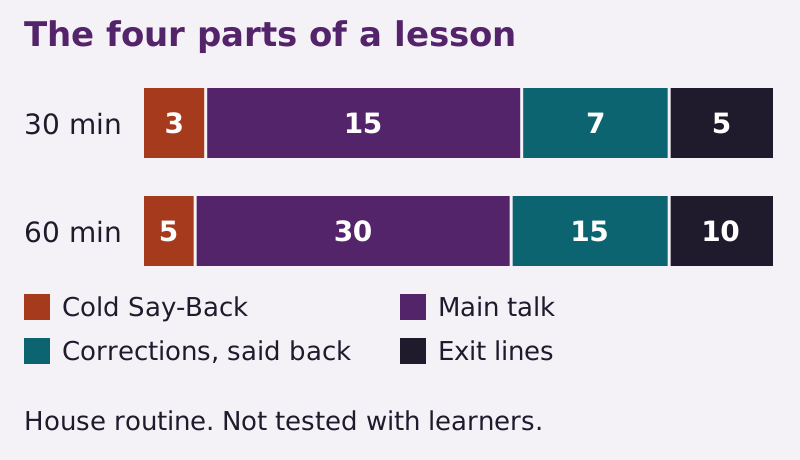
Four parts, in the same order every time. The tutor can still steer, but you know what the time is for.
"The four parts of a tutor lesson, in minutes" from Conversation Mile (https://conversationmile.com/routines/language-tutor-lesson-plan/). CC BY 4.0 (creativecommons.org/licenses/by/4.0)
| Part | 30-minute lesson | 60-minute lesson | What happens |
|---|---|---|---|
| Cold Say-Back | 3 | 5 | You say last lesson's new lines from memory. The tutor checks them. |
| Main talk | 15 | 30 | You talk about the topic you sent. The tutor asks questions. |
| Corrections, said back | 7 | 15 | The tutor gives the fixes. You say each fixed sentence aloud. If you were corrected after each answer, you only say them again. |
| Exit lines | 5 | 10 | You pick three new lines from today and say them twice. |
The opening is a Cold Say-Back: saying something from at least a night ago with nothing in front of you, then checking it. In a lesson, the tutor does the checking.
The main talk is the part you came for, so it gets half the time. Tell the tutor at the start that you want to do most of the talking.
The exit lines are what you take home. Pick sentences you needed today and didn't have, not the hardest thing you heard.
For a lesson of another length, such as 45 minutes, keep the four parts in the same order and give about half the time to the main talk.
Here's how a 30-minute lesson might run. Say your topic is a trip next month. You open with three minutes on the lines from your last lesson, said from memory while the tutor listens. In your very first lesson there are no such lines yet, so say your three sentences about yourself instead.
Then fifteen minutes on the trip: where you're going, who with, what you'll do there, with your three questions mixed in. The tutor keeps notes. In the seven minutes of corrections, you hear each fix and say the whole sentence back, not only the changed word. In the last five minutes, you choose three lines you reached for and didn't have, such as how to say you've booked a room, and say each one twice.
What do you send the day before?
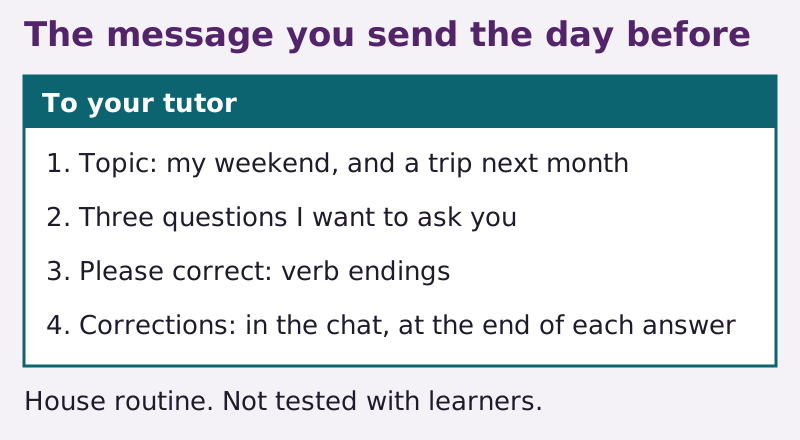
A short message, in English if you like. It saves the first five minutes of the lesson.
"What to send your tutor the day before a lesson" from Conversation Mile (https://conversationmile.com/routines/language-tutor-lesson-plan/). CC BY 4.0 (creativecommons.org/licenses/by/4.0)
- The topic. This site suggests something from your own week at first: your weekend, your job, a plan. A tutor can prepare a few questions around it.
- Three questions you'll ask. You'll ask them in the language during the main talk. They also rescue a talk that runs dry.
- One thing to correct. Choose one area, such as verb endings or the r. One area keeps the corrections to a number you can say back in the time.
- How you want corrections. The next section lists three ways.
Before your first lesson, prepare three sentences about yourself and say them cold for a few days. In that lesson, they fill the opening minutes in place of last lesson's lines, and the main talk stays on the topic you sent.
In the first message, also say roughly where you are: how long you've been learning, and what you can already say. The CEFR self-check gives you a few concrete lines to describe that, without a test. Knowing that you can order a coffee but not yet tell a story helps the tutor pitch the questions.
How should the tutor correct you?
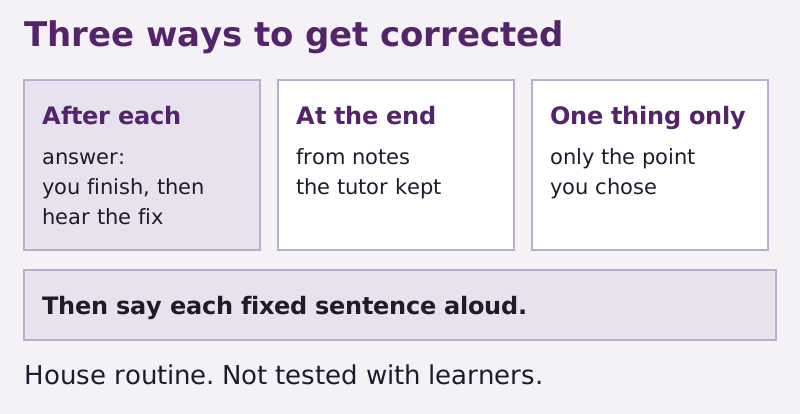
Pick one of three ways and say which in your message. You can change it later.
"Three ways to ask a tutor to correct you" from Conversation Mile (https://conversationmile.com/routines/language-tutor-lesson-plan/). CC BY 4.0 (creativecommons.org/licenses/by/4.0)
- After each answer. You finish what you're saying, then hear the fix. It works well for brief answers.
- At the end. The tutor keeps notes during the main talk and goes through them in the corrections part. You talk without interruptions.
- One thing only. The tutor fixes only the area you chose and lets the rest go.
If you choose corrections after each answer, use the corrections part only to say each fixed sentence once more, without looking for new mistakes.
Ask for corrections in writing too, typed into the lesson chat or on a shared page, so you can make cards from them. Whatever you choose, say each corrected sentence aloud before moving on. A correction you've only read hasn't been through your mouth yet.
Which phrases will you need in the lesson?
Three lines cover most stalls: one to ask for a correction, one to slow things down and one to ask for a word. Learn the version that matches how you and your tutor address each other.
"Informal and formal ways to say you, by language" from Conversation Mile (https://conversationmile.com/routines/language-tutor-lesson-plan/). CC BY 4.0 (creativecommons.org/licenses/by/4.0)
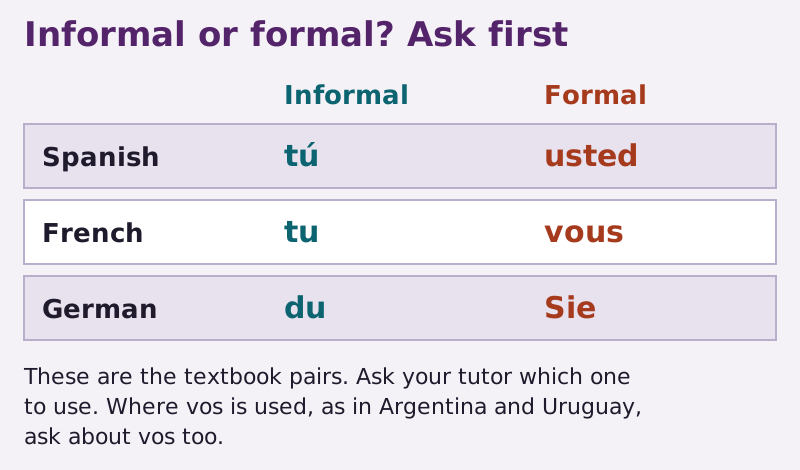
Spanish has informal tú and formal usted, according to the open textbook Trayectos. In French, tu is informal and vous is the usual form for one person you don't know well, according to Tex's French Grammar. German has informal du and formal Sie, according to Deutsch im Blick. Ask your tutor which one to use at the start of the first lesson.
| Informal | Formal | |
|---|---|---|
| Spanish, correct me | Corrígeme si me equivoco. | Corríjame si me equivoco. |
| French, correct me | Corrige-moi si je me trompe. | Corrigez-moi si je me trompe. |
| German, correct me | Korrigiere bitte meine Fehler. | Korrigieren Sie bitte meine Fehler. |
| Spanish, slower | ¿Puedes hablar más despacio, por favor? | ¿Puede hablar más despacio, por favor? |
| French, slower | Peux-tu parler plus lentement, s'il te plaît ? | Pouvez-vous parler plus lentement, s'il vous plaît ? |
| German, slower | Könntest du langsamer sprechen? | Könnten Sie langsamer sprechen? |
The Spanish and French correction lines mean "Correct me if I'm wrong." The German ones mean "Please correct my mistakes." The slower lines all ask the speaker to speak more slowly.
Where people use vos, as Trayectos describes for Argentina and Uruguay, some informal forms change. In the present tense, for example, puedes becomes podés. Commands change too: Wiktionary's entry for corregir lists corregime as the vos version of corrígeme. That list is generated automatically, so don't drill it until your tutor confirms it's what they say. The verb lookup lists the vos forms for the present tense. Ask your tutor which forms they use.
For a missing word, use a line that works with anyone. Put your own English word inside the quotes: ¿Cómo se dice "cat" en español?, Comment dit-on « hello » en français ? or Wie sagt man „cheese“ auf Deutsch?. They ask how to say "cat," "hello" and "cheese."
What do you do after the lesson?
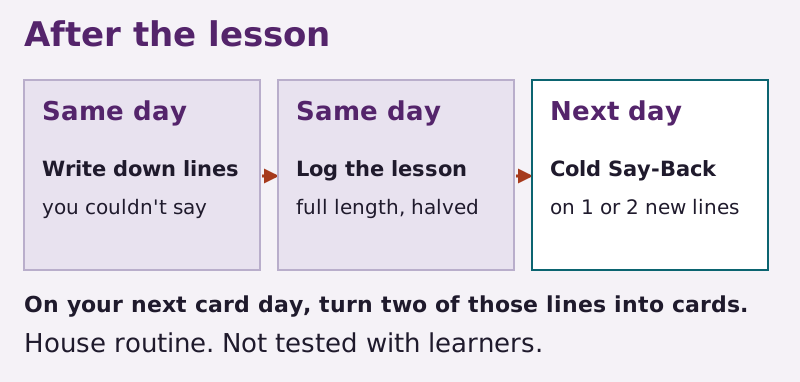
Three small things, two of them on the same day.
"What to do after a tutor lesson" from Conversation Mile (https://conversationmile.com/routines/language-tutor-lesson-plan/). CC BY 4.0 (creativecommons.org/licenses/by/4.0)
- Write down the lines you couldn't say, with their corrections and your exit lines, the same day while you still remember the context. Don't make cards yet.
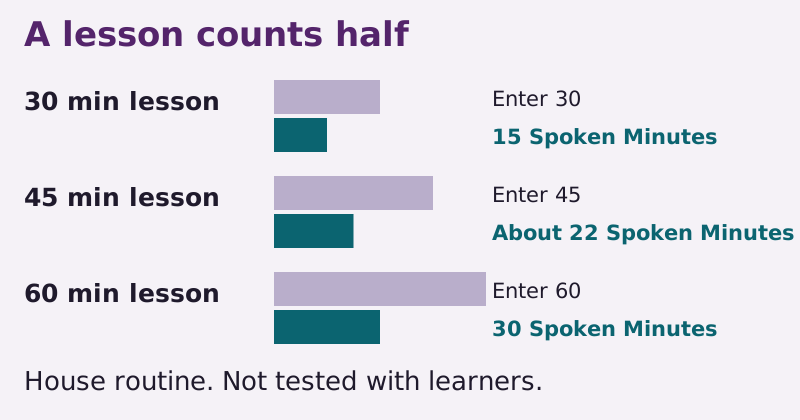
- Log the lesson in the Mile Log as conversation minutes, at its full clock length. For a 30-minute lesson, enter 30, and the log halves it. On paper, halve it yourself.
- The next morning, do a Cold Say-Back on one or two of the new lines before you look at your notes.
On the next day your plan has you write cards, turn two of those lines into cards. The Anki page shows how to set them up, and sentence mining covers keeping whole sentences rather than single words.
Those lines also become the Cold Say-Back that opens your next lesson.
How does a lesson count, and how often?
A lesson counts half, for its whole length, because about half of it is listening. Keep your tutor's usual lesson length, even if it's longer than your daily amount.
"Spoken Minutes from a tutor lesson" from Conversation Mile (https://conversationmile.com/routines/language-tutor-lesson-plan/). CC BY 4.0 (creativecommons.org/licenses/by/4.0)
On a lesson day, the lesson replaces the day's other jobs, Cold Say-Back included.
In the 90-day plan, the first conversation falls on day 30 and a weekly one starts on day 49. A tutor or a language exchange partner can fill those days. A tutor costs money and a partner doesn't, but a partner also wants half the time in their own language. If you can't book anyone by day 30, use speaking practice alone that day and keep looking.
Between lessons, keep your daily minutes going. Shadowing a short clip the day before warms you up.
What if the lesson drifts?
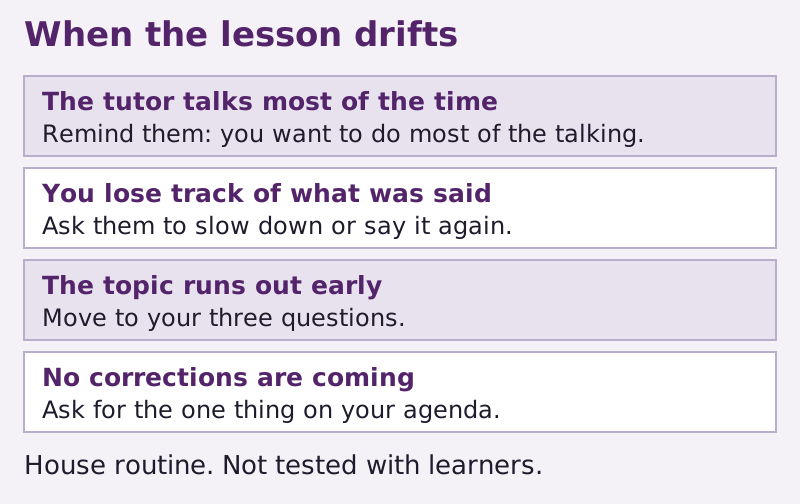
Lessons drift. Each common drift has a short fix. Most of them come straight from the agenda.
"What to do when a tutor lesson drifts from the agenda" from Conversation Mile (https://conversationmile.com/routines/language-tutor-lesson-plan/). CC BY 4.0 (creativecommons.org/licenses/by/4.0)
- The tutor talks most of the time. Remind them that you want to do most of the talking.
- You lose track. Use the slower line from the table above, or ask them to say it again.
- The topic runs out early. Move to your three questions.
- No corrections are coming. Ask for the one thing on your agenda.
A lesson online needs only basic care. Keep things you wouldn't give a stranger, such as your home address or passwords, out of the lesson chat. Pay only through the channel you booked with.
Tomorrow, before you look at your notes, do a Cold Say-Back on the correction line from the top of this page, in the version your tutor will hear. Then check it.
What this rests on
Checked against
- The phrases for asking for corrections, a slower pace and a missing word Source 1
- Spanish tú as informal and usted as formal, and vos in Argentina and Uruguay Source 2
- French tu as informal and vous for someone you don't know well Source 3
- German du as informal and Sie as formal Source 4
- Podés as the vos form of poder in the present Source 5
- Corregime as the vos version of corrígeme Source 6
House routine
- The four parts of a lesson, their minutes for 30 and 60 minutes, and about half the time on the main talk for other lengths
- The message sent the day before, with a topic, three questions, one thing to correct and, the first time, where you are
- The sample run of a 30-minute lesson
- The three ways to get corrected, each ending with the fixed sentence said aloud
- Writing down the lines you couldn't say on the lesson day, a Cold Say-Back on one or two of them the next day, and two cards from them on the next card day
- A lesson counting half at its usual length, replacing the day's other jobs
- The first conversation on day 30 and a weekly one from day 49
- Telling the tutor at the start that you want to do most of the talking
Sources
- Tatoeba. Sentence collection, downloaded exports. Tatoeba Open. Read: The fifteen sentences on this page and their linked English, read one by one. Authors are credited under Sentence credits.. License: CC BY 2.0 FR.
- Zapata. Trayectos, Volumen 2: Más sobre mí, Módulo 1, pp. 3 and 14, and the reflexive pronoun table. COERLL, University of Texas at Austin, 2022 Open. Read: The note on vos in Argentina, the pronoun list on p. 14 and the table marking tú as informal and Ud. as formal. License: CC BY-SA 4.0.
- Tex's French Grammar. "Subject pronouns." COERLL, University of Texas at Austin Open. Read: The whole page. License: CC BY 3.0.
- Abrams, Zsuzsanna, and others. "Kapitel 1." Deutsch im Blick, COERLL, University of Texas at Austin, 2017 Open. Read: The core vocabulary list of the chapter. License: CC BY 4.0.
- Wiktionary contributors. "poder," Spanish conjugation table. Wiktionary, via Wiktextract and kaikki.org Open. Read: The present tense row of the conjugation table, as stored in this site's verb data. License: CC BY-SA 4.0.
- Wiktionary contributors. "corregir," Spanish conjugation table and combined forms. Wiktionary Open. Read: The voseo imperative cell and the combined forms with the voseo imperative. License: CC BY-SA 4.0.
Sentence credits
- Corrígeme si me equivoco. Tatoeba sentence 981507 by Shishir; English by CK. CC BY 2.0 FR.
- Corrige-moi si je me trompe. Tatoeba sentence 1544576 by sacredceltic; English by CK. CC BY 2.0 FR.
- Korrigiere bitte meine Fehler. Tatoeba sentence 7883025 by Pfirsichbaeumchen; English by shekitten. CC BY 2.0 FR.
- Corríjame si me equivoco. Tatoeba sentence 831287 by LugoIlmer; English by CK. CC BY 2.0 FR.
- Corrigez-moi si je me trompe. Tatoeba sentence 13662 by TRANG; English by CK. CC BY 2.0 FR.
- Korrigieren Sie bitte meine Fehler. Tatoeba sentence 7883027 by Pfirsichbaeumchen; English by shekitten. CC BY 2.0 FR.
- ¿Puedes hablar más despacio, por favor? Tatoeba sentence 1878886 by Shishir; English by CK. CC BY 2.0 FR.
- ¿Puede hablar más despacio, por favor? Tatoeba sentence 513194 by Shishir; English by CK. CC BY 2.0 FR.
- Peux-tu parler plus lentement, s'il te plaît ? Tatoeba sentence 6060016 by christian63; English by colwem. CC BY 2.0 FR.
- Pouvez-vous parler plus lentement, s'il vous plaît ? Tatoeba sentence 11166624 by Aiji; English by CK. CC BY 2.0 FR.
- Könntest du langsamer sprechen? Tatoeba sentence 10074866 by wolfgangth; English by lukaszpp. CC BY 2.0 FR.
- Könnten Sie langsamer sprechen? Tatoeba sentence 1136157 by Pfirsichbaeumchen; English by lukaszpp. CC BY 2.0 FR.
- ¿Cómo se dice "cat" en español? Tatoeba sentence 436118 by lukaszpp; English by lukaszpp. CC BY 2.0 FR.
- Comment dit-on « hello » en français ? Tatoeba sentence 3269278 by nimfeo; English by CK. CC BY 2.0 FR.
- Wie sagt man „cheese“ auf Deutsch? Tatoeba sentence 2709236 by Pfirsichbaeumchen; English by CN. CC BY 2.0 FR.
Next stops
Cite this page
Language Tutor Lesson Plan: The Learner's Agenda to Bring. Conversation Mile, 2026-11-10. https://conversationmile.com/routines/language-tutor-lesson-plan/
Corrections
No corrections on this page. Spotted a language error? Please tell this site.