Your First 90 Days Plan
How to Learn a Language by Speaking a Little Every Day
Straight answer
Speak your new language out loud every day, even for five minutes, and count only the minutes you spoke. Start now. Pick the line for your language, put your own name in it, and say it twice without looking: Me llamo Tom. in Spanish, Je m'appelle Hugo. in French, or Ich heiße Tom. in German. Each one gives your name. The 90-day plan on this page is one way to lay out those minutes. It's a length this site chose, not the time it takes to learn a language.
Lay out your 90 days
The planner needs JavaScript. Here's what one day looks like at each length.
| Days | Main work | 5 Spoken Minutes | 10 Spoken Minutes | 20 Spoken Minutes | Leave for later |
|---|---|---|---|---|---|
| 1 to 14 | Letters and sounds, minimal pairs, and first sentences built on very common words | 1 min: Cold Say-Back, first thing: without looking, say something from an earlier day, such as a sentence, a word pair or a sound, then check it. 4 min: Say the letters and sounds that are new to you, one small group at a time. | 2 min: Cold Say-Back, first thing: without looking, say something from an earlier day, such as a sentence, a word pair or a sound, then check it. 8 min: Say the letters and sounds that are new to you, one small group at a time. | 3 min: Cold Say-Back, first thing: without looking, say something from an earlier day, such as a sentence, a word pair or a sound, then check it. 10 min: Say the letters and sounds that are new to you, one small group at a time. 7 min: Say one minimal pair: each word alone, then both together. | Verb tense charts, reading a grammar book through |
| 15 to 45 | Short audio clips, sentence cards, and a first conversation on day 30 | 1 min: Cold Say-Back, first thing: without looking, say something from an earlier day, such as a sentence, a word pair or a sound, then check it. 4 min: Play one short audio clip and say it along with the speaker. | 2 min: Cold Say-Back, first thing: without looking, say something from an earlier day, such as a sentence, a word pair or a sound, then check it. 8 min: Play one short audio clip and say it along with the speaker. | 3 min: Cold Say-Back, first thing: without looking, say something from an earlier day, such as a sentence, a word pair or a sound, then check it. 10 min: Play one short audio clip and say it along with the speaker. 7 min: Write two sentence cards and say each one aloud as you write it. | Rare words, advanced grammar such as the subjunctive |
| 46 to 90 | More input, a conversation every week, and the grammar point you keep tripping on | 1 min: Cold Say-Back, first thing: without looking, say something from an earlier day, such as a sentence, a word pair or a sound, then check it. 4 min: After listening to or reading something you can mostly follow, say three things from it in your own words. | 2 min: Cold Say-Back, first thing: without looking, say something from an earlier day, such as a sentence, a word pair or a sound, then check it. 8 min: After listening to or reading something you can mostly follow, say three things from it in your own words. | 3 min: Cold Say-Back, first thing: without looking, say something from an earlier day, such as a sentence, a word pair or a sound, then check it. 10 min: After listening to or reading something you can mostly follow, say three things from it in your own words. 7 min: Pick the grammar point you keep tripping on and say five sentences that use it. | Exams, a perfect accent |
What do the 90 days look like?
Three stages, each with one main job. Use the planner above, under "Lay out your 90 days," to turn them into a dated list: choose a language, a daily amount and a start date, then print it or download a CSV. It runs in your browser and sends nothing anywhere.
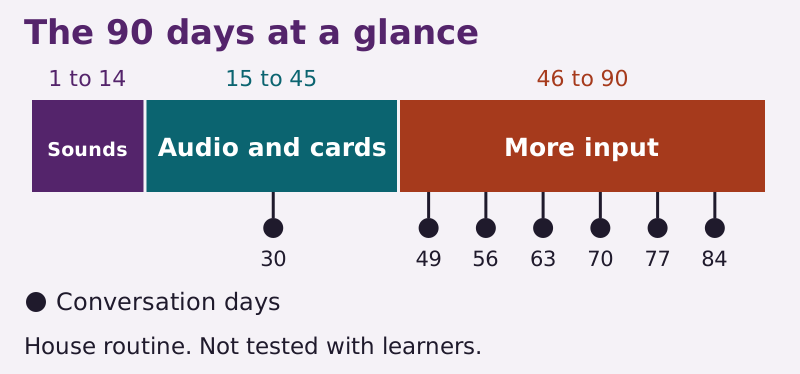
"The three stages of the 90-day plan and its conversation days" from Conversation Mile (https://conversationmile.com/start/how-to-learn-a-language/). CC BY 4.0 (creativecommons.org/licenses/by/4.0)
| Days | Main work |
|---|---|
| 1 to 14 | Letters and sounds, minimal pairs, first sentences from very common words |
| 15 to 45 | Short audio clips, sentence cards, a first conversation on day 30 |
| 46 to 90 | More input, a conversation each week from day 49, the grammar point you keep tripping on |
All of this is a House routine: this site chose these lengths and hasn't tested them with learners. The plan starts you speaking in the first week because that's how this site lays out the days. If you'd rather listen for a few weeks first, you can, and this page doesn't call that a mistake.
For what's particular to your language, read the Spanish start, the French start or the German start for your first two weeks.
How do Spoken Minutes work?
The timer runs only while you're making sounds in the language, such as saying along with audio, reading aloud or talking to yourself.
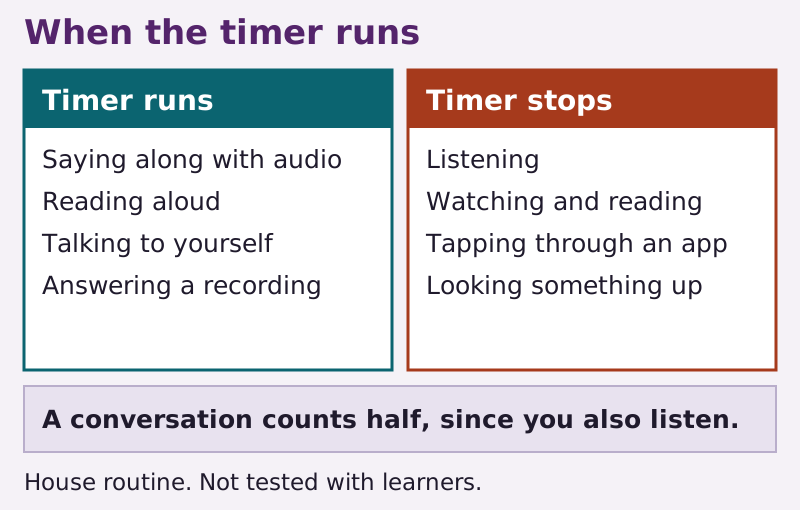
"What counts as a Spoken Minute" from Conversation Mile (https://conversationmile.com/start/how-to-learn-a-language/). CC BY 4.0 (creativecommons.org/licenses/by/4.0)
It stops while you listen, read or look something up, and a conversation counts half because you spend about half of it listening. The minutes show that you did the work, not your level. The shadowing page has the full rules, and the Mile Log keeps your count, at 20 Spoken Minutes to a mile.
How much should you speak each day?
Choose 5, 10 or 20 Spoken Minutes by the time you really have on a normal day, not your best day.
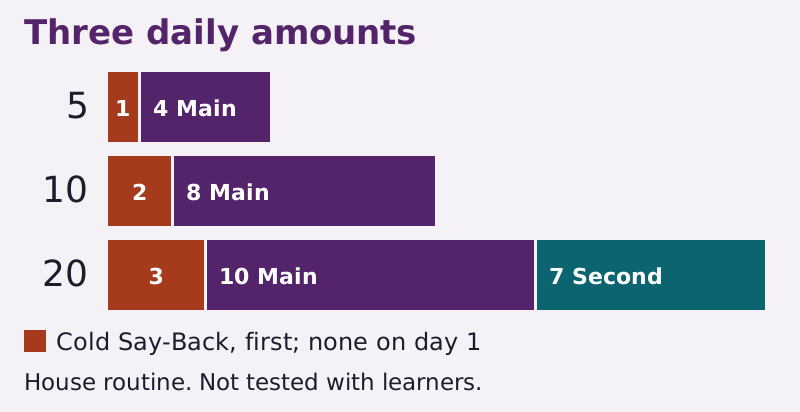
"How 5, 10 or 20 Spoken Minutes split across a day" from Conversation Mile (https://conversationmile.com/start/how-to-learn-a-language/). CC BY 4.0 (creativecommons.org/licenses/by/4.0)
| Daily amount | Cold Say-Back, first | Main job | Second job |
|---|---|---|---|
| 5 | 1 | 4 | None |
| 10 | 2 | 8 | None |
| 20 | 3 | 10 | 7 |
A Cold Say-Back means saying something from at least a night ago, with nothing in front of you, and only then checking it. It comes first, before you look at anything. Day 1 has nothing to test yet, so those minutes go to the main job.
If you can't decide, start with 5. You can move up later, and nothing on this page says more is required. You'll also need somewhere you can talk out loud without feeling watched. A walk, a parked car or an empty kitchen all work, and earbuds let you say along with audio on the way.
What do days 1 to 14 look like?
Three jobs take turns, and the planner rotates them for you: one a day on 5 or 10 Spoken Minutes, two on 20.
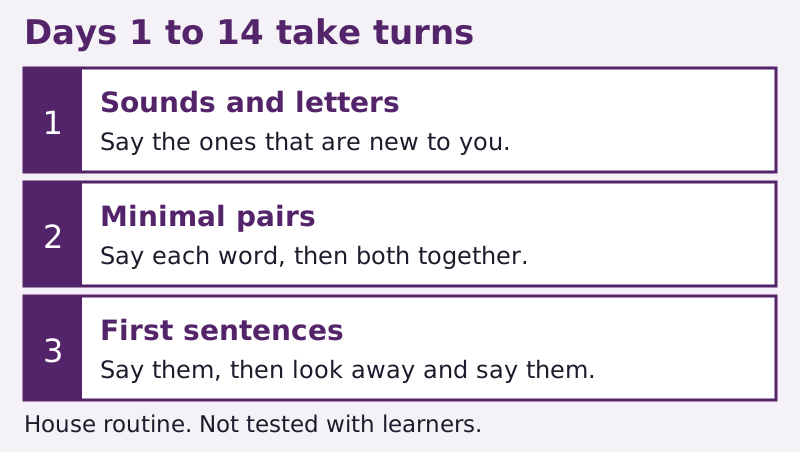
"The three jobs that rotate on days 1 to 14" from Conversation Mile (https://conversationmile.com/start/how-to-learn-a-language/). CC BY 4.0 (creativecommons.org/licenses/by/4.0)
- Letters and sounds. Say the ones that are new to you, one small group at a time.
- Minimal pairs. A minimal pair is two words that differ by one sound. Say each word alone, then both together. The minimal pairs tool has them by language.
- First sentences. Take very common words from the first 1,000 words and say three sentences that use them. Look away for the last try.
Here's how day 2 runs at 5 Spoken Minutes. You start with 1 minute on yesterday's letters and sounds, from memory. Then you spend 4 minutes on one minimal pair, saying each word and then both. Day 3 moves to first sentences, and day 4 starts the turn again.
Your sentences will be short at this stage. A name, a place and a plan for today are enough.
What changes on days 15 to 45?
Three new jobs take turns. One is a short audio clip that you say along with the speaker. Another is writing two sentence cards and saying each one aloud. The writing sits outside the timer, and only the saying counts. The Anki page shows how to set them up, and sentence mining shows where to find the sentences. The third is a run through your older cards: say each one aloud before you check it. That covers the whole stack, while the Cold Say-Back that opens every day tests only a line or two.
Day 30 is your first conversation. Book a tutor or find a language exchange partner before then. Having someone hear you is the one thing pages and recordings can't give you, which is why this plan puts a person ahead of any course. A recorded course can give you an order to follow, but it can't replace speaking, and you can do this plan without one.
Since a conversation counts half, it takes at least twice your daily amount on the clock.
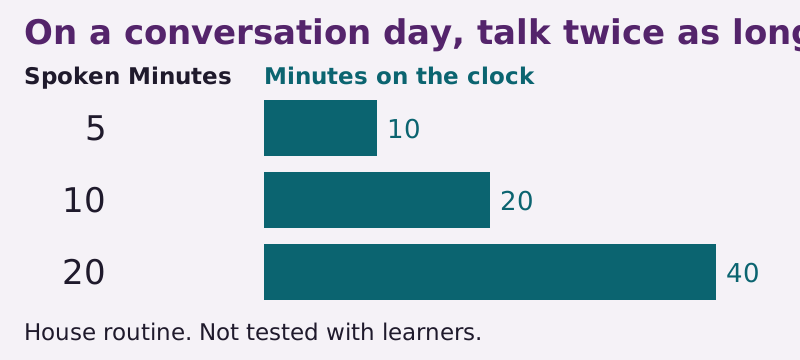
"Clock minutes needed on a conversation day" from Conversation Mile (https://conversationmile.com/start/how-to-learn-a-language/). CC BY 4.0 (creativecommons.org/licenses/by/4.0)
A talk replaces the day's other jobs, including the Cold Say-Back. A tutor's usual lesson length is fine too, even if it runs longer, and it still counts half.
Prepare a little for the first one. In the days before, pick three sentences about yourself and say them cold. Tell the person at the start that you want to do most of the talking. Keep paper nearby and note what you couldn't say, then turn those notes into sentence cards the next day. The tutor agenda has more on how to run the time.
If you can't find anyone by day 30, use speaking practice alone that day and keep looking.
What do days 46 to 90 add?
Input goes up, and speaking grows out of it. Listen to or read something you can mostly follow, which the input menu helps you pick. That part sits outside the timer. Then say three things from it in your own words, and the timer runs.
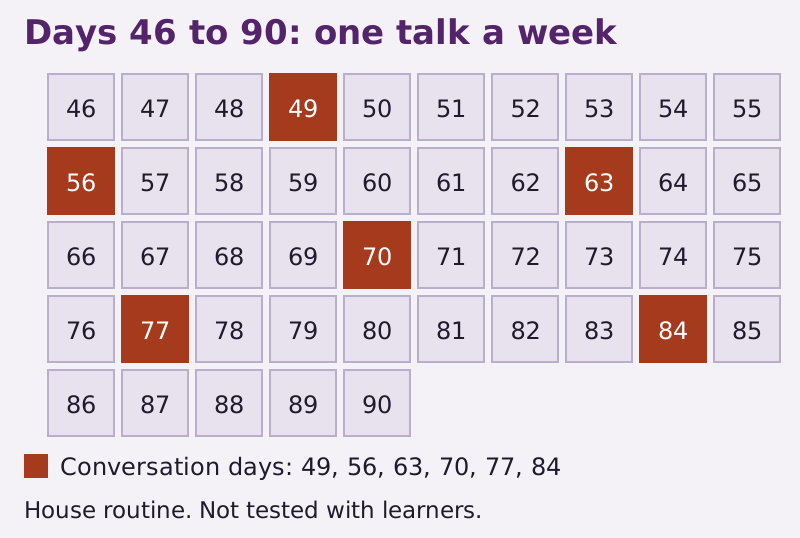
"Conversation days from day 46 to day 90" from Conversation Mile (https://conversationmile.com/start/how-to-learn-a-language/). CC BY 4.0 (creativecommons.org/licenses/by/4.0)
Conversations become weekly, starting on day 49. This is also the stage to work on the grammar point you keep tripping on. Keep it small, such as wo against wohin from German cases, the subjunctive after quiero que from the Spanish subjunctive, or the choice between the two French past tenses. A whole topic holds several points, so take them one at a time. Pick one, and say five sentences that use it. Stay on it until those sentences come out without much thought, then pick another.
The weekly talk also steers the other days. Note what you couldn't say, and let that decide which clips and cards you use next.
What should you leave alone for now?
Start with less. These can wait, and the planner lists them too.
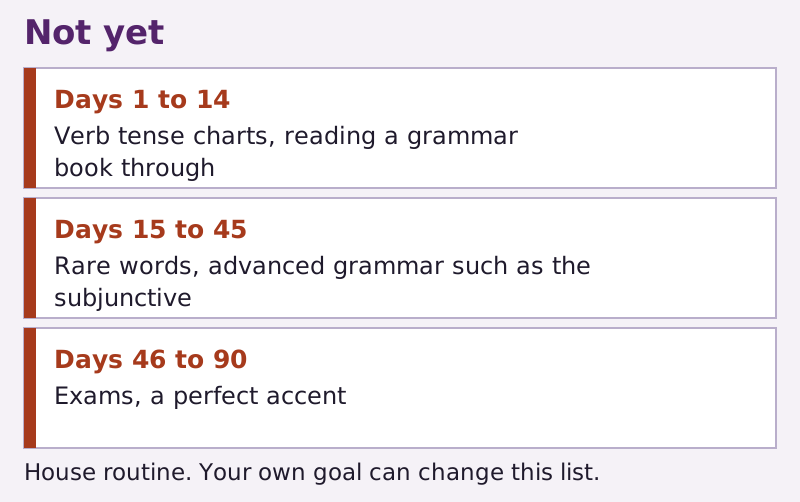
"What to leave for later at each stage" from Conversation Mile (https://conversationmile.com/start/how-to-learn-a-language/). CC BY 4.0 (creativecommons.org/licenses/by/4.0)
Leaving these out isn't a claim that they don't matter. Verb forms first come to you inside whole sentences, and some charts do need memorizing later on, so this site gives ways to do that when the time comes. Rare words can wait until the common ones are easy to say.
This list suits someone learning to talk. Change it if your goal is different. If your job needs reading, or you already have an exam date, your list won't look like this one.
What if you miss a day?
Do the next day on your list. Nothing resets, and you don't owe the missed minutes. If the dates on your list have drifted, ignore them and go by the day number. If you miss a conversation day, have the talk on the next day you can.
After a longer gap, start with a Cold Say-Back on a few old lines. Any line you can't say goes back on your daily list, and then you carry on from where you stopped.
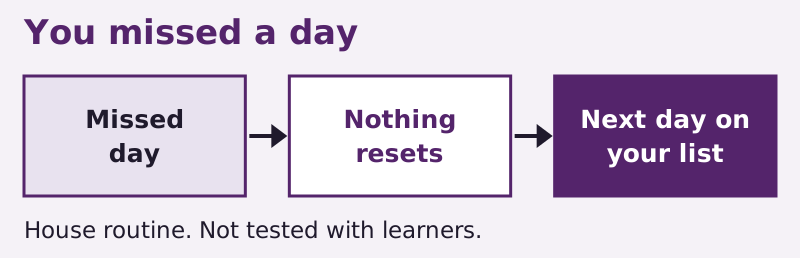
"What to do after a missed day" from Conversation Mile (https://conversationmile.com/start/how-to-learn-a-language/). CC BY 4.0 (creativecommons.org/licenses/by/4.0)
What does 90 days mean here?
It's the length of this plan and nothing more. This page can't tell you what level you'll reach, and neither can a count of miles. The plan does give you a total you can check.
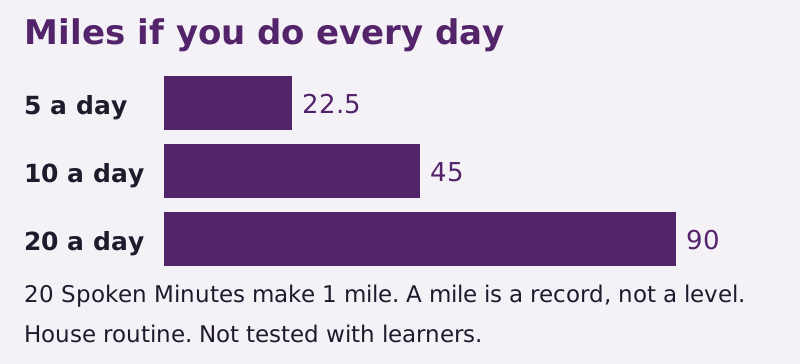
"Total miles after 90 days at each daily amount" from Conversation Mile (https://conversationmile.com/start/how-to-learn-a-language/). CC BY 4.0 (creativecommons.org/licenses/by/4.0)
Those totals assume you do every day, and few calendars work out that neatly. To see what you can do at any point, try the CEFR self-check. It's a set of questions for you, not an exam or a certificate.
Tomorrow morning, before you look at anything, do your first Cold Say-Back: say the line with your name in it, once, from memory. Then check it against this page.
What this rests on
Checked against
- The three sentences that give your name Source 1
House routine
- What counts as a Spoken Minute, conversations counting half, and 20 Spoken Minutes as 1 mile
- The 5, 10 and 20 Spoken Minute days and how each one splits
- The 90-day length and the three stages
- The first conversation on day 30, and a weekly one from day 49
- The leave-for-later list at each stage
- Speaking from the first week. It's how this site lays out the days, and not a research finding
- Three jobs taking turns in each stage, one a day on the 5 and 10 minute plans and two on the 20 minute plan
- The Cold Say-Back first in the day, testing anything from an earlier day
- Going on with the next day after a missed one, going by the day number when dates drift, and moving a missed conversation to the next free day
- After a longer gap, a Cold Say-Back on old lines first, with any line you can't say going back on the list
- Preparing three sentences before the first conversation, asking to do most of the talking, and turning notes into cards the next day
- Speaking practice alone if no partner is found by day 30
- Staying on one grammar point until five sentences come easily
- A tutor's usual lesson length counting half
Sources
- Tatoeba. Sentence collection, downloaded exports. Tatoeba Open. Read: The three sentences on this page and their linked English read one by one. Authors are credited under Sentence credits.. License: CC BY 2.0 FR.
Sentence credits
- Me llamo Tom. Tatoeba sentence 2351587 by Shishir; English by CK. CC BY 2.0 FR.
- Je m'appelle Hugo. Tatoeba sentence 7851032 by theachaean; English by rul. CC BY 2.0 FR.
- Ich heiße Tom. Tatoeba sentence 1935119 by Pfirsichbaeumchen; English by CK. CC BY 2.0 FR.
Next stops
Cite this page
How to Learn a Language by Speaking a Little Every Day. Conversation Mile, 2026-11-10. https://conversationmile.com/start/how-to-learn-a-language/
Corrections
No corrections on this page. Spotted a language error? Please tell this site.