Grammar in Use Grammar
Preterite vs Imperfect: The Event and the Background
Straight answer
Use the preterite for what happened, and the imperfect for what was going on around it. Say this out loud: Estaba lloviendo cuando llegué. (When I arrived, it was raining.) Llegué is the event. Estaba lloviendo is the scene. That split is a good first guess. It has limits. A long stretch told as finished, like ten years abroad, takes the preterite, and a few verbs change meaning between the two.
The English trap
English has one simple past, like "it rained" or "I lived," for both. ¡Chévere! notes that English has to add other words to show what Spanish shows by choosing the preterite or the imperfect.
Say this today
Estaba lloviendo cuando llegué.
When I arrived, it was raining.
What does the imperfect do?
The imperfect describes. ¡Chévere!, an open university Spanish course, says it gives the background of a story and that the order of its events often doesn't matter. It covers habits, actions in progress, and what things were like, often where English says "used to."
| Use | Say it | Meaning |
|---|---|---|
| A habit | La artista siempre pintaba sola. | The artist always painted alone. |
| What life was like | Vivía en Boston cuando era niño. | I lived in Boston when I was a kid. |
| In progress | Estaba comiendo cuando me llamaste. | I was eating when you called me. |
| Clock time | Eran las siete y media. | It was seven thirty. |
| Age | Yo tenía 13 años en 2003. | I was 13 in 2003. |
| A state of mind | No sabía cómo hacerlo. | He didn't know how to do it. |
| Weather as a setting | Hacía mucho frío. | It was very cold. |
Sabía is the same form for "I" and "he" or "she," so No sabía can mean I, he or she; the translation here picks he. Niño is for a boy; if you were a girl, say niña, and Wiktionary gives the same -o to -a change for enfermo and enferma. Read the table out loud once. Then cover the middle column and say each sentence from the English.
What does the preterite do?
The preterite tells what happened. ¡Chévere! says it moves a story forward and shows one action finished before the next began. Its list also has some uses you might not expect.
| Use | Say it | Meaning |
|---|---|---|
| One event at a set time | Anoche hubo tormenta. | Last night there was a storm. |
| A counted number of times | Fui dos veces. | I went twice. |
| A stretch with a set length | Viví diez años en el extranjero. | I lived abroad for ten years. |
| One action after another | Me apresuré y logré alcanzar el bus. | I hurried and managed to catch the bus. |
| The action that cuts in | María se cortó un dedo mientras cocinaba. | María cut her finger while cooking. |
| A state starting | Tom se puso nervioso. | Tom got nervous. |
In the cut-in row, se cortó is the preterite and cocinaba is the imperfect. One sentence can hold both tenses.
How do the two fit in one story?
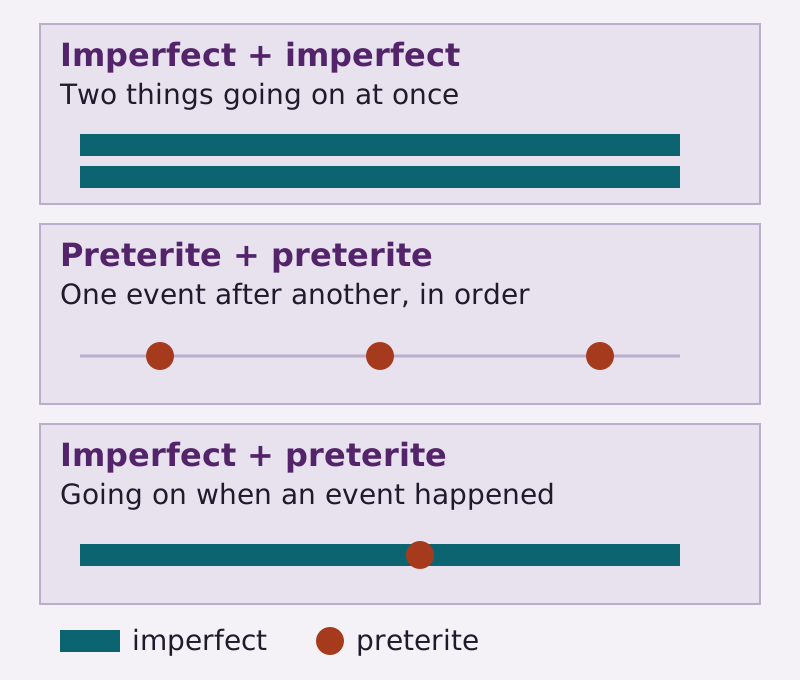
¡Chévere! sets out three ways to combine them. Each one tells the listener something different about time.
"Three ways to combine the preterite and the imperfect" from Conversation Mile (https://conversationmile.com/grammar-in-use/preterite-vs-imperfect/). CC BY 4.0 (creativecommons.org/licenses/by/4.0)
| Pattern | What it says | Say it |
|---|---|---|
| Imperfect + imperfect | Two things going on at once | La banda tocaba música tradicional y mis tíos se sentían nostálgicos. |
| Preterite + preterite | Events one after another, in the order they happened | Mi tía se levantó a bailar, el tacón de su zapato se rompió y ella se cayó. |
| Imperfect + preterite | Something going on when something else happened | Nuestra prima bailaba con mi hermano cuando su novio llegó a la fiesta. |
The first means the band was playing while the aunt and uncle felt nostalgic. The second is a chain: she got up, the heel broke, she fell. The third has the cousin dancing when her boyfriend arrived. For a chain, ¡Chévere! stresses telling the events in the order they happened.
Say all three out loud. Then swap the order of the chain and hear how the story changes.
Where does "event and background" break?
The shortcut on this page is a summary. FSI's 1959 course calls the two past tenses one English idea split into two Spanish ones, the same way it treats ser and estar. Here is where the shortcut leads you wrong.
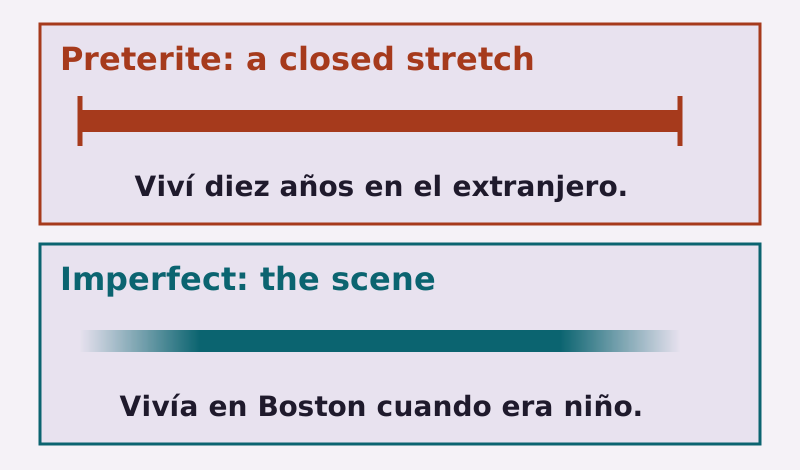
A long stretch told as finished. Ten years of living abroad sounds like background. But ¡Chévere! lists "for a specific amount of time" and "completed action" under the preterite, so you say Viví diez años en el extranjero. The stretch doesn't need a number: Llovió todo el día. (It rained all day long.) is one finished stretch too. The imperfect is for a stretch used as the scene for something else, like cuando era niño. A number alone doesn't switch the tense: ¡Chévere! keeps age and clock time in the imperfect, so tenía 13 años stays imperfect. Viví diez años is a stretch of living, told as finished, not an age.
"A closed stretch or the scene" from Conversation Mile (https://conversationmile.com/grammar-in-use/preterite-vs-imperfect/). CC BY 4.0 (creativecommons.org/licenses/by/4.0)
Habits against counted times. Repeated actions take the imperfect: La artista siempre pintaba sola. Once you count them as a total, they take the preterite: Fui dos veces. A count inside a habit still takes the imperfect: Jenny lavaba la pared de la cocina dos veces al año. (Jenny washed the kitchen wall twice a year.)
Key words are hints. ¡Chévere! gives words that often go with each tense, such as siempre and todos los días for the imperfect, and ayer and anoche for the preterite. It also lists nunca with the imperfect, yet its own example says La chica se sentía cohibida en las fiestas y nunca quiso bailar. (The girl felt shy at parties and never wanted to dance.) The verb is in the preterite, so nunca didn't force the imperfect. Use the words as a first guess, then ask what the verb is doing.
Weather. Hacía mucho frío. sets a scene. Anoche hizo mucho frío. tells the cold as one finished stretch, last night. ¡Chévere! lists the preterite of hacer for weather that starts, or that lasts a set amount of time. Anoche doesn't force it, though: Anoche hacía tanto frío que no pude dormir. (It was so cold last night that I couldn't sleep.) uses the cold as the scene for not sleeping. No pude is the preterite, the table's "didn't manage to" below, not the imperfect no podía.
Which verbs change meaning?
Some verbs name a state, not an action. ¡Chévere! says these change meaning between the two tenses. It gives a table.
| Verb | Imperfect | Preterite |
|---|---|---|
| conocer | knew someone: Tom conocía a Mary. | met for the first time: Conocí a una anciana. |
| saber | knew a fact | found out: Lo supe de él. (I learned it from him.) |
| poder | was able to | managed to: Pude llegar allá a tiempo. |
| no poder | wasn't able to | didn't manage to: Corrí con todas mis fuerzas pero no pude alcanzarla. |
| querer | wanted | tried to (no example on this page); also plain wanted: Quise pagar. (I wanted to pay.) |
| no querer | didn't want to | refused: Se lo pedí de buenas maneras, pero no quiso. (I kindly asked him, but he refused to.) |
| haber | there was, as background | there was, as an incident: Anoche hubo tormenta. |
| estar | was | was, for a closed stretch, or got: Mamá estuvo enojada cuando le dimos una fiesta sorpresa. |
These are ¡Chévere!'s readings, not the only ones; Tatoeba's Quise pagar is plain "wanted." Quiso is he, she or you (formal); for I, it's quise, so "I refused" is no quise. The nunca quiso line further up keeps the book's "never wanted"; don't carry this row's "refused" over to it. ¡Chévere! also notes that haber in this sense stays singular, hubo and había, even when there's more than one thing. ¡Chévere! glosses the estar example as Mom getting angry when the family threw her a surprise party. Don't read every estuve as "got," though. Tatoeba has Estuve enfermo ayer. for "I was ill yesterday." A woman talking about herself says enferma. ¡Chévere! adds that ponerse works the same way: Tom se puso nervioso. is Tom getting nervous.
What are the forms?
You need these before the drill. The endings come from ¡Chévere!.
| Person | -ar preterite | -er, -ir preterite | -ar imperfect | -er, -ir imperfect |
|---|---|---|---|---|
| I | hablé | comí | hablaba | comía |
| you (familiar) | hablaste | comiste | hablabas | comías |
| he, she, you (formal) | habló | comió | hablaba | comía |
| first person plural | hablamos | comimos | hablábamos | comíamos |
| you all (Spain only, familiar) | hablasteis | comisteis | hablabais | comíais |
| they, you all | hablaron | comieron | hablaban | comían |
Watch the written accents. Hablo is "I speak," and habló is "he spoke." The "first person plural" preterite of regular -ar and -ir verbs looks just like the present, so context tells them apart: Nosotros siempre llamamos a mamá los domingos. is a habit now, and Nosotros llamamos a mamá el domingo pasado. is last Sunday.
Only three verbs are irregular in the imperfect, says ¡Chévere!: ser (era), ir (iba) and ver (veía). The preterite has more. Wiktionary gives ir and ser the same forms, fui and fue, and lists hice for hacer and tuve for tener. Some -ir verbs change their stem in the "he" and "they" forms: Wiktionary gives pidió and pidieron for pedir. An -ar verb like pensar keeps its stem: pensó. Check any verb in the conjugation lookup. In the "I" form, verbs ending in -car, -gar and -zar change spelling: busqué, pagué, empecé.
¡Chévere! marks the vosotros forms as used only in Spain. Trayectos, an open course from COERLL, uses vos for familiar "you" in Argentina and Uruguay. Wiktionary gives vos its own forms in the present but none in these two tenses, and Tatoeba has lines like ¿Vos usaste mi cámara? (Did you use my camera?) with the same form as the second row. If the people you'll talk to use vos, copy their forms.
How do you train the choice out loud?
FSI's Spanish course from 1982 drills the two tenses as a pair. It asks ¿Traía Ud. a los niños antes? (Did you use to bring the children?) and answers No, antes no los traía. (No, I didn't use to bring them.) then Ayer los traje por primera vez. (Yesterday I brought them for the first time.) The question asks about you, but the answers speak as I: traje is "I brought," and the form for you (formal) is trajo. The first is a habit that wasn't there. The second is one event. Use the same frame.
| Frame | Tense | Fill it |
|---|---|---|
| Antes no... | imperfect | a thing you didn't use to do |
| Ayer... por primera vez. | preterite | the day it first happened |
| Estaba... cuando... | imperfect, then preterite | estaba plus an -ndo form, like comiendo, then what cut in |
Start with regular verbs, such as tomar café or comer tacos. Say the pair about yourself: "I didn't use to drink coffee. Yesterday I drank it for the first time." Then say it about a friend, then about two people. For a friend, the imperfect stays the same as for you (tomaba) and only the preterite changes (tomé to tomó). For two people, both change: tomaban, tomaron. In the third frame, use the -ndo form after estaba: tomando, comiendo. For two people, estaba becomes estaban; the verb after cuando follows whoever did the cutting in. When you've done every person, pick a new verb. Look up each new verb in all its forms before you say it, since the "he" and "they" forms can change even when "I" looks regular.
Count it in Spoken Minutes. On a 5-minute day, spend 1 minute on yesterday's Cold Say-Back and 4 on the frames. On a 10-minute day, it's 2 and 8. On a 20-minute day, it's 3 on the Cold Say-Back, 10 on the frames and 7 on the self-test below, run twice. Skip the self-test on shorter days. On your first day there's nothing to say back yet, so the Cold Say-Back minutes go to the frames; on a 20-minute day the self-test still runs. This split and the drill are this site's House routine, untested with learners. Add the minutes to your Mile Log.
On a 20-minute day, say each line in Spanish before you read the note after it.
- When I arrived, it was raining. (imperfect for the scene, preterite for the arrival)
- I lived abroad for ten years. (preterite, a set length)
- The artist always painted alone. (imperfect, a habit)
- I went twice. (preterite, counted times)
- It was seven thirty. (imperfect, clock time: Eran las siete y media.)
- I met an old woman. (preterite of conocer, a first meeting: Conocí a una anciana. Keep the a before a person.)
- Tom got nervous. (preterite, a state starting)
If you miss one, don't reread the rule. Find the sentence in the tables and say it three times.
These choices sit next to others that English hides, like ser and estar, por and para and the subjunctive. If you're just starting, the Spanish starting plan shows where past tenses fit.
Tomorrow, before you look at anything, run a Cold Say-Back: say that it was raining when you arrived, that you lived somewhere for some years, and that you met someone, with the a before the person.
What this rests on
Checked against
- Preterite endings, written accents, the nosotros forms that match the present, and spelling changes in the yo form Source 1
- Imperfect for habits, ongoing actions and what things were like; its endings; only ser, ir and ver irregular; haber staying singular Source 2
- The imperfect giving the background of a story, and the preterite moving it forward in order Source 3
- Imperfect with imperfect, preterite after preterite, and imperfect cut off by preterite; English needing extra words Source 4
- Estar, ponerse and feelings: the preterite for getting into a state, the imperfect for being in it; nunca quiso bailar Source 5
- The two lists of uses, including completed actions and a specific amount of time; the key words; the verbs that change meaning, including no querer as declined to and weather with hacer Source 6
- The two past tenses as one English idea split in two Source 7
- The drill that pairs antes with the imperfect and ayer, por primera vez, with the preterite Source 8
- Irregular preterites such as fui, hice and tuve; ser and ir sharing fui; pedir giving pidió and pidieron, querer giving quise for I and quiso for he or she, pensar keeping pensó; tomaba the same for I and he or she; -ndo forms; sabía the same for I and he or she; the personal a before a person; niña and enferma as the feminine forms; traje for I and trajo for you (formal); estaban; no separate vos forms in these two tenses Source 9
- Vosotros used only in Spain Source 10
- Vos for familiar you in Argentina and Uruguay Source 11
House routine
- Rotating people through the antes and ayer drill, the 5, 10 and 20 Spoken Minute splits, the self-test, saying a missed sentence three times, and the Cold Say-Back
Sources
- Brown, Escudero, Montoya and Small. ¡Chévere! Introductory Spanish II, 3.7: El pretérito. SUNY Oneonta via OER SUNY Open. Read: The whole page, including the Lumen CC BY credits at the end. License: CC BY 4.0.
- Brown, Escudero, Montoya and Small. ¡Chévere! Introductory Spanish II, 7.7: El imperfecto. SUNY Oneonta via OER SUNY Open. Read: The whole page. License: CC BY 4.0.
- Brown, Escudero, Montoya and Small. ¡Chévere! Introductory Spanish II, 9.7: Pretérito e imperfecto I. SUNY Oneonta via OER SUNY Open. Read: The whole page. License: CC BY 4.0.
- Brown, Escudero, Montoya and Small. ¡Chévere! Introductory Spanish II, 9.11: Pretérito e imperfecto II. SUNY Oneonta via OER SUNY Open. Read: The whole page. License: CC BY 4.0.
- Brown, Escudero, Montoya and Small. ¡Chévere! Introductory Spanish II, 10.7: Pretérito e imperfecto III. SUNY Oneonta via OER SUNY Open. Read: The whole page. License: CC BY 4.0.
- Brown, Escudero, Montoya and Small. ¡Chévere! Introductory Spanish II, 10.11: Pretérito e imperfecto IV. SUNY Oneonta via OER SUNY Open. Read: The whole page. License: CC BY 4.0.
- Stockwell, Bowen, Segreda, Montero and Silva-Fuenzalida. Spanish Basic Course: Units 31-45, section 34.21.1, discussion of por and para. Foreign Service Institute, U.S. Department of State, 1959 Open. Read: The discussion on p. 34.9 that compares the two past tenses to ser and estar, from a scanned copy.
- Trease and Ulsh. Spanish Basic Course: Units 46-55, section 51.22.2, Past I and Past II in contrast. Foreign Service Institute, U.S. Department of State, 1982 Open. Read: That drill, pp. 51.27 and 51.28, from a scanned copy.
- Wiktionary, entries for hablar, comer, ir, ser, hacer, tener, pedir, saber, pensar, tomar, traer, estar and querer (Spanish conjugation tables), the preposition a (personal a), and niño and enfermo (feminine forms), via Wiktextract and kaikki.org Open. Read: Preterite and imperfect forms of those verbs in this site's conjugation data (dump 2026-10-01), and the vos-form tags for hablar in the local kaikki file. License: CC BY-SA 4.0.
- Brown, Escudero, Montoya and Small. ¡Chévere! Introductory Spanish II, 2.11: Por y para / Pronombres preposicionales. SUNY Oneonta via OER SUNY Open. Read: The pronoun table, which marks vosotros as used only in Spain. License: CC BY 4.0.
- Zapata. Trayectos, Volumen 2: Más sobre mí, Módulo 1, pp. 3 and 14. COERLL, University of Texas at Austin, 2022 Open. Read: The note on vos in Argentina and the pronoun table on pp. 3 and 14. License: CC BY-SA 4.0.
Sentence credits
- Estaba lloviendo cuando llegué. Tatoeba sentence 1418947 by marcelostockle; English by CK. CC BY 2.0 FR.
- La artista siempre pintaba sola. Tatoeba sentence 1721256 by marcelostockle; English by CK. CC BY 2.0 FR.
- Vivía en Boston cuando era niño. Tatoeba sentence 2486145 by Shishir; English by CK. CC BY 2.0 FR.
- Estaba comiendo cuando me llamaste. Tatoeba sentence 1085046 by hayastan; English by tabular. CC BY 2.0 FR.
- Eran las siete y media. Tatoeba sentence 2181921 by marcelostockle; English by CK. CC BY 2.0 FR.
- Yo tenía 13 años en 2003. Tatoeba sentence 4179477 by Leono; English by CK. CC BY 2.0 FR.
- No sabía cómo hacerlo. Tatoeba sentence 7256707 by arh; English by Luornu. CC BY 2.0 FR.
- Hacía mucho frío. Tatoeba sentence 1123756 by cueyayotl; English by CK. CC BY 2.0 FR.
- Anoche hubo tormenta. Tatoeba sentence 7119447 by arh; English by LimeGreenTeknii. CC BY 2.0 FR.
- Fui dos veces. Tatoeba sentence 2476441 by hayastan; English by CK. CC BY 2.0 FR.
- Viví diez años en el extranjero. Tatoeba sentence 1364659 by Shishir; English by CK. CC BY 2.0 FR.
- Me apresuré y logré alcanzar el bus. Tatoeba sentence 1264736 by marcelostockle; English by CK. CC BY 2.0 FR.
- María se cortó un dedo mientras cocinaba. Tatoeba sentence 5014459 by don_ramon; English by mzmzmz. CC BY 2.0 FR.
- Tom se puso nervioso. Tatoeba sentence 1284304 by marcelostockle; English by CK. CC BY 2.0 FR.
- La banda tocaba música tradicional y mis tíos se sentían nostálgicos. ¡Chévere! Introductory Spanish II, 9.11. CC BY 4.0.
- Mi tía se levantó a bailar, el tacón de su zapato se rompió y ella se cayó. ¡Chévere! Introductory Spanish II, 9.11. CC BY 4.0.
- Nuestra prima bailaba con mi hermano cuando su novio llegó a la fiesta. ¡Chévere! Introductory Spanish II, 9.11. CC BY 4.0.
- Llovió todo el día. Tatoeba sentence 4464247 by ecorralest101; English by CK. CC BY 2.0 FR.
- Jenny lavaba la pared de la cocina dos veces al año. Tatoeba sentence 1196031 by alexmarcelo; English by yujin. CC BY 2.0 FR.
- La chica se sentía cohibida en las fiestas y nunca quiso bailar. ¡Chévere! Introductory Spanish II, 10.7. CC BY 4.0.
- Anoche hizo mucho frío. Tatoeba sentence 3704908 by cueyayotl; English by _undertoad. CC BY 2.0 FR.
- Anoche hacía tanto frío que no pude dormir. Tatoeba sentence 10795776 by megamanenm; English by megamanenm. CC BY 2.0 FR.
- Tom conocía a Mary. Tatoeba sentence 4438812 by miren; English by CK. CC BY 2.0 FR.
- Conocí a una anciana. Tatoeba sentence 1435790 by marcelostockle; English by CK. CC BY 2.0 FR.
- Lo supe de él. Tatoeba sentence 13450071 by Seael; English by CM. CC BY 2.0 FR.
- Pude llegar allá a tiempo. Tatoeba sentence 728876 by ventana; English by CK. CC BY 2.0 FR.
- Corrí con todas mis fuerzas pero no pude alcanzarla. Tatoeba sentence 10323729 by Seael; English by helloroto. CC BY 2.0 FR.
- Quise pagar. Tatoeba sentence 5952253 by albrusgher; English by CK. CC BY 2.0 FR.
- Se lo pedí de buenas maneras, pero no quiso. Tatoeba sentence 2050412 by Shishir; English by mialiesperantistas. CC BY 2.0 FR.
- Mamá estuvo enojada cuando le dimos una fiesta sorpresa. ¡Chévere! Introductory Spanish II, 10.7. CC BY 4.0.
- Estuve enfermo ayer. Tatoeba sentence 536497 by Leono; English by CK. CC BY 2.0 FR.
- Nosotros siempre llamamos a mamá los domingos. ¡Chévere! Introductory Spanish II, 3.7. CC BY 4.0.
- Nosotros llamamos a mamá el domingo pasado. ¡Chévere! Introductory Spanish II, 3.7. CC BY 4.0.
- ¿Vos usaste mi cámara? Tatoeba sentence 1611147 by hayastan; English by CK. CC BY 2.0 FR.
- ¿Traía Ud. a los niños antes? FSI Spanish Basic Course, Units 46-55, 51.22.2. Public domain (U.S. government work).
- No, antes no los traía. FSI Spanish Basic Course, Units 46-55, 51.22.2. Public domain (U.S. government work).
- Ayer los traje por primera vez. FSI Spanish Basic Course, Units 46-55, 51.22.2. Public domain (U.S. government work).
Next stops
Cite this page
Preterite vs Imperfect: The Event and the Background. Conversation Mile, 2026-11-10. https://conversationmile.com/grammar-in-use/preterite-vs-imperfect/
Corrections
No corrections on this page. Spotted a language error? Please tell this site.