Grammar in Use Grammar
Ser vs Estar: What Something Is, Where It Is, How It Is Now
Straight answer
Ser says what something is. Estar says where something is, even a town that never moves, and how it is right now. Say this pair out loud: Tom es aburrido. means Tom is boring, and Tom está aburrido. means he's bored. That shortcut fails in five places: where an event is held can take ser, dead and pregnant both take estar, some adjectives change meaning with the verb, and married turns up with both.
The English trap
English has one verb, be, where Spanish has two. FSI's Spanish course (1961 printing) warns that the choice can seem arbitrary to Americans, and that using the wrong verb is painfully obvious to a listener.
Say this today
Tom está aburrido.
Tom's bored.
When do you use ser?
Use ser when you say who or what something is: identity, profession, origin, material, ownership, the time or date, and traits. FSI's course calls ser the link of identity, and it says a noun that names someone's identity always takes ser.
| Use | Say it | Meaning |
|---|---|---|
| Who someone is | Yo soy Manuel. | I am Manuel. |
| Profession | Él es profesor. | He is a teacher. |
| Origin | Soy de Ecuador. | I am from Ecuador. |
| Material | Mi escritorio es de madera. | My desk is made of wood. |
| Ownership | El cuaderno azul es de Raúl. | The blue notebook is Raúl's. |
| Clock time | Son las cinco menos cuarto. | It's quarter to five. |
| Date or day | La fiesta es el lunes. | The party's Monday. |
| Trait | Judy es lista. | Judy is smart. |
Read the table out loud once. Now cover the middle column and say each sentence from the English.
When do you use estar?
Use estar for where someone or something is, and for a condition or feeling. Location takes estar even when it never changes. It also builds the verb form that says an action is going on now, estar plus an -ndo word.
| Use | Say it | Meaning |
|---|---|---|
| Location | ¿Dónde está el zoológico? | Where's the zoo? |
| Location that never changes | Oneonta está en las montañas. | Oneonta is in the mountains. |
| Location of things | ¿Dónde están las fresas? | Where are the strawberries? |
| Condition | Tom está enfermo. | Tom is sick. |
| Feeling, said by a woman | Estoy aburrida. | I am bored. |
| Feeling, said by a man | Estoy aburrido. | I'm bored. |
| Temporary state | La acera está cerrada. | The sidewalk is closed. |
| Going on now | Estoy estudiando. | I am studying. |
Watch the last row. English can use "are going" for a plan, but ¡Chévere! says the Spanish form always refers to an action in progress. For a plan, it uses the plain present or a future form: Vamos al cine este fin de semana. is about going to the movies this weekend.
Say the sentences again, and swap in your own word for Tom if you like. The adjective's ending follows the person or thing you describe, which ¡Chévere! covers in its unit on adjectives. Only with estoy is that person you: a woman says Estoy cansada de trabajar. and a man says Estoy cansado de esperar. About anyone else, match them, not yourself: Tom está enfermo., but Ella está enferma. (She is sick.)
Which question do you ask before you speak?
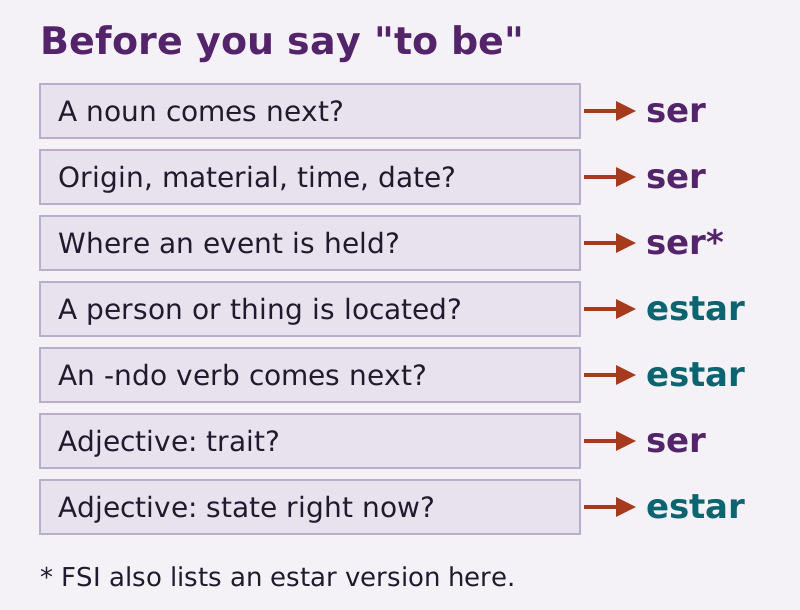
Run down this chart in order. The order is this site's own, but each answer comes from the two lists above and the exceptions below.
"Questions to ask before choosing ser or estar" from Conversation Mile (https://conversationmile.com/grammar-in-use/ser-vs-estar/). CC BY 4.0 (creativecommons.org/licenses/by/4.0)
The last two rows are the hard ones. ¡Chévere! suggests asking whether the adjective names a characteristic or a state, and notes that feelings usually go with estar while personality goes with ser.
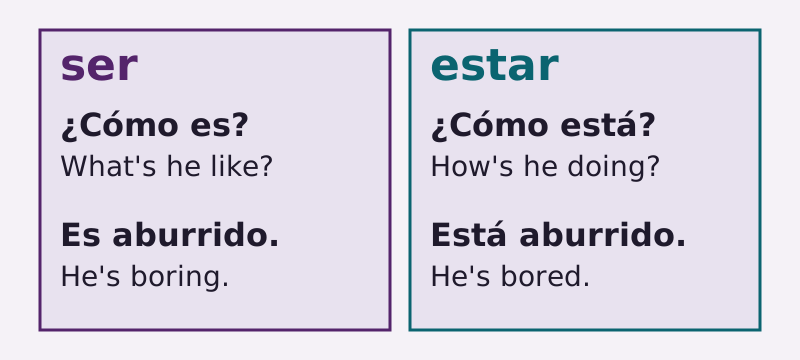
Two everyday questions carry the same split, so they make a good test. ¿Cómo es tu hermana? asks what your sister is like. ¿Cómo estás? asks how you are right now. If your adjective answers the first kind, use ser. If it answers the second, use estar.
"What he is like, and how he is doing" from Conversation Mile (https://conversationmile.com/grammar-in-use/ser-vs-estar/). CC BY 4.0 (creativecommons.org/licenses/by/4.0)
Where does the shortcut fail?
"Ser is permanent, estar is temporary" will lead you wrong in these places.
Where an event is held. A thing's location takes estar, but FSI translates the ser version of this question as asking where a party is being held. So you can say ¿Dónde es la fiesta de cumpleaños? even though it asks "where." FSI also lists an estar version, glossed simply as "where's the party?", and it doesn't say which one people use more. Its day takes ser too, like the date row in the first table: La fiesta es el lunes. ¡Chévere! doesn't cover this case, so here the page rests on FSI's course from the 1950s and on sentences like this one.
Death. Nothing is more permanent, and it still takes estar: Está muerto. ¡Chévere! explains it as a change away from being alive.
Married. FSI's drills say es casada and es soltero with ser. Tatoeba has both Está casado. and ¿Es casado o soltero? The sources read for this page don't say which regions prefer which. Listen to the people you'll talk to, or ask a tutor in your first lesson.
Pregnant. ¡Chévere! lists this one with estar too: Mi compañera está embarazada. It's a state, even if it lasts for months, and it's only said of women.
The same thing on a good day. FSI points out that a Spanish speaker can't simply say a house is pretty. La casa es bonita. means it's a pretty house, and La casa está bonita. Built by this site to show the contrast means it looks pretty right now.
Which adjectives change meaning?
With these adjectives the verb changes what you've said, so learn them as pairs. The meanings come from ¡Chévere!.
| Word | With ser | With estar |
|---|---|---|
| aburrido | Tom es aburrido. boring | Tom está aburrido. bored |
| listo | El niño es listo. clever | El niño está listo. ready |
| verde | La fruta es verde. green in color | La fruta está verde. not ripe |
| rico | La mujer es rica. wealthy | La comida está rica. delicious |
| vivo | El abuelo es vivo. clever, alert | El abuelo está vivo. still alive |
One warning from ¡Chévere!: está rico or está rica said about a person has a sexual meaning and can offend. Keep it for food.
Age can go both ways too. La abuela está joven para su edad. says she looks young for her age. ¡Chévere! sets it against Tienes diez años, eres muy joven para mirar esa película. (You're ten, so you're too young to watch that movie.), where ser treats youth as a plain fact about someone.
What are the forms?
You need these forms before anything else on this page works. Both verbs are irregular, so learn them as sound, not as a rule.
| Person | ser | estar |
|---|---|---|
| I | soy | estoy |
| you (familiar) | eres | estás |
| he, she, you (formal) | es | está |
| first person plural | somos | estamos |
| you all (Spain only, familiar) | sois | estáis |
| they, you all | son | están |
¡Chévere! marks the vosotros row as used only in Spain, with ustedes son as the Latin American form. There's one more "you" to know. Trayectos, an open course from COERLL, uses vos for familiar "you" in Argentina and Uruguay, and vos has forms of its own: Vos sos estudiante. (You're a student.) If the people you'll talk to use vos, copy their forms.
You can check other tenses in the conjugation lookup. Say each one with steady vowels, and put the stress on the last syllable of está.
How do you train the choice out loud?
FSI's advice is plain: you build a feel for this by making many sentences your own, memorized in context. A rule alone won't do it. So train with sentences about people and things you know.
Start with one person. Say your sister is at home with a cold. Out loud, without writing anything, give two ser sentences about her and two estar sentences, with each adjective matching her. Who is she? Where is she from? Where is she today? How does she feel?
Then move on to the next person or thing: a friend, a coworker, your desk, your town. Give each one two sentences with each verb. When you run out of names, start the list again and change the details.
Count it in Spoken Minutes. On a 5-minute day, spend 1 minute on yesterday's Cold Say-Back and 4 on the people drill. On a 10-minute day, it's 2 and 8. On a 20-minute day, it's 3 on the Cold Say-Back, 10 on the drill and 7 on the self-test below, run twice. The self-test belongs to the 20-minute day, so skip it on shorter days. On your first day there's nothing to say back yet, so all of it goes to the drill. This split and the drill are this site's House routine, untested with learners. Add the minutes to your Mile Log.
On a 20-minute day, test yourself from English. Say each line in Spanish before you read the verb after it.
- He is sick. (estar, a condition)
- The party's Monday. (ser, a day)
- Where's the zoo? (estar, a place)
- Where is the birthday party? (ser or estar: FSI lists both, so either one counts)
- My desk is made of wood. (ser, a material)
- He is dead. (estar, even though it won't change)
- The fruit isn't ripe. (estar, because ser would mean its color)
If you miss one, don't reread the rule. Go back to the sentence in the table and say it three times.
Once this feels easier, the same habit carries over to other choices that English hides, like por and para, the two past tenses and the subjunctive. If you're just starting, the Spanish starting plan shows where this fits.
Tomorrow, before you look at anything, run a Cold Say-Back: say how a person is boring, then how the same person is bored, then ask where a party is being held.
What this rests on
Checked against
- Ser for identifying, origin, profession, description, dates and ownership with de Source 1
- An adjective's ending follows the noun it describes Source 2
- Estar forms, and estar for where people and things are, including a town in the mountains Source 3
- Estar with adjectives for emotions and conditions Source 4
- Traits with ser, states with estar; adjectives that change meaning, including joven with both verbs; rico with people; muerto and embarazada with estar; ¿Cómo es? and ¿Cómo está? Source 5
- ¡Chévere! says the present progressive always refers to an action in progress, and that plans take the present or a future form Source 6
- Materials and clock time with ser; location, progressive and conditions with estar Source 7
- A noun for identity always takes ser; a ser question for where a party is held listed beside an estar question; es bonita against está bonita; building a feel by memorizing sentences in context Source 8
- Casado and soltero drilled with ser Source 9
- Vos for familiar you in Argentina and Uruguay Source 10
House routine
- The order of the questions in the chart, the people-and-things drill, the 5, 10 and 20 Spoken Minute splits, the self-test, saying a missed sentence 3 times, and the Cold Say-Back
Sources
- Brown, Escudero, Montoya and Small. ¡Chévere! Introductory Spanish I, 2.12: Gramática, El verbo ser / Ser + de. SUNY Oneonta via OER SUNY Open. Read: The whole page. License: CC BY 4.0.
- Brown, Escudero, Montoya and Small. ¡Chévere! Introductory Spanish I, 2.17: Gramática, Concordancia de adjetivos. SUNY Oneonta via OER SUNY Open. Read: The whole page. License: CC BY 4.0.
- Brown, Escudero, Montoya and Small. ¡Chévere! Introductory Spanish I, 7.7: Gramática, El verbo estar + preposiciones / ¿Dónde?. SUNY Oneonta via OER SUNY Open. Read: The whole page. License: CC BY 4.0.
- Brown, Escudero, Montoya and Small. ¡Chévere! Introductory Spanish I, 9.7: Gramática, Estar + emociones. SUNY Oneonta via OER SUNY Open. Read: The whole page. License: CC BY 4.0.
- Brown, Escudero, Montoya and Small. ¡Chévere! Introductory Spanish I, 9.11: Gramática, Ser y Estar I / ¿Cómo?. SUNY Oneonta via OER SUNY Open. Read: The whole page. License: CC BY 4.0.
- Brown, Escudero, Montoya and Small. ¡Chévere! Introductory Spanish I, 11.7: Gramática, El presente progresivo. SUNY Oneonta via OER SUNY Open. Read: The whole page. License: CC BY 4.0.
- Brown, Escudero, Montoya and Small. ¡Chévere! Introductory Spanish I, 11.15: Gramática, Ser y Estar II. SUNY Oneonta via OER SUNY Open. Read: The whole page. License: CC BY 4.0.
- Stockwell, Bowen and Silva-Fuenzalida. Spanish Basic Course: Units 1-15, Unit 5, section 5.21.1. Foreign Service Institute, U.S. Department of State, 1961 printing (first printed 1957) Open. Read: Section 5.21.1, from a scanned copy with some unreadable characters.
- Stockwell, Bowen and Silva-Fuenzalida. Spanish Basic Course: Units 1-15, Unit 7, review drill 7.24. Foreign Service Institute, U.S. Department of State, 1961 printing (first printed 1957) Open. Read: Drill 7.24, from a scanned copy with some unreadable characters.
- Zapata. Trayectos, Volumen 2: Más sobre mí, Módulo 1, pp. 3 and 14. COERLL, University of Texas at Austin, 2022 Open. Read: The note on vos in Argentina and the pronoun table on pp. 3 and 14. License: CC BY-SA 4.0.
Sentence credits
- Tom está aburrido. Tatoeba sentence 2580796 by hayastan; English by CK. CC BY 2.0 FR.
- Tom es aburrido. Tatoeba sentence 2436012 by hayastan; English by CK. CC BY 2.0 FR.
- Yo soy Manuel. ¡Chévere! Introductory Spanish I, 2.12. CC BY 4.0.
- Él es profesor. Tatoeba sentence 1281275 by marcelostockle; English by CK. CC BY 2.0 FR.
- Soy de Ecuador. Tatoeba sentence 1718466 by marcelostockle; English by pauldhunt. CC BY 2.0 FR.
- Mi escritorio es de madera. Tatoeba sentence 2348058 by marcelostockle; English by CK. CC BY 2.0 FR.
- El cuaderno azul es de Raúl. ¡Chévere! Introductory Spanish I, 2.12. CC BY 4.0.
- Son las cinco menos cuarto. Tatoeba sentence 8814106 by arh; English by sundown. CC BY 2.0 FR.
- La fiesta es el lunes. Tatoeba sentence 5970750 by arh; English by mailohilohi. CC BY 2.0 FR.
- Judy es lista. Tatoeba sentence 1292130 by marcelostockle; English by CN. CC BY 2.0 FR.
- ¿Dónde está el zoológico? Tatoeba sentence 843181 by hayastan; English by parheliu. CC BY 2.0 FR.
- Oneonta está en las montañas. ¡Chévere! Introductory Spanish I, 7.7. CC BY 4.0.
- ¿Dónde están las fresas? Tatoeba sentence 6022094 by Julian_L; English by CK. CC BY 2.0 FR.
- Tom está enfermo. Tatoeba sentence 1306044 by marcelostockle; English by CK. CC BY 2.0 FR.
- Estoy aburrida. Tatoeba sentence 3668871 by cueyayotl; English by Asma. CC BY 2.0 FR.
- Estoy aburrido. Tatoeba sentence 455828 by lukaszpp; English by Clavain. CC BY 2.0 FR.
- La acera está cerrada. ¡Chévere! Introductory Spanish I, 9.11. CC BY-SA 4.0 (page is CC BY 4.0 with some content adapted under CC BY-SA; treated as BY-SA).
- Estoy estudiando. Tatoeba sentence 451710 by Shishir; English by CK. CC BY 2.0 FR.
- Vamos al cine este fin de semana. ¡Chévere! Introductory Spanish I, 11.7. CC BY 4.0.
- Estoy cansada de trabajar. Tatoeba sentence 13709608 by ecorralest101; English by frpzzd. CC BY 2.0 FR.
- Estoy cansado de esperar. Tatoeba sentence 5017490 by don_ramon; English by CK. CC BY 2.0 FR.
- Ella está enferma. Tatoeba sentence 5085421 by cueyayotl; English by _undertoad. CC BY 2.0 FR.
- ¿Cómo es tu hermana? Tatoeba sentence 6164921 by cls; English by cls. CC BY 2.0 FR.
- ¿Cómo estás? Tatoeba sentence 397688 by brauliobezerra; English by CK. CC BY 2.0 FR.
- ¿Dónde es la fiesta de cumpleaños? Tatoeba sentence 7147850 by arh; English by araneo. CC BY 2.0 FR.
- Está muerto. Tatoeba sentence 13453969 by Seael; English by popball. CC BY 2.0 FR.
- Está casado. Tatoeba sentence 9841483 by arh; English by CM. CC BY 2.0 FR.
- ¿Es casado o soltero? Tatoeba sentence 5020721 by don_ramon; English by Jane_Austen. CC BY 2.0 FR.
- Mi compañera está embarazada. ¡Chévere! Introductory Spanish I, 9.11. CC BY-SA 4.0 (page is CC BY 4.0 with some content adapted under CC BY-SA; treated as BY-SA).
- La casa es bonita. Tatoeba sentence 690149 by Shishir; English by YeshuaC. CC BY 2.0 FR.
- El niño es listo. ¡Chévere! Introductory Spanish I, 9.11. CC BY-SA 4.0 (page is CC BY 4.0 with some content adapted under CC BY-SA; treated as BY-SA).
- El niño está listo. ¡Chévere! Introductory Spanish I, 9.11. CC BY-SA 4.0 (page is CC BY 4.0 with some content adapted under CC BY-SA; treated as BY-SA).
- La fruta es verde. ¡Chévere! Introductory Spanish I, 9.11. CC BY-SA 4.0 (page is CC BY 4.0 with some content adapted under CC BY-SA; treated as BY-SA).
- La fruta está verde. ¡Chévere! Introductory Spanish I, 9.11. CC BY-SA 4.0 (page is CC BY 4.0 with some content adapted under CC BY-SA; treated as BY-SA).
- La mujer es rica. ¡Chévere! Introductory Spanish I, 9.11. CC BY-SA 4.0 (page is CC BY 4.0 with some content adapted under CC BY-SA; treated as BY-SA).
- La comida está rica. ¡Chévere! Introductory Spanish I, 9.11. CC BY-SA 4.0 (page is CC BY 4.0 with some content adapted under CC BY-SA; treated as BY-SA).
- El abuelo es vivo. ¡Chévere! Introductory Spanish I, 9.11. CC BY-SA 4.0 (page is CC BY 4.0 with some content adapted under CC BY-SA; treated as BY-SA).
- El abuelo está vivo. ¡Chévere! Introductory Spanish I, 9.11. CC BY-SA 4.0 (page is CC BY 4.0 with some content adapted under CC BY-SA; treated as BY-SA).
- La abuela está joven para su edad. ¡Chévere! Introductory Spanish I, 9.11. CC BY-SA 4.0 (page is CC BY 4.0 with some content adapted under CC BY-SA; treated as BY-SA).
- Tienes diez años, eres muy joven para mirar esa película. ¡Chévere! Introductory Spanish I, 9.11. CC BY-SA 4.0 (page is CC BY 4.0 with some content adapted under CC BY-SA; treated as BY-SA).
- Vos sos estudiante. Tatoeba sentence 10047202 by hayastan; English by DJ_Saidez. CC BY 2.0 FR.
Next stops
Cite this page
Ser vs Estar: What Something Is, Where It Is, How It Is Now. Conversation Mile, 2026-11-10. https://conversationmile.com/grammar-in-use/ser-vs-estar/
Corrections
No corrections on this page. Spotted a language error? Please tell this site.