Your First 90 Days Plan
Learn Spanish for Beginners by Speaking From Week One
Straight answer
Start Spanish today with two sentences about yourself. Say this out loud, with your own name in it: Me llamo Tom. Then say where you're from, with your own place: Soy de Ecuador. Look away and say both again. You've spoken Spanish today.
The English trap
¡Chévere! says así así, the "so-so" that Spanish-speaking characters say in American movies, isn't accurate. For "I'm OK," it gives más o menos or regular.
Say this today
Estoy más o menos.
I am ok.
This page covers what's particular to Spanish in your first two weeks. The general plan covers how the days work overall, and its planner can lay out your 90 days.
Whose Spanish should you copy?
Spanish changes from place to place, and you'll meet some of it in your first week. Pick the Spanish of the people you plan to talk to. If you don't know yet, pick one and keep it for two weeks. That's a House routine, not a rule of the language.
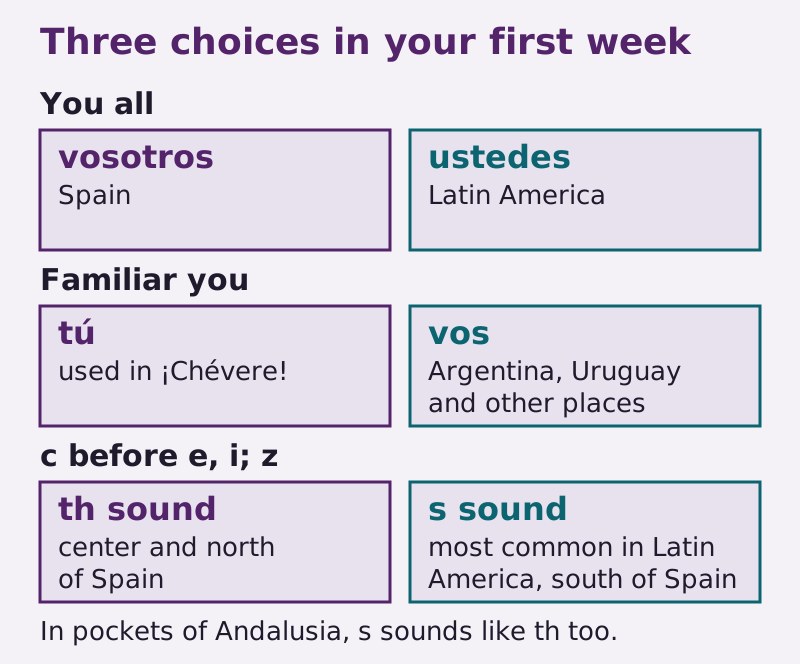
"Three regional choices in the first week of Spanish" from Conversation Mile (https://conversationmile.com/start/how-to-learn-spanish/). CC BY 4.0 (creativecommons.org/licenses/by/4.0)
Three differences show up early:
- You all. ¡Chévere!, an open first-year textbook, marks the vosotros forms as used only in Spain. Latin America uses ustedes instead.
- Familiar you. Trayectos, an open course from the University of Texas, uses vos for familiar "you" in Argentina and Uruguay. Vos has its own verb forms. These lines from Tatoeba use them: ¿De dónde sos? asks where you're from, where tú gives ¿De dónde eres? There's also Disculpame, ¿cómo te llamás? (Sorry, what's your name?) and Estoy bien, ¿y vos? (I am fine, and you?) Wiktionary lists llamás as the vos form of llamar. Wiktionary also lists vos in other places, such as Central America, Chile and Paraguay. Don't carry these Tatoeba lines over to those places as they are. Ask the people you'll talk to which forms they use.
- C, z and s. ¿Cómo suena?, an open phonetics book, says that c before e or i, z and s all coming out as s is the most common way in Latin America and the south of Spain. In the center and north of Spain, c and z there sound like the th in "thin." The book also notes pockets of Andalusia, in the south, where s sounds like that th too.
None of these is the wrong one. They're just different places.
Which sounds come first?
Spend your first two weeks on the five vowels and the r. The U.S. Foreign Service Institute's Spanish course from the 1950s, known as FSI, does something similar: its first two units are mostly about pronunciation.
¿Cómo suena? says Spanish has five vowels, each short and steady. English speakers tend to slide the e, so este comes out like "estey." Say Hola, ¿cómo estás? and hold each vowel still. The h in hola is silent: Wiktionary's pronunciation of hola starts on the o. The same list warns about a y sound slipping in before u, so universidad turns into "yuniversidad," and about stretching vowels until pan sounds like "paaan." Start right on the u. Keep every vowel short. The Spanish pronunciation page goes through the rest, and the alphabet week covers the letters.
Spanish has two r sounds. The tap touches the ridge behind your top teeth once, and the trill touches it several times. Swap them and you get a different word. The page on rolling your r breaks the trill down step by step.
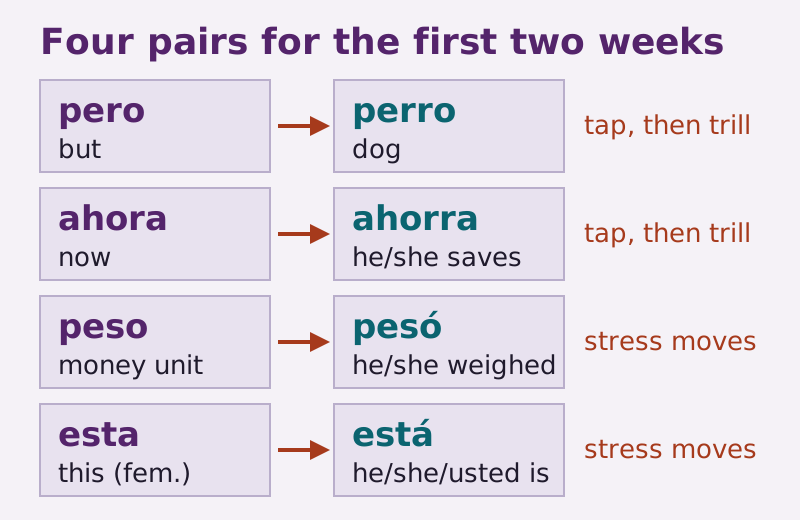
"Four Spanish pairs that differ by one sound or by stress" from Conversation Mile (https://conversationmile.com/start/how-to-learn-spanish/). CC BY 4.0 (creativecommons.org/licenses/by/4.0)
These pairs each differ by one sound or by stress. The h in ahora and ahorra is silent, since Wiktionary's pronunciations of ahora and ahorrar have no h sound, so the only change in that pair is the r. The alphabet week has more on the h. Say each word alone, then both together.
| Pair | What changes | Meanings |
|---|---|---|
| pero, perro | Tap, then trill | but, dog |
| ahora, ahorra | Tap, then trill | now, he or she saves (ahorrar) |
| peso, pesó | Stress moves to the end | a unit of money, he or she weighed |
| esta, está | Stress moves to the end | this (feminine), he, she or usted is (estar) |
The first two pairs come from ¿Cómo suena?, and the last two from FSI's drills on stress. Now try both r sounds in one line, the tap in pero and the trill in perro: ¡Pero qué enorme perro! The minimal pairs tool has more.
What do you say first?
Your first sentences are greetings, your name and where you're from. Spanish makes you choose between two words for "you" right away. ¡Chévere! sets usted as the formal one and tú as the informal one.
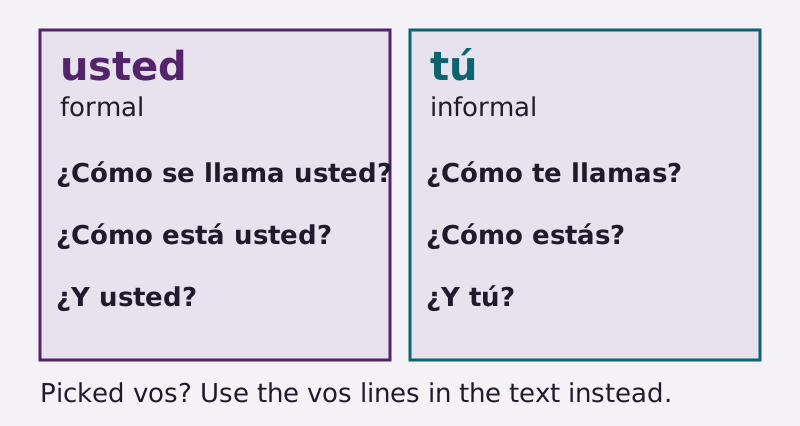
"The same three questions with usted and with tú" from Conversation Mile (https://conversationmile.com/start/how-to-learn-spanish/). CC BY 4.0 (creativecommons.org/licenses/by/4.0)
| Formal (usted) | Informal (tú) | Meaning |
|---|---|---|
| ¿Cómo se llama usted? | ¿Cómo te llamas? | What's your name? |
| ¿Cómo está usted? | ¿Cómo estás? | How are you? |
| ¿Y usted? | ¿Y tú? | And you? |
Say the left column, then the right. The tú column is for people who picked tú. If you picked vos, use the vos lines from the list above in its place. For the name, the question part ¿cómo te llamás? is enough, since Disculpame only adds "excuse me." For "and you?", use the ¿y vos? from Estoy bien, ¿y vos? This page's sources give no vos line for "How are you?", so for that row use the usted line or ask the person you're talking to. Don't say ¿Cómo te llamas? from the tú column, and don't build other vos forms yourself. ¡Chévere! adds that some of the difference is subtle and depends on the setting. With a tutor you've just met, ask which one they'd like you to use.
Now answer. Estoy bien, gracias. means "I'm fine, thank you." For "I'm OK," ¡Chévere! gives Estoy más o menos. It also lists regular for the same answer, and warns against así así. For "nice to meet you," ¡Chévere! uses ¡Mucho gusto! in both its formal and its informal dialogues. If you say "pleased to meet you" with encantado, the ending follows you: ¡Chévere! has a man say encantado and a woman say encantada. With tú, a woman can say the book's line Encantada de conocerte. A man puts the same de conocerte after encantado: Encantado de conocerte. With usted, a man in ¡Chévere!'s formal dialogue says Encantado de conocerle. A woman changes encantado to encantada there too.
How should you learn nouns?
Learn each noun together with its word for "the." FSI's course says to memorize a noun's gender along with it, and that usually you can do this by memorizing el or la with the noun. So learn el libro, not just libro. Say Dame el libro. (Give me the book.)
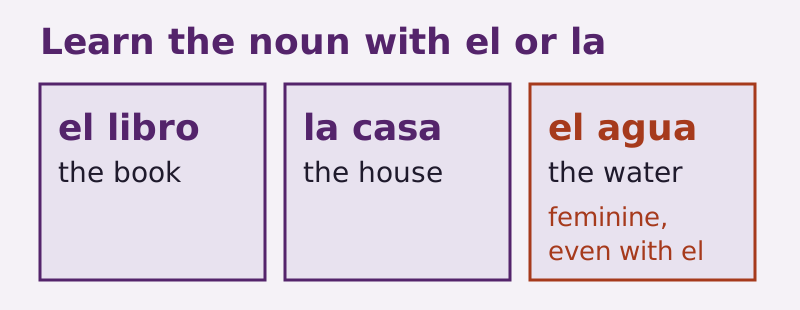
"Spanish nouns learned with their article" from Conversation Mile (https://conversationmile.com/start/how-to-learn-spanish/). CC BY 4.0 (creativecommons.org/licenses/by/4.0)
FSI also flags an exception: el agua takes el but is feminine. The adjective after it shows this, since fría is the feminine form: El agua está fría. (The water's cold.)
Agua isn't alone. Wiktionary's entry for el says it's also used before feminine nouns that start with a stressed a sound, such as el alma (the soul) and el aula (the classroom). So when a noun starts with a stressed a, el doesn't tell you the gender. Check the dictionary, or listen for the ending on a word that follows it.
These little words come up all the time. In this site's count of words in Tatoeba, a free collection of example sentences, la ranks 2nd and el ranks 4th. It counts written forms, so la there also includes la as a pronoun ("her" or "it"). That count only covers this sentence collection, not Spanish in general, and the first 1,000 words page explains how it was made. Take your first nouns from there and say each one in a short sentence.
How do the first 14 days run?
Three jobs take turns, as in the general plan. For Spanish, they hold these:
- Sounds. The five vowels and the two r sounds first, then the letter names from the alphabet week, row by row.
- Pairs. The four pairs above, said alone and then together.
- Sentences. Greetings, your name and where you're from, in both the tú (or vos) and the usted versions, and nouns with el or la.
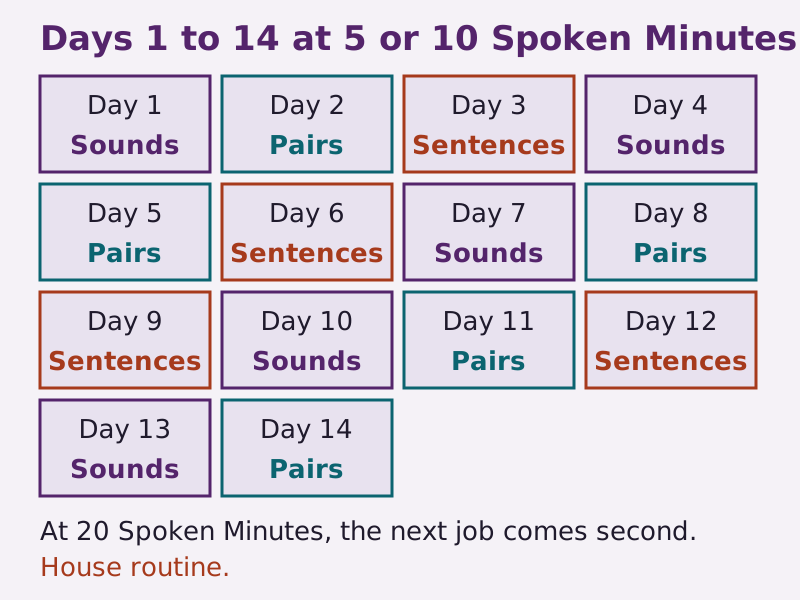
"Three jobs taking turns over the first 14 days of Spanish" from Conversation Mile (https://conversationmile.com/start/how-to-learn-spanish/). CC BY 4.0 (creativecommons.org/licenses/by/4.0)
Count the work in Spoken Minutes, which run only while you're saying Spanish out loud. Each day opens with a Cold Say-Back: say something from an earlier day from memory, then check it.
On a 5-minute day, spend 1 minute on the Cold Say-Back and 4 on the day's job. On a 10-minute day, it's 2 and 8. On a 20-minute day, it's 3 on the Cold Say-Back, then 10 on one job and 7 on the next. Day 1 has nothing to say back yet, so those minutes go to the day's first job. At 20 Spoken Minutes, the next job in the turn comes second: day 1 is sounds then pairs, day 2 pairs then sentences, day 3 sentences then sounds. These splits are this site's House routine, untested with learners.
A Sounds turn splits its time between the vowels and r and the letter names:
| Sounds time | Vowels and r | Letter names |
|---|---|---|
| 4 minutes, on a 5-minute day | 2 | 2, the next two rows |
| 8 minutes, on a 10-minute day | 4 | 4, the next two rows |
| 10 minutes, on a 20-minute day | 5 | 5, the next row and its review |
| 7 minutes, on a 20-minute day | 3 | 4, the next row and its review |
Do the five vowels first, then the tap and the trill, about half the time each. On day 1, the Cold Say-Back minutes go to the letters. The alphabet table has seven rows, and both ways they're done by day 10. At 5 or 10 minutes, it's rows 1 and 2 on day 1, 3 and 4 on day 4, 5 and 6 on day 7, and row 7 on day 10. At 20 minutes, it's one row on each of days 1, 3, 4, 6, 7, 9 and 10. After that, the whole Sounds time goes to the vowels and the r. This split is House routine too.
Here's day 2 at 10 Spoken Minutes. You spend 2 minutes on day 1's five vowels and r, the letter names a to n from rows 1 and 2, and your two lines from the top of this page, Me llamo… and Soy de…, all from memory. Then you spend 8 on the four pairs, starting with pero and perro, each word alone and then both.
Day 3 at 20 Spoken Minutes could look like this. You spend 3 minutes saying an earlier pair, peso and pesó, from memory. The next 10 go to sentences: ask and answer names in the tú version, or the vos lines if you picked vos, and then the usted version. The last 7 go to sounds. Spend 3 of them on the vowels and the r together, the five vowels first and then the tap and the trill, about half each. Spend the other 4 on row 2 of the alphabet table and its review. Add the minutes to your Mile Log.
What can wait until after week two?
Leave these for later. You'll meet some of them inside your first sentences, and that's fine. Say those sentences as whole lines and don't stop to work out the grammar yet.
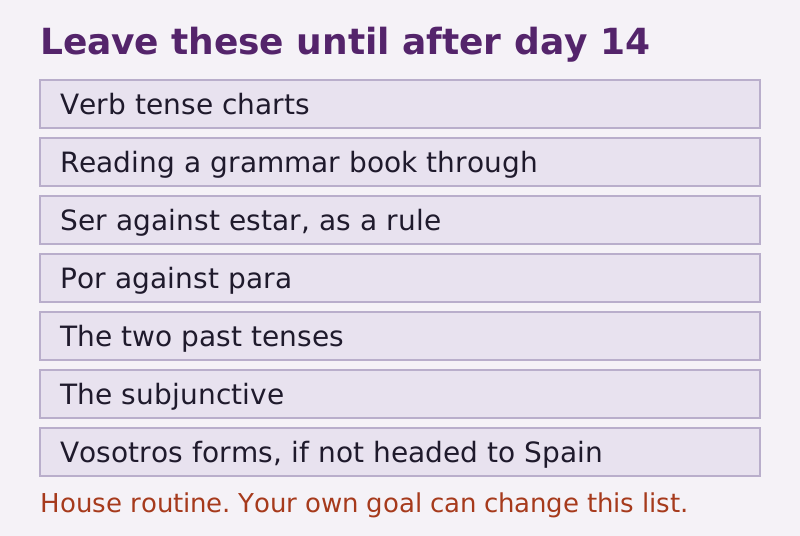
"What a Spanish learner can leave until after day 14" from Conversation Mile (https://conversationmile.com/start/how-to-learn-spanish/). CC BY 4.0 (creativecommons.org/licenses/by/4.0)
- Ser and estar. Soy de… uses one verb for "to be" and ¿Cómo estás? uses the other. Learn them as lines now. Ser vs estar explains the choice when you're ready.
- Me llamo. It comes from llamarse, a verb that Wiktionary lists with se attached. Reflexive verbs can wait.
- Por and para, the two past tenses, the subjunctive. Each has its own page: por vs para, preterite vs imperfect and the subjunctive. None of them belongs in your first two weeks.
- Verb charts. When you need a form, look it up in the conjugation lookup and say it in a sentence.
- Vosotros forms, if the people you'll talk to aren't in Spain.
This list fits someone learning to talk, and you can change it if your goal is different. After day 14, go back to the general plan for days 15 to 45, where your first conversation is on day 30. If you're learning another language instead, there's a French start and a German start.
Tomorrow, before you look at anything, run a Cold Say-Back: say your name and where you're from, then ask someone's name both ways, with tú (or your vos line) and with usted.
What this rests on
Checked against
- Vosotros forms only in Spain, with ustedes in Latin America Source 3
- Vos for familiar you in Argentina and Uruguay Source 4
- Vos listed in other places too, the meanings of the words in the pairs, el before feminine nouns starting with a stressed a, la also being a pronoun, llamás as the vos form of llamar, disculpar meaning to excuse, and the silent h in hola, ahora and ahorrar Source 5
- Seseo as the most common way in Latin America and the south of Spain; distinción in the center and north of Spain; ceceo in pockets of Andalusia Source 8
- Five short, steady vowels and the English slide in este Source 6
- Tap and trill, pero and perro, ahora and ahorra Source 7
- FSI's course putting pronunciation first; peso and pesó, esta and está Source 9
- Learning each noun with el or la, and el agua being feminine Source 10
- Greetings, encantado and encantada, Encantada de conocerte as informal, and más o menos or regular instead of así así Source 1
- Usted as formal and tú as informal, and a man saying Encantado de conocerle in the formal dialogue Source 2
- The vos lines, and Encantado de conocerte as a whole sentence Source 11
- La and el near the top of this site's count of Tatoeba sentences Source 11
House routine
- Vowels and r in the first two weeks, three jobs taking turns, the 5, 10 and 20 Spoken Minute splits with the Cold Say-Back first, day 1 with no Cold Say-Back and its minutes going to the first job, the order of the two jobs on a 20-minute day, the split of a Sounds turn between the vowels and r and the alphabet rows, and staying with one region's Spanish for two weeks
Sources
- Brown, Escudero, Montoya and Small. ¡Chévere! Introductory Spanish I, 1.4: Vocabulario, ¡Bienvenidos a la clase!. SUNY Oneonta via OER SUNY Open. Read: The whole page: the dialogues, the vocabulary tables and the note on así así. License: CC BY 4.0.
- Brown, Escudero, Montoya and Small. ¡Chévere! Introductory Spanish I, 1.6: Gramática, ¿Formal o informal?. SUNY Oneonta via OER SUNY Open. Read: The two dialogues and the paragraph after them; the embedded interview, under a separate license, used only as background. License: CC BY 4.0.
- Brown, Escudero, Montoya and Small. ¡Chévere! Introductory Spanish I, 2.12: Gramática, El verbo ser / Ser + de. SUNY Oneonta via OER SUNY Open. Read: The note that vosotros forms are only used in Spain. License: CC BY 4.0.
- Zapata. Trayectos, Volumen 2: Más sobre mí, Módulo 1, pp. 3 and 14. COERLL, University of Texas at Austin, 2022 Open. Read: The note on vos in Argentina and the pronoun table on pp. 3 and 14. License: CC BY-SA 4.0.
- Wiktionary contributors. Entries for vos, llamarse, llamás, disculpar, hola, ahora, ahorrar, agua, fría, ahorra, esta, está, el, la, alma and aula. Wiktionary, as distributed by kaikki.org Open. Read: The Spanish senses and region labels of vos, the gloss of llamarse as llamar with se, the gender of agua, alma and aula, the sense of el used before feminine nouns that start with a stressed a, la as a pronoun, and the glosses used for the pairs. License: CC BY-SA 4.0.
- Escudero, Barreca and Carbone. ¿Cómo suena? Fonética y fonología del español, Módulo 4: Las vocales. SUNY Create OER, 2021 Open. Read: The whole module text; embedded videos not watched. License: CC BY 4.0.
- Escudero, Barreca and Carbone. ¿Cómo suena? Fonética y fonología del español, Módulo 12: Las consonantes vibrantes. SUNY Create OER, 2021 Open. Read: The whole module text; embedded videos not watched. License: CC BY 4.0.
- Escudero, Barreca and Carbone. ¿Cómo suena? Fonética y fonología del español, Módulo 14: Las consonantes fricativas. SUNY Create OER, 2021 Open. Read: The whole module text; embedded videos not watched. License: CC BY 4.0.
- Stockwell, Bowen and Silva-Fuenzalida. Spanish Basic Course: Units 1-15, Introduction and Unit 1, section 1.22. Foreign Service Institute, U.S. Department of State, 1961 printing (first printed 1957) Open. Read: The introduction on method and pronunciation, and the stress pairs in 1.22.1, from a scanned copy with some unreadable characters.
- Stockwell, Bowen and Silva-Fuenzalida. Spanish Basic Course: Units 1-15, Unit 3, discussion of nouns and articles. Foreign Service Institute, U.S. Department of State, 1961 printing (first printed 1957) Open. Read: The paragraphs on noun gender and on memorizing el or la with each noun, from a scanned copy with some unreadable characters.
- Conversation Mile. Word counts computed from Tatoeba sentences (export of 2026-11-07), Spanish list. Sentences by Tatoeba contributors Open. Read: The ranks of la and el in this site's Spanish word-form count; the example sentences on this page and their linked English read one by one, credited under Sentence credits. License: CC BY 2.0 FR.
Sentence credits
- Estoy más o menos. ¡Chévere! Introductory Spanish I, 1.4 Vocabulario: ¡Bienvenidos a la clase!. CC BY 4.0.
- Me llamo Tom. Tatoeba sentence 2351587 by Shishir; English by CK. CC BY 2.0 FR.
- Soy de Ecuador. Tatoeba sentence 1718466 by marcelostockle; English by pauldhunt. CC BY 2.0 FR.
- ¿De dónde sos? Tatoeba sentence 1111668 by hayastan; English by saeb. CC BY 2.0 FR.
- ¿De dónde eres? Tatoeba sentence 3071 by Shishir; English by CK. CC BY 2.0 FR.
- Disculpame, ¿cómo te llamás? Tatoeba sentence 1211919 by El_mas_capo; English by alec. CC BY 2.0 FR.
- Estoy bien, ¿y vos? Tatoeba sentence 1708402 by hayastan; English by japegon. CC BY 2.0 FR.
- Hola, ¿cómo estás? Tatoeba sentence 473456 by Shishir; English by exjimmy. CC BY 2.0 FR.
- ¡Pero qué enorme perro! Tatoeba sentence 1241416 by marcelostockle; English by fliegster. CC BY 2.0 FR.
- ¿Cómo se llama usted? Tatoeba sentence 687369 by lukaszpp; English by frpzzd. CC BY 2.0 FR.
- ¿Cómo te llamas? Tatoeba sentence 449153 by naikodemus; English by frpzzd. CC BY 2.0 FR.
- ¿Cómo está usted? Tatoeba sentence 1308776 by Shishir; English by riccioberto. CC BY 2.0 FR.
- ¿Cómo estás? Tatoeba sentence 397688 by brauliobezerra; English by CK. CC BY 2.0 FR.
- ¿Y usted? Tatoeba sentence 1642424 by Shishir; English by lugal. CC BY 2.0 FR.
- ¿Y tú? Tatoeba sentence 524691 by Shishir; English by CK. CC BY 2.0 FR.
- Estoy bien, gracias. Tatoeba sentence 493008 by Shishir; English by CM. CC BY 2.0 FR.
- ¡Mucho gusto! Tatoeba sentence 2732593 by hayastan; English by mackay. CC BY 2.0 FR.
- Encantada de conocerte. Tatoeba sentence 456638 by lukaszpp; English by lukaszpp. CC BY 2.0 FR.
- Encantado de conocerte. Tatoeba sentence 536849 by joshitobuba; English by CK. CC BY 2.0 FR.
- Encantado de conocerle. Tatoeba sentence 615651 by Leono; English by CK. CC BY 2.0 FR.
- Dame el libro. Tatoeba sentence 538633 by Shishir; English by CK. CC BY 2.0 FR.
- El agua está fría. Tatoeba sentence 1987699 by Shishir; English by CK. CC BY 2.0 FR.
Next stops
Cite this page
Learn Spanish for Beginners by Speaking From Week One. Conversation Mile, 2026-11-10. https://conversationmile.com/start/how-to-learn-spanish/
Corrections
No corrections on this page. Spotted a language error? Please tell this site.