Grammar in Use Grammar
Spanish Subjunctive Starts With the Trigger, Not the Endings
Straight answer
The Spanish subjunctive is a verb form that usually appears after a trigger, so learn the trigger first. Say this out loud: Quiero que escuches. It means "I want you to listen," and the wanting is what calls for the form. Most of this page rests on one old source, the U.S. Foreign Service Institute's 1959 Spanish course. It leans Latin American, so wording may differ today and in Spain.
The English trap
FSI's 1959 course warns that English often gives no sign that Spanish needs a subjunctive. I don't think that's right looks like any other sentence in English, so you can't translate your way to the form.
Say this today
Quiero que escuches.
I want you to listen.
What does a trigger look like?
Most triggers fit one frame. A first verb sets it off, que links it, a new subject follows, and that subject's verb is in the subjunctive.
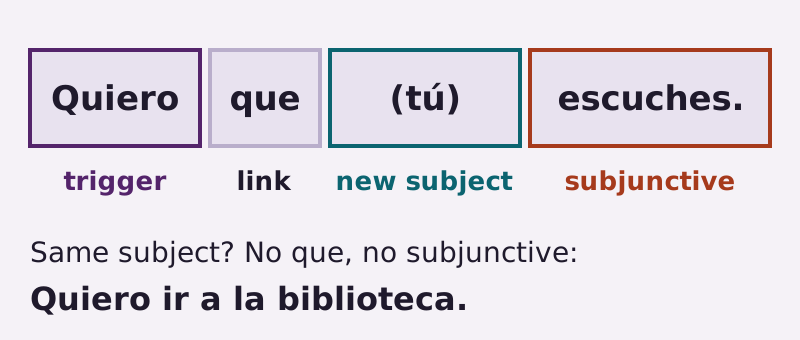
"The subjunctive frame" from Conversation Mile (https://conversationmile.com/grammar-in-use/spanish-subjunctive/). CC BY 4.0 (creativecommons.org/licenses/by/4.0)
The new subject matters. If you want something for yourself, there is no second person involved, so you keep the infinitive, the "to" form of the verb: Quiero ir a la biblioteca. Say that, then say Quiero que salgas. FSI says the frame "usually" works this way and calls neither condition strictly required, so treat it as a strong pattern.
One trigger needs no frame. Ojalá, which FSI glosses as something like "would to God," takes the form on its own: Ojalá tengas suerte. and Ojalá te vaya bien.
English has leftovers of this form, which FSI uses to explain it: "I move that the proposal be tabled," "Thy kingdom come," "if he were to come." Those sound formal or old to you. FSI's point is that the Spanish form carries no such flavor. It belongs to everyday talk.
Starting here and not with tables is this site's choice, not a finding from FSI. Its reason is simple: you can say a whole sentence today with only one form you've met.
Which verbs set it off?
FSI sorts these verbs into three groups: pushing your will on someone, doubt, and emotion. It puts esperar (to hope) with the emotions. Its lists aren't complete, and it says so.
| Group | Say it | Meaning |
|---|---|---|
| Will | ¿Quieres que vaya ahora? | Do you want me to go now? |
| Will | No dejes que te engañen. | Don't let them fool you. |
| Feeling | Espero que mañana haga más calor. | I hope tomorrow is warmer. |
| Feeling | Me alegra que vengas. | I'm glad that you'll come. |
| Feeling | Siento que nos dejes. | I'm sorry you're leaving us. |
| Doubt | Dudo que Tomás venga. | I doubt Tom will come. |
| Doubt | No creo que sea correcto. | I don't think that's right. |
Without a trigger, Spanish uses its ordinary verb form, which grammar books call the indicative. The meaning of the first verb decides which one you need, not its spelling. Say both sides of these two pairs.
| Meaning | Indicative | Subjunctive |
|---|---|---|
| decir: reporting or ordering | Dice que viene enseguida. He says he will come at once. | Dice que venga. Built by this site to show the contrast He says you should come. |
| creer: believing or not | Creo que es verdad. I believe it to be true. | No creo que sea correcto. I don't think that's right. |
FSI adds a wrinkle on no creo que: a speaker can use either form, and the choice shows how much doubt they mean. This site's House routine is to use the subjunctive as your default there.
In Dice que venga, the venga form is the one for usted, so the "you" is formal. The same form also works for he or she, and for I: he says she should come, or he says I should come. Said to a friend as tú, it would be vengas.
What about "it is" phrases?
Phrases built on es plus a describing word work the same way when they lack certainty. FSI lists necessary, better, possible, important, probable and a pity, among others.
| Say it | Meaning |
|---|---|
| Es posible que nieve. | It may snow. |
| Es importante que respondas. | It's important that you answer. |
Certainty phrases go the other way, until you negate them. Say this pair and listen to the second verb change.
| Certain | Negated |
|---|---|
| Es verdad que está muerta. It's true that she's dead. | No es verdad que sea viernes. It's not true that it's Friday. |
With no person named, you don't need the frame at all. Use the infinitive: Es importante aprender alemán. (It is important to learn German.)
What about someone you haven't found yet?
If you have a specific person in mind, use the indicative. If anyone will do, or nobody may exist, use the subjunctive. Say these two and hear the difference between habla and hable.
| What you mean | Say it | Meaning |
|---|---|---|
| Not yet found | Busco a alguien que hable portugués. | I'm looking for someone who can speak Portuguese. |
| One known person | Busco a la persona que habla portugués. Built by this site to show the contrast | I'm looking for the person who speaks Portuguese. |
| May not exist | ¿Hay alguien que sepa conducir? | Is there anybody who can drive a car? |
Decide by whether you have someone specific in mind, not by the little word before the noun. FSI says that after el or la there, the indicative is near certain, while un or una only makes the subjunctive likely. It warns that "a person" can still mean someone you met yesterday, and then the indicative is right: Tengo un hijo que está enfermo. (I have a son who's sick.) And it stresses that the form doesn't create the vagueness. It only expresses vagueness that's already there.
Which connectors always call for it?
FSI's list of connectors that always take the subjunctive is short enough to learn: antes de que (before), para que (so that), con tal de que (provided that), en caso de que (in case), sin que (without), a menos que (unless).
| Say it | Meaning |
|---|---|
| Quiero hablarte antes de que salgas. | I want to talk to you before you leave. |
| Vamos a ayudarlo para que tenga éxito. | Let's help him so that he will succeed. |
| Yo también voy, a menos que llueva. | Unless it rains, I will go, too. |
| No tienes que ir a menos que quieras. | You don't have to go unless you want to. |
FSI says these connectors suggest something not yet done, and that they take the subjunctive whenever a conjugated verb follows. A new subject isn't what calls for it. In the last sentence above, both verbs are about you, and quieras is still subjunctive. What a new subject changes is your options. FSI shows that with sin: with the same subject you can also say sin plus the "to" form, and with a different subject only sin que works. FSI shows that choice only with sin, so don't assume every connector has a "to" form.
When can the same word go either way?
Words like cuando (when), en cuanto and tan pronto como (as soon as) and hasta que (until) depend on whether the event has happened yet.
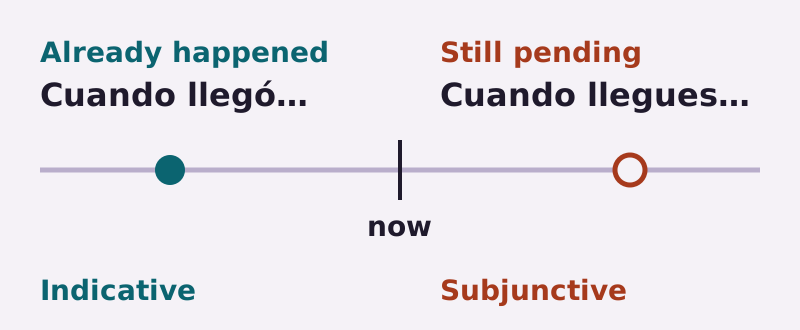
"Cuando with a done event and a pending one" from Conversation Mile (https://conversationmile.com/grammar-in-use/spanish-subjunctive/). CC BY 4.0 (creativecommons.org/licenses/by/4.0)
| Word | Done or settled | Still pending |
|---|---|---|
| cuando | Cuando llegó hice café. When he arrived, I made coffee. | Cuando llegues allí llámame. When you get there, call me. |
| aunque | Aunque no quería beber solo, lo hice. Even though I didn't want to drink alone, I did. | Aunque no lo hagas, yo lo haré. Even if you don't do that, I will. |
More pending ones to say: En cuanto llegue, avísame. (let me know as soon as he comes), Tan pronto como llegue se lo diré. (as soon as he arrives, I'll tell him), and Esperaré aquí hasta que vuelva. (I will wait here until he comes back).
FSI lists aunque (even though, even if) in the same group, with a done-or-pending pair of its own, and the aunque row in the table follows that pattern. That contrast is as far as this page's sources go on aunque, so learn those two sentences as they are, and check other aunque sentences with a tutor before you change their verb.
The pending form is most common after a future idea or a command, FSI notes, and it says there are exceptions. English "when" gives you no warning here. "When you get there" uses a plain present, and Spanish doesn't.
Which endings do you need?
Now the table. In the present subjunctive, the verb swaps its usual vowel: -ar verbs take e, and -er and -ir verbs take a.
| Person | hablar | comer | vivir |
|---|---|---|---|
| I, he, she, you (formal) | hable | coma | viva |
| you (familiar) | hables | comas | vivas |
| first person plural | hablemos | comamos | vivamos |
| they, you all | hablen | coman | vivan |
In Spain, the vosotros form ends in -éis for -ar verbs and -áis for -er and -ir verbs, such as ayudéis and salgáis. Trayectos, an open course from COERLL, uses vos for familiar "you" in Argentina and Uruguay. If the people you'll talk to use vos, copy their forms.
To get the stem, FSI says you can usually take the "I" form of the present and drop the -o: tengo gives tenga, salgo gives salga. FSI names six exceptions: ser (sea), estar (esté), ir (vaya), dar (dé), saber (sepa) and haber (haya). That "I" form trick stops working in the first person plural of verbs whose stem vowel changes. FSI says the change only shows up where the stress falls on the stem, so poder gives pueda but podamos, and querer gives quiera but queramos. It says that always holds for -ar and -er verbs. Some -ir verbs go a third way there: dormir gives duerma but durmamos, and sentir gives sienta but sintamos. Wiktionary's tables give the Spain-only vosotros form the same stem as the first person plural: podáis, durmáis, sintáis. So for verbs whose stem vowel changes, don't build the first person plural or the vosotros form from the "I" form; check them in the conjugation lookup. Other verbs keep the "I" stem: salgo gives salgamos.
There's also a past subjunctive, which you'll see in sentences like Ojalá lloviera. (I wish it would rain). FSI holds it until Unit 47, and this page does the same.
How do you practice it today?
Pick 3 triggers from this page. Keep the trigger the same and change the person after que. The verb's ending follows that new person, so check it in the endings table above. Say you pick quiero que: start with Quiero que salgas., said to one friend. About Tom, it becomes Quiero que Tom salga a jugar. (I want Tom to go outside and play.) Said to a group, it's Quiero que salgan ahora mismo. (I want you to leave right away.) Go through your list of people with the first trigger, then the second and third. When you reach the end, change the verb, say from salir to comer, and go round again.
Count it in Spoken Minutes. On a 5-minute day, spend 1 minute on yesterday's Cold Say-Back and 4 on the triggers. On a 10-minute day, it's 2 and 8. On a 20-minute day, it's 3, then 10 on the triggers and 7 on the cuando and aunque pairs. On your first day, skip the Cold Say-Back. This split is this site's House routine, untested with learners. Log the minutes in your Mile Log. When a form comes out with a muddy vowel, steady vowels will help, because hable and habla differ by one vowel.
This page pairs with ser vs estar, since sea and esté turn up in these frames. Por vs para is a good next stop, and the two past tenses will help when you get to the past forms. The Spanish starting plan holds advanced grammar like this for later.
Tomorrow, with nothing in front of you, run a Cold Say-Back: say "I want you to listen" and "When you get there, call me" in Spanish, then check them here.
What this rests on
Checked against
- Endings swap their usual vowel; the yo form usually gives the stem; ser, estar, ir, dar, saber and haber are the exceptions; a stem vowel change appears only under stress, so poder gives podamos, always for -ar and -er verbs; -ir verbs like dormir and sentir change the stem a third way in the first person plural; ojalá calls for the subjunctive Source 1
- The frame with a new subject; verbs of will, doubt and emotion, with esperar among the emotions; dice que with both forms; no creo que allowing both Source 2
- It-is phrases that lack certainty; certainty phrases take the indicative until negated; the infinitive when no person is named Source 3
- An unidentified or nonexistent person or thing takes the subjunctive; the article is a clue, not a law, and a known person takes the indicative even after a Source 4
- Connectors that always take it whenever a conjugated verb follows, English giving no sign, and a new subject removing the choice between sin and sin que Source 5
- Connectors such as cuando depend on whether the event has happened; aunque listed in the same group Source 6
- The Spain-only vosotros forms in -éis and -áis Source 7
- Read as a modern check on the will, feeling and doubt triggers, the it-is phrases and the connectors; it groups them differently, and nothing on this page is adapted from it Source 8
- Vos for familiar you in Argentina and Uruguay Source 9
- Venga as the form for usted, he, she and I, and vengas for tú; -éis for -ar verbs and -áis for -er and -ir verbs in the vosotros form; podáis, durmáis and sintáis sharing the first person plural stem Source 10
House routine
- Learning triggers before endings, the order of this page, the subjunctive as a default after no creo que, 3 triggers a day with the person changing and then the verb, the 5, 10 and 20 Spoken Minute splits, and the Cold Say-Back
Sources
- Stockwell, Bowen, Segreda, Montero and Silva-Fuenzalida. Spanish Basic Course: Units 31-45, section 36.21.1, on ojalá and the present forms. Foreign Service Institute, U.S. Department of State, 1959 Open. Read: That section, from a scanned copy with some unreadable characters.
- Stockwell, Bowen, Segreda, Montero and Silva-Fuenzalida. Spanish Basic Course: Units 31-45, section 37.21.1, verbs of will, doubt and emotion. Foreign Service Institute, U.S. Department of State, 1959 Open. Read: That section, from a scanned copy with some unreadable characters.
- Stockwell, Bowen, Segreda, Montero and Silva-Fuenzalida. Spanish Basic Course: Units 31-45, section 38.21.1, it-is phrases. Foreign Service Institute, U.S. Department of State, 1959 Open. Read: That section, from a scanned copy with some unreadable characters.
- Stockwell, Bowen, Segreda, Montero and Silva-Fuenzalida. Spanish Basic Course: Units 31-45, section 40.21.1, clauses describing a noun. Foreign Service Institute, U.S. Department of State, 1959 Open. Read: That section, from a scanned copy with some unreadable characters.
- Stockwell, Bowen, Segreda, Montero and Silva-Fuenzalida. Spanish Basic Course: Units 31-45, section 41.21.1, connectors that always take it. Foreign Service Institute, U.S. Department of State, 1959 Open. Read: That section, from a scanned copy with some unreadable characters.
- Stockwell, Bowen, Segreda, Montero and Silva-Fuenzalida. Spanish Basic Course: Units 31-45, section 42.21.1, connectors that depend on the event. Foreign Service Institute, U.S. Department of State, 1959 Open. Read: That section, from a scanned copy with some unreadable characters.
- Trease and Ulsh. Spanish Basic Course: Units 46-55, section 53.21.3, vosotros forms. Foreign Service Institute, U.S. Department of State Open. Read: The illustrations in section 53.21.3 only.
- Bullock and Toribio. Spanish Grammar in Context, Subjunctive. COERLL, University of Texas at Austin Open. Read: The whole page, read to check the rules only; nothing here is adapted from it. License: CC BY-NC-SA 4.0.
- Zapata. Trayectos, Volumen 2: Más sobre mí, Módulo 1, pp. 3 and 14. COERLL, University of Texas at Austin, 2022 Open. Read: The note on vos in Argentina and the pronoun table on pp. 3 and 14. License: CC BY-SA 4.0.
- Wiktionary contributors. Spanish conjugation of venir, dormir, sentir and poder. Wiktionary, as distributed by kaikki.org Open. Read: The present subjunctive rows of venir, dormir, sentir, poder, hablar, comer, ayudar and salir in this site's conjugation data. License: CC BY-SA 4.0.
Sentence credits
- Quiero que escuches. Tatoeba sentence 2102048 by marcelostockle; English by CK. CC BY 2.0 FR.
- Quiero ir a la biblioteca. Tatoeba sentence 13713724 by ecorralest101; English by Babelball. CC BY 2.0 FR.
- Quiero que salgas. Tatoeba sentence 2033171 by Shishir; English by CK. CC BY 2.0 FR.
- Ojalá tengas suerte. Tatoeba sentence 1170963 by marcelostockle; English by CK. CC BY 2.0 FR.
- Ojalá te vaya bien. Tatoeba sentence 1167654 by marcelostockle; English by CK. CC BY 2.0 FR.
- ¿Quieres que vaya ahora? Tatoeba sentence 6589710 by arh; English by CK. CC BY 2.0 FR.
- No dejes que te engañen. Tatoeba sentence 1271986 by hayastan; English by CK. CC BY 2.0 FR.
- Espero que mañana haga más calor. Tatoeba sentence 10161409 by Shishir; English by espamatics. CC BY 2.0 FR.
- Me alegra que vengas. Tatoeba sentence 1406129 by marcelostockle; English by CK. CC BY 2.0 FR.
- Siento que nos dejes. Tatoeba sentence 1451422 by peibolvig; English by CK. CC BY 2.0 FR.
- Dudo que Tomás venga. Tatoeba sentence 5147777 by don_ramon; English by CK. CC BY 2.0 FR.
- No creo que sea correcto. Tatoeba sentence 8893187 by arh; English by PvtMarc. CC BY 2.0 FR.
- Dice que viene enseguida. Tatoeba sentence 340260 by tatoerique; English by CK. CC BY 2.0 FR.
- Creo que es verdad. Tatoeba sentence 1189218 by Shishir; English by CK. CC BY 2.0 FR.
- Es posible que nieve. Tatoeba sentence 6682409 by arh; English by CK. CC BY 2.0 FR.
- Es importante que respondas. Tatoeba sentence 9535592 by hayastan; English by moxy. CC BY 2.0 FR.
- Es verdad que está muerta. Tatoeba sentence 952181 by Shishir; English by CK. CC BY 2.0 FR.
- No es verdad que sea viernes. Tatoeba sentence 5714501 by arh; English by DJ_Saidez. CC BY 2.0 FR.
- Es importante aprender alemán. Tatoeba sentence 12931494 by ecorralest101; English by Ooneykcall. CC BY 2.0 FR.
- Busco a alguien que hable portugués. Tatoeba sentence 3670318 by Seael; English by CK. CC BY 2.0 FR.
- ¿Hay alguien que sepa conducir? Tatoeba sentence 2156804 by Shishir; English by CM. CC BY 2.0 FR.
- Tengo un hijo que está enfermo. Tatoeba sentence 4392692 by pchamorro; English by CK. CC BY 2.0 FR.
- Quiero hablarte antes de que salgas. Tatoeba sentence 1698611 by marcelostockle; English by cromwellt. CC BY 2.0 FR.
- Vamos a ayudarlo para que tenga éxito. Tatoeba sentence 570957 by Leono; English by CM. CC BY 2.0 FR.
- Yo también voy, a menos que llueva. Tatoeba sentence 2010193 by marcelostockle; English by CK. CC BY 2.0 FR.
- No tienes que ir a menos que quieras. Tatoeba sentence 1143197 by marcelostockle; English by CK. CC BY 2.0 FR.
- Cuando llegó hice café. Tatoeba sentence 622352 by Shishir; English by CM. CC BY 2.0 FR.
- Cuando llegues allí llámame. Tatoeba sentence 10328082 by Seael; English by Sarita2020. CC BY 2.0 FR.
- Aunque no quería beber solo, lo hice. Tatoeba sentence 2102125 by Shishir; English by CK. CC BY 2.0 FR.
- Aunque no lo hagas, yo lo haré. Tatoeba sentence 7726112 by Leono; English by CK. CC BY 2.0 FR.
- En cuanto llegue, avísame. Tatoeba sentence 3699702 by cueyayotl; English by _undertoad. CC BY 2.0 FR.
- Tan pronto como llegue se lo diré. Tatoeba sentence 2264690 by hayastan; English by _undertoad. CC BY 2.0 FR.
- Esperaré aquí hasta que vuelva. Tatoeba sentence 852992 by Rafp; English by CK. CC BY 2.0 FR.
- Ojalá lloviera. Tatoeba sentence 4364194 by umano; English by CK. CC BY 2.0 FR.
- Quiero que Tom salga a jugar. Tatoeba sentence 14087438 by mervert1; English by CK. CC BY 2.0 FR.
- Quiero que salgan ahora mismo. Tatoeba sentence 7317548 by arh; English by CK. CC BY 2.0 FR.
Next stops
Cite this page
Spanish Subjunctive Starts With the Trigger, Not the Endings. Conversation Mile, 2026-11-10. https://conversationmile.com/grammar-in-use/spanish-subjunctive/
Corrections
No corrections on this page. Spotted a language error? Please tell this site.