Grammar in Use Grammar
Por vs Para: Sort Each One by What It Does in the Sentence
Straight answer
Por and para can both come out as "for," so sort them by the job each one does. Say this pair out loud: Trabajo para McDonald's. (I work for McDonald's.) and No lo hice por ti. (I didn't do it for you, meaning for your sake.) Para marks a deadline, the person who gets something, a goal, or a place you head for. Por marks a stretch of time, a swap or a price, a reason, and the way you go or send something. A few common phrases don't sort neatly, so this page gives those as whole phrases.
The English trap
English often says for with both words. FSI's Spanish course (1959) calls por and para one of the most difficult overlaps from the English point of view, and ¡Chévere! warns that the two aren't interchangeable.
Say this today
¡Esto es para ti!
This is for you!
What jobs does para do?
¡Chévere!, an open university Spanish course, lists four jobs for para, and its contrast pairs add the person you work for. FSI's Spanish course from the 1950s adds a few more, such as "what for?" and "as for."
| Job | Say it | Meaning |
|---|---|---|
| Deadline | Estaré listo para el lunes. | I'll be ready by Monday. |
| Person who gets it | ¡Esto es para ti! | This is for you! |
| Goal, before a verb | Estoy aquí para aprender. | I'm here to learn. |
| Place you head for | Yumi sale para Osaka pasado mañana. | Yumi is leaving for Osaka the day after tomorrow. |
| Your employer | Tom trabaja para una gran compañía. | Tom works for a large company. |
| What for? | ¿Para qué quieres dinero? | What do you want money for? |
| As for someone | Para mí, el dinero lo es todo. | For me, money is everything. |
If you're a woman, say Estaré lista para el lunes. Built by this site to show the contrast for the first row; Wiktionary lists lista as the feminine form. If the people you'll talk to use vos, say para vos where the table has para ti, as in Esta canción es para vos further down.
Read the table out loud once. Then cover the middle column and say each sentence from the English.
Para plus a plain verb means "in order to," as in para aprender, "to learn." English usually says just "to" there, so listen for it.
What jobs does por do?
¡Chévere! gives por four jobs: a length of time, an exchange, a motive, and a way of traveling or getting a message across. Its examples include going through a door and along a hallway, and its contrast pairs use por for the route. FSI adds a part of the day and the person who did something.
| Job | Say it | Meaning |
|---|---|---|
| Length of time | Ella lo esperó por dos horas. | She waited for him for two hours. |
| Swap or price | Compré el libro por diez dólares. | I bought the book for ten dollars. |
| Thanks for something | Gracias por la explicación. | Thanks for the explanation. |
| Reason or motive | No lo hice por ti. | I didn't do it for you (for your sake). |
| How you send or travel | Envíalo por correo. | Send it by mail. |
| Route along or through a place | Él caminaba lentamente por la calle. | He was walking slowly down the street. |
| Part of the day | Vi la televisión por la mañana. | I watched TV in the morning. |
| Who did it | El poema fue escrito por una niña. | The poem was written by a girl. |
Look at how many English words por takes: for, by, down, in. FSI lists still more, like "along" and "on behalf of." That's why matching the English word won't help you choose.
Both courses put a length of time with por, as in the first row. Neither says how often people leave the por out, so listen for what the people you talk to say.
What changes when you swap them?
Some sentences work with either word, but the meaning changes. ¡Chévere! warns that the two aren't interchangeable, and these pairs from its page show why.
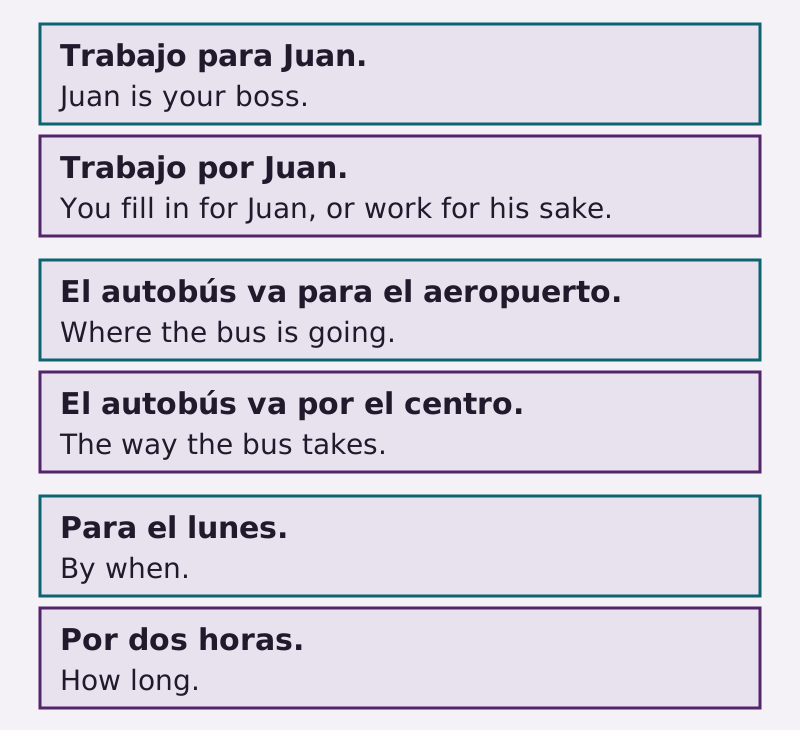
"One sentence, two meanings" from Conversation Mile (https://conversationmile.com/grammar-in-use/por-vs-para/). CC BY 4.0 (creativecommons.org/licenses/by/4.0)
| Para | Por |
|---|---|
| Yo trabajo para Juan. Juan is your boss. | Yo trabajo por Juan. You're filling in for Juan, or he's the reason you work. |
| El autobús va para el aeropuerto. Where it's going. | El autobús va por el centro del pueblo. The way it takes. |
| Debo escribir esa tarea para el lunes. Due Monday. | Debo escribir esa tarea por dos horas. Two hours of work. |
Say each pair out loud. After each one, say in English what changed.
More pairs of this kind turn up in FSI's course. A dress made para Luisa was made for her. One made por Luisa was made by her. ¿Por qué? asks why, looking back to a cause. ¿Para qué? asks what for, looking ahead to a purpose.
Is there one idea behind both?
FSI's course offers one. It ties almost all the uses where the two contrast to "motion through" for por and "motion to" for para. It calls this nearly always helpful, which isn't the same as always. ¡Chévere! takes the other path: it says a single rule would have too many exceptions, so it teaches the jobs one by one.
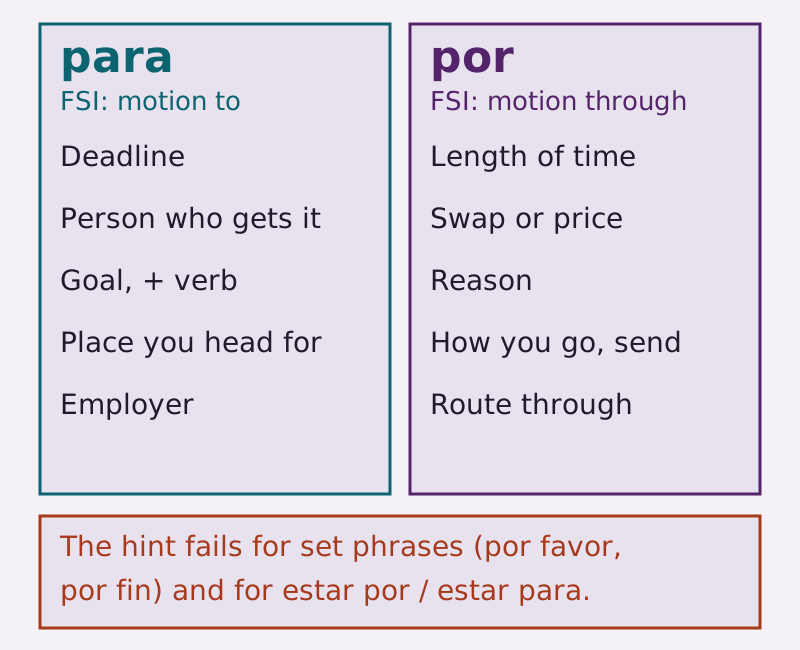
"What para does and what por does, with FSI's hint and where it fails" from Conversation Mile (https://conversationmile.com/grammar-in-use/por-vs-para/). CC BY 4.0 (creativecommons.org/licenses/by/4.0)
Use the hint only to sort a sentence you're unsure about, and check it against the two tables. It won't help with set phrases. FSI itself says those mostly contain por and are best learned whole, without trying to analyze them. It also can't explain a pair from FSI's own drills: estar por and estar para can both mean "about to," as the next section shows.
Which phrases should you learn whole?
These come straight from ¡Chévere!'s list. Learn each one as a single chunk, the way you'd learn a word.
| Phrase | Meaning | Say it |
|---|---|---|
| por favor | please | Por favor, más despacio. Please slow down. |
| por fin | at last | Por fin conseguí trabajo. I finally got a job. |
| por eso | that's why | Me gustan los niños, por eso me hice profesor. I like children. That's why I became a teacher. |
| por lo menos | at least | Podrías intentarlo por lo menos. You could at least try. |
| por si acaso | just in case | ¿Por qué no llevas un paraguas por si acaso? Why don't you bring an umbrella, just in case? |
| por supuesto | of course | Por supuesto que esperaré. Of course I'll wait. |
| para nada | not at all | No entiendo para nada. I don't understand at all. |
| para empezar | to begin with | Para empezar, es demasiado caro. First, it's too expensive. |
If you're a woman, say profesora in the por eso sentence. Wiktionary lists it as the feminine form.
One pair needs care. ¡Chévere! gives estar para plus a verb as "to be about to." FSI agrees, but it says estar por plus a verb can mean "about to" too, or "in favor of." Tatoeba has Estoy por irme. for "I'm about to go." Neither book says which regions prefer which. Ask a tutor what the people you'll talk to say.
What comes after por and para?
After either word, use the same pronouns as for the subject, except for "me" and the familiar "you" of tú. ¡Chévere! marks the accent on mí and warns that spelling counts.
| Person | After por or para | Say it |
|---|---|---|
| me | mí | ¿El regalo es para mí? |
| you (familiar) | ti | Sí, es para ti. |
| he, she, you (formal) | él, ella, usted | Este mensaje es para él. |
| first person plural | nosotros, nosotras | |
| you all (Spain only, familiar) | vosotros, vosotras | |
| they, you all | ellos, ellas, ustedes |
With con, and only with con, "me" and familiar "you" join the word: conmigo, contigo. There's one more "you" to know. Trayectos, an open course from COERLL, uses vos for familiar "you" in Argentina and Uruguay. People who use it say Esta canción es para vos. (This song is for you.) Contigo is the form for tú. If the people you'll talk to use vos, copy how they say "for you" and "with you."
How do you train the choice out loud?
FSI's review drill keeps one sentence and moves it between the two words: going para Chile, then por two years, working para the government, then por money. Do the same with your own life.
Pick one plan, such as a trip to see your sister. Out loud, give it one short sentence for each job in this table, changing the verb as each row needs. Then pick another plan, like a course, a gift or a move, and start again. When you run out of plans, go back to the first one and change the details.
| Job | Frame |
|---|---|
| Deadline | ... para el lunes |
| Person who gets it | ... es para + a name, or mí, ti (tú), vos, él |
| Goal | ... para + a plain verb, like aprender |
| Place you head for | voy para, sale para + place |
| Length of time | ... por dos horas |
| Swap or price | ... por + amount |
| Reason | ... por mi salud, por dinero |
| Way you send or travel | ... por correo, por avión, por taxi |
Keep the reason row to things, like your health or money. The mi in por mi salud means "my," so it has no accent. After a verb of going, por plus a person can mean something else: FSI glosses Paso por ti a las ocho. as calling for someone: I'll come by for you at eight. If you aren't sure a sentence is right, use a sentence from the tables above instead. Change only a name, a place, a time or an amount, and leave por or para as it is.
Count it in Spoken Minutes. On a 5-minute day, spend 1 minute on yesterday's Cold Say-Back and 4 on the plan drill. On a 10-minute day, it's 2 and 8. On a 20-minute day, it's 3 on the Cold Say-Back, 10 on the drill and 7 on the self-test below, run twice. Skip the self-test on shorter days. On your first day there's nothing to say back yet, so those 1, 2 or 3 minutes go to the drill. The self-test still runs on a 20-minute day. This split and the drill are this site's House routine, untested with learners. Add the minutes to your Mile Log.
On a 20-minute day, say each line in Spanish before you read the note after it.
- This is for you! (para, the person who gets it; with vos, para vos)
- I'll be ready by Monday. (para, a deadline; a woman says lista)
- I'm here to learn. (para, a goal)
- She waited for him for two hours. (por, how long)
- I bought the book for ten dollars. (por, a price)
- Send it by mail. (por, how it travels)
- Thanks for the explanation. (por, after gracias)
- Tom works for a large company. (para, an employer)
If you miss one, don't reread the rule. Find the sentence in the tables and say it three times.
The same habit of sorting by job helps with other choices English hides, like ser and estar and the two past tenses. Verbs with se have their own page, Spanish reflexive verbs. If you're just starting, the Spanish starting plan shows where this fits.
Tomorrow, before you look at anything, run a Cold Say-Back: say that you work for a company, that you waited two hours, and that a gift is for someone you know.
What this rests on
Checked against
- Por for a length of time, an exchange, a motive, and travel or communication; para for a deadline, a recipient, a purpose and a destination; the three contrast pairs, including the employer and the route; por taxi; set phrases; estar para for about to; pronouns after a preposition, conmigo and contigo, vosotros only in Spain Source 1
- Por for along, through, during, via, by, on behalf of and because of; para for use, benefit, in order to, destination, until and as for; the paired sentences that change meaning; motion through and motion to as a hint, with set phrases learned whole; estar por with two readings Source 2
- The review drill that moves one sentence between para and por: para Chile, por dos años, para el gobierno, por dinero, para comer, por la mañana, por avión Source 3
- Vos for familiar you in Argentina and Uruguay Source 4
- The feminine forms lista and profesora Source 5
House routine
- The eight-job plan drill, the 5, 10 and 20 Spoken Minute splits, the self-test, saying a missed sentence three times, the Cold Say-Back, and day 1 giving its Cold Say-Back minutes to the drill
Sources
- Brown, Escudero, Montoya and Small. ¡Chévere! Introductory Spanish II, 2.11: Por y para / Pronombres preposicionales. SUNY Oneonta via OER SUNY Open. Read: The whole page. License: CC BY 4.0.
- Stockwell, Bowen, Segreda, Montero and Silva-Fuenzalida. Spanish Basic Course: Units 31-45, section 34.21.1, the phrase relators por and para. Foreign Service Institute, U.S. Department of State, 1959 Open. Read: That section, pp. 34.5 to 34.9, from a scanned copy with some unreadable characters.
- Trease and Ulsh. Spanish Basic Course: Units 46-55, section 53.22.1, review drill on por and para. Foreign Service Institute, U.S. Department of State, 1982 Open. Read: That drill, p. 53.31, from a scanned copy.
- Zapata. Trayectos, Volumen 2: Más sobre mí, Módulo 1, pp. 3 and 14. COERLL, University of Texas at Austin, 2022 Open. Read: The note on vos in Argentina and the pronoun table on pp. 3 and 14. License: CC BY-SA 4.0.
- Wiktionary contributors. Spanish entries listo and profesor. Wiktionary, as distributed by kaikki.org Open. Read: The feminine forms of listo and profesor in the local kaikki extract. License: CC BY-SA 4.0.
Sentence credits
- ¡Esto es para ti! Tatoeba sentence 1388672 by Shishir; English by sundown. CC BY 2.0 FR.
- Trabajo para McDonald's. Tatoeba sentence 1332014 by marcelostockle; English by CK. CC BY 2.0 FR.
- No lo hice por ti. Tatoeba sentence 1664943 by marcelostockle; English by Spamster. CC BY 2.0 FR.
- Estaré listo para el lunes. Tatoeba sentence 5769394 by arh; English by CK. CC BY 2.0 FR.
- Estoy aquí para aprender. Tatoeba sentence 3882762 by Shishir; English by CK. CC BY 2.0 FR.
- Yumi sale para Osaka pasado mañana. Tatoeba sentence 640840 by clerval; English by CN. CC BY 2.0 FR.
- Tom trabaja para una gran compañía. Tatoeba sentence 1718228 by marcelostockle; English by CK. CC BY 2.0 FR.
- ¿Para qué quieres dinero? Tatoeba sentence 7931201 by arh; English by araneo. CC BY 2.0 FR.
- Para mí, el dinero lo es todo. Tatoeba sentence 8333985 by arh; English by helloroto. CC BY 2.0 FR.
- Ella lo esperó por dos horas. Tatoeba sentence 1300937 by marcelostockle; English by CK. CC BY 2.0 FR.
- Compré el libro por diez dólares. Tatoeba sentence 2848548 by teskmon; English by CK. CC BY 2.0 FR.
- Gracias por la explicación. Tatoeba sentence 6688563 by arh; English by pauldhunt. CC BY 2.0 FR.
- Envíalo por correo. Tatoeba sentence 1402288 by marcelostockle; English by CK. CC BY 2.0 FR.
- Él caminaba lentamente por la calle. Tatoeba sentence 1426364 by marcelostockle; English by CK. CC BY 2.0 FR.
- Vi la televisión por la mañana. Tatoeba sentence 13709947 by ecorralest101; English by frpzzd. CC BY 2.0 FR.
- El poema fue escrito por una niña. Tatoeba sentence 1207513 by alexmarcelo; English by CK. CC BY 2.0 FR.
- Yo trabajo para Juan. ¡Chévere! Introductory Spanish II, 2.11. CC BY 4.0.
- Yo trabajo por Juan. ¡Chévere! Introductory Spanish II, 2.11. CC BY 4.0.
- El autobús va para el aeropuerto. ¡Chévere! Introductory Spanish II, 2.11. CC BY 4.0.
- El autobús va por el centro del pueblo. ¡Chévere! Introductory Spanish II, 2.11. CC BY 4.0.
- Debo escribir esa tarea para el lunes. ¡Chévere! Introductory Spanish II, 2.11. CC BY 4.0.
- Debo escribir esa tarea por dos horas. ¡Chévere! Introductory Spanish II, 2.11. CC BY 4.0.
- Por favor, más despacio. Tatoeba sentence 7778573 by arh; English by CK. CC BY 2.0 FR.
- Por fin conseguí trabajo. Tatoeba sentence 1752887 by Alba; English by CK. CC BY 2.0 FR.
- Me gustan los niños, por eso me hice profesor. Tatoeba sentence 9706988 by Shishir; English by CK. CC BY 2.0 FR.
- Podrías intentarlo por lo menos. Tatoeba sentence 2671675 by Shishir; English by CK. CC BY 2.0 FR.
- ¿Por qué no llevas un paraguas por si acaso? Tatoeba sentence 9446112 by ignacio; English by DJ_Saidez. CC BY 2.0 FR.
- Por supuesto que esperaré. Tatoeba sentence 1296669 by marcelostockle; English by CK. CC BY 2.0 FR.
- No entiendo para nada. Tatoeba sentence 4567996 by cueyayotl; English by CM. CC BY 2.0 FR.
- Para empezar, es demasiado caro. Tatoeba sentence 1245592 by wallebot; English by Eldad. CC BY 2.0 FR.
- Estoy por irme. Tatoeba sentence 3300034 by gianich73; English by CM. CC BY 2.0 FR.
- ¿El regalo es para mí? ¡Chévere! Introductory Spanish II, 2.11. CC BY 4.0.
- Sí, es para ti. ¡Chévere! Introductory Spanish II, 2.11. CC BY 4.0.
- Este mensaje es para él. Tatoeba sentence 5058310 by don_ramon; English by CH. CC BY 2.0 FR.
- Esta canción es para vos. Tatoeba sentence 3045082 by hayastan; English by Eldad. CC BY 2.0 FR.
- Paso por ti a las ocho. FSI Spanish Basic Course, Units 31-45, 34.21.1. Public domain (U.S. government work).
Next stops
Cite this page
Por vs Para: Sort Each One by What It Does in the Sentence. Conversation Mile, 2026-11-10. https://conversationmile.com/grammar-in-use/por-vs-para/
Corrections
No corrections on this page. Spotted a language error? Please tell this site.