Grammar in Use Tool
Verb Conjugation Lookup: Spanish, French, and German
Straight answer
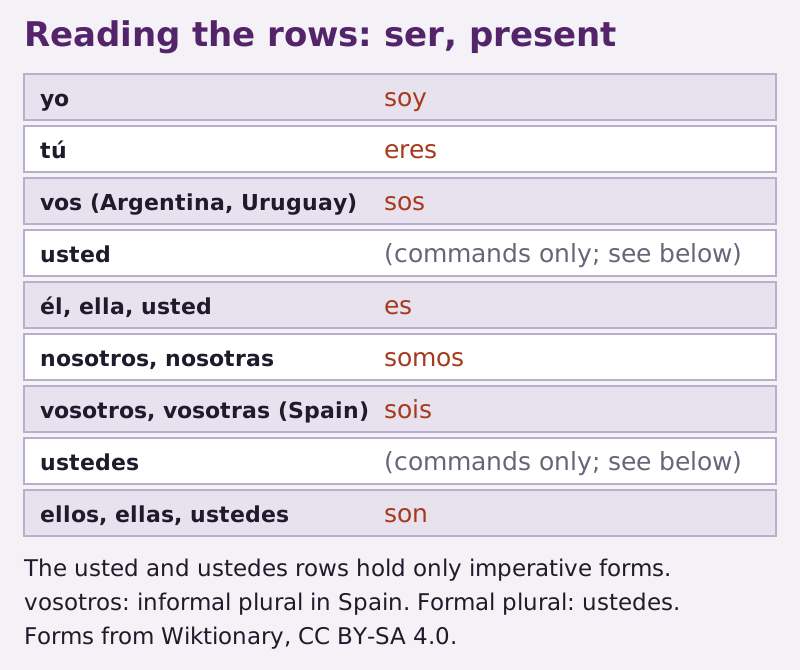
Type an infinitive above and the lookup shows that verb's forms in one table, tense by tense. Try it with Spanish ser. Pick the present tense and say the first two rows out loud, pronoun and verb together: yo soy, tú eres. If you use vos, as in Argentina and Uruguay, your second row is vos sos instead, and with usted it's usted es, from the él, ella, usted row.
Look up a verb
The lookup needs JavaScript. The most common verbs are listed here.
Spanish
| Present | Preterite | Imperfect | Future | Conditional | Present subjunctive | Imperfect subjunctive (-ra) | Imperfect subjunctive (-se) | Imperative | |
|---|---|---|---|---|---|---|---|---|---|
| yo | estoy | estuve | estaba | estaré | estaría | esté | estuviera | estuviese | — |
| tú | estás | estuviste | estabas | estarás | estarías | estés | estuvieras | estuvieses | está |
| usted | — | — | — | — | — | — | — | — | esté |
| él, ella, usted | está | estuvo | estaba | estará | estaría | esté | estuviera | estuviese | — |
| nosotros, nosotras | estamos | estuvimos | estábamos | estaremos | estaríamos | estemos | estuviéramos | estuviésemos | estemos |
| vosotros, vosotras | estáis | estuvisteis | estabais | estaréis | estaríais | estéis | estuvierais | estuvieseis | estad |
| ustedes | — | — | — | — | — | — | — | — | estén |
| ellos, ellas, ustedes | están | estuvieron | estaban | estarán | estarían | estén | estuvieran | estuviesen | — |
- Gerund
- estando
- Past participle
- estado
| Present | Preterite | Imperfect | Future | Conditional | Present subjunctive | Imperfect subjunctive (-ra) | Imperfect subjunctive (-se) | Imperative | |
|---|---|---|---|---|---|---|---|---|---|
| yo | tengo | tuve | tenía | tendré | tendría | tenga | tuviera | tuviese | — |
| tú | tienes | tuviste | tenías | tendrás | tendrías | tengas | tuvieras | tuvieses | ten |
| vos | tenés | — | — | — | — | tengás | — | — | tené |
| usted | — | — | — | — | — | — | — | — | tenga |
| él, ella, usted | tiene | tuvo | tenía | tendrá | tendría | tenga | tuviera | tuviese | — |
| nosotros, nosotras | tenemos | tuvimos | teníamos | tendremos | tendríamos | tengamos | tuviéramos | tuviésemos | tengamos |
| vosotros, vosotras | tenéis | tuvisteis | teníais | tendréis | tendríais | tengáis | tuvierais | tuvieseis | tened |
| ustedes | — | — | — | — | — | — | — | — | tengan |
| ellos, ellas, ustedes | tienen | tuvieron | tenían | tendrán | tendrían | tengan | tuvieran | tuviesen | — |
- Gerund
- teniendo
- Past participle
- tenido
| Present | Preterite | Imperfect | Future | Conditional | Present subjunctive | Imperfect subjunctive (-ra) | Imperfect subjunctive (-se) | Imperative | |
|---|---|---|---|---|---|---|---|---|---|
| yo | soy | fui | era | seré | sería | sea | fuera | fuese | — |
| tú | eres | fuiste | eras | serás | serías | seas | fueras | fueses | sé |
| vos | sos | — | — | — | — | seás | — | — | — |
| usted | — | — | — | — | — | — | — | — | sea |
| él, ella, usted | es | fue | era | será | sería | sea | fuera | fuese | — |
| nosotros, nosotras | somos | fuimos | éramos | seremos | seríamos | seamos | fuéramos | fuésemos | seamos |
| vosotros, vosotras | sois | fuisteis | erais | seréis | seríais | seáis | fuerais | fueseis | sed |
| ustedes | — | — | — | — | — | — | — | — | sean |
| ellos, ellas, ustedes | son | fueron | eran | serán | serían | sean | fueran | fuesen | — |
- Gerund
- siendo
- Past participle
- sido
| Present | Preterite | Imperfect | Future | Conditional | Present subjunctive | Imperfect subjunctive (-ra) | Imperfect subjunctive (-se) | Imperative | |
|---|---|---|---|---|---|---|---|---|---|
| yo | he | hube | había | habré | habría | haya | hubiera | hubiese | — |
| tú | has | hubiste | habías | habrás | habrías | hayas | hubieras | hubieses | habe / he |
| vos | — | — | — | — | — | hayás | — | — | — |
| usted | — | — | — | — | — | — | — | — | haya |
| él, ella, usted | ha / hay | hubo | había | habrá | habría | haya | hubiera | hubiese | — |
| nosotros, nosotras | hemos | hubimos | habíamos | habremos | habríamos | hayamos | hubiéramos | hubiésemos | hayamos |
| vosotros, vosotras | habéis | hubisteis | habíais | habréis | habríais | hayáis | hubierais | hubieseis | habed |
| ustedes | — | — | — | — | — | — | — | — | hayan |
| ellos, ellas, ustedes | han | hubieron | habían | habrán | habrían | hayan | hubieran | hubiesen | — |
- Gerund
- habiendo
- Past participle
- habido
| Present | Preterite | Imperfect | Future | Conditional | Present subjunctive | Imperfect subjunctive (-ra) | Imperfect subjunctive (-se) | Imperative | |
|---|---|---|---|---|---|---|---|---|---|
| yo | puedo | pude | podía | podré | podría | pueda | pudiera | pudiese | — |
| tú | puedes | pudiste | podías | podrás | podrías | puedas | pudieras | pudieses | puede |
| vos | podés | — | — | — | — | podás | — | — | podé |
| usted | — | — | — | — | — | — | — | — | pueda |
| él, ella, usted | puede | pudo | podía | podrá | podría | pueda | pudiera | pudiese | — |
| nosotros, nosotras | podemos | pudimos | podíamos | podremos | podríamos | podamos | pudiéramos | pudiésemos | podamos |
| vosotros, vosotras | podéis | pudisteis | podíais | podréis | podríais | podáis | pudierais | pudieseis | poded |
| ustedes | — | — | — | — | — | — | — | — | puedan |
| ellos, ellas, ustedes | pueden | pudieron | podían | podrán | podrían | puedan | pudieran | pudiesen | — |
- Gerund
- pudiendo
- Past participle
- podido
| Present | Preterite | Imperfect | Future | Conditional | Present subjunctive | Imperfect subjunctive (-ra) | Imperfect subjunctive (-se) | Imperative | |
|---|---|---|---|---|---|---|---|---|---|
| yo | quiero | quise | quería | querré | querría | quiera | quisiera | quisiese | — |
| tú | quieres | quisiste | querías | querrás | querrías | quieras | quisieras | quisieses | quiere |
| vos | querés | — | — | — | — | querás | — | — | queré |
| usted | — | — | — | — | — | — | — | — | quiera |
| él, ella, usted | quiere | quiso | quería | querrá | querría | quiera | quisiera | quisiese | — |
| nosotros, nosotras | queremos | quisimos | queríamos | querremos | querríamos | queramos | quisiéramos | quisiésemos | queramos |
| vosotros, vosotras | queréis | quisisteis | queríais | querréis | querríais | queráis | quisierais | quisieseis | quered |
| ustedes | — | — | — | — | — | — | — | — | quieran |
| ellos, ellas, ustedes | quieren | quisieron | querían | querrán | querrían | quieran | quisieran | quisiesen | — |
- Gerund
- queriendo
- Past participle
- querido
| Present | Preterite | Imperfect | Future | Conditional | Present subjunctive | Imperfect subjunctive (-ra) | Imperfect subjunctive (-se) | Imperative | |
|---|---|---|---|---|---|---|---|---|---|
| yo | hago | hice | hacía | haré | haría | haga | hiciera | hiciese | — |
| tú | haces | hiciste | hacías | harás | harías | hagas | hicieras | hicieses | haz |
| vos | hacés | — | — | — | — | hagás | — | — | hacé |
| usted | — | — | — | — | — | — | — | — | haga |
| él, ella, usted | hace | hizo | hacía | hará | haría | haga | hiciera | hiciese | — |
| nosotros, nosotras | hacemos | hicimos | hacíamos | haremos | haríamos | hagamos | hiciéramos | hiciésemos | hagamos |
| vosotros, vosotras | hacéis | hicisteis | hacíais | haréis | haríais | hagáis | hicierais | hicieseis | haced |
| ustedes | — | — | — | — | — | — | — | — | hagan |
| ellos, ellas, ustedes | hacen | hicieron | hacían | harán | harían | hagan | hicieran | hiciesen | — |
- Gerund
- haciendo
- Past participle
- hecho
| Present | Preterite | Imperfect | Future | Conditional | Present subjunctive | Imperfect subjunctive (-ra) | Imperfect subjunctive (-se) | Imperative | |
|---|---|---|---|---|---|---|---|---|---|
| yo | voy | fui | iba | iré | iría | vaya | fuera | fuese | — |
| tú | vas | fuiste | ibas | irás | irías | vayas | fueras | fueses | ve |
| vos | — | — | — | — | — | vayás | — | — | andá |
| usted | — | — | — | — | — | — | — | — | vaya |
| él, ella, usted | va | fue | iba | irá | iría | vaya | fuera | fuese | — |
| nosotros, nosotras | vamos | fuimos | íbamos | iremos | iríamos | vayamos | fuéramos | fuésemos | vamos / vayamos |
| vosotros, vosotras | vais | fuisteis | ibais | iréis | iríais | vayáis | fuerais | fueseis | id |
| ustedes | — | — | — | — | — | — | — | — | vayan |
| ellos, ellas, ustedes | van | fueron | iban | irán | irían | vayan | fueran | fuesen | — |
- Gerund
- yendo
- Past participle
- ido
| Present | Preterite | Imperfect | Future | Conditional | Present subjunctive | Imperfect subjunctive (-ra) | Imperfect subjunctive (-se) | Imperative | |
|---|---|---|---|---|---|---|---|---|---|
| yo | digo | dije | decía | diré | diría | diga | dijera | dijese | — |
| tú | dices | dijiste | decías | dirás | dirías | digas | dijeras | dijeses | di |
| vos | decís | — | — | — | — | digás | — | — | decí |
| usted | — | — | — | — | — | — | — | — | diga |
| él, ella, usted | dice | dijo | decía | dirá | diría | diga | dijera | dijese | — |
| nosotros, nosotras | decimos | dijimos | decíamos | diremos | diríamos | digamos | dijéramos | dijésemos | digamos |
| vosotros, vosotras | decís | dijisteis | decíais | diréis | diríais | digáis | dijerais | dijeseis | decid |
| ustedes | — | — | — | — | — | — | — | — | digan |
| ellos, ellas, ustedes | dicen | dijeron | decían | dirán | dirían | digan | dijeran | dijesen | — |
- Gerund
- diciendo
- Past participle
- dicho
| Present | Preterite | Imperfect | Future | Conditional | Present subjunctive | Imperfect subjunctive (-ra) | Imperfect subjunctive (-se) | Imperative | |
|---|---|---|---|---|---|---|---|---|---|
| yo | gusto | gusté | gustaba | gustaré | gustaría | guste | gustara | gustase | — |
| tú | gustas | gustaste | gustabas | gustarás | gustarías | gustes | gustaras | gustases | gusta |
| vos | gustás | — | — | — | — | gustés | — | — | gustá |
| usted | — | — | — | — | — | — | — | — | guste |
| él, ella, usted | gusta | gustó | gustaba | gustará | gustaría | guste | gustara | gustase | — |
| nosotros, nosotras | gustamos | gustamos | gustábamos | gustaremos | gustaríamos | gustemos | gustáramos | gustásemos | gustemos |
| vosotros, vosotras | gustáis | gustasteis | gustabais | gustaréis | gustaríais | gustéis | gustarais | gustaseis | gustad |
| ustedes | — | — | — | — | — | — | — | — | gusten |
| ellos, ellas, ustedes | gustan | gustaron | gustaban | gustarán | gustarían | gusten | gustaran | gustasen | — |
- Gerund
- gustando
- Past participle
- gustado
Where a cell lists more than one form, the source lists them all. The order does not say which one is standard.
Conjugations from Wiktionary (https://en.wiktionary.org/), CC BY-SA 4.0, via Wiktextract and kaikki.org, retrieved 2026-11-09. Filtered and reformatted by Conversation Mile. Verb ranking computed from Tatoeba (https://tatoeba.org), CC BY 2.0 FR. License terms. About this data.
French
| Present | Imperfect | Passé simple | Future | Conditional | Present subjunctive | Imperfect subjunctive | Imperative | |
|---|---|---|---|---|---|---|---|---|
| je | ai | avais | eus | aurai | aurais | aie | eusse | — |
| tu | as | avais | eus | auras | aurais | aies | eusses | aie |
| il, elle, on | a | avait | eut | aura | aurait | ait | eût | — |
| nous | avons | avions | eûmes | aurons | aurions | ayons | eussions | ayons |
| vous | avez | aviez | eûtes | aurez | auriez | ayez | eussiez | ayez |
| ils, elles | ont | avaient | eurent | auront | auraient | aient | eussent | — |
- Present participle
- ayant
- Past participle
- eu
| Present | Imperfect | Passé simple | Future | Conditional | Present subjunctive | Imperfect subjunctive | Imperative | |
|---|---|---|---|---|---|---|---|---|
| je | suis | étais | fus | serai | serais | sois | fusse | — |
| tu | es | étais | fus | seras | serais | sois | fusses | sois |
| il, elle, on | est | était | fut | sera | serait | soit | fût | — |
| nous | sommes | étions | fûmes | serons | serions | soyons | fussions | soyons |
| vous | êtes | étiez | fûtes | serez | seriez | soyez | fussiez | soyez |
| ils, elles | sont | étaient | furent | seront | seraient | soient | fussent | — |
- Present participle
- étant
- Past participle
- été
| Present | Imperfect | Passé simple | Future | Conditional | Present subjunctive | Imperfect subjunctive | Imperative | |
|---|---|---|---|---|---|---|---|---|
| je | fais | faisais | fis | ferai | ferais | fasse | fisse | — |
| tu | fais | faisais | fis | feras | ferais | fasses | fisses | fais |
| il, elle, on | fait | faisait | fit | fera | ferait | fasse | fît | — |
| nous | faisons | faisions | fîmes | ferons | ferions | fassions | fissions | faisons |
| vous | faites | faisiez | fîtes | ferez | feriez | fassiez | fissiez | faites |
| ils, elles | font | faisaient | firent | feront | feraient | fassent | fissent | — |
- Present participle
- faisant
- Past participle
- fait
| Present | Imperfect | Passé simple | Future | Conditional | Present subjunctive | Imperfect subjunctive | |
|---|---|---|---|---|---|---|---|
| je | peux | pouvais | pus | pourrai | pourrais | puisse | pusse |
| tu | peux | pouvais | pus | pourras | pourrais | puisses | pusses |
| il, elle, on | peut | pouvait | put | pourra | pourrait | puisse | pût |
| nous | pouvons | pouvions | pûmes | pourrons | pourrions | puissions | pussions |
| vous | pouvez | pouviez | pûtes | pourrez | pourriez | puissiez | pussiez |
| ils, elles | peuvent | pouvaient | purent | pourront | pourraient | puissent | pussent |
- Present participle
- pouvant
- Past participle
- pu
| Present | Imperfect | Passé simple | Future | Conditional | Present subjunctive | Imperfect subjunctive | Imperative | |
|---|---|---|---|---|---|---|---|---|
| je | vais | allais | allai | irai | irais | aille | allasse | — |
| tu | vas | allais | allas | iras | irais | ailles | allasses | va |
| il, elle, on | va | allait | alla | ira | irait | aille | allât | — |
| nous | allons | allions | allâmes | irons | irions | allions | allassions | allons |
| vous | allez | alliez | allâtes | irez | iriez | alliez | allassiez | allez |
| ils, elles | vont | allaient | allèrent | iront | iraient | aillent | allassent | — |
- Present participle
- allant
- Past participle
- allé
| Present | Imperfect | Passé simple | Future | Conditional | Present subjunctive | Imperfect subjunctive | Imperative | |
|---|---|---|---|---|---|---|---|---|
| je | veux | voulais | voulus | voudrai | voudrais | veuille | voulusse | — |
| tu | veux | voulais | voulus | voudras | voudrais | veuilles | voulusses | veux / veuille |
| il, elle, on | veut | voulait | voulut | voudra | voudrait | veuille | voulût | — |
| nous | voulons | voulions | voulûmes | voudrons | voudrions | voulions | voulussions | voulons / veuillons |
| vous | voulez | vouliez | voulûtes | voudrez | voudriez | vouliez | voulussiez | voulez / veuillez |
| ils, elles | veulent | voulaient | voulurent | voudront | voudraient | veuillent | voulussent | — |
- Present participle
- voulant
- Past participle
- voulu
| Present | Imperfect | Passé simple | Future | Conditional | Present subjunctive | Imperfect subjunctive | Imperative | |
|---|---|---|---|---|---|---|---|---|
| je | sais | savais | sus | saurai | saurais | sache | susse | — |
| tu | sais | savais | sus | sauras | saurais | saches | susses | sache |
| il, elle, on | sait | savait | sut | saura | saurait | sache | sût | — |
| nous | savons | savions | sûmes | saurons | saurions | sachions | sussions | sachons |
| vous | savez | saviez | sûtes | saurez | sauriez | sachiez | sussiez | sachez |
| ils, elles | savent | savaient | surent | sauront | sauraient | sachent | sussent | — |
- Present participle
- sachant
- Past participle
- su
| Present | Imperfect | Passé simple | Future | Conditional | Present subjunctive | Imperfect subjunctive | Imperative | |
|---|---|---|---|---|---|---|---|---|
| je | dois | devais | dus | devrai | devrais | doive | dusse | — |
| tu | dois | devais | dus | devras | devrais | doives | dusses | dois |
| il, elle, on | doit | devait | dut | devra | devrait | doive | dût | — |
| nous | devons | devions | dûmes | devrons | devrions | devions | dussions | devons |
| vous | devez | deviez | dûtes | devrez | devriez | deviez | dussiez | devez |
| ils, elles | doivent | devaient | durent | devront | devraient | doivent | dussent | — |
- Present participle
- devant
- Past participle
- dû
| Present | Imperfect | Passé simple | Future | Conditional | Present subjunctive | Imperfect subjunctive | Imperative | |
|---|---|---|---|---|---|---|---|---|
| je | aime | aimais | aimai | aimerai | aimerais | aime | aimasse | — |
| tu | aimes | aimais | aimas | aimeras | aimerais | aimes | aimasses | aime |
| il, elle, on | aime | aimait | aima | aimera | aimerait | aime | aimât | — |
| nous | aimons | aimions | aimâmes | aimerons | aimerions | aimions | aimassions | aimons |
| vous | aimez | aimiez | aimâtes | aimerez | aimeriez | aimiez | aimassiez | aimez |
| ils, elles | aiment | aimaient | aimèrent | aimeront | aimeraient | aiment | aimassent | — |
- Present participle
- aimant
- Past participle
- aimé
| Present | Imperfect | Passé simple | Future | Conditional | Present subjunctive | Imperfect subjunctive | Imperative | |
|---|---|---|---|---|---|---|---|---|
| je | dis | disais | dis | dirai | dirais | dise | disse | — |
| tu | dis | disais | dis | diras | dirais | dises | disses | dis |
| il, elle, on | dit | disait | dit | dira | dirait | dise | dît | — |
| nous | disons | disions | dîmes | dirons | dirions | disions | dissions | disons |
| vous | dites | disiez | dîtes | direz | diriez | disiez | dissiez | dites |
| ils, elles | disent | disaient | dirent | diront | diraient | disent | dissent | — |
- Present participle
- disant
- Past participle
- dit
Where a cell lists more than one form, the source lists them all. The order does not say which one is standard.
Conjugations from Wiktionary (https://en.wiktionary.org/), CC BY-SA 4.0, via Wiktextract and kaikki.org, retrieved 2026-11-09. Filtered and reformatted by Conversation Mile. Verb ranking computed from Tatoeba (https://tatoeba.org), CC BY 2.0 FR. License terms. About this data.
German
| Present | Preterite | Subjunctive I | Subjunctive II | Imperative | |
|---|---|---|---|---|---|
| ich | bin | war | sei | wäre | — |
| du | bist | warst | seist / seiest | wärst / wärest | sei |
| er, sie, es | ist | war | sei | wäre | — |
| wir | sind | waren | seien | wären | — |
| ihr | seid | wart | seiet | wärt / wäret | seid |
| sie, Sie | sind | waren | seien | wären | — |
- Present participle
- seiend
- Past participle
- gewesen
| Present | Preterite | Subjunctive I | Subjunctive II | Imperative | |
|---|---|---|---|---|---|
| ich | habe | hatte | habe | hätte | — |
| du | hast | hattest | habest | hättest | hab / habe |
| er, sie, es | hat | hatte | habe | hätte | — |
| wir | haben | hatten | haben | hätten | — |
| ihr | habt | hattet | habet | hättet | habt |
| sie, Sie | haben | hatten | haben | hätten | — |
- Present participle
- habend
- Past participle
- gehabt
| Present | Preterite | Subjunctive I | Subjunctive II | Imperative | |
|---|---|---|---|---|---|
| ich | werde | wurde | werde | würde | — |
| du | wirst | wurdest | werdest | würdest | werd / werde |
| er, sie, es | wird | wurde | werde | würde | — |
| wir | werden | wurden | werden | würden | — |
| ihr | werdet | wurdet | werdet | würdet | werdet |
| sie, Sie | werden | wurden | werden | würden | — |
- Present participle
- werdend
- Past participle
- geworden / worden
| Present | Preterite | Subjunctive I | Subjunctive II | |
|---|---|---|---|---|
| ich | kann | konnte | könne | könnte |
| du | kannst | konntest | könnest | könntest |
| er, sie, es | kann | konnte | könne | könnte |
| wir | können | konnten | können | könnten |
| ihr | könnt | konntet | könnet | könntet |
| sie, Sie | können | konnten | können | könnten |
- Present participle
- könnend
- Past participle
- gekonnt / können
| Present | Preterite | Subjunctive I | Subjunctive II | Imperative | |
|---|---|---|---|---|---|
| ich | sage | sagte | sage | sagte | — |
| du | sagst | sagtest | sagest | sagtest | sag / sage |
| er, sie, es | sagt | sagte | sage | sagte | — |
| wir | sagen | sagten | sagen | sagten | — |
| ihr | sagt | sagtet | saget | sagtet | sagt |
| sie, Sie | sagen | sagten | sagen | sagten | — |
- Present participle
- sagend
- Past participle
- gesagt
| Present | Preterite | Subjunctive I | Subjunctive II | |
|---|---|---|---|---|
| ich | will | wollte | wolle | wollte |
| du | willst | wolltest | wollest | wolltest |
| er, sie, es | will | wollte | wolle | wollte |
| wir | wollen | wollten | wollen | wollten |
| ihr | wollt | wolltet | wollet | wolltet |
| sie, Sie | wollen | wollten | wollen | wollten |
- Present participle
- wollend
- Past participle
- gewollt
| Present | Preterite | Subjunctive I | Subjunctive II | Imperative | |
|---|---|---|---|---|---|
| ich | gehe | ging | gehe | ginge | — |
| du | gehst | gingst | gehest | gingest / gingst | geh / gehe |
| er, sie, es | geht | ging | gehe | ginge | — |
| wir | gehen | gingen | gehen | gingen | — |
| ihr | geht | gingt | gehet | ginget / gingt | geht |
| sie, Sie | gehen | gingen | gehen | gingen | — |
- Present participle
- gehend
- Past participle
- gegangen
| Present | Preterite | Subjunctive I | Subjunctive II | Imperative | |
|---|---|---|---|---|---|
| ich | mache | machte | mache | machte | — |
| du | machst | machtest | machest | machtest | mach / mache |
| er, sie, es | macht | machte | mache | machte | — |
| wir | machen | machten | machen | machten | — |
| ihr | macht | machtet | machet | machtet | macht |
| sie, Sie | machen | machten | machen | machten | — |
- Present participle
- machend
- Past participle
- gemacht
| Present | Preterite | Subjunctive I | Subjunctive II | |
|---|---|---|---|---|
| ich | muss | musste | müsse | müsste |
| du | musst | musstest | müssest | müsstest |
| er, sie, es | muss | musste | müsse | müsste |
| wir | müssen | mussten | müssen | müssten |
| ihr | müsst | musstet | müsset | müsstet |
| sie, Sie | müssen | mussten | müssen | müssten |
- Present participle
- müssend
- Past participle
- gemusst
| Present | Preterite | Subjunctive I | Subjunctive II | Imperative | |
|---|---|---|---|---|---|
| ich | komme | kam | komme | käme | — |
| du | kommst | kamst | kommest | kämest / kämst | komm / komme |
| er, sie, es | kommt | kam | komme | käme | — |
| wir | kommen | kamen | kommen | kämen | — |
| ihr | kommt | kamt | kommet | kämet / kämt | kommt |
| sie, Sie | kommen | kamen | kommen | kämen | — |
- Present participle
- kommend
- Past participle
- gekommen
Where a cell lists more than one form, the source lists them all. The order does not say which one is standard.
Conjugations from Wiktionary (https://en.wiktionary.org/), CC BY-SA 4.0, via Wiktextract and kaikki.org, retrieved 2026-11-09. Filtered and reformatted by Conversation Mile. Verb ranking computed from Tatoeba (https://tatoeba.org), CC BY 2.0 FR. License terms. About this data.
What do the tables hold?
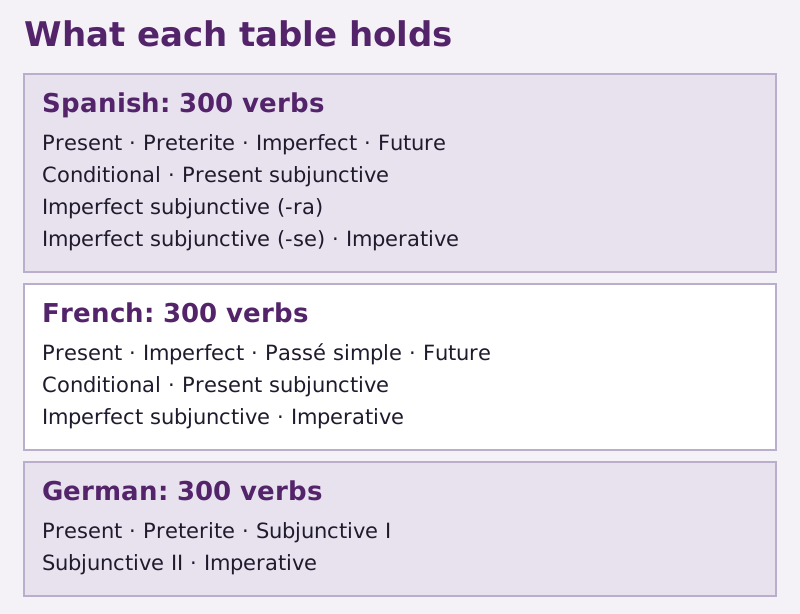
Three hundred verbs each for Spanish, French and German, and only single-word forms, apart from German separable verbs: type anfangen and the table shows fange an. It shows them as they stand in a main clause, where other words can come between the two parts. In a clause that starts with a subordinating conjunction such as bevor, the prefix joins the front of the verb at the end of the clause. For ich, fange an becomes anfange, and the other rows join the same way, so fängt an becomes anfängt.
"The verbs and tenses in each conjugation table" from Conversation Mile (https://conversationmile.com/grammar-in-use/verb-conjugation-lookup/). CC BY 4.0 (creativecommons.org/licenses/by/4.0)
Each table also lists the participles, and the gerund for Spanish. Compound tenses, built from a helper verb and a participle, aren't in the tables. For French and German, the table names the helper verb that the compound tenses use, such as avoir or haben. Some verbs list two, without saying when to use which, so check the entry. The Spanish future subjunctive is left out.
Tex's French Grammar describes the passé simple as mainly a written tense, used aloud only in very formal speech. The French past tenses page covers the ones to say. Grimm Grammar says German uses the Perfekt, a compound tense, for informal talk about the past. It's built from haben or sein, the helper the table names, plus the past participle, and the table doesn't show where each part goes in a sentence. In standard German, haben, sein, wissen and the modal verbs are often preferred in the simple past, the Preterite column, instead.
The 300 verbs were picked by how often their forms turn up in Tatoeba's open sentence collection, which isn't the whole language, as the first 1,000 words page explains.
How do you read the rows?
"The person rows of the Spanish table, with ser in the present" from Conversation Mile (https://conversationmile.com/grammar-in-use/verb-conjugation-lookup/). CC BY-SA 4.0 (creativecommons.org/licenses/by-sa/4.0)
Data: Conjugations from Wiktionary (https://en.wiktionary.org/wiki/ser#Spanish), CC BY-SA 4.0, via Wiktextract and kaikki.org, retrieved 2026-11-09
Spanish. People in Argentina and Uruguay use vos where others use tú, as the open textbook Trayectos notes. The vos row has forms only in the present, the present subjunctive and the imperative, so for other tenses use the tú row. Wiktionary's Spanish tables add a note to the present subjunctive: in Argentina and Uruguay, vos speakers prefer the tú form there, such as hables rather than hablés. Trayectos marks vosotros as the informal plural you used in Spain. Ustedes, the other plural you, including the formal one in Spain, shares the ellos row, and usted shares the él row. The separate usted and ustedes rows hold only imperative forms. The Imperative column has the affirmative commands from Wiktionary's table. For a negative command, check the entry.
French. The tense labeled Passé simple is the one Wiktionary calls the past historic.
German. Wiktionary's German tables write er in the third-person singular and sie in the third-person plural. This tool adds sie and es next to er, and Sie next to plural sie. Each added pronoun uses the verb form already in that row.
Two forms in one cell. The tool shows every form Wiktionary lists, and the order doesn't say which one is standard. Where Wiktionary labels a form with a place, the label follows the form in brackets. For example, escripto, listed next to escrito for escribir, is marked (Argentina, Uruguay). Other notes Wiktionary attaches to a form, such as rare or colloquial, aren't shown, even when a cell has only one form. Before you rely on a form, and whenever a cell has two, open the Wiktionary entry linked under the table.
How do you use it to speak?
"How to turn a conjugation table into speaking practice" from Conversation Mile (https://conversationmile.com/grammar-in-use/verb-conjugation-lookup/). CC BY 4.0 (creativecommons.org/licenses/by/4.0)
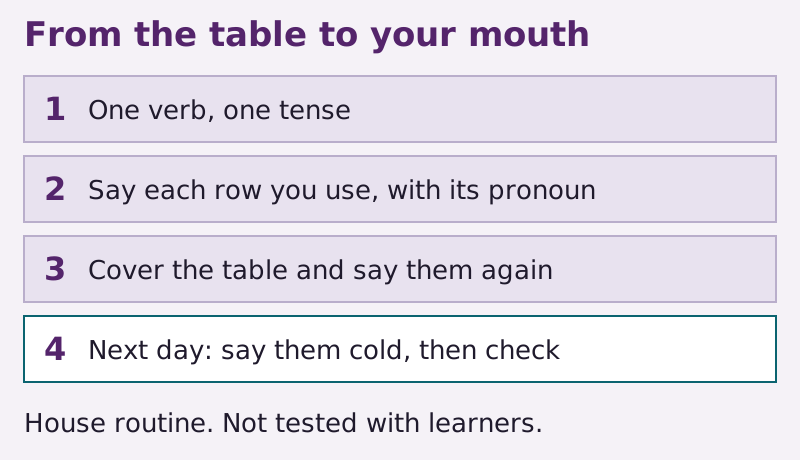
Take one verb and a tense you'll say aloud, not the passé simple. In the Imperative column, say only the forms shown, without a pronoun, as Tex's French Grammar and Grimm Grammar do. Skip blank cells, such as German Sie; don't fill them from the present. In other tenses, say each row you use, pronoun and verb together: every row in French and German. In Spanish, pick one set of you forms: tú or vos for one person, and for more than one, vosotros for informal talk in Spain or the ellos, ellas, ustedes row otherwise. Usted takes the él, ella, usted row, or its own row for commands. If you pick the imperfect subjunctive, practice one of its two columns. With vos in the present subjunctive in Argentina and Uruguay, say the tú form, such as hables. Then cover the table and say the forms again. The next day, do a Cold Say-Back: say them from memory, then check. This routine is this site's own, not tested with learners.
Then use the forms in sentences on the grammar pages: ser and estar, the Spanish subjunctive, the preterite and imperfect, the two French past tenses, the French subjunctive and German cases.
Where does the data come from, and how far was it checked?
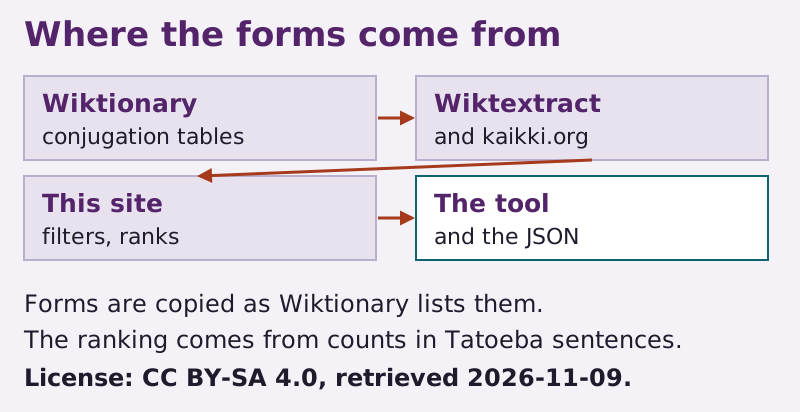
From Wiktionary's conjugation tables, through the Wiktextract project and kaikki.org, retrieved on November 9, 2026. The forms are copied as Wiktionary lists them, and this site picked the verbs.
"How the conjugation data reaches the tool" from Conversation Mile (https://conversationmile.com/grammar-in-use/verb-conjugation-lookup/). CC BY 4.0 (creativecommons.org/licenses/by/4.0)
Samples were checked against rules and against open textbooks. For Spanish, 186 cells from 17 verbs matched ¡Chévere!, an open textbook. For French, 5,274 cells from 157 verbs were compared with Français interactif, and 3 didn't match. For German, 161 cells from 19 verbs matched Grimm Grammar. Most verbs had no second source, and some tenses, such as the French passé simple, weren't checked at all. If a form looks wrong to you, report it through the corrections page.
The tables are shared under CC BY-SA 4.0, like Wiktionary, and each links to its verb's Wiktionary entry, whose history lists the contributors. The notes on the verb tables give the details and link to the files.
Sources
- Wiktionary contributors. Conjugation tables in the entries "hablar," "parler" and "sprechen," and in each verb's entry. Wiktionary Open. Read: The conjugation table headers of hablar, parler and sprechen, note 2 under the hablar table on the vos present subjunctive, and its affirmative and negative imperative rows; each verb's entry is linked from its table. License: CC BY-SA 4.0.
- Ylonen, Tatu. Wiktextract, and the Spanish, French and German dictionary extracts on kaikki.org (October 30, 2026 extraction) Open. Read: The local extract files, and the escribir entry for the escripto tags. License: CC BY-SA 4.0.
- Zapata. Trayectos, Volumen 2: Más sobre mí, Módulo 1, pp. 3 and 14. COERLL, University of Texas at Austin, 2022 Open. Read: The note on vos in Argentina, the pronoun list on p. 14, and the levantarse table and pronoun chart that mark vosotros as informal plural in Spain and Uds. as plural you. License: CC BY-SA 4.0.
- Tatoeba. Sentence collection, downloaded exports. Tatoeba Open. Read: Word-form counts over the whole export, computed by this site. License: CC BY 2.0 FR.
- Français interactif. "Verb Conjugation Reference." COERLL, University of Texas at Austin Open. Read: Used by this site's data check, cell by cell, as recorded in data/conjugation-fr-README.md; not reread for this page. License: CC BY 3.0.
- Brown, Escudero, Montoya and Small. ¡Chévere! Introductory Spanish I and II. Open SUNY, via LibreTexts Open. Read: Used by this site's data check, as recorded in data/conjugation-es-README.md; not reread for this page. License: CC BY 4.0.
- Grimm Grammar. COERLL, University of Texas at Austin Open. Read: Used by this site's data check, as recorded in data/conjugation-de-README.md; not reread for this page. License: CC BY 4.0.
- Tex's French Grammar. "Passé simple." COERLL, University of Texas at Austin Open. Read: The opening explanation of when the passé simple is used. License: CC BY 3.0.
- Grimm Grammar. "Das Perfekt - Einführung." COERLL, University of Texas at Austin Open. Read: The sections on when the Perfekt and the simple past are used and how the Perfekt is formed. License: CC BY 4.0.
- Grimm Grammar. "Präsens - Trennbare Verben." COERLL, University of Texas at Austin Open. Read: Section D, separable prefix verbs with subordinating conjunctions. License: CC BY 4.0.
- Tex's French Grammar. "Imperative mood." COERLL, University of Texas at Austin Open. Read: The formation section. License: CC BY 3.0.
- Grimm Grammar. "Imperativ." COERLL, University of Texas at Austin Open. Read: The examples for du, wir, ihr and Sie and the note on pronouns in commands. License: CC BY 4.0.
Next stops
Cite this page
Verb Conjugation Lookup: Spanish, French, and German. Conversation Mile, 2026-11-10. https://conversationmile.com/grammar-in-use/verb-conjugation-lookup/
Corrections
No corrections on this page. Spotted a language error? Please tell this site.