Pronunciation Workshop Reference
Spanish Alphabet Letter Names to Say Aloud
Straight answer
The Spanish alphabet has 27 letters: the 26 you know, plus ñ. That's the count in ¡Chévere!, an open first-year textbook. Say this question out loud now: ¿Cómo se deletrea tu nombre? It asks how to spell your name. Row 6 of the week below has you answering it with Spanish letter names.
The English trap
FSI's Spanish course warns that the familiar letters fool English speakers: none of the English sounds you link to those letters is an exact match for the Spanish sound.
Say this today
¿Cómo se deletrea tu nombre?
How do you spell your name?
What are the 27 letters called?
Each letter has a name, and you'll need the names to spell anything out loud.
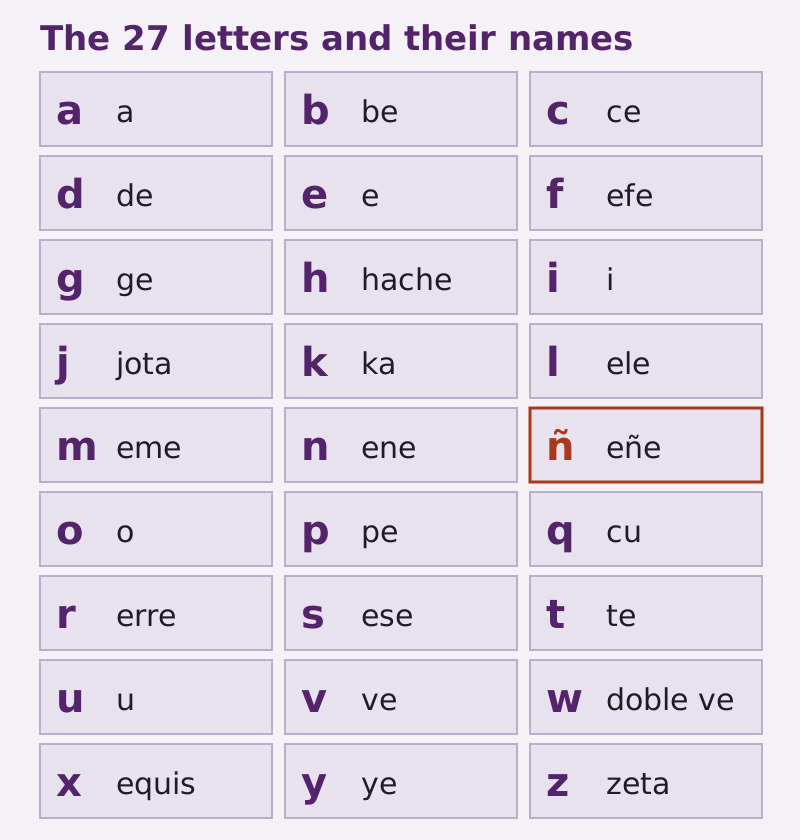
"The 27 letters of the Spanish alphabet and their names" from Conversation Mile (https://conversationmile.com/pronunciation/spanish-alphabet/). CC BY 4.0 (creativecommons.org/licenses/by/4.0)
| Letter | Name | A word with it |
|---|---|---|
| a | a | agua |
| b | be | bien |
| c | ce | casa |
| d | de | día |
| e | e | este |
| f | efe | foto |
| g | ge | gato |
| h | hache | hola |
| i | i | isla |
| j | jota | jota |
| k | ka | kilo |
| l | ele | libro |
| m | eme | mano |
| n | ene | no |
| ñ | eñe | año |
| o | o | ojo |
| p | pe | pero |
| q | cu | queso |
| r | erre | rojo |
| s | ese | sopa |
| t | te | tú |
| u | u | uno |
| v | ve | vino |
| w | doble ve | wifi |
| x | equis | taxi |
| y | ye | yo |
| z | zeta | zapato |
Two notes on the table. ¡Chévere! prints the name of p as just "(p)," so the name here, pe, comes from Wiktionary. And where ¡Chévere! writes "doble v" for w, Wiktionary spells the name out as doble ve.
Say the names out loud with steady vowels. The name be is one short "e," not "bay." The Spanish pronunciation page explains why that slide matters.
A few names use sounds from the table further down, so don't say them the English way. Ge starts with the jota sound, like jota itself. Ce and zeta start with an s sound, or with the th of "thin" in the center and north of Spain. Erre has the trill. Be and ve sound the same in standard Spanish.
Which letters have more than one name?
A few letters have more than one name. Wiktionary ties only one of them, uve, to a place. The table uses the names from ¡Chévere!, plus pe and doble ve from Wiktionary, but you'll hear the others too.
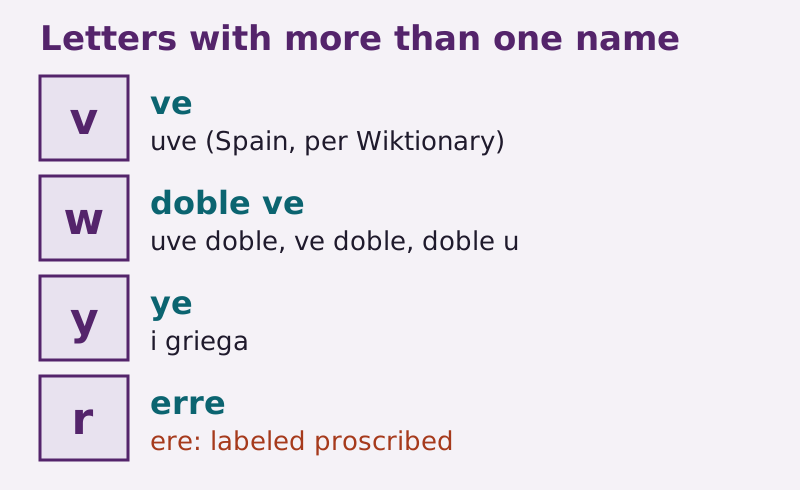
"Spanish letters with more than one name" from Conversation Mile (https://conversationmile.com/pronunciation/spanish-alphabet/). CC BY 4.0 (creativecommons.org/licenses/by/4.0)
- V. Wiktionary labels uve as the name used in Spain. It also lists ve corta, ve chica and ve baja for v, without saying where.
- W. Besides doble ve, Wiktionary lists uve doble, ve doble and doble u, without saying where each is used.
- Y. Wiktionary gives both ye and i griega.
- R. Wiktionary lists ere too, but labels it "proscribed," meaning it's marked as a form to avoid. Stick with erre.
If the people you talk to use a different name, copy theirs. The Spanish starting plan has more on picking whose Spanish to follow.
Which letters don't sound like English?
Letter names are one job. What the letters do inside words is another, and some of them surprise English speakers. This table is a quick map. Each row has more on the pronunciation page.
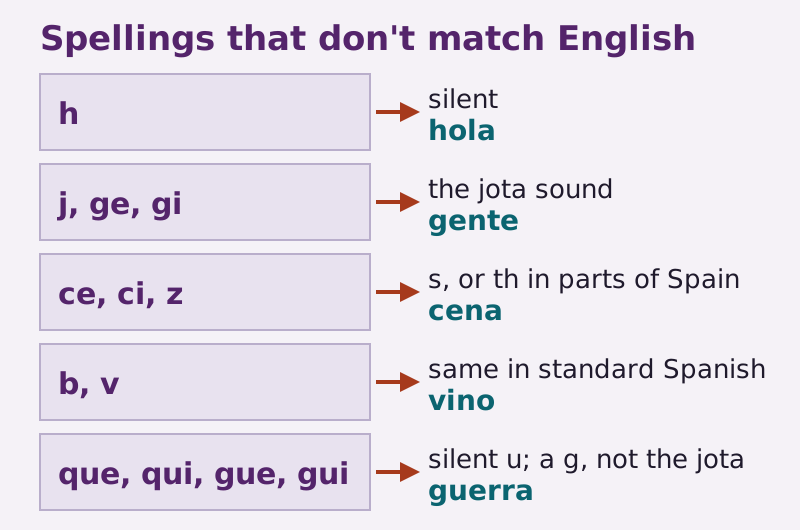
"Spanish spellings that don't match English" from Conversation Mile (https://conversationmile.com/pronunciation/spanish-alphabet/). CC BY 4.0 (creativecommons.org/licenses/by/4.0)
| Spelling | What it does | Word |
|---|---|---|
| h | Silent: Wiktionary's pronunciation of hola has no h sound | hola, ahora |
| j; g before e or i | The jota sound | jota, gente |
| g before a, o, u | A g sound: firm in gato said on its own, softer after the vowel in agua | gato, agua |
| c before e or i; z | An s sound, or the th of "thin" in the center and north of Spain | cena, zapato |
| b and v | The same sound in standard Spanish | bien, vino |
| ll and y | One sound for many speakers; it varies by region | llave, yo |
| qu, gu before e or i | The u is silent, and the g of gue and gui is a g sound, not the jota, as in guerra | queso, guerra |
| ü | The u is said | pingüino |
| r and rr | A tap or a trill | pero, perro |
A few more come up less often. Wiktionary gives the x of taxi and examen as two sounds, close to "gs." In México, it gives the jota sound. The letter ñ is its own sound, the one in año and señor, so don't say it as a plain n. And k and w show up in words like kilo, kiwi and wifi. Wiktionary gives two ways to say wifi: like English "why-fy" in Latin America, and with an "ee" sound in Spain.
The region notes come from ¿Cómo suena?, an open phonetics book. It says the jota is made farther back in Spain. The r sounds have their own page.
What about ch, ll, rr and qu?
¡Chévere! lists four letter pairs that you need to know how to say. They aren't in its count of 27, but each pair spells one sound.
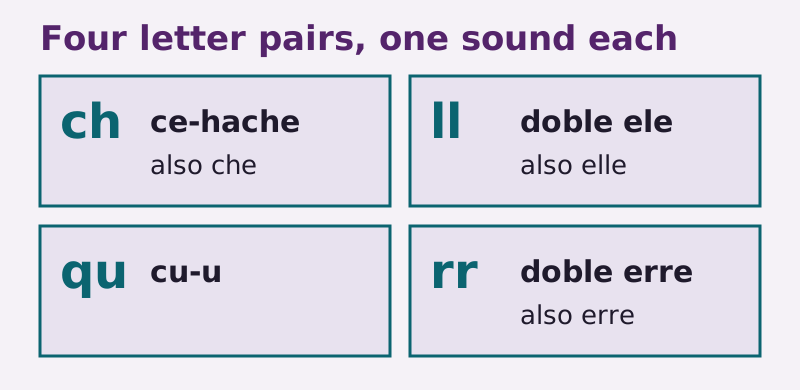
"Four Spanish letter pairs and their names" from Conversation Mile (https://conversationmile.com/pronunciation/spanish-alphabet/). CC BY 4.0 (creativecommons.org/licenses/by/4.0)
| Pair | Name in ¡Chévere! | Also called (Wiktionary) | Word |
|---|---|---|---|
| ch | ce-hache | che | chica |
| ll | doble ele | elle | llave |
| qu | cu-u | — | queso |
| rr | doble erre | erre | perro |
Say each pair name, then the word. The ch has a sound of its own, close to the ch in "chance," even though h alone is silent.
How do you spell a word out loud?
Spelling out loud means saying the letter names in order, with a short pause between them. ¡Chévere! gives the question and answer for it. You ask ¿Cómo se escribe esa palabra? (How do you spell that word?) The answer names the word, then "se escribe," then the letters.
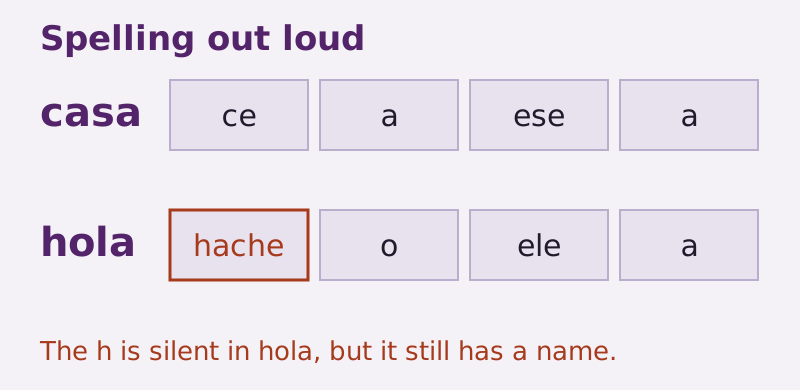
"Spelling casa and hola with Spanish letter names" from Conversation Mile (https://conversationmile.com/pronunciation/spanish-alphabet/). CC BY 4.0 (creativecommons.org/licenses/by/4.0)
When a word has rr, say doble erre, the ¡Chévere! name, since plain erre is also the name of r. Try two now. Casa is ce, a, ese, a. Hola is hache, o, ele, a. The h makes no sound in the word, but it still gets its name when you spell.
Written accents matter here too. To mark stress, ¡Chévere! says Spanish uses only one accent, the one that slants up to the right, as in bebé. It tells you which syllable to stress. The sources for this page don't say how people name the accent while spelling a word out loud, so ask a tutor or a speaker you know.
To type the marks, ¡Chévere! suggests the special-character menu in most programs. On newer Macs you can hold down a vowel, and on an iPhone or iPad you tap and hold the letter.
How do you learn it in one week?
The table has seven rows. On 5- or 10-minute days, do two rows a day: rows 1 and 2, then 3 and 4, then 5 and 6, then row 7, so you finish in four days. On 20-minute days, do one row a day for seven days, and use the last column to review it. Count the time in Spoken Minutes, which run only while you're saying Spanish out loud. Every day after the first starts with a Cold Say-Back: say yesterday's letter names from memory, then check.
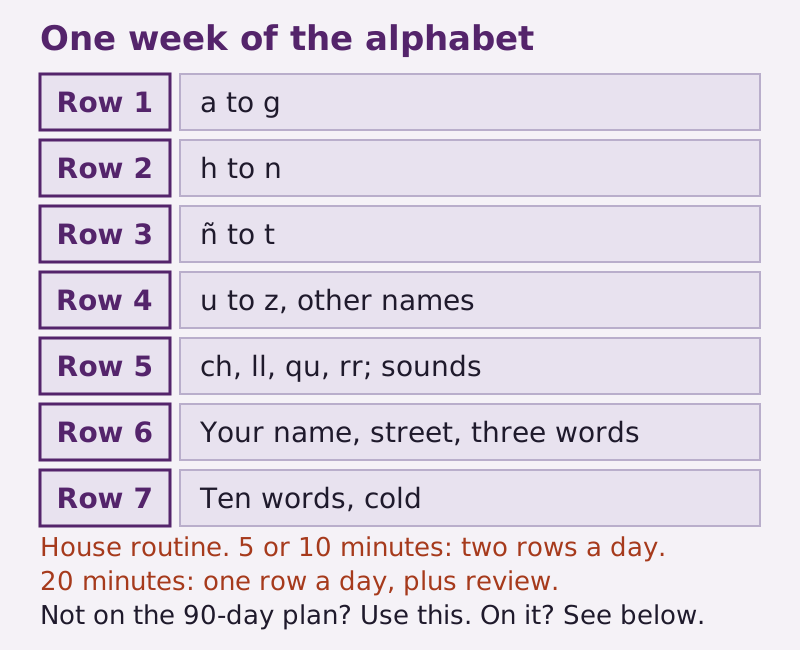
"Seven rows of saying the Spanish alphabet" from Conversation Mile (https://conversationmile.com/pronunciation/spanish-alphabet/). CC BY 4.0 (creativecommons.org/licenses/by/4.0)
| Row | Main job | Review on 20-minute days |
|---|---|---|
| 1 | Names a to g | Say a word for each |
| 2 | Names h to n | Say a word for each |
| 3 | Names ñ to t | Say a word for each |
| 4 | Names u to z, and the other names for v, w, y | Say a word for each |
| 5 | ch, ll, qu, rr, and the sounds table | Read the table's words aloud |
| 6 | Spell your name, your street and three words | Ask and answer the spelling question |
| 7 | Spell ten words from this page, cold | Spell any you missed three times |
On a 5-minute day, spend 1 minute on the Cold Say-Back and 4 on the day's two rows. On a 10-minute day, it's 2 and 8. On a 20-minute day, it's 3, then 10 on the day's row and 7 on its review. Your first day has nothing to say back yet, so those Cold Say-Back minutes go to the rows; on a 20-minute day the 7 minutes of review stay as they are. The rows, the order and the minutes are this site's House routine, untested with learners. Log them in your Mile Log.
If you're following the Spanish starting plan, the Spanish start of the 90-day plan, the letters share its Sounds turn with the vowels and the r in days 1 to 14, coming after the vowels and the r each time. The letters get 2 of the 4 minutes on a 5-minute day and 4 of the 8 on a 10-minute day, for the next two rows. On a 20-minute day, they get 5 minutes when Sounds is the 10-minute job and 4 when it's the 7-minute job, for the next row and its review. On day 1, the Cold Say-Back minutes go to the letters too. Either way, row 7 is done on day 10. The week above is for when you're not following the plan. When a sound gives you trouble, try the minimal pairs tool.
Tomorrow, before you look at anything, run a Cold Say-Back on what you did today: say the names of a to g in order, and h to n too if you did two rows, then check them against the table. Spelling your own name waits for row 6.
Sources
- Brown, Escudero, Montoya and Small. ¡Chévere! Introductory Spanish I, 1.5: Vocabulario, El alfabeto. SUNY Oneonta via OER SUNY Open. Read: The whole page: the 27 letters and their names, the four letter pairs, accent marks, the spelling question and the note on typing special characters. License: CC BY 4.0.
- Stockwell, Bowen and Silva-Fuenzalida. Spanish Basic Course: Units 1-15, Introduction. Foreign Service Institute, U.S. Department of State, 1961 printing (first printed 1957) Open. Read: The introduction's paragraph on spelling and respelling, from a scanned copy with some unreadable characters.
- Wiktionary contributors. Spanish entries for the letter names (pe, uve, ve corta, ve chica, ve baja, doble ve, uve doble, ve doble, ye, i griega, erre, ere, che, elle) and for hola, ahora, taxi, examen, México, año, señor, pingüino, kilo, kiwi, wifi and agua. Wiktionary, as distributed by kaikki.org Open. Read: The senses, labels and pronunciation lines of those entries. License: CC BY-SA 4.0.
- Escudero, Barreca and Carbone. ¿Cómo suena? Fonética y fonología del español, Módulo 4: Las vocales. SUNY Create OER, 2021 Open. Read: The whole module text; embedded videos not watched. License: CC BY 4.0.
- Escudero, Barreca and Carbone. ¿Cómo suena? Fonética y fonología del español, Módulo 5: La sílaba y las consonantes 'yod' y 'wau'. SUNY Create OER, 2021 Open. Read: The section on silent u only. License: CC BY 4.0.
- Escudero, Barreca and Carbone. ¿Cómo suena? Fonética y fonología del español, Módulo 9: Las consonantes africadas y los fonemas oclusivos sordos. SUNY Create OER, 2021 Open. Read: The whole module text; embedded videos not watched. License: CC BY 4.0.
- Escudero, Barreca and Carbone. ¿Cómo suena? Fonética y fonología del español, Módulo 11: Los sonidos obstruyentes sonoros. SUNY Create OER, 2021 Open. Read: The whole module text; embedded videos not watched. License: CC BY 4.0.
- Escudero, Barreca and Carbone. ¿Cómo suena? Fonética y fonología del español, Módulo 12: Las consonantes vibrantes. SUNY Create OER, 2021 Open. Read: The whole module text; embedded videos not watched. License: CC BY 4.0.
- Escudero, Barreca and Carbone. ¿Cómo suena? Fonética y fonología del español, Módulo 14: Las consonantes fricativas. SUNY Create OER, 2021 Open. Read: The whole module text; embedded videos not watched. License: CC BY 4.0.
Sentence credits
- ¿Cómo se deletrea tu nombre? Tatoeba sentence 7741719 by arh; English by CK. CC BY 2.0 FR.
- ¿Cómo se escribe esa palabra? Tatoeba sentence 1637196 by teskmon; English by CK. CC BY 2.0 FR.
Next stops
Cite this page
Spanish Alphabet Letter Names to Say Aloud. Conversation Mile, 2026-11-10. https://conversationmile.com/pronunciation/spanish-alphabet/
Corrections
No corrections on this page. Spotted a language error? Please tell this site.