Speaking & Input Routines Tool
CEFR Levels A1 to B2 as a Rough Speaking Self-Check
Straight answer
Tick the speaking tasks you can do today, and the self-check suggests one thing to try next. Before you tick the first line, test it: say your name, where you live and one thing you like, out loud, in the language you're learning, with no notes. If all three came out with no notes, in a way a listener would follow, tick it. If only part came out, leave it blank.
Check off what you can do
The checklist needs JavaScript to suggest a next step. Every line is here, and you can tick them on paper.
A1
- Say your name, where you live and one thing you like, with no notes.
- Spell your name aloud, letter by letter.
- Say a phone number or a price out loud without stopping to count on your fingers.
- Ask someone to say something again, or more slowly, and keep going once they do.
- Order a drink or a snack in one short sentence.
- Answer three yes-or-no questions about yourself in whole sentences.
A2
- Say what you did yesterday in four or five sentences.
- Say what you plan to do this weekend, with a time and a place.
- Tell someone how to get from your door to the nearest shop.
- In a shop, ask for something, ask the price and ask for another size or color.
- Talk for five minutes about your work, studies or family, even if the other person helps you along.
- Leave a short voice message saying you will be late and why.
B1
- Tell something that happened to you, in order, with a clear start and end.
- Say what you thought of a film or a book and give one reason.
- Explain a problem, such as a wrong bill or a lost bag, and ask for it to be fixed.
- Talk about your week for ten minutes with someone who keeps asking follow-up questions.
- Explain step by step how to do something you know well, such as a recipe.
- When a word is missing, describe it until the other person gets it.
B2
- Argue for one side of a question, then answer the best point from the other side.
- Watch a ten-minute video on a subject you know, then say its main points aloud from memory.
- Compare two options in some detail and say which one you would pick and why.
- Catch your own mistake mid-sentence and fix it without stopping the conversation.
- Say the same request two ways: once to a friend and once to someone you've never met.
- Keep a half-hour conversation going in the language without switching to English.
The lines are this site's own, grouped under the CEFR labels A1 to B2 as a rough guide. You won't get a level, a score or a certificate, and nothing here is an exam.
What is the CEFR?
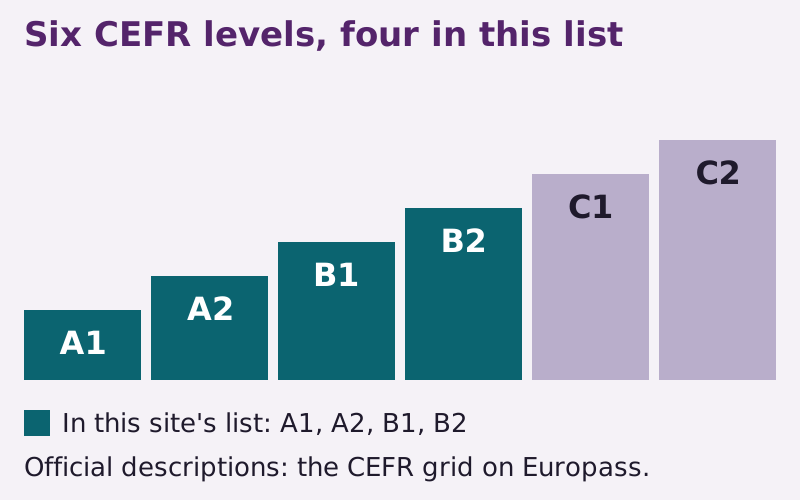
The Common European Framework of Reference for Languages is a scale with six levels, A1, A2, B1, B2, C1 and C2. Its self-assessment grid, published on the EU's Europass site, describes each level for listening, reading, spoken interaction, spoken production and writing.
"The six CEFR levels and the ones this self-check covers" from Conversation Mile (https://conversationmile.com/routines/cefr-self-check/). CC BY 4.0 (creativecommons.org/licenses/by/4.0)
That grid isn't copied or reworded here. To read the official descriptions, open it on Europass from the sources below.
This check stops at B2. It's written for adults teaching themselves from zero, and a list that runs to the top of the scale would be mostly lines you can't use yet.
How is this check different from the official grid?
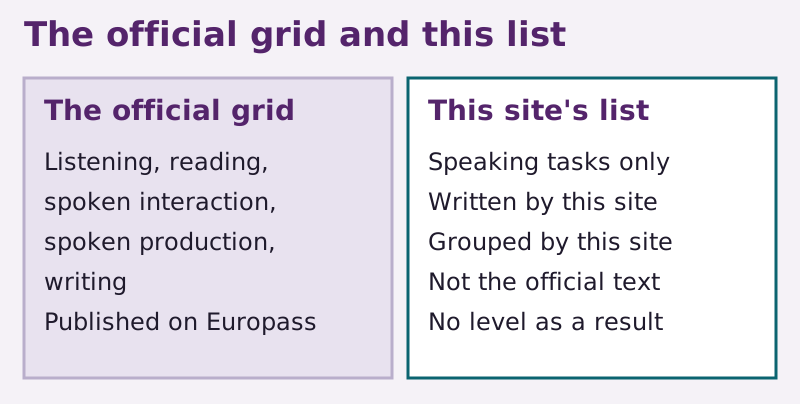
The official grid covers five areas. This list covers one: speaking. Each line is a task you can test by saying something out loud, today.
"How this self-check differs from the official CEFR grid" from Conversation Mile (https://conversationmile.com/routines/cefr-self-check/). CC BY 4.0 (creativecommons.org/licenses/by/4.0)
This site wrote every line and put each one under A1, A2, B1 or B2. That grouping is a House routine, this site's own choice, not tested with learners. It doesn't follow the official text line by line, so ticking every A2 line doesn't mean you're at A2. It means you can do those tasks.
Tick a line only if you can do it now, without notes, in a way a listener would follow, as in a real conversation. If you could do it last month but not today, leave it blank. A line you can half do counts as blank too.
A line that needs another person, such as keeping a conversation going, stays blank until you've done it in a conversation. Speaking practice alone helps you get ready for it.
What do you do with the result?
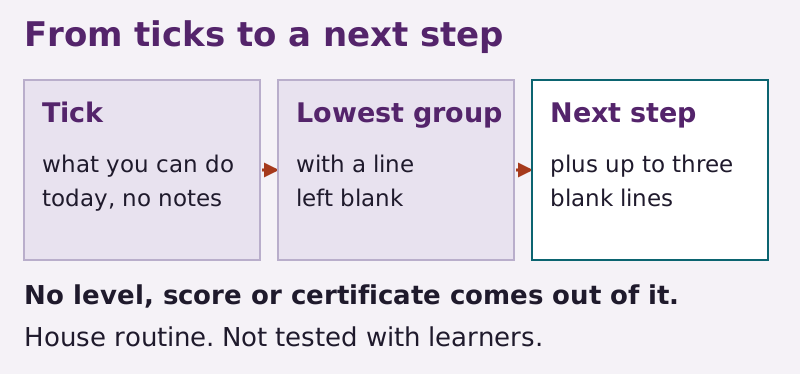
The check finds the lowest group that still has a blank line. It shows that group's next step and up to three of the lines you left blank.
"How the self-check turns ticks into a next step" from Conversation Mile (https://conversationmile.com/routines/cefr-self-check/). CC BY 4.0 (creativecommons.org/licenses/by/4.0)
Each next step turns a blank line into practice. At A1, it's a few short sentences, checked in a dictionary or with a tutor, said today and tested cold the next morning. Higher up, it's a role-play or a topic for your next conversation, and those sentences get checked first too. Take those lines to a tutor lesson or a language exchange, or work on them in speaking practice alone.
The ticks aren't saved. Run the check again after a few weeks, ideally on a day you've just had a conversation, and see which lines have changed. Nothing here is a scoreboard, and the Mile Log doesn't turn miles into a level either.
You can also use the lines to tell a tutor or partner where you are, in words rather than a letter: "I can say what I did yesterday, but I can't tell a story yet."
In the 90-day plan, the self-check fits on any conversation day. Today, take the first blank line the check gave you, write two or three sentences for it and check them in a dictionary or with your tutor.
Tomorrow, before anything else, do a Cold Say-Back on those sentences: say the corrected version from memory, then check it against that version. A good Cold Say-Back isn't a tick by itself. Tick the line by the same rule as above.
Sources
- Europass. "Common European Framework of Reference for Language skills": the CEFR self-assessment grids. © European Union Open. Read: The level names and section headings of the grid. The descriptions were read only to make sure this site's lines don't follow them..
- Europass. "Can I use or reproduce the information contained on the Europass website?" © European Union Open. Read: The whole answer.
Next stops
Cite this page
CEFR Levels A1 to B2 as a Rough Speaking Self-Check. Conversation Mile, 2026-11-10. https://conversationmile.com/routines/cefr-self-check/
Corrections
No corrections on this page. Spotted a language error? Please tell this site.