Speaking & Input Routines How-to
Language Exchange: How to Split the Hour Between Languages
Straight answer
Split a language exchange hour into two halves, one for each language, and let a timer call the switch. Before you meet anyone, learn the line you'll need most and say it aloud: No entiendo. in Spanish, Je ne comprends pas. in French, or Ich verstehe nicht. in German. Each one means "I don't understand." In an exchange, each of you is learning the other's language, and you take turns helping. This page covers how to share the time fairly, what to agree on first, and how to meet a new partner safely.
How do you split the hour?
Two halves of 30 minutes. In one, you speak your new language and your partner helps. In the other, your partner speaks theirs and you help.
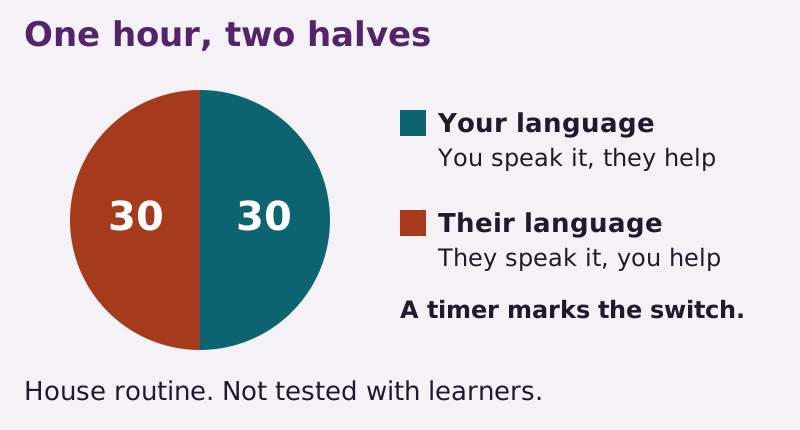
"Splitting a language exchange hour into two halves" from Conversation Mile (https://conversationmile.com/routines/language-exchange/). CC BY 4.0 (creativecommons.org/licenses/by/4.0)
Set a timer on your phone where you can both see it. When it goes off, switch, even in the middle of a story. The timer keeps either language from quietly taking over the hour.
Take turns going first, so neither of you always gets the second half. Next week, the other person starts.
If an hour is too long, use the same split on a shorter session: two halves of 15 or 20 minutes work the same way.
What should you agree on first?
Five minutes of planning, in whichever language is easier, saves the hour. It sits outside the two timed halves, and planning in English doesn't go in the log.
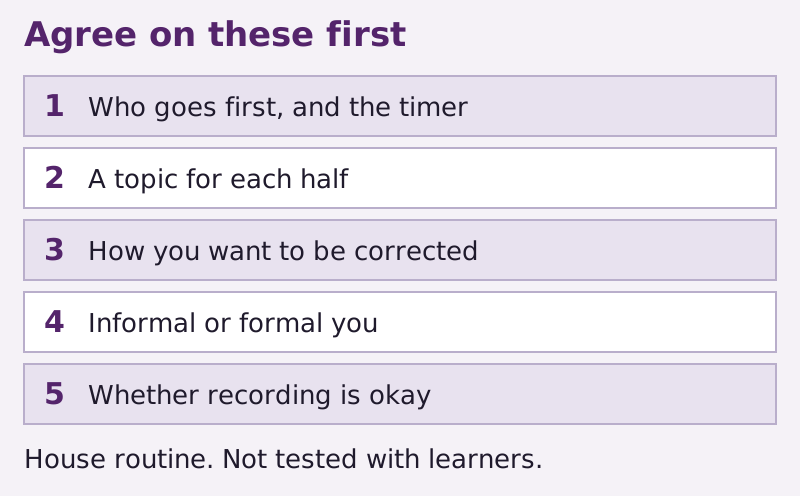
"What to agree on before a language exchange starts" from Conversation Mile (https://conversationmile.com/routines/language-exchange/). CC BY 4.0 (creativecommons.org/licenses/by/4.0)
- Who goes first, and the timer.
- A topic for each half. Your week, a plan, a film. A topic beats "so, what do you want to talk about?"
- How you want to be corrected. After each answer, at the end, or one thing only. The tutor agenda explains all three, and they work the same between partners.
- Informal or formal you. Ask which one your partner expects. The tutor agenda has formal and informal versions of the lines for corrections and a slower pace. The middle row of the table below uses the informal you. If you need it formal, ask your partner for the formal line instead of swapping the pronoun yourself.
- Whether recording is okay. Ask before you record anything, and record only your own half if your partner prefers.
On a first meeting, add one more thing: roughly what level each of you is at. The CEFR self-check gives you a few concrete lines to describe that, so you can say "I can talk about my day but not argue a point" instead of guessing at a letter.
How do you help in your partner's half?
When it's their half, you're the helper. You don't need to know any grammar to do this well.
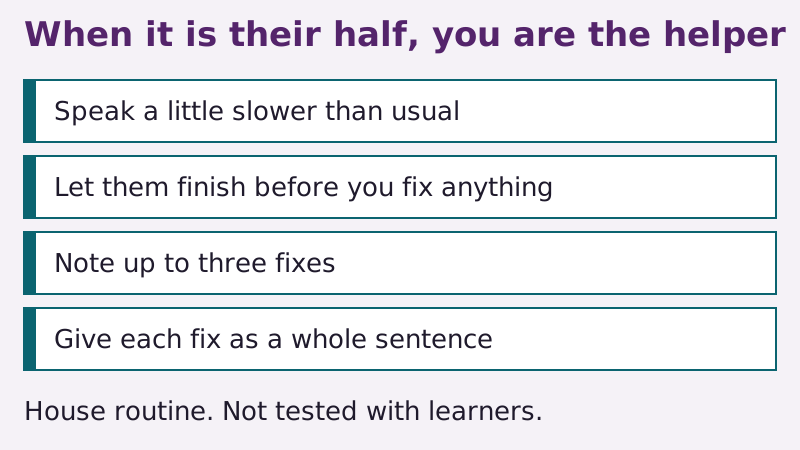
"How to help your partner during their half" from Conversation Mile (https://conversationmile.com/routines/language-exchange/). CC BY 4.0 (creativecommons.org/licenses/by/4.0)
- Speak a little slower than usual, and use everyday words.
- Let them finish before you fix anything, so they get the whole thought out.
- Note up to three fixes, on paper or in the chat, rather than every slip.
- Give each fix as a whole sentence, the way you'd say it, so they can repeat it.
You'll get the same help back in your half. Ask your partner to do these four things too, and to type the fixes so you can turn them into cards later.
Which lines keep the talk going?
Three stalls come up again and again: you lost the whole sentence, you lost part of it, or one word is missing. Have a line ready for each.
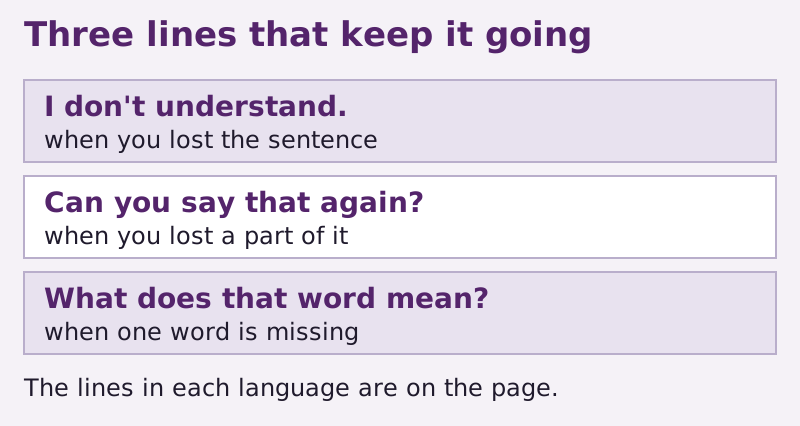
"Three lines for when a language exchange stalls" from Conversation Mile (https://conversationmile.com/routines/language-exchange/). CC BY 4.0 (creativecommons.org/licenses/by/4.0)
| Spanish | French | German | |
|---|---|---|---|
| I don't understand. | No entiendo. | Je ne comprends pas. | Ich verstehe nicht. |
| Say that again? | ¿Podrías repetir eso? | Peux-tu répéter cela ? | Kannst du das wiederholen? |
| What does that word mean? | ¿Qué significa esa palabra? | Que signifie ce mot ? | Was bedeutet dieses Wort? |
The Spanish line in the middle row means "Could you repeat that?" and the French and German ones mean "Can you say that again?" All three lines in that row use the informal you. In the last row, the French and German lines say "this word" rather than "that word." If your partner uses vos, ask them which forms change, rather than changing the words yourself.
Say each line aloud a few times before your first exchange, so it comes out without a search. A stall handled in the language keeps the timer honest. A stall handled in English quietly turns your half into theirs.
How do you meet a new partner safely?
Basic care is enough, the same you'd take meeting anyone from the internet.
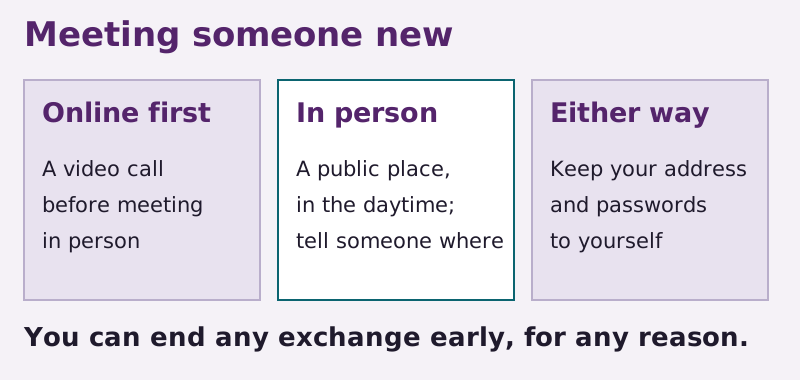
"Basic care when meeting a language exchange partner" from Conversation Mile (https://conversationmile.com/routines/language-exchange/). CC BY 4.0 (creativecommons.org/licenses/by/4.0)
- Start online. Have a video call or two before you meet in person.
- Meet in a public place, in the daytime, such as a café or a library, and tell someone where you'll be.
- Keep private details private. Your home address, workplace details and passwords stay out of the chat until you know the person well, and passwords stay out for good.
- Leave whenever you want. You can end an exchange early, for any reason, and you don't owe anyone a second meeting.
An exchange doesn't involve money. If a partner asks for money or pushes to move off the app or site where you met before you're ready, end it.
How does an exchange count, and how often?
Only your half goes in the log, and it counts half, like any conversation. Enter the clock length of your half, such as 30 minutes, and the Mile Log halves it to 15 Spoken Minutes. On paper, halve it yourself. Your partner's half is in English or another language, so it doesn't count at all.
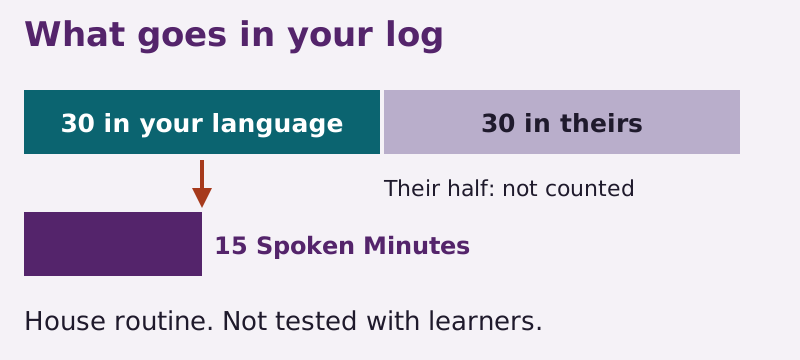
"How a language exchange hour goes in the log" from Conversation Mile (https://conversationmile.com/routines/language-exchange/). CC BY 4.0 (creativecommons.org/licenses/by/4.0)
Spoken Minutes are the unit this site uses for speaking time, and the Mile Log adds them up. On an exchange day, the exchange replaces the day's other jobs, the Cold Say-Back included, as in the 90-day plan. Tell your partner at the start that you want to do most of the talking in your half.
In the 90-day plan, the first conversation falls on day 30 and a weekly one starts on day 49. An exchange partner can fill those days, and so can a tutor. Before the first one, prepare three sentences about yourself, and afterward write down what you couldn't say. If no one is free by day 30, use speaking practice alone that day and keep looking. On the days in between, a short shadowing clip keeps your mouth used to the language.
The same day, save your partner's typed fixes and write down anything you couldn't say. Don't make cards yet. On your plan's next card day, turn two of those lines into cards. The Anki page shows how.
Tomorrow, before you look at those notes, do a Cold Say-Back: say the "I don't understand" line from memory, plus one fix from today. Then check both.
What this rests on
Checked against
- The lines for I don't understand, can you say that again, and what does that word mean Source 1
House routine
- Two timed halves of 30 minutes, one language each, taking turns to go first
- The five things to agree on first
- The four ways to help during your partner's half
- A video call first, a public place in the daytime, telling someone where you are, and keeping your address and passwords to yourself
- Counting only the half in your new language, at half its length
- Keeping the typed fixes on the day, and turning two of them into cards on the next card day
- The first conversation on day 30 and a weekly one from day 49, with three sentences prepared before the first
Sources
- Tatoeba. Sentence collection, downloaded exports. Tatoeba Open. Read: The nine sentences on this page and their linked English, read one by one. Authors are credited under Sentence credits.. License: CC BY 2.0 FR.
Sentence credits
- No entiendo. Tatoeba sentence 2874 by Shishir; English by CK. CC BY 2.0 FR.
- Je ne comprends pas. Tatoeba sentence 3528 by le_petit_ane_gris; English by CK. CC BY 2.0 FR.
- Ich verstehe nicht. Tatoeba sentence 455404 by MUIRIEL; English by CK. CC BY 2.0 FR.
- ¿Podrías repetir eso? Tatoeba sentence 1252015 by marcelostockle; English by CK. CC BY 2.0 FR.
- Peux-tu répéter cela ? Tatoeba sentence 1101503 by sacredceltic; English by Source_VOA. CC BY 2.0 FR.
- Kannst du das wiederholen? Tatoeba sentence 757065 by Pfirsichbaeumchen; English by Source_VOA. CC BY 2.0 FR.
- ¿Qué significa esa palabra? Tatoeba sentence 639715 by Shishir; English by CK. CC BY 2.0 FR.
- Que signifie ce mot ? Tatoeba sentence 348842 by sysko; English by CK. CC BY 2.0 FR.
- Was bedeutet dieses Wort? Tatoeba sentence 343703 by MUIRIEL; English by CK. CC BY 2.0 FR.
Next stops
Cite this page
Language Exchange: How to Split the Hour Between Languages. Conversation Mile, 2026-11-10. https://conversationmile.com/routines/language-exchange/
Corrections
No corrections on this page. Spotted a language error? Please tell this site.