Words That Stick Reference
Most Common Spanish Words in Tatoeba's Free Sentences
Straight answer
These lists rank the 1,000 word forms that turn up most in a free sentence collection. The collection is Tatoeba, where volunteers write and translate short sentences, and the lists cover Spanish, French and German. Before you read any list, say one line built only from words near the top: No lo sé. in Spanish, Je ne sais pas. in French, or Ich weiß es nicht. in German. Each means "I don't know." The lists show what is common in this collection. They aren't a count of Spanish, French or German as a whole.
What do these lists count, and what don't they?
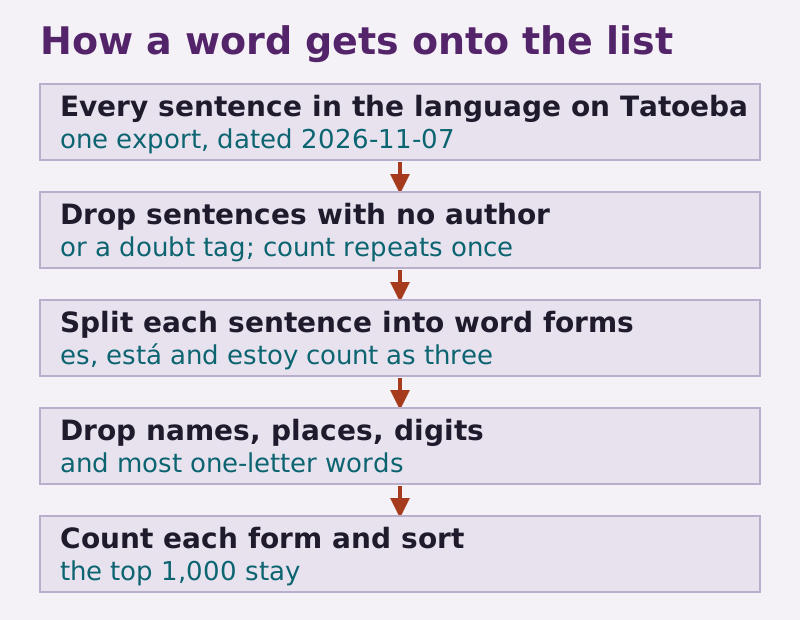
Each list counts word forms in one export of Tatoeba sentences, dated 2026-11-07. Tatoeba's sentences are short and written by volunteers. The lists haven't been checked against any other word count.
"How a word form gets onto this list" from Conversation Mile (https://conversationmile.com/vocabulary/first-1000-words/). CC BY 4.0 (creativecommons.org/licenses/by/4.0)
| Language | Sentences counted | Words counted | Different forms | Contributors |
|---|---|---|---|---|
| Spanish | 442,593 | 3,219,974 | 80,526 | 1,949 |
| French | 727,760 | 5,734,406 | 77,818 | 1,996 |
| German | 785,882 | 6,114,809 | 134,459 | 1,745 |
Names show how much the people writing the sentences shape the counts. Before names were taken out, Tom ranked 11th in Spanish, 25th in French and 5th in German. That rank tells you what the sentence writers like to write about, not what Spanish speakers say. So names and places are removed, partly by rule and partly by a hand-made list, along with a few words that belong to the Tatoeba community itself. Numbers written in digits go too (number words such as dos stay), and so do most one-letter words and any sentence that has no author or carries a tag that questions it.
Read the order of the small words at the top, the ones that hold sentences together, as a rough guide. Don't read much into the order of the nouns and verbs further down. Changing which sentences go in barely moves the lists. With the biggest contributor's sentences left out, 976 of the 1,000 Spanish forms stay the same. That shows the lists are stable. It doesn't show that they stand for the whole language.
Why do some words show up more than once?
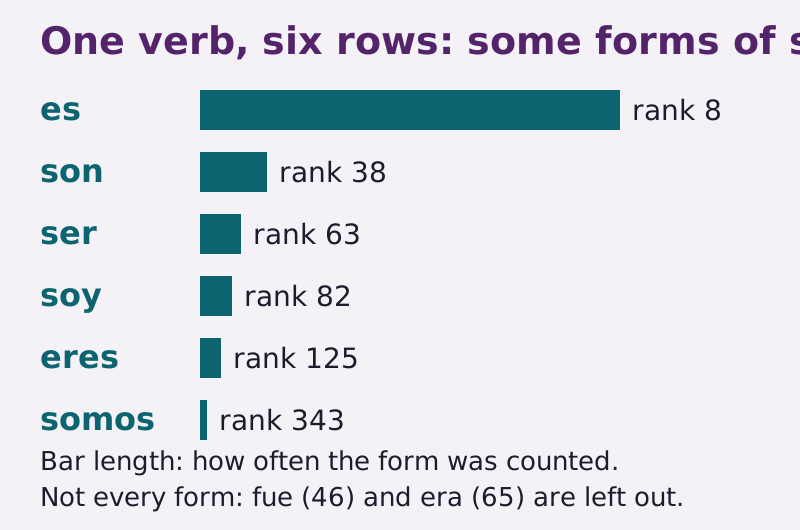
The lists count word forms, not dictionary words. Es, soy and son are all forms of ser, to be, and each one gets its own rank. The picture shows six of them, not the whole verb. A spelling can also belong to more than one word. fue (46) is a form of ser and of ir, to go. era (65) is a form of ser and also a noun, "era." Even ser is also a noun, "a being." The rank counts the spelling, not one meaning.
"Six forms of ser, each counted on its own" from Conversation Mile (https://conversationmile.com/vocabulary/first-1000-words/). CC BY 4.0 (creativecommons.org/licenses/by/4.0)
A few more rules shape what you see:
- Spanish and French are counted in lower case, so a word at the start of a sentence counts with the same word elsewhere.
- German keeps capital letters, because a capital can make a different word. Essen and essen are counted apart, except at the start of a sentence, where every word is counted under the spelling it has most often mid-sentence. One known slip: Sie at the start of a sentence can't be sorted between "she," "they" and the polite "you," so Sie is counted too high and sie too low. The polite forms built on it have the same problem. Ihnen ("to you," polite) is counted too high and ihnen ("to them") too low. ihre, ihren and ihrer take in the polite forms that start a sentence. Polite Ihr ("your") has no row of its own and is counted under ihr.
- French splits short forms with an apostrophe. l'homme counts as l' and homme. A few fixed words stay whole, such as aujourd'hui and quelqu'un.
- Some everyday words are missing. Spanish estados and unidos were dropped along with Estados Unidos, and the German words for it were dropped too. They're ordinary words that the name rule caught.
Spanish: which word forms come first?
"The 10 most counted Spanish word forms in Tatoeba sentences" from Conversation Mile (https://conversationmile.com/vocabulary/first-1000-words/). CC BY 4.0 (creativecommons.org/licenses/by/4.0)
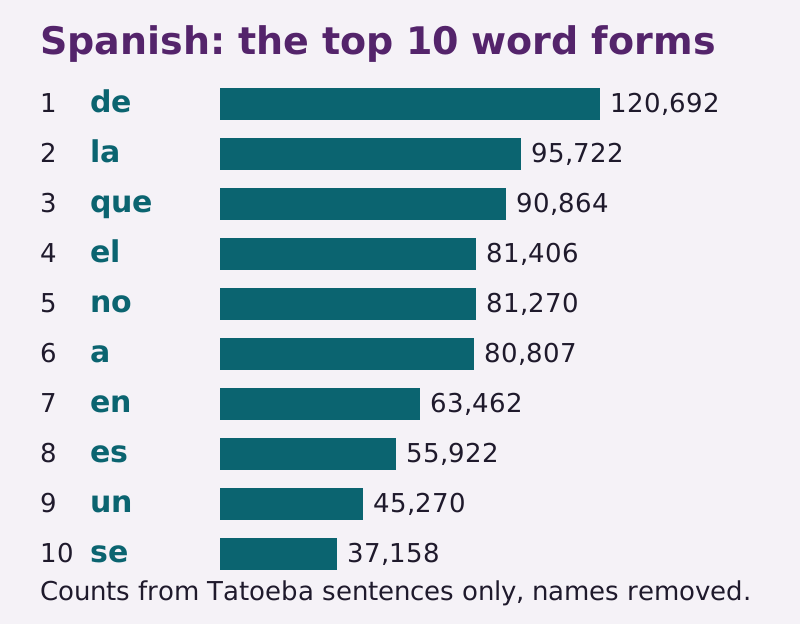
The first 100, read down each pair of columns:
| # | Word | # | Word | # | Word | # | Word |
|---|---|---|---|---|---|---|---|
| 1 | de | 26 | te | 51 | estaba | 76 | o |
| 2 | la | 27 | al | 52 | hacer | 77 | hace |
| 3 | que | 28 | le | 53 | todos | 78 | ahora |
| 4 | el | 29 | del | 54 | nos | 79 | nunca |
| 5 | no | 30 | ella | 55 | aquí | 80 | sin |
| 6 | a | 31 | si | 56 | sus | 81 | ese |
| 7 | en | 32 | este | 57 | puede | 82 | soy |
| 8 | es | 33 | yo | 58 | quiero | 83 | día |
| 9 | un | 34 | tiene | 59 | mucho | 84 | están |
| 10 | se | 35 | como | 60 | tiempo | 85 | ir |
| 11 | los | 36 | muy | 61 | tan | 86 | favor |
| 12 | me | 37 | esta | 62 | nada | 87 | sé |
| 13 | y | 38 | son | 63 | ser | 88 | mañana |
| 14 | una | 39 | tu | 64 | bien | 89 | hoy |
| 15 | por | 40 | hay | 65 | era | 90 | mejor |
| 16 | lo | 41 | pero | 66 | he | 91 | ellos |
| 17 | las | 42 | ha | 67 | vez | 92 | vida |
| 18 | con | 43 | todo | 68 | puedo | 93 | va |
| 19 | su | 44 | eso | 69 | algo | 94 | quién |
| 20 | mi | 45 | estoy | 70 | esto | 95 | dónde |
| 21 | para | 46 | fue | 71 | solo | 96 | años |
| 22 | él | 47 | tengo | 72 | gusta | 97 | creo |
| 23 | está | 48 | cuando | 73 | dos | 98 | esa |
| 24 | qué | 49 | ya | 74 | siempre | 99 | dijo |
| 25 | más | 50 | casa | 75 | cómo | 100 | trabajo |
Get the whole list: Spanish list, 1,000 forms (CSV) About this table Data: Word counts computed by Conversation Mile from sentences on Tatoeba (https://tatoeba.org), released under CC BY 2.0 FR (https://creativecommons.org/licenses/by/2.0/fr/). Contributors are listed in frequency-contributors-es.csv. Changes: sentences without an author, flagged sentences and repeats were left out; sentences were tokenized and counted; names, places, numbers written in digits (number words stay), most one-letter words and a few Tatoeba-specific words were removed. The ranking reflects this corpus only.. The people whose sentences were counted are in the Spanish contributor list (CSV) About this table Data: Word counts computed by Conversation Mile from sentences on Tatoeba (https://tatoeba.org), released under CC BY 2.0 FR (https://creativecommons.org/licenses/by/2.0/fr/). Contributors are listed in frequency-contributors-es.csv. Changes: sentences without an author, flagged sentences and repeats were left out; sentences were tokenized and counted; names, places, numbers written in digits (number words stay), most one-letter words and a few Tatoeba-specific words were removed. The ranking reflects this corpus only..
French: which word forms come first?
"The 10 most counted French word forms in Tatoeba sentences" from Conversation Mile (https://conversationmile.com/vocabulary/first-1000-words/). CC BY 4.0 (creativecommons.org/licenses/by/4.0)
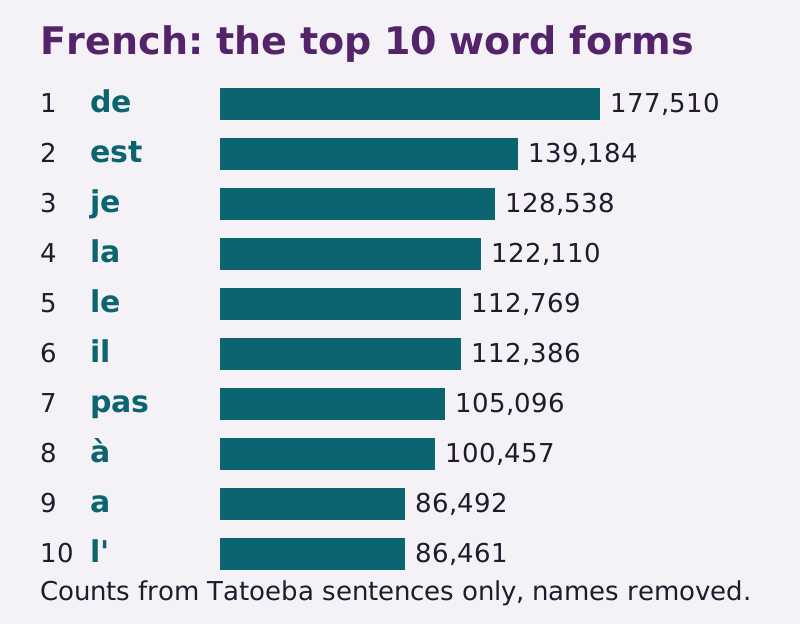
The first 100. One spelling can be two words: été (70) is the past participle of être, "been," and also the noun "summer," and its rank counts both.
| # | Word | # | Word | # | Word | # | Word |
|---|---|---|---|---|---|---|---|
| 1 | de | 26 | des | 51 | était | 76 | pourquoi |
| 2 | est | 27 | et | 52 | fait | 77 | temps |
| 3 | je | 28 | pour | 53 | ont | 78 | où |
| 4 | la | 29 | qu' | 54 | mon | 79 | ses |
| 5 | le | 30 | dans | 55 | moi | 80 | êtes |
| 6 | il | 31 | c' | 56 | lui | 81 | votre |
| 7 | pas | 32 | du | 57 | as | 82 | toi |
| 8 | à | 33 | qui | 58 | si | 83 | jamais |
| 9 | a | 34 | s' | 59 | te | 84 | peux |
| 10 | l' | 35 | me | 60 | cette | 85 | cela |
| 11 | que | 36 | ils | 61 | par | 86 | quand |
| 12 | ne | 37 | plus | 62 | elles | 87 | ici |
| 13 | vous | 38 | se | 63 | sa | 88 | tous |
| 14 | les | 39 | suis | 64 | être | 89 | beaucoup |
| 15 | un | 40 | sont | 65 | ma | 90 | rien |
| 16 | tu | 41 | au | 66 | avez | 91 | comment |
| 17 | n' | 42 | y | 67 | bien | 92 | avons |
| 18 | ce | 43 | avec | 68 | très | 93 | ton |
| 19 | en | 44 | on | 69 | t' | 94 | aime |
| 20 | une | 45 | tout | 70 | été | 95 | toujours |
| 21 | d' | 46 | ça | 71 | comme | 96 | va |
| 22 | j' | 47 | faire | 72 | veux | 97 | peut |
| 23 | nous | 48 | son | 73 | dit | 98 | leur |
| 24 | elle | 49 | m' | 74 | mais | 99 | chose |
| 25 | ai | 50 | sur | 75 | es | 100 | sais |
Get the whole list: French list, 1,000 forms (CSV) About this table Data: Word counts computed by Conversation Mile from sentences on Tatoeba (https://tatoeba.org), released under CC BY 2.0 FR (https://creativecommons.org/licenses/by/2.0/fr/). Contributors are listed in frequency-contributors-fr.csv. Changes: sentences without an author, flagged sentences and repeats were left out; sentences were tokenized and counted; names, places, numbers written in digits (number words stay), most one-letter words and a few Tatoeba-specific words were removed. The ranking reflects this corpus only., and the French contributor list (CSV) About this table Data: Word counts computed by Conversation Mile from sentences on Tatoeba (https://tatoeba.org), released under CC BY 2.0 FR (https://creativecommons.org/licenses/by/2.0/fr/). Contributors are listed in frequency-contributors-fr.csv. Changes: sentences without an author, flagged sentences and repeats were left out; sentences were tokenized and counted; names, places, numbers written in digits (number words stay), most one-letter words and a few Tatoeba-specific words were removed. The ranking reflects this corpus only..
German: which word forms come first?
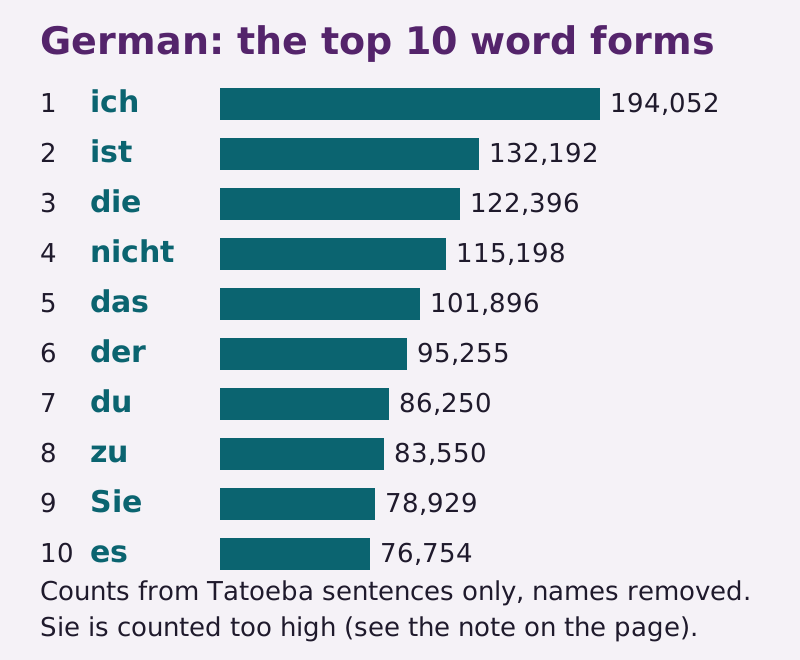
"The 10 most counted German word forms in Tatoeba sentences" from Conversation Mile (https://conversationmile.com/vocabulary/first-1000-words/). CC BY 4.0 (creativecommons.org/licenses/by/4.0)
The first 100. Remember the slips above: Sie is counted too high, and ihr at number 27 is one spelling for several words: "you" (to more than one friend), "her," "to her" and "their." It also holds the polite Ihr, "your." weiß (75) is both "know" or "knows" and "white." daß at number 100 is the spelling used before the 1996 spelling reform; today it's dass, number 19.
| # | Word | # | Word | # | Word | # | Word |
|---|---|---|---|---|---|---|---|
| 1 | ich | 26 | mir | 51 | nach | 76 | bei |
| 2 | ist | 27 | ihr | 52 | dich | 77 | zum |
| 3 | die | 28 | wie | 53 | dir | 78 | will |
| 4 | nicht | 29 | sind | 54 | uns | 79 | nichts |
| 5 | das | 30 | von | 55 | sehr | 80 | bist |
| 6 | der | 31 | war | 56 | nur | 81 | gut |
| 7 | du | 32 | mich | 57 | aber | 82 | über |
| 8 | zu | 33 | haben | 58 | meine | 83 | seine |
| 9 | Sie | 34 | an | 59 | schon | 84 | ihm |
| 10 | es | 35 | als | 60 | hier | 85 | viel |
| 11 | er | 36 | dem | 61 | immer | 86 | heute |
| 12 | in | 37 | einen | 62 | werden | 87 | einer |
| 13 | und | 38 | so | 63 | mehr | 88 | oder |
| 14 | ein | 39 | für | 64 | etwas | 89 | alles |
| 15 | hat | 40 | kann | 65 | des | 90 | hatte |
| 16 | den | 41 | im | 66 | mein | 91 | tun |
| 17 | wir | 42 | wenn | 67 | vor | 92 | können |
| 18 | sich | 43 | man | 68 | auch | 93 | muss |
| 19 | dass | 44 | noch | 69 | keine | 94 | alle |
| 20 | eine | 45 | aus | 70 | ihn | 95 | wurde |
| 21 | mit | 46 | sein | 71 | einem | 96 | da |
| 22 | auf | 47 | um | 72 | warum | 97 | gibt |
| 23 | was | 48 | wird | 73 | diese | 98 | euch |
| 24 | sie | 49 | bin | 74 | am | 99 | wo |
| 25 | habe | 50 | hast | 75 | weiß | 100 | daß |
Get the whole list: German list, 1,000 forms (CSV) About this table Data: Word counts computed by Conversation Mile from sentences on Tatoeba (https://tatoeba.org), released under CC BY 2.0 FR (https://creativecommons.org/licenses/by/2.0/fr/). Contributors are listed in frequency-contributors-de.csv. Changes: sentences without an author, flagged sentences and repeats were left out; sentences were tokenized and counted; names, places, numbers written in digits (number words stay), most one-letter words and a few Tatoeba-specific words were removed. The ranking reflects this corpus only., and the German contributor list (CSV) About this table Data: Word counts computed by Conversation Mile from sentences on Tatoeba (https://tatoeba.org), released under CC BY 2.0 FR (https://creativecommons.org/licenses/by/2.0/fr/). Contributors are listed in frequency-contributors-de.csv. Changes: sentences without an author, flagged sentences and repeats were left out; sentences were tokenized and counted; names, places, numbers written in digits (number words stay), most one-letter words and a few Tatoeba-specific words were removed. The ranking reflects this corpus only..
Norwegian isn't here yet. It will be added once this site has checked enough open sources for it.
Credit for all three lists. Word counts computed by Conversation Mile from sentences on Tatoeba (https://tatoeba.org), released under CC BY 2.0 FR (https://creativecommons.org/licenses/by/2.0/fr/). Contributors are listed in frequency-contributors-es.csv, frequency-contributors-fr.csv and frequency-contributors-de.csv. Changes: sentences without an author, flagged sentences and repeats were left out; sentences were tokenized and counted; names, places, numbers written in digits (number words stay), most one-letter words and a few Tatoeba-specific words were removed. The ranking reflects this corpus only.
How do you use a list like this out loud?
Don't memorize the list as single words. A word like de or est means little alone. Find short sentences that use a few top words and that you could say today, the way the three "I don't know" lines do.
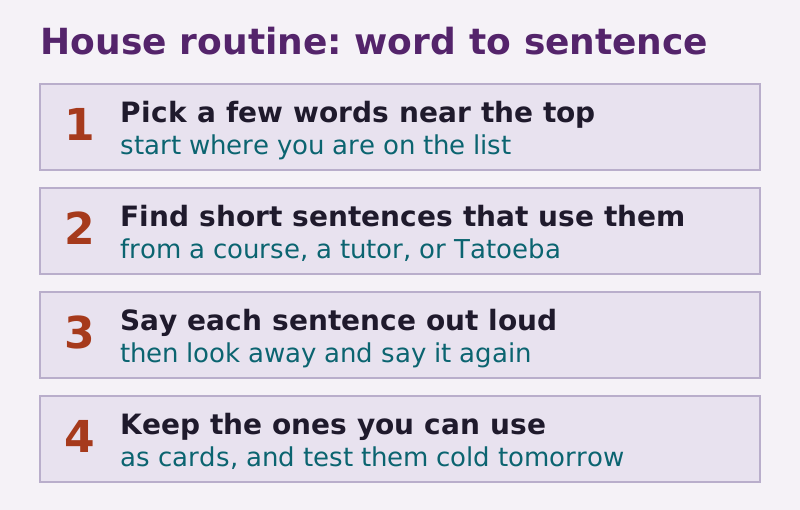
"From a word on the list to a sentence you can say" from Conversation Mile (https://conversationmile.com/vocabulary/first-1000-words/). CC BY 4.0 (creativecommons.org/licenses/by/4.0)
The steps in the picture are this site's House routine, untested with learners. Pick a few words near the top. Find short sentences that use them, from your course, your tutor, or Tatoeba itself. Say each sentence aloud, then look away and say it again. Keep the ones you'd really use. Sentence mining shows how to choose them, and the Anki page shows how to turn them into cards. If you're learning Spanish, Spanish cognates gives you another set of words that look like English.
Count only the time you speak, in Spoken Minutes, and add it to your Mile Log. Where this fits in your first weeks is on the main plan and the starts for Spanish, French and German.
Tomorrow, before you look at anything, run a Cold Say-Back: say "I don't know" in your language, then one of the new sentences you found with words from near the top of the list.
Sources
- Tatoeba. Weekly sentence export (Spanish, French and German sentences, tags and links to English), dated 2026-11-07; word counts computed by this site Open. Read: The full Spanish, French and German sentence exports, counted by this site's scripts; the counting rules and results were checked against the data notes. License: CC BY 2.0 FR.
- Tatoeba. Terms of Use, effective 2022-04-24 Open. Read: Read by the source check of 2026-11-09 (English version); this page relies on the summary in the data notes of sections 6.2 and 6.5 on crediting sentence authors.
- Wiktionary contributors. Spanish conjugation of ser. Wiktionary, as distributed by kaikki.org Open. Read: The present indicative forms of ser in the local kaikki extract (es, soy, eres, somos, son). License: CC BY-SA 4.0.
Sentence credits
- No lo sé. Tatoeba sentence 1023537 by jayefes65; English by fatih. CC BY 2.0 FR.
- Je ne sais pas. Tatoeba sentence 3100 by Sprachprofi; English by fatih. CC BY 2.0 FR.
- Ich weiß es nicht. Tatoeba sentence 394166 by xtofu80; English by fatih. CC BY 2.0 FR.
Next stops
Cite this page
Most Common Spanish Words in Tatoeba's Free Sentences. Conversation Mile, 2026-11-10. https://conversationmile.com/vocabulary/first-1000-words/
Corrections
No corrections on this page. Spotted a language error? Please tell this site.