Words That Stick Reference
Spanish Cognates and the False Friends Among Them
Straight answer
Many Spanish words look like English words, and many of those mean what they look like. Say this out loud now: Tom es una buena persona. You understood persona without help. Some look-alikes, though, mean something else, and a few can embarrass you. This page sorts a short list of them into three groups, each checked against a dictionary entry, with sentences to say for most of them.
The English trap
Spanish actual looks like English actual, but Wiktionary gives its first meanings as present and current, and it marks the pair as false friends.
Say this today
Actualmente vivo en Boston.
I currently live in Boston.
On this page, a cognate is a Spanish word related to an English one: either its Wiktionary entry names the English word, or FSI's course lists it as a cognate loan word. A false friend is a pair that looks alike but doesn't share the meaning you'd guess.
Which Spanish words can you guess from English?
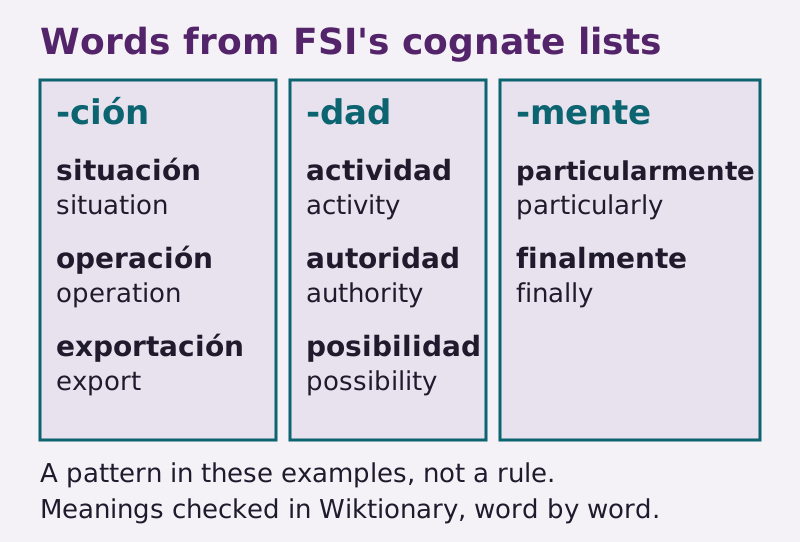
FSI's Spanish course is from the 1950s. Its early readings add no new words except what it calls easy and obvious cognate loan words, ones a student can readily guess. Its later units print lists of them before each reading. Here are a few from those lists, with meanings checked in Wiktionary.
"Words from FSI's cognate lists, grouped by ending" from Conversation Mile (https://conversationmile.com/vocabulary/spanish-cognates/). CC BY 4.0 (creativecommons.org/licenses/by/4.0)
In these examples, Spanish -ción lines up with English -tion, -dad with -ty, and -mente with -ly. Treat that as a pattern in this handful of words, not as a rule. No source read for this page states it as one. Use it to recognize a Spanish word, not to build one from English. Run backward, it goes wrong. Actually plus -mente gives actualmente, which means currently, as the false friends section shows. Liberty is libertad, with -tad, and connection is conexión, with no -ción at all.
Say these three. Each Spanish word here has an English cognate that Wiktionary names, and the meaning matches:
- Él es inteligente. (He is smart.)
- Tu traje es igual al mío. (Your suit is the same as mine.) Wiktionary gives igual as cognate with "equal."
- Tom es una buena persona. (Tom is a good person.)
FSI's lists come from a 1950s course with readings on trade and politics, so they lean toward formal words. For everyday words, start with the first 1,000 words.
Which look-alikes changed meaning?
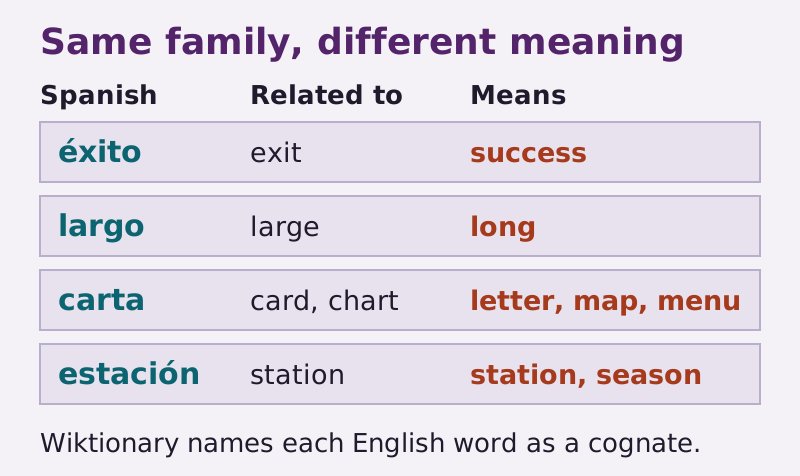
Some Spanish words are related to an English word, by Wiktionary's account, and still mean something else. You'll recognize the shape and guess wrong.
"Cognates whose meaning moved" from Conversation Mile (https://conversationmile.com/vocabulary/spanish-cognates/). CC BY 4.0 (creativecommons.org/licenses/by/4.0)
| Spanish | Related to | Means | For the English meaning |
|---|---|---|---|
| éxito | exit | success, a hit | exit: salida |
| largo | large | long | large: grande |
| carta | card, chart | letter, map, menu, playing card | no single word; check a dictionary |
| estación | station | station, season | same word for station |
Of the English card senses, Wiktionary's entry for carta lists only a playing card. Check a dictionary before you use carta for any other card.
Say each pair of sentences and hear the difference:
- Tuvieron éxito. (They succeeded.) Against Le mostré la salida. (I showed him the exit.)
- Su discurso es muy largo. (His lecture is very long.) Here largo is about length, not size.
- ¿Dónde está la estación? (Where is the station?) Against Hay cuatro estaciones en un año. (There are four seasons in a year.)
Which pairs does the dictionary call false friends?
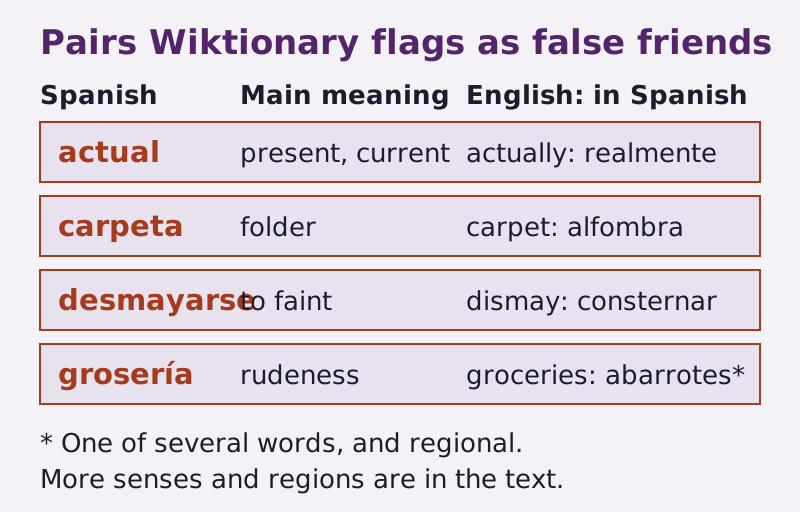
Wiktionary's entries for these four Spanish words say outright that they're false friends of the English look-alike. The right column gives a Spanish word that Wiktionary glosses with the English meaning.
"Four pairs that Wiktionary calls false friends" from Conversation Mile (https://conversationmile.com/vocabulary/spanish-cognates/). CC BY 4.0 (creativecommons.org/licenses/by/4.0)
Actual. Wiktionary lists "present, current" first, then "factual," "actual, real" and "present-day." So it can overlap with English. One word to watch is the adverb. Actualmente means at present: Actualmente vivo en Boston. (I currently live in Boston.) For "really" or "actually," Wiktionary glosses realmente.
Carpeta. It's a folder, for paper or on a computer: ¿En qué carpeta guardaste el archivo? (In which folder did you save the file?) Wiktionary also lists some regional meanings, among them a lace doily in Colombia and the Río de la Plata area. A carpet is an alfombra, though Wiktionary also lists carpeta for carpet in Louisiana.
Desmayar. With se, it means to faint: Tom se desmayó. (Tom fainted.) There's also a figurative sense, "to dishearten," which is near English "dismay." For "to dismay," Wiktionary glosses consternar.
Grosería. It means rudeness, and in Latin America also a vulgar word: Quedé sorprendido por su grosería. (I was taken aback by his rudeness.) A woman would say sorprendida. Watch the region here. Wiktionary has a second entry, borrowed from English, for a grocery store in Puerto Rico and in the US. Elsewhere, the words differ by country. Wiktionary labels abarrotes for groceries in Mexico, Central America, Colombia, Peru, Chile and several other countries, and lists other words too. Ask the people you'll talk to.
Does embarazada mean embarrassed?
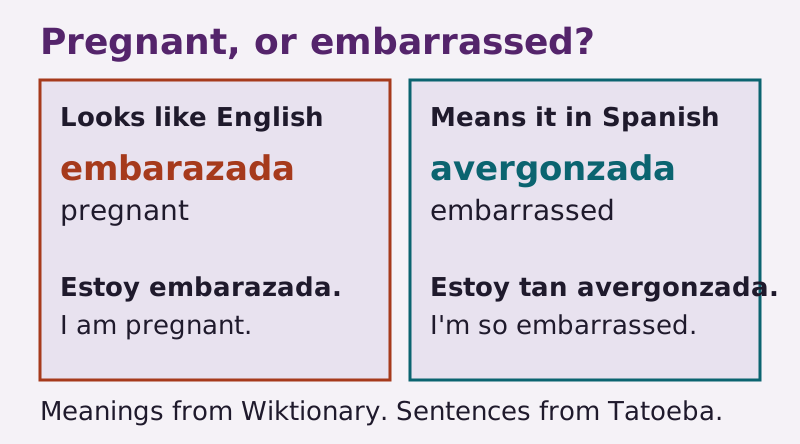
No. Embarazada means pregnant. Wiktionary glosses embarazado as "pregnant," usually in the feminine form, and marks a second meaning, "uncomfortable," as uncommon. It also notes that the verb embarazar gave French a word, and English took that word as "embarrass." So the two are related. The meanings split.
"Embarazada and avergonzada" from Conversation Mile (https://conversationmile.com/vocabulary/spanish-cognates/). CC BY 4.0 (creativecommons.org/licenses/by/4.0)
For embarrassed, the word is avergonzado, glossed as "embarrassed, ashamed," so it covers both feelings. Its ending matches the word it describes. In the sentences below, that word is the speaker, so here the ending follows whoever is talking. When it describes something else, it matches that noun instead. Say these two as a woman would: Estoy embarazada. (I am pregnant.) Estoy tan avergonzada. (I'm so embarrassed.) A man who's embarrassed changes only avergonzada to avergonzado: Estoy tan avergonzado. (I'm so embarrassed.) Leave the embarazada sentence as it is. With a man's ending, embarazado still means pregnant. All three use estar, and ser vs estar explains why pregnant takes that verb.
How do you check a look-alike before you say it?
When a Spanish word looks like an English one, check it before you build a sentence on it. These four steps are this site's House routine, not a rule from a source.
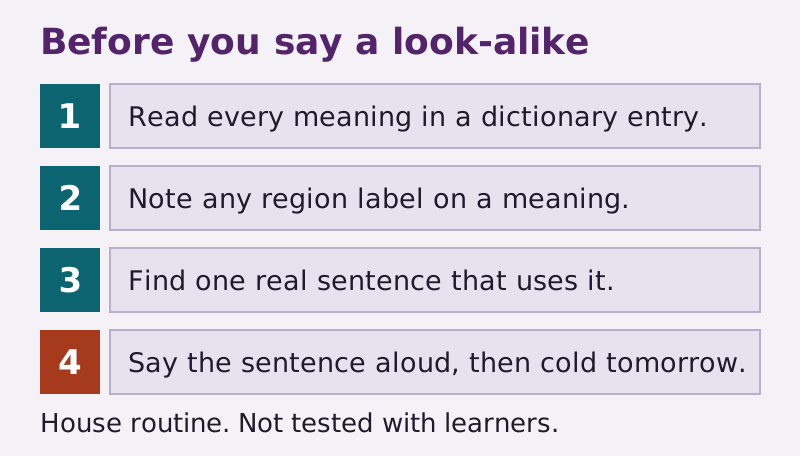
"Four checks before you say a look-alike" from Conversation Mile (https://conversationmile.com/vocabulary/spanish-cognates/). CC BY 4.0 (creativecommons.org/licenses/by/4.0)
- Read every meaning. The first one may match English and the next ones may not, as with estación.
- Look for region labels. Grosería changes by place.
- Find a real sentence. Sentence mining shows where to look.
- Say it aloud. Then say it cold the next day.
To practice the words on this page, say the sentences out loud and count only that time, in Spoken Minutes. On a 5-minute day, spend 1 minute on yesterday's Cold Say-Back and 4 on the sentences. On a 10-minute day, it's 2 and 8. On a 20-minute day, it's 3, then 10 on the sentences and 7 on swapping your own words into two of them. Put your town in place of Boston in Actualmente vivo en Boston. Put another person's name in place of Tom in Tom se desmayó. Leave the rest of each sentence as it is. Day 1 has nothing to say back yet, so those minutes go to the sentences. The split is this site's House routine, untested with learners. Log the minutes in your Mile Log. If you're just starting, the Spanish starting plan shows where vocabulary fits.
Tomorrow, before you look at anything, do a Cold Say-Back: say "I currently live in" and your town in Spanish, then say what éxito and carpeta mean. Check them against this page.
Sources
- Wiktionary contributors. Spanish entries for the words on this page. Wiktionary, as distributed by kaikki.org Open. Read: The senses, region labels and etymology lines of persona, inteligente, igual, situación, operación, exportación, actividad, autoridad, posibilidad, particularmente, finalmente, éxito, salida, largo, grande, carta, estación, actual, actualmente, realmente, carpeta, alfombra, desmayar, consternar, grosería, abarrote, embarazado, embarazar, avergonzado, sorprendido, libertad, conexión. The words 'cognate with English' and 'false friend' are quoted from those etymology lines.. License: CC BY-SA 4.0.
- Stockwell, Bowen and Silva-Fuenzalida. Spanish Basic Course: Units 1-15, Introduction, the section on readings, and Unit 3 on gender agreement. Foreign Service Institute, U.S. Department of State, 1961 printing (first printed 1957) Open. Read: The paragraph on readings in the Introduction and the paragraph on gender agreement in Unit 3, from a scanned copy with some unreadable characters.
- Stockwell, Bowen, Segreda, Montero and Silva-Fuenzalida. Spanish Basic Course: Units 31-45, the Cognate Loan Words lists before each reading. Foreign Service Institute, U.S. Department of State, 1959 Open. Read: All Cognate Loan Words lists in units 31 to 45, from a scanned copy with some unreadable characters; the lists give no English glosses, so meanings on this page come from Wiktionary.
Sentence credits
- Actualmente vivo en Boston. Tatoeba sentence 4732328 by DarkHollow; English by CK. CC BY 2.0 FR.
- Tom es una buena persona. Tatoeba sentence 770911 by Shishir; English by CK. CC BY 2.0 FR.
- Él es inteligente. Tatoeba sentence 1289286 by marcelostockle; English by saeb. CC BY 2.0 FR.
- Tu traje es igual al mío. Tatoeba sentence 3009797 by hayastan; English by CK. CC BY 2.0 FR.
- Tuvieron éxito. Tatoeba sentence 9423039 by ignacio; English by CM. CC BY 2.0 FR.
- Le mostré la salida. Tatoeba sentence 7859482 by arh; English by DJ_Saidez. CC BY 2.0 FR.
- Su discurso es muy largo. Tatoeba sentence 5270684 by albrusgher; English by Dejo. CC BY 2.0 FR.
- ¿Dónde está la estación? Tatoeba sentence 730471 by Shishir; English by CK. CC BY 2.0 FR.
- Hay cuatro estaciones en un año. Tatoeba sentence 1004999 by hayastan; English by CM. CC BY 2.0 FR.
- ¿En qué carpeta guardaste el archivo? Tatoeba sentence 2887723 by marcelostockle; English by Zifre. CC BY 2.0 FR.
- Tom se desmayó. Tatoeba sentence 4527666 by cueyayotl; English by CK. CC BY 2.0 FR.
- Quedé sorprendido por su grosería. Tatoeba sentence 6896204 by Eremon; English by CM. CC BY 2.0 FR.
- Estoy embarazada. Tatoeba sentence 515926 by Shishir; English by shekitten. CC BY 2.0 FR.
- Estoy tan avergonzada. Tatoeba sentence 4103580 by gianich73; English by CK. CC BY 2.0 FR.
- Estoy tan avergonzado. Tatoeba sentence 4103578 by gianich73; English by CK. CC BY 2.0 FR.
Next stops
Cite this page
Spanish Cognates and the False Friends Among Them. Conversation Mile, 2026-11-10. https://conversationmile.com/vocabulary/spanish-cognates/
Corrections
No corrections on this page. Spotted a language error? Please tell this site.