Grammar in Use Grammar
German Adjective Endings Depend on What the Article Shows
Straight answer
A German adjective before a noun takes an ending, and the article decides which one. Say this now, then look away and say it again: Tom hat ein neues Auto. (Tom has a new car.) The -es on neues is there because ein doesn't show that Auto is a das noun. Grimm Grammar explains the endings this way: the more the article shows, the less the adjective has to. This page gives the tables, a short check to use while speaking, and a House routine drill.
The English trap
English adjectives keep one form: an old man, the old men, with old men. Grimm Grammar points out that German adjectives before a noun change their ending with the noun's case, gender and number.
Say this today
Tom hat ein neues Auto.
Tom has a new car.
When does an adjective take an ending?
Only when it comes before the noun. When sein, werden or heißen links it back to the subject, and no noun follows, it takes no ending: Das Haus ist alt. FSI's 1961 German course says so in capital letters: adjectives like alt here never have endings, and neither do adjectives used as adverbs. If a noun follows, the ending comes back, even after ist: Es ist eine kleine Stadt. Adjectives before a noun do, except a few such as lila, covered further down.
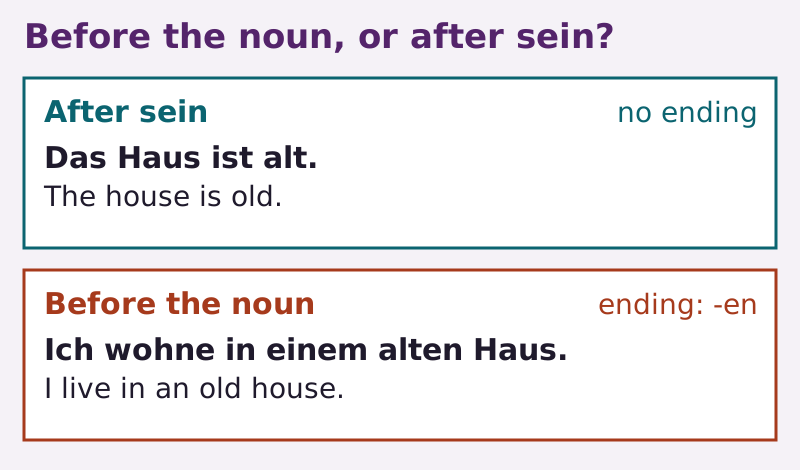
"An ending before the noun, none after sein" from Conversation Mile (https://conversationmile.com/grammar-in-use/german-adjective-endings/). CC BY 4.0 (creativecommons.org/licenses/by/4.0)
| Where | Say this |
|---|---|
| After sein | Das Haus ist alt. The house is old. |
| Before the noun | Ich wohne in einem alten Haus. I live in an old house. |
| Both in one sentence | Die kleine Blume ist weiß. The little flower is white. |
In the last one, kleine comes before Blume and has an ending. The word weiß comes after ist and has none. Comparisons such as "older" have their own forms. This page leaves them for later.
To pick an ending, you need the noun's gender and its case. If those are shaky, start with der, die and das and German cases.
What ending comes after der, die and das?
Only two: -e or -en. Grimm says the article already shows the gender, case and number here, so the adjective doesn't need to. The same endings follow the other der-words Grimm lists: dieser, jeder, jener, mancher, solcher, welcher, alle.
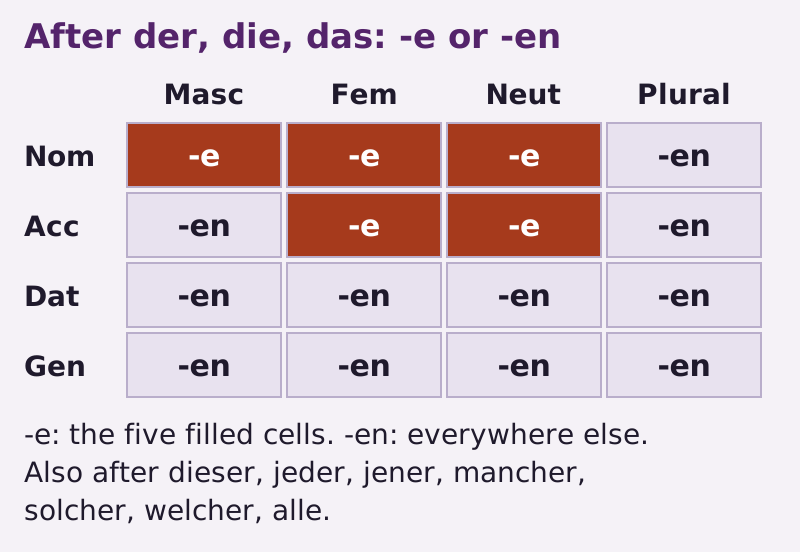
"Adjective endings after der, die and das" from Conversation Mile (https://conversationmile.com/grammar-in-use/german-adjective-endings/). CC BY 4.0 (creativecommons.org/licenses/by/4.0)
Read Grimm's table this way. Five spots take -e: the nominative of all three genders, plus the accusative feminine and neuter. Everything else takes -en, including the masculine accusative and every plural.
| Case and gender | Say this |
|---|---|
| Nominative, masculine | Der alte Mann lebt allein. The old man lives by himself. |
| Nominative, neuter | Das neue Auto gehört ihr. The new car is hers. |
| Accusative, masculine | Was denkst du über den neuen Lehrer? What do you think of the new teacher? |
| Dative, masculine | Er überließ seinen Platz dem alten Mann. He gave his seat to the old man. |
| Plural | Die neuen Schuhe drücken. The new shoes pinch my feet. |
Look at den neuen. Outside the dative and genitive, the masculine accusative is the one singular spot that takes -en.
What changes after ein, kein and mein?
Three cells, and only three. Grimm groups ein and kein with the possessives mein, dein, sein, ihr, unser, euer. These words take their own endings too, and this page only covers the adjective's, so look up a possessive's form, such as for euer, before you say it. Put its ein table next to its der table, and they differ where ein has no ending of its own.
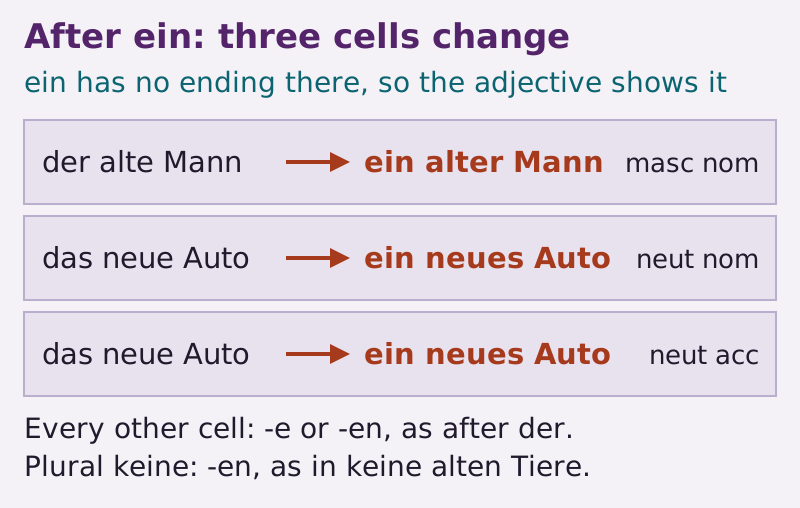
"Where endings after ein differ from endings after der" from Conversation Mile (https://conversationmile.com/grammar-in-use/german-adjective-endings/). CC BY 4.0 (creativecommons.org/licenses/by/4.0)
In those three cells, the adjective picks up the letter that der or das would have shown: ein alter Mann, ein neues Auto. Everywhere else, use -e or -en just as after der.
| Case and gender | Say this |
|---|---|
| Nominative, masculine | Du bist ein guter Freund. You're a good friend. |
| Accusative, neuter | Tom hat ein neues Auto. Tom has a new car. |
| Nominative, feminine | Es ist eine kleine Stadt. It's a small town. |
| Accusative, masculine | Tom wollte einen neuen Wagen. Tom wanted a new car. |
| Dative, feminine | Ich wohne in einer kleinen Stadt. I live in a small town. |
| Plural with keine | Sie haben keine neuen Nachrichten. You have no new messages. |
The first one follows bist, yet it's nominative. That's because sein keeps the noun after it in the nominative (German cases has that rule). Don't stretch the shortcut to the dative. There, einem and einer already show the case, and the adjective takes -en.
What if there's no article at all?
Then the adjective carries the ending the article would have had. FSI says that with no article, the endings in the nominative, accusative and dative match the endings of the der-words. So der gives guter, den gives heißen, and dem gives kaltem.
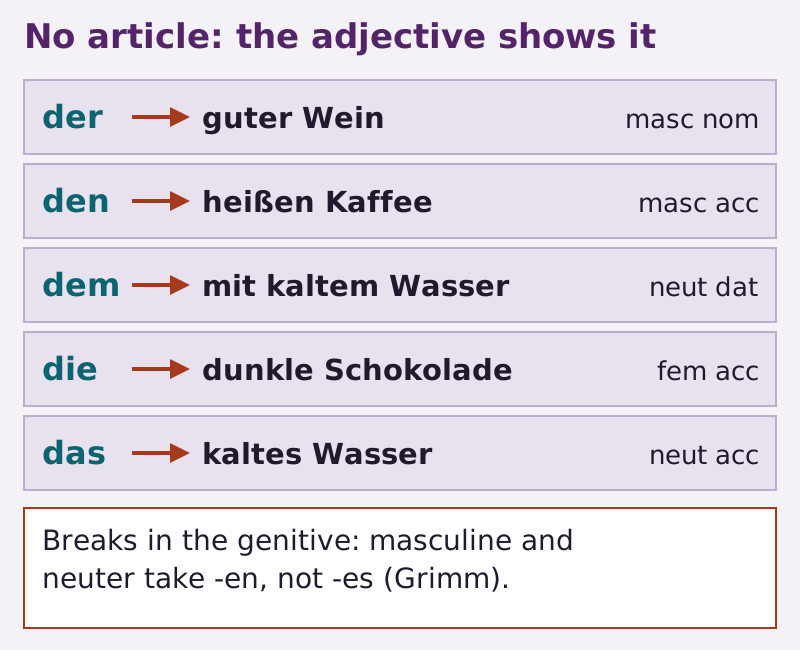
"With no article, the adjective carries the der-word ending" from Conversation Mile (https://conversationmile.com/grammar-in-use/german-adjective-endings/). CC BY 4.0 (creativecommons.org/licenses/by/4.0)
| Would-be article | Say this |
|---|---|
| der | Guter Wein schadet nie. Good wine never hurts. |
| den | Ich mag heißen Kaffee. I like hot coffee. Here heißen is heiß (hot) plus -en, not the verb. |
| das | Ich brauche kaltes Wasser. I need some cold water. |
| dem | Ich habe mich mit kaltem Wasser gewaschen. I washed in cold water. |
The match breaks in the genitive. Grimm's table gives -en for masculine and neuter there, as in barmherzigen Jägers, not -es. FSI says genitives without an article are rare, so the other three cases matter more for speaking.
Grimm also says the same endings follow viele, einige, wenige and numbers. FSI adds that several adjectives all take the same ending. You can hear both in one corpus sentence: Eva hat Adam zwei schöne rote Äpfel gegeben. (Eve gave Adam two beautiful red apples.) With an article in front, a number doesn't change anything, and the article decides as usual. Two adjectives after an article share one ending too: Ich habe einen neuen roten Wagen. (I have a new red car.)
The same endings turn up where you might not expect an adjective. FSI notes that adjectives are sometimes used as nouns, and then they keep the same endings. Its example is the word for an acquaintance: ein alter Bekannter for a man, eine alte Bekannte for a woman, and der Bekannte after der. When a noun's ending seems to shift around, check whether it behaves like an adjective, because the tables above will tell you which ending it needs.
Which adjectives break the pattern?
A few change their own shape before the ending goes on.
| Adjective | Before a noun | Where it comes from |
|---|---|---|
| dunkel (dark) | dunkle, as in Ich mag dunkle Schokolade. I like dark chocolate. | Grimm; Wiktionary |
| teuer (expensive) | teure, drops the e | Wiktionary |
| sauber (clean), offen (open) | saubere, offene, keep the e | Wiktionary |
| hoch (high) | hohe, as in Hohe Bäume fangen viel Wind. Tall trees catch a lot of wind. | FSI; Wiktionary |
| lila, rosa, beige, prima, super | no ending | Grimm |
Grimm's rule says adjectives ending in -el, -en or -er drop the e before the ending, and its example is dunkel. Wiktionary's tables agree for teuer, but offen and sauber keep their e. So drop the e on -el adjectives, and look up each -er or -en adjective before you say it with an ending.
Hoch stays hoch after sein: Die Mieten sind hier hoch. (Corpus translation: Rent is expensive here. Here hoch means high.) Before a noun, FSI says it becomes hoh-. Grimm says the colors lila, rosa and beige, and also prima and super, take no ending. For lila, Wiktionary also records forms with an ending, such as lilane, so you may hear both.
How do you pick the ending while you're talking?
Run four steps, in this order. The order is this site's House routine, and it only works once you know the noun's gender and case.
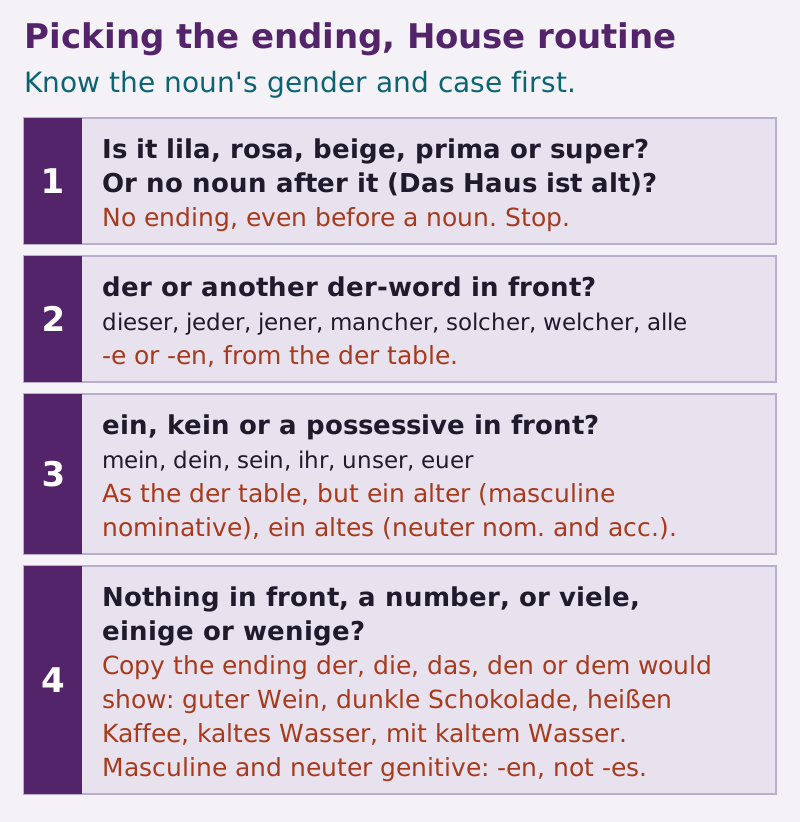
"The order to check when you pick an adjective ending" from Conversation Mile (https://conversationmile.com/grammar-in-use/german-adjective-endings/). CC BY 4.0 (creativecommons.org/licenses/by/4.0)
Step 4 has one gap: the masculine and neuter genitive take -en, not the -es of des. If you can't tell the case, stop. Work that out first with the case questions.
How do you drill this out loud?
The drill runs in Spoken Minutes: the timer moves only while you're talking. The steps and minutes are a House routine, untested with learners.
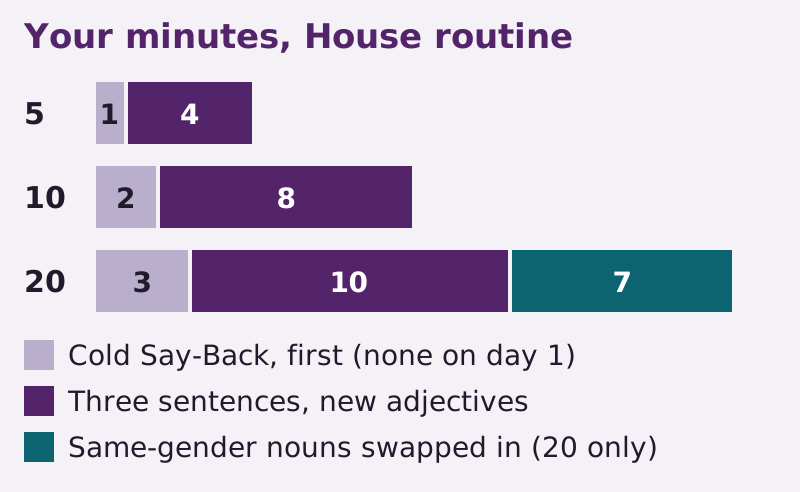
"How the adjective drill fills 5, 10 or 20 Spoken Minutes" from Conversation Mile (https://conversationmile.com/grammar-in-use/german-adjective-endings/). CC BY 4.0 (creativecommons.org/licenses/by/4.0)
On day 1 there's nothing to say back yet, so those minutes go to the sentences.
- Take three sentences, one from each table: Das neue Auto gehört ihr. Tom hat ein neues Auto. Ich brauche kaltes Wasser.
- Say each one. Then look away and say it again.
- Swap the adjective and keep the ending: neue becomes alte, neues becomes altes, and kaltes becomes heißes. Say each new sentence out loud. Use simple adjectives such as alt, neu, klein, gut, kalt, heiß, and skip the ones in the table under "Which adjectives break the pattern?"
- On the 20-minute plan, swap the noun in the first two sentences for another thing of the same gender, so the ending stays: Auto for Buch, both das, in both sentences. Check the gender first, and keep to singular nouns.
Stay with the same three until the endings come out without much thought. Then pick three new sentences from the tables. Log the minutes in the Mile Log. For where this fits in your first weeks, see how to learn German.
Tomorrow, before you open anything, try a Cold Say-Back: say Tom hat ein neues Auto from memory, then say why the ending is -es.
What this rests on
Checked against
- Adjectives before a noun taking endings by case, gender and number, unlike English; three sets of endings by what comes in front; the article already showing enough after der-words; and colors such as lila taking no ending Source 1
- The table after der, die and das, and the list of der-words Source 3
- The table after ein, kein and mein, the list of ein-words, and dropping the e in dunkel Source 2
- The table with no article, the genitive in -en, and the same endings after viele, einige and numbers Source 4
- No ending after sein or as an adverb; nouns such as Bekannter that keep adjective endings; -e or -en after der-type words and -e, -en, -er or -es after ein-type words; several adjectives sharing one ending; numbers not changing the ending; with no article, endings matching the der-type words outside the genitive; hoch becoming hoh- Source 5
- Dunkle and teure dropping the e, saubere and offene keeping it, hohe, and forms such as lilane Source 6
- All German example sentences Source 7
House routine
- Reading the tables as five -e cells and three cells that change after ein, the four-step check, and checking -er and -en adjectives one at a time
- The 5, 10 and 20 Spoken Minute splits with the Cold Say-Back first, the three sentences, which adjectives and nouns to swap in, and staying with three sentences until they come without thought
Sources
- Grimm Grammar. "Adjectives: Adjektive." Grimm Grammar, COERLL, University of Texas at Austin Open. Read: Sections I to IV, without the list of common adjectives read closely and without the exercise.. License: CC BY 4.0.
- Grimm Grammar. "Adjectives: Adjektive nach Ein-Wörtern." Grimm Grammar, COERLL, University of Texas at Austin Open. Read: Full page, without the exercise.. License: CC BY 4.0.
- Grimm Grammar. "Adjectives: Adjektive nach Der-Wörtern." Grimm Grammar, COERLL, University of Texas at Austin Open. Read: Full page, without the exercise.. License: CC BY 4.0.
- Grimm Grammar. "Adjectives: Adjektive ohne Artikel." Grimm Grammar, COERLL, University of Texas at Austin Open. Read: Full page, without the exercise.. License: CC BY 4.0.
- Foreign Service Institute. German Basic Course, Units 1-12. U.S. Department of State, 1961 Open. Read: Notes on Grammar in Unit 6, Adjectives (pp. 144-146), and Unit 7, The Adjective-Noun Sequence and hoch (pp. 172-175). A course from 1961, used here for rules, not example sentences..
- Wiktionary contributors. German entries for dunkel, teuer, sauber, offen, hoch, lila and rosa. Wiktionary, as distributed by kaikki.org Open. Read: The declined forms of each adjective. License: CC BY-SA 4.0.
- Tatoeba. Sentence collection, downloaded exports. Tatoeba Open. Read: Each sentence on this page and its linked English read one by one. Authors are credited under Sentence credits.. License: CC BY 2.0 FR.
Sentence credits
- Tom hat ein neues Auto. Tatoeba sentence 3233937 by Trebalor; English by CK. CC BY 2.0 FR.
- Das Haus ist alt. Tatoeba sentence 8320539 by MisterTrouser; English by rul. CC BY 2.0 FR.
- Ich wohne in einem alten Haus. Tatoeba sentence 1719374 by al_ex_an_der; English by CM. CC BY 2.0 FR.
- Die kleine Blume ist weiß. Tatoeba sentence 5064375 by dispy; English by Objectivesea. CC BY 2.0 FR.
- Der alte Mann lebt allein. Tatoeba sentence 708218 by Esperantostern; English by CK. CC BY 2.0 FR.
- Das neue Auto gehört ihr. Tatoeba sentence 2518580 by Tamy; English by CK. CC BY 2.0 FR.
- Was denkst du über den neuen Lehrer? Tatoeba sentence 533072 by Espi; English by CK. CC BY 2.0 FR.
- Er überließ seinen Platz dem alten Mann. Tatoeba sentence 3331425 by Pfirsichbaeumchen; English by CH. CC BY 2.0 FR.
- Die neuen Schuhe drücken. Tatoeba sentence 2802042 by Tamy; English by shekitten. CC BY 2.0 FR.
- Du bist ein guter Freund. Tatoeba sentence 1909106 by Pfirsichbaeumchen; English by CK. CC BY 2.0 FR.
- Es ist eine kleine Stadt. Tatoeba sentence 9998613 by wolfgangth; English by Hybrid. CC BY 2.0 FR.
- Tom wollte einen neuen Wagen. Tatoeba sentence 3246043 by Pfirsichbaeumchen; English by CK. CC BY 2.0 FR.
- Ich wohne in einer kleinen Stadt. Tatoeba sentence 505951 by Pfirsichbaeumchen; English by CK. CC BY 2.0 FR.
- Sie haben keine neuen Nachrichten. Tatoeba sentence 2812940 by Pfirsichbaeumchen; English by memries. CC BY 2.0 FR.
- Guter Wein schadet nie. Tatoeba sentence 6216189 by wxcraft; English by CarpeLanam. CC BY 2.0 FR.
- Ich mag heißen Kaffee. Tatoeba sentence 12189820 by mhr; English by shekitten. CC BY 2.0 FR.
- Ich brauche kaltes Wasser. Tatoeba sentence 6383795 by Pfirsichbaeumchen; English by sundown. CC BY 2.0 FR.
- Ich habe mich mit kaltem Wasser gewaschen. Tatoeba sentence 12297719 by Pfirsichbaeumchen; English by sundown. CC BY 2.0 FR.
- Eva hat Adam zwei schöne rote Äpfel gegeben. Tatoeba sentence 11569673 by Adelpa; English by Adelpa. CC BY 2.0 FR.
- Ich habe einen neuen roten Wagen. Tatoeba sentence 446609 by Pfirsichbaeumchen; English by CK. CC BY 2.0 FR.
- Ich mag dunkle Schokolade. Tatoeba sentence 2919363 by Manfredo; English by Hybrid. CC BY 2.0 FR.
- Hohe Bäume fangen viel Wind. Tatoeba sentence 5006977 by Esperantostern; English by Zurich899. CC BY 2.0 FR.
- Die Mieten sind hier hoch. Tatoeba sentence 5934894 by brauchinet; English by mailohilohi. CC BY 2.0 FR.
Next stops
Cite this page
German Adjective Endings Depend on What the Article Shows. Conversation Mile, 2026-11-10. https://conversationmile.com/grammar-in-use/german-adjective-endings/
Corrections
No corrections on this page. Spotted a language error? Please tell this site.