Grammar in Use Grammar
German Cases for English Speakers: The Four-Question Method
Straight answer
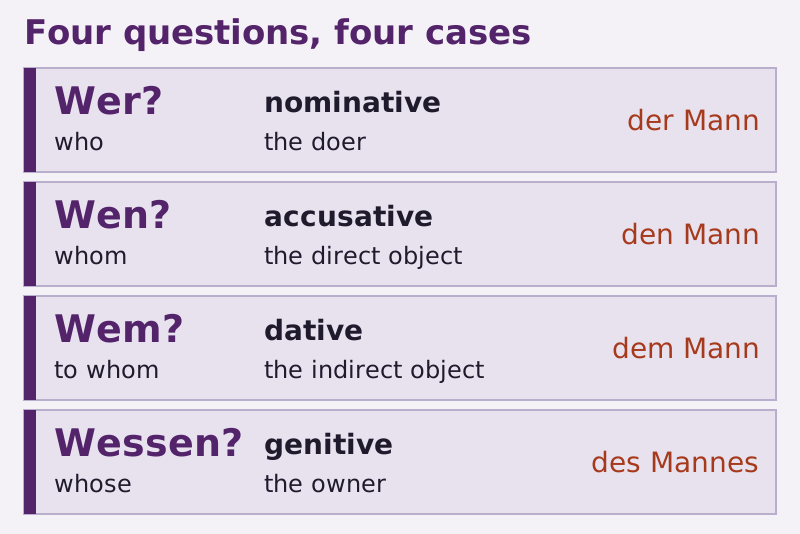
German marks a noun's job on the word in front of it. Four question words line up with the four jobs: wer (who), wen (whom), wem (to whom) and wessen (whose).
The English trap
English nouns don't change for their job in a sentence, and subject-verb-object is the basic English order. German marks the job on the article, so the first noun in a German sentence may be the object.
Say this today
Den Hund habe ich gesehen.
I saw the dog.
Say those four out loud now, three times. Then look away and say them again. When you're unsure about a noun, ask which question it answers.
The match between question and case comes from two course books, and one of them adds wessen. Using it as a drill is this site's House routine, and prepositions and some verbs override it, as this page shows.
Which question goes with which case?
Grimm Grammar lists wer, wen and wem as the nominative, accusative and dative forms of one question word. The Foreign Service Institute's 1961 German Basic Course gives the same three and adds that wessen is the genitive form of wer.
"Which question word goes with which German case" from Conversation Mile (https://conversationmile.com/grammar-in-use/german-cases/). CC BY 4.0 (creativecommons.org/licenses/by/4.0)
Now say one real question for each case. Read it once, look away, and say it.
| Case | Question | English |
|---|---|---|
| Nominative | Wer kommt? | Who's coming? |
| Accusative | Wen besucht Tom? | Who's Tom visiting? |
| Dative | Wem schreibt ihr? | Who are you writing to? |
| Genitive | Wessen Idee war das? | Whose idea was it? |
English says "who" in the first three. German can't, so English gives you little help here. Grimm also flags two false friends: wer means "who," and wo means "where."
For things, use was (what) in place of wer and wen. FSI lists was as both the nominative and the accusative form. It gives no dative form. After a preposition, it uses a different shape for things, shown further down.
What actually changes in the sentence?
Mostly the article. Grimm's point is that English nouns keep their shape while German changes the word in front. This table merges Grimm's four charts, with "the" and "a" in each cell.
| Masculine | Feminine | Neuter | Plural | |
|---|---|---|---|---|
| Nominative | der, ein | die, eine | das, ein | die, no "a" |
| Accusative | den, einen | die, eine | das, ein | die, no "a" |
| Dative | dem, einem | der, einer | dem, einem | den, no "a" |
| Genitive | des, eines | der, einer | des, eines | der, no "a" |
Read the first two rows together. Only the masculine column changes, so in the singular den is your clearest accusative signal. In the plural, den is dative. A few endings land on the noun too:
- Dative plural: add -n unless the plural already ends in -n or -s, as in den Kindern but den Eltern and den Autos. Wiktionary's tables keep the -s plurals as they are.
- Genitive masculine and neuter: add -s. One-syllable nouns usually take -es, as in des Mannes. FSI says speakers use either on many of them, such as des Doms and des Domes.
- A small group of masculine nouns: these add -n or -en outside the nominative, so der Prinz becomes den Prinzen, dem Prinzen and des Prinzen.
All of this assumes you know the noun's gender. Grimm calls that the biggest trick of the whole system, and learning each noun with its article is the fix. Adjective endings come later and build on this table.
Pronouns show the case on their own, with no article to help.
| Nominative | ich | du | er | sie | es | wir | ihr | sie, Sie |
|---|---|---|---|---|---|---|---|---|
| Accusative | mich | dich | ihn | sie | es | uns | euch | sie, Sie |
| Dative | mir | dir | ihm | ihr | ihm | uns | euch | ihnen, Ihnen |
Say these two: Ich kenne ihn gut. (I am well acquainted with him.) and Ich glaube dir immer. (I always believe you.)
How do you run the questions on a real sentence?
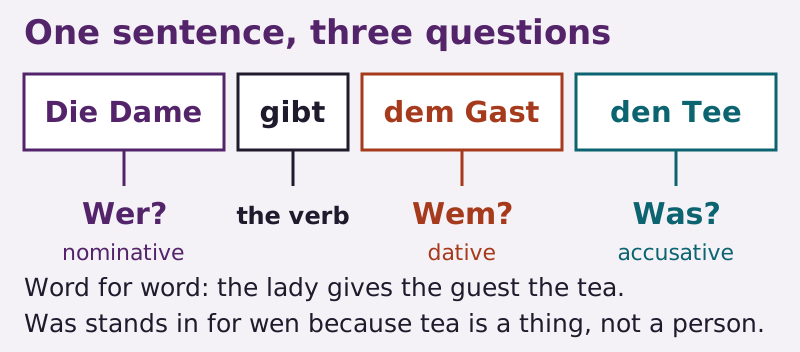
Find the verb, then ask each question about it. Try this one out loud: Die Dame gibt dem Gast den Tee. The corpus translation is "The lady serves tea to her guest." Word for word, it's "the lady gives the guest the tea."
"Finding each noun’s job in one German sentence" from Conversation Mile (https://conversationmile.com/grammar-in-use/german-cases/). CC BY 4.0 (creativecommons.org/licenses/by/4.0)
Who gives? Die Dame. To whom? Dem Gast. What? Den Tee. Each noun answers one question. Its article matches the table.
This matters because German doesn't lean on word order the way English does. FSI notes that the first element of a German statement can be nominative, accusative or dative. Compare these two:
- Der Hund brachte den Vogel. The dog fetched the bird.
- Den Hund habe ich gesehen. I saw the dog.
Both start with "the dog." Only the first dog does anything. Go by position and you'd get the second one backward. Go by the article.
Owners work the same way. In Er übernahm die Firma seines Vaters. (He took over his father's firm.), ask whose firm: seines Vaters. For plain direct objects, Er kennt den Bürgermeister. (He knows the mayor.) answers wen with den Bürgermeister.
When does the question not decide the case?
Often. Some words pick the case for you, and then the job in the sentence doesn't matter. FSI says it plainly about mit: any pronoun after it is dative, always.
| What's in the sentence | Case | Say this |
|---|---|---|
| durch, für, gegen, ohne, um | Accusative | Danke für den Kaffee. Thanks for the coffee. |
| aus, außer, bei, mit, nach, seit, von, zu, gegenüber | Dative | Sei nett zu den Kindern. Be nice to the children. |
| anstatt, statt, trotz, während, wegen | Genitive | Trotz des Regens kamen sie. They came in spite of the rain. |
| Verbs such as antworten, danken, folgen, gehören, helfen | Dative | Sie hilft ihm. She helps him. |
| sein, bleiben, heißen, werden with a noun | Nominative on both sides | Wer ist Ihr Hausarzt? Who is your doctor? |
| es gibt (there is) | Accusative | Gibt es einen Parkplatz? Is there a parking lot? |
| A specific stretch of time | Accusative | Sie arbeiteten den ganzen Tag. They worked all day. |
Watch the dative verbs, since "She helps him" reads like a plain object in English. Glauben is split: Wiktionary gives it the dative for the person you believe, as in Ich glaube dir, and the accusative for the thing you believe. Learn each of those verbs with wem attached, and look up its forms in the verb lookup.
The question still works after a preposition, too. It just moves behind it: Mit wem sprichst du? (Who are you talking with?) For a thing, FSI gives a joined form that starts with wo-, such as womit (with what), or wor- before a vowel: Woran denkst du? (What are you thinking about?)
"The order to check when you need a German case" from Conversation Mile (https://conversationmile.com/grammar-in-use/german-cases/). CC BY 4.0 (creativecommons.org/licenses/by/4.0)
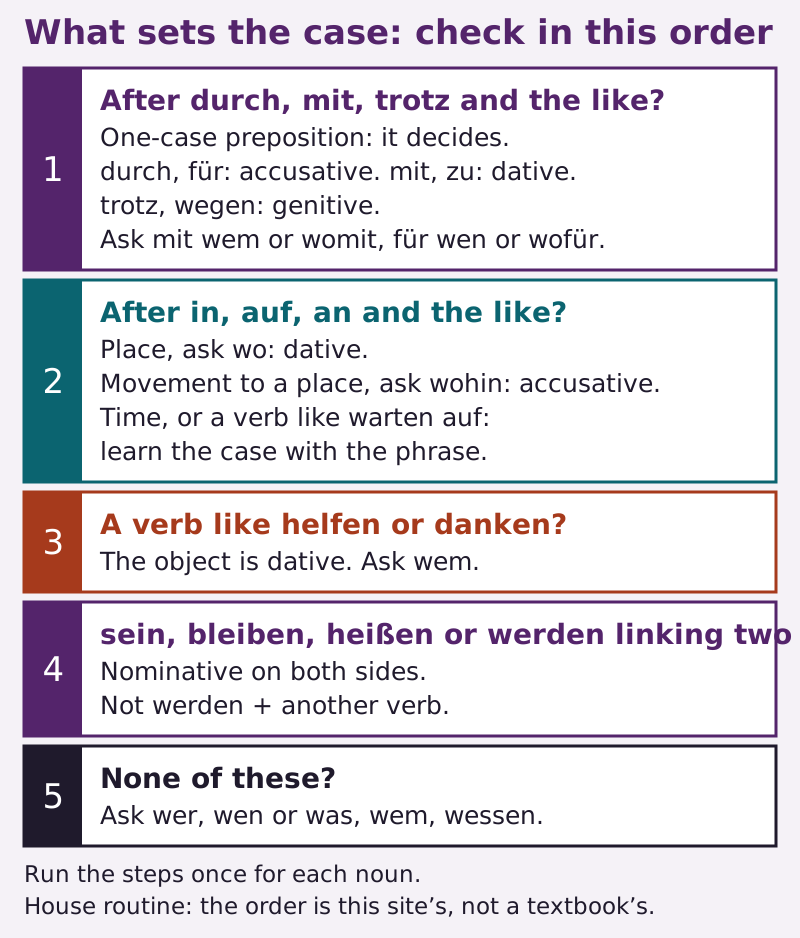
That order is this site's House routine, not a rule from a textbook. Use it when a sentence stalls. Run it once for each noun, not once for the whole sentence. A sentence with two prepositions needs two runs. The second step gets its own section next.
What about in, auf and the other two-way prepositions?
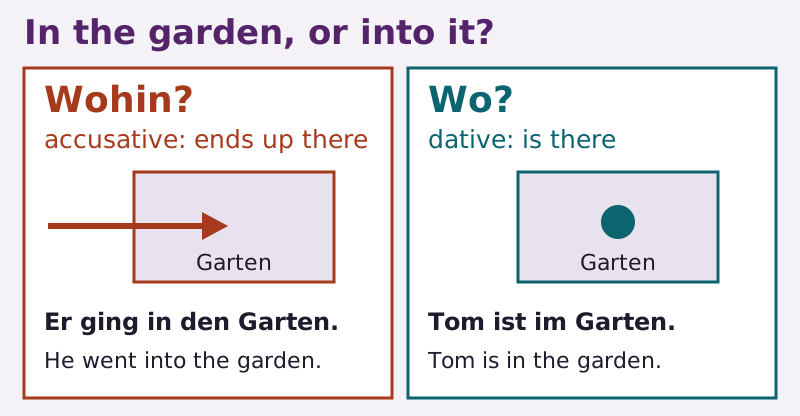
Nine prepositions can take either case: an, auf, in, hinter, neben, über, unter, vor, zwischen. Grimm's rule is movement. Going from one place to another takes the accusative. Staying put, or moving around inside one place, takes the dative. FSI puts it this way: the dative tells where something is found, and the accusative tells where something in motion will end up.
"Accusative for where to, dative for where, after a two-way preposition" from Conversation Mile (https://conversationmile.com/grammar-in-use/german-cases/). CC BY 4.0 (creativecommons.org/licenses/by/4.0)
| Ask | Case | Say this |
|---|---|---|
| Wohin? (where to) | Accusative | Er ging in den Garten. He went into the garden. |
| Wo? (where) | Dative | Tom ist im Garten. Tom is in the garden. |
Those two questions are this site's shortcut, built on the rule above (House routine). In the second sentence, im is short for in dem.
The shortcut only works for places and movement. FSI's second volume notes that an, in and vor take the dative when they talk about time: Sie sind vor einer Stunde gegangen. (They went an hour ago.) It also says that when a verb comes paired with one of these prepositions, the case is fixed for that pair and has to be learned with it. Warten auf (wait for) takes the accusative: Ich warte auf das Essen. (I'm waiting for the food.)
Tatoeba also has Tom kam im Hotel an. (Tom arrived at the hotel.) with the dative. That one sentence can't tell you the rule for ankommen or any other verb of arriving, so learn it as a whole sentence. When the test and a real sentence disagree, trust the sentence.
Do you need the genitive when you speak?
You need to recognize it. Grimm says the genitive is "dying a slow death" in the German-speaking countries, especially in speech, where the dative is replacing it. It still tells you to learn the forms because you'll meet them in writing. Grimm's wording is its own, and this page has no count of how often speakers use each form. It also doesn't give a spoken form for trotz, wegen and the rest, so say them with the genitive, as in Trotz des Regens kamen sie.
| To ask about an owner | Say this |
|---|---|
| With the genitive | Wessen Idee war das? Whose idea was it? |
| With the dative verb gehören | Wem gehört dieses Auto? Whose car is that? |
Das Buch gehört dem Mädchen. (The book belongs to the girl.) is the answer shape to practice for that second one. This site's drill puts the genitive last (House routine), so spend your first minutes on wen and wem.
How do you drill this out loud?
The whole drill runs in Spoken Minutes, so the timer only moves while you're talking. The steps and minutes are a House routine, untested with learners.
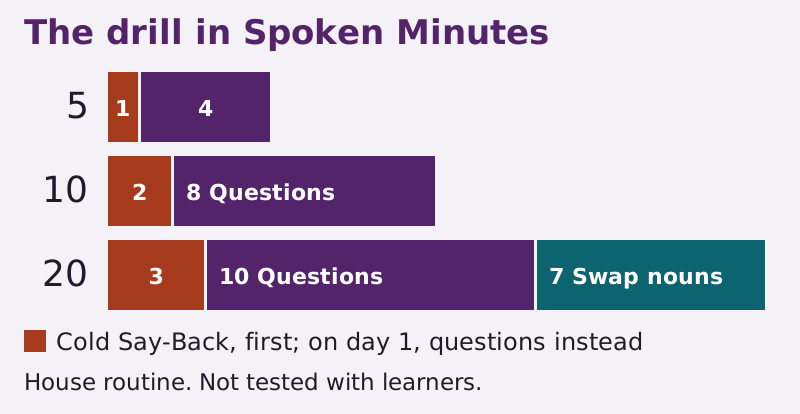
"How the case drill fills 5, 10 or 20 Spoken Minutes" from Conversation Mile (https://conversationmile.com/grammar-in-use/german-cases/). CC BY 4.0 (creativecommons.org/licenses/by/4.0)
On day 1 there's nothing to say back yet, so those minutes go to the questions.
- Pick one sentence from this page and say it.
- Say a question and its answer: Wem? Dem Gast.
- Look away and say the whole sentence again.
- On the longest plan, swap in nouns from your own day. Keep the article's case and check the noun's gender. Stick to singular nouns for things, like coffee or a book, and skip the small group of masculine nouns above that change their ending.
Do one sentence well before you add another. Log the minutes in the Mile Log. Once the sentences come easily, record yourself and check your German sounds, or say along with audio instead. For where cases fit in your first weeks, see how to learn German.
Tomorrow, before you open anything, try a Cold Say-Back: say Die Dame gibt dem Gast den Tee from memory, then name the question each noun answers.
What this rests on
Checked against
- Who or what each case marks: subject, direct object, indirect object, possession Source 1
- Wer, wen and wem as the nominative, accusative and dative question words, and wer and wo as false friends Source 7
- The same question words in a case table, was in the nominative and accusative, wessen as the genitive of wer, and wo- forms such as womit for a thing after a preposition Source 11
- Nominative articles, and the nominative after sein, bleiben, heißen and werden Source 2
- Accusative articles, accusative prepositions, es gibt, and specific times Source 3
- Dative articles, the plural -n, dative prepositions and dative verbs Source 4
- Genitive articles, the -s and -es endings, genitive prepositions, and the genitive fading in speech Source 5
- The nine two-way prepositions, and moving to a place against staying in one Source 6
- Accusative pronouns Source 8
- Dative pronouns Source 9
- A small group of masculine nouns that change form outside the nominative, as in den, dem and des Prinzen Source 10
- The dative after an, in and vor in time expressions, and verbs such as warten auf whose case has to be learned with the verb Source 12
- Plurals ending in -s, such as Autos, taking no extra -n in the dative; glauben with the dative for a person and the accusative for a thing Source 13
- All German example sentences Source 14
House routine
- The name Four-Question Method, using the questions as a speaking drill, the order for checking what sets the case, and running it once for each noun
- Wo and wohin as a shortcut for two-way prepositions, for places and movement only. The sources describe the rule without this test
- Practicing the genitive last, and saying trotz and wegen with the genitive
- The 5, 10 and 20 Spoken Minute splits, the steps of the drill, and which nouns to swap in
Sources
- Grimm Grammar. "Cases: Fälle." Grimm Grammar, COERLL, University of Texas at Austin Open. Read: Full page.. License: CC BY 4.0.
- Grimm Grammar. "Cases: Der Nominativ." Grimm Grammar, COERLL, University of Texas at Austin Open. Read: Full page, without the exercises' answers.. License: CC BY 4.0.
- Grimm Grammar. "Cases: Der Akkusativ." Grimm Grammar, COERLL, University of Texas at Austin Open. Read: Full page, without the exercises' answers.. License: CC BY 4.0.
- Grimm Grammar. "Cases: Der Dativ." Grimm Grammar, COERLL, University of Texas at Austin Open. Read: Page text down to the verb list; the end of the list and the exercises were not read.. License: CC BY 4.0.
- Grimm Grammar. "Cases: Der Genitiv." Grimm Grammar, COERLL, University of Texas at Austin Open. Read: Full page, without the exercises.. License: CC BY 4.0.
- Grimm Grammar. "Cases: Wechselpräpositionen." Grimm Grammar, COERLL, University of Texas at Austin Open. Read: Full page, without the exercises.. License: CC BY 4.0.
- Grimm Grammar. "Conjunctions: Fragen." Grimm Grammar, COERLL, University of Texas at Austin Open. Read: Full page.. License: CC BY 4.0.
- Grimm Grammar. "Pronouns: Personalpronomen im Akkusativ." Grimm Grammar, COERLL, University of Texas at Austin Open. Read: Page text, without the exercises.. License: CC BY 4.0.
- Grimm Grammar. "Pronouns: Personalpronomen im Dativ." Grimm Grammar, COERLL, University of Texas at Austin Open. Read: Page text down to the prepositions section.. License: CC BY 4.0.
- Grimm Grammar. "Nouns: Schwache Substantive." Grimm Grammar, COERLL, University of Texas at Austin Open. Read: Opening paragraphs, first dialog, and the der Prinz table (den, dem, des Prinzen).. License: CC BY 4.0.
- Foreign Service Institute. German Basic Course, Units 1-12. U.S. Department of State, 1961 Open. Read: Grammar notes in Unit 2 (pp. 33-34), Unit 3 (pp. 59-64), Unit 5 (pp. 120-121), Unit 6 (p. 146), Unit 7 (pp. 175-176) and Unit 8 (pp. 205-206). A course from 1961, used here for rules, not example sentences..
- Foreign Service Institute. German Basic Course, Units 13-24. U.S. Department of State, 1965 Open. Read: Grammar notes in Unit 17 (pp. 471-472) and Unit 18 (pp. 513-514). A course from 1965, used here for rules, not example sentences..
- Wiktionary contributors. German entries for Auto, Hotel and glauben. Wiktionary, as distributed by kaikki.org Open. Read: The declension tables of Auto and Hotel, and the senses of glauben with their case notes. License: CC BY-SA 4.0.
- Tatoeba. Sentence collection, downloaded exports. Tatoeba Open. Read: Each sentence on this page and its linked English read one by one. Authors are credited under Sentence credits.. License: CC BY 2.0 FR.
Sentence credits
- Den Hund habe ich gesehen. Tatoeba sentence 12170782 by mhr; English by andresevargas. CC BY 2.0 FR.
- Wer kommt? Tatoeba sentence 2204344 by Pfirsichbaeumchen; English by CK. CC BY 2.0 FR.
- Wen besucht Tom? Tatoeba sentence 8302617 by GuidoW; English by CK. CC BY 2.0 FR.
- Wem schreibt ihr? Tatoeba sentence 7046728 by Pfirsichbaeumchen; English by CK. CC BY 2.0 FR.
- Wessen Idee war das? Tatoeba sentence 452613 by al_ex_an_der; English by CK. CC BY 2.0 FR.
- Ich kenne ihn gut. Tatoeba sentence 2448359 by Pfirsichbaeumchen; English by CM. CC BY 2.0 FR.
- Ich glaube dir immer. Tatoeba sentence 6034519 by Zaghawa; English by CK. CC BY 2.0 FR.
- Die Dame gibt dem Gast den Tee. Tatoeba sentence 6776887 by ruth_tatoeba; English by sundown. CC BY 2.0 FR.
- Der Hund brachte den Vogel. Tatoeba sentence 3434469 by Pfirsichbaeumchen; English by Hybrid. CC BY 2.0 FR.
- Er übernahm die Firma seines Vaters. Tatoeba sentence 547249 by samueldora; English by sundown. CC BY 2.0 FR.
- Er kennt den Bürgermeister. Tatoeba sentence 689346 by Manfredo; English by Luornu. CC BY 2.0 FR.
- Danke für den Kaffee. Tatoeba sentence 11304878 by Malkuth; English by CK. CC BY 2.0 FR.
- Sei nett zu den Kindern. Tatoeba sentence 5785218 by landano; English by Herobane. CC BY 2.0 FR.
- Trotz des Regens kamen sie. Tatoeba sentence 1429283 by Esperantostern; English by coynejeremy. CC BY 2.0 FR.
- Sie hilft ihm. Tatoeba sentence 910961 by Esperantostern; English by CK. CC BY 2.0 FR.
- Wer ist Ihr Hausarzt? Tatoeba sentence 8634634 by Melang; English by Amastan. CC BY 2.0 FR.
- Gibt es einen Parkplatz? Tatoeba sentence 1590846 by Zaghawa; English by CK. CC BY 2.0 FR.
- Sie arbeiteten den ganzen Tag. Tatoeba sentence 6144376 by Pfirsichbaeumchen; English by sundown. CC BY 2.0 FR.
- Mit wem sprichst du? Tatoeba sentence 971209 by Manfredo; English by saeb. CC BY 2.0 FR.
- Woran denkst du? Tatoeba sentence 769886 by samueldora; English by CK. CC BY 2.0 FR.
- Er ging in den Garten. Tatoeba sentence 2034150 by al_ex_an_der; English by sundown. CC BY 2.0 FR.
- Tom ist im Garten. Tatoeba sentence 2349804 by Espi; English by CK. CC BY 2.0 FR.
- Sie sind vor einer Stunde gegangen. Tatoeba sentence 2258715 by Zaghawa; English by sundown. CC BY 2.0 FR.
- Ich warte auf das Essen. Tatoeba sentence 8320674 by MisterTrouser; English by rul. CC BY 2.0 FR.
- Tom kam im Hotel an. Tatoeba sentence 1590231 by jakov; English by Source_VOA. CC BY 2.0 FR.
- Wem gehört dieses Auto? Tatoeba sentence 714100 by Manfredo; English by CK. CC BY 2.0 FR.
- Das Buch gehört dem Mädchen. Tatoeba sentence 1428677 by Esperantostern; English by frpzzd. CC BY 2.0 FR.
Next stops
Cite this page
German Cases for English Speakers: The Four-Question Method. Conversation Mile, 2026-11-10. https://conversationmile.com/grammar-in-use/german-cases/
Corrections
No corrections on this page. Spotted a language error? Please tell this site.