Grammar in Use Grammar
Der, Die, Das and Learning Each Noun With Its Article
Straight answer
For most German nouns, nothing tells you whether the article is der, die or das. You learn it with the noun. Say these three out loud now, then look away and say them again: Der Tisch ist aus Holz. (The table is made of wood.) Die Tür ist kaputt. (The door is broken.) Das Messer ist scharf. (The knife is sharp.) Some endings hint at the article, and this page lists them. For everything else, the drill at the end is this site's House routine.
The English trap
English picks he, she or it by whether a thing is male, female or neither. FSI's 1961 German course warns English speakers that German's three groups of nouns aren't about male and female, and a girl is das Mädchen.
Say this today
Das Mädchen ist krank.
The girl is unwell.
Why learn the article with the noun?
Because for most nouns you can't work it out. The Foreign Service Institute's 1961 German Basic Course says there's no way to guess the article of a basic noun like the words for house, wine or milk. Its advice is to learn the word for "the" as part of the noun. The German word for wine is der Wein, not just Wein. Say it often enough that das Wein sounds wrong to you.
Grimm Grammar says the same and adds the plural: learn the gender the way you learn the plural form, because neither one follows much logic. Deutsch im Blick lists its vocabulary that way, as in das Brot (Brote), and tells you to repeat each word out loud and learn nouns with their gender.
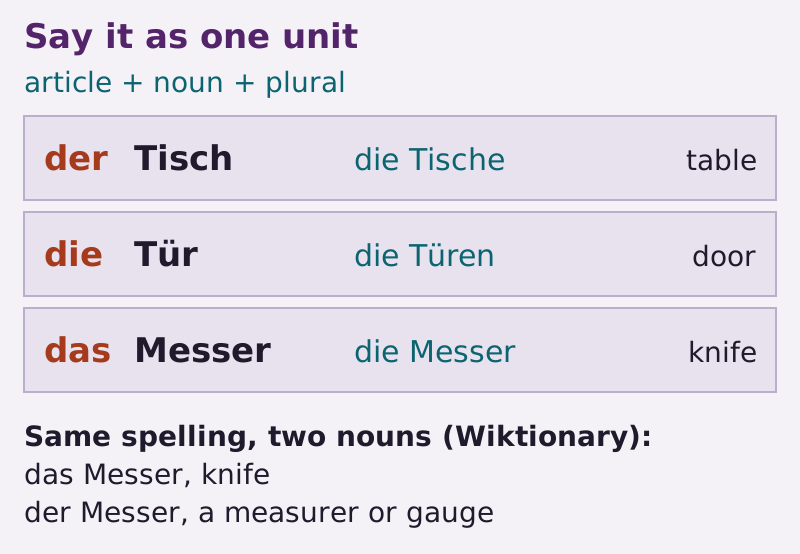
"Say the article, the noun and the plural as one unit" from Conversation Mile (https://conversationmile.com/grammar-in-use/der-die-das/). CC BY 4.0 (creativecommons.org/licenses/by/4.0)
So say each new noun as one unit: article, noun, plural. Der Tisch, die Tische. Die Tür, die Türen. Das Messer, die Messer. That last one shows why the bare noun isn't enough. Wiktionary lists a second noun spelled the same way, der Messer, which means someone or something that measures.
Finding the nouns is the easy part. Grimm notes that German nouns are always capitalized. Names are capitalized too, so not every capital letter means a noun with an article. Still, when you read a German sentence, the capitalized words in the middle are the first place to look.
Collect the nouns you'll want to say yourself, and look up each one's article. If you keep cards, put the article and the plural on the card with the noun. The Anki page shows how to set a card up so you say it, not just read it.
Which endings give the article away?
A few do, and Grimm lists them. They're hints. Grimm's wording for the der list is "chances are," not "always."
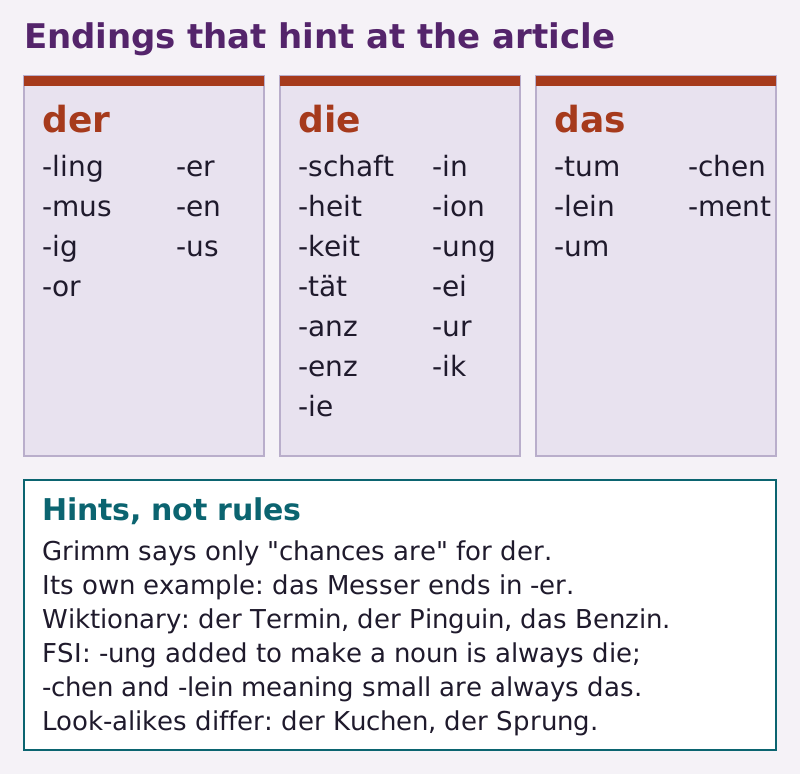
"Noun endings that hint at der, die or das" from Conversation Mile (https://conversationmile.com/grammar-in-use/der-die-das/). CC BY 4.0 (creativecommons.org/licenses/by/4.0)
| Ending | Article | Say this |
|---|---|---|
| -ung, added to make a noun | die | Die Zeitung ist von gestern. The newspaper is from yesterday. |
| -in | often die, not always | Die Lehrerin hat recht. The teacher is right. |
| -chen, meaning small | das | Das Mädchen ist krank. The girl is unwell. |
| -er | often der, not always | An exception: Das Messer ist scharf. The knife is sharp. |
Two of these are firm, within limits. FSI says that when -ung is added to make a noun from another word, the noun always takes die. It says the same for -chen and -lein, the endings that mean small: always das. That's why Mädchen (girl) takes das: the ending decides, not the person. A noun that only looks like one of these can differ. Wiktionary lists der Kuchen (cake) and der Sprung (jump).
The other hints fail too. Grimm's own example on the same page is das Messer, which ends in -er and isn't der.
Grimm lists -in under die, as in die Lehrerin, but Wiktionary gives der Termin (a set date), der Pinguin (penguin) and das Benzin (gasoline). Grimm's own example for -in is die Prinzessin (the princess). Lehrerin, in the table, is the female form of Lehrer (teacher), Wiktionary says. Termin, Pinguin and Benzin just end in the same letters.
Treat a hint as a guess you check, then learn the real article.
Words for people often match the person. Grimm gives der Vater (the father) and die Mutter (the mother). It also says most nouns have nothing to do with male or female, and das Mädchen shows that even a person can take das.
What article does a plural take?
Always die in the nominative, the form for the subject. FSI says the three groups disappear in the plural, and Grimm says the same about plural nouns as subjects.
This die is the plural for the subject. For other cases, use the tables on German cases; this page doesn't work them out. That's one less thing to remember for now. The hard part moves to the plural form itself.
| Singular | Plural | Say this |
|---|---|---|
| die Tür | die Türen | Die Türen sind offen. The doors are open. |
| das Messer | die Messer | Die Messer sind ganz verrostet. The knives are covered with rust. |
Grimm says there's no easy way to guess which plural a noun takes, so learn it with the article. With Messer, only the article tells you one knife from several.
Cases change the article too. Der Tisch, a masculine noun, becomes den Tisch as a direct object, for example. That's a separate step, covered in German cases, and its tables assume you already know whether the noun is der, die or das.
How do er, sie and es help you practice?
They follow the article. FSI shows it with a simple question and answer: ask where something is, then answer with a pronoun. The pronoun matches the article, so the answer checks the article you just said.
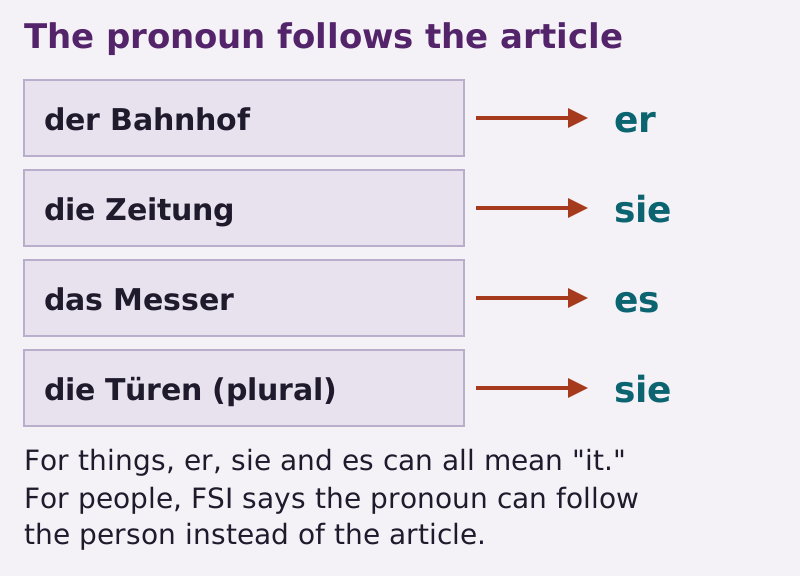
"Er, sie and es follow der, die and das" from Conversation Mile (https://conversationmile.com/grammar-in-use/der-die-das/). CC BY 4.0 (creativecommons.org/licenses/by/4.0)
| Question | Answer |
|---|---|
| Wo ist der Bahnhof? Where is the railroad station? | Er ist dort links. It's there to the left. |
| Wo ist die Zeitung? Where's the newspaper? | Sie ist da drüben. It's just over there. |
| Wo ist das Messer? Where's the knife? | Es ist hier. It's here. |
All three answers mean "it" in English. In German, the station is er and the newspaper is sie.
Keep this drill to things. This page has no model line for people, so don't swap the pronoun yourself. FSI says that for people the pronoun can follow the person instead: its 1961 example is das Fräulein (the young lady), which takes sie. Wiktionary marks Fräulein as a dated way to address a woman, so don't use it as a model line.
Do German speakers ever disagree?
Yes, on a few words. Grimm says some Germans say das Joghurt and others der Joghurt. Deutsch im Blick lists die or das Nutella and notes that it depends on the region.
| Noun | What the sources say |
|---|---|
| Joghurt (yogurt) | Grimm: das in northern Germany, der in the south. Wiktionary: der in Germany, das in Austria, Switzerland and southern Germany. |
| Nutella | Deutsch im Blick: die or das, depending on the region. |
The two sources don't match on where each article is used for Joghurt, so this page doesn't pick one. If you learn for one region, ask a speaker from there. These two are the only ones the sources on this page flag. For the nouns in the drill below, they each give one article.
How do you drill this out loud?
The drill runs in Spoken Minutes, so the timer moves only while you're talking. The steps and minutes are a House routine, untested with learners.
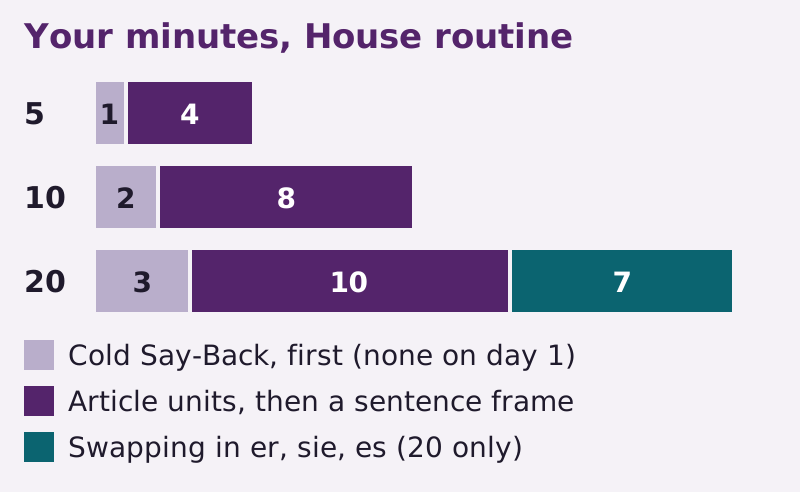
"How the article drill fills 5, 10 or 20 Spoken Minutes" from Conversation Mile (https://conversationmile.com/grammar-in-use/der-die-das/). CC BY 4.0 (creativecommons.org/licenses/by/4.0)
On day 1 there's nothing to say back yet, so those minutes go to the units.
- Pick five nouns for things: from this page or from your own day. Look up each article and plural before you say it the first time, so you don't practice a guess.
- Say each one as a unit: die Zeitung, die Zeitungen.
- Put each noun into the question frame and say it: Wo ist die Zeitung? Keep to singular nouns, since Wo ist asks about one thing. Go down the list, then start again at the top.
- On the 20-minute plan, answer each question with the pronoun that matches the article, as in the table above: Er ist dort links. Sie ist da drüben. Es ist hier.
When you catch a wrong article, such as die Tisch, stop right there. Say the correct unit twice, der Tisch, die Tische, then say the whole question again. Don't just note the mistake and move on, because the point is to hear the right version in your own voice.
Stay with the same five until all of them come out without much thought. Then swap in five new ones.
Log the minutes in the Mile Log. Once articles feel steady, move on to adjective endings, which build on them. For where this fits in your first weeks, see how to learn German.
Tomorrow, before you open anything, try a Cold Say-Back: say your five nouns as units, article and plural included, from memory. Then check them.
What this rests on
Checked against
- Most nouns give no clue to their article, so you learn der, die or das as part of the noun; -ung added to make a noun from another word always takes die, and the diminutive -chen and -lein always take das; er, sie and es follow the noun's article, except for people; plurals as subjects take die Source 4
- Every noun has a gender shown by der, die or das; learn it like the plural; the list of endings that hint at each article, with chances are for der; das Messer; speakers who disagree about Joghurt Source 1
- Gender mostly independent of whether a person or thing is male or female, das Mädchen, and nouns always written with a capital letter Source 2
- Plurals taking die, and plurals that are hard to guess Source 3
- Repeating each word out loud, and learning nouns with their gender Source 5
- Listing nouns as article, noun and plural, and Nutella taking die or das by region Source 6
- The gender and plural of each noun shown, the two nouns spelled Messer, Fräulein marked dated, Lehrerin as the female form of Lehrer, der Termin, der Pinguin, das Benzin, der Kuchen and der Sprung, and the regions Wiktionary gives for der and das Joghurt Source 7
- All German example sentences Source 8
House routine
- Saying article, noun and plural as one unit, the Wo ist frame, looking up the article before the first try, saying a corrected unit twice, and staying with five nouns until they come without thought
- The 5, 10 and 20 Spoken Minute splits with the Cold Say-Back first, and swapping in er, sie and es on the longest plan
Sources
- Grimm Grammar. "Nouns: Genus der Substantive." Grimm Grammar, COERLL, University of Texas at Austin Open. Read: Full page, without the exercise.. License: CC BY 4.0.
- Grimm Grammar. "Nouns: Substantive." Grimm Grammar, COERLL, University of Texas at Austin Open. Read: Full page.. License: CC BY 4.0.
- Grimm Grammar. "Nouns: Der Plural." Grimm Grammar, COERLL, University of Texas at Austin Open. Read: Full page, without the exercise.. License: CC BY 4.0.
- Foreign Service Institute. German Basic Course, Units 1-12. U.S. Department of State, 1961 Open. Read: Notes on Grammar in Unit 1, The German Noun-Classification ('Gender') System (pp. 8-10). A course from 1961, used here for rules, not example sentences..
- Abrams, Zsuzsanna, and others. "Kapitel 1." Deutsch im Blick, COERLL, University of Texas at Austin, 2017 Open. Read: The vocabulary study suggestions on p. 16 (Wortschatz Vorbereitung).. License: CC BY 4.0.
- Abrams, Zsuzsanna, and others. "Kapitel 3." Deutsch im Blick, COERLL, University of Texas at Austin, 2017 Open. Read: The vocabulary list for Das Frühstück (p. 148).. License: CC BY 4.0.
- Wiktionary contributors. German entries for Tisch, Tür, Messer, Wein, Mädchen, Zeitung, Bahnhof, Joghurt, Kuchen, Sprung, Termin, Pinguin, Benzin, Fräulein and Lehrerin. Wiktionary, as distributed by kaikki.org Open. Read: Gender and nominative plural of each word; the regional gender notes for Joghurt; the first sense of Kuchen, Sprung, Termin, Pinguin and Benzin; the dated tag on Fräulein as a term of address; Lehrerin as the female equivalent of Lehrer. License: CC BY-SA 4.0.
- Tatoeba. Sentence collection, downloaded exports. Tatoeba Open. Read: Each sentence on this page and its linked English read one by one. Authors are credited under Sentence credits.. License: CC BY 2.0 FR.
Sentence credits
- Das Mädchen ist krank. Tatoeba sentence 8100285 by Luiaard; English by sundown. CC BY 2.0 FR.
- Der Tisch ist aus Holz. Tatoeba sentence 2592273 by samueldora; English by CarpeLanam. CC BY 2.0 FR.
- Die Tür ist kaputt. Tatoeba sentence 11955484 by Naina; English by CK. CC BY 2.0 FR.
- Das Messer ist scharf. Tatoeba sentence 8999487 by Luiaard; English by mailohilohi. CC BY 2.0 FR.
- Die Zeitung ist von gestern. Tatoeba sentence 1306608 by Pfirsichbaeumchen; English by sundown. CC BY 2.0 FR.
- Die Lehrerin hat recht. Tatoeba sentence 10033418 by wolfgangth; English by Lindoula. CC BY 2.0 FR.
- Die Türen sind offen. Tatoeba sentence 10774687 by toivo; English by ilovegreece. CC BY 2.0 FR.
- Die Messer sind ganz verrostet. Tatoeba sentence 13097123 by Waldelfe; English by sharptoothed. CC BY 2.0 FR.
- Wo ist der Bahnhof? Tatoeba sentence 544538 by jakov; English by CM. CC BY 2.0 FR.
- Er ist dort links. Tatoeba sentence 403074 by Ramses; English by Ramses. CC BY 2.0 FR.
- Wo ist die Zeitung? Tatoeba sentence 445090 by landano; English by CK. CC BY 2.0 FR.
- Sie ist da drüben. Tatoeba sentence 6099712 by al_ex_an_der; English by CK. CC BY 2.0 FR.
- Wo ist das Messer? Tatoeba sentence 8104114 by Luiaard; English by CK. CC BY 2.0 FR.
- Es ist hier. Tatoeba sentence 5284084 by bonny37; English by CK. CC BY 2.0 FR.
Next stops
Cite this page
Der, Die, Das and Learning Each Noun With Its Article. Conversation Mile, 2026-11-10. https://conversationmile.com/grammar-in-use/der-die-das/
Corrections
No corrections on this page. Spotted a language error? Please tell this site.