Grammar in Use Grammar
Spanish Reflexive Verbs and Why Se Is Not Always Oneself
Straight answer
A reflexive verb comes with a small pronoun that matches the person doing the action. Say this out loud: Me levanto a las 7:00. That's "I get up at 7:00," and me goes with "I." The pronoun for "he," "she" and "they" is se, and it does more than one job. Sometimes it means "oneself." Sometimes English says it with "get," and sometimes it means "each other" or nobody in particular. This page sorts those jobs so you can say each one.
The English trap
¡Chévere! warns that English says many of these with get plus an adjective, like get bored or get angry, and not to translate those idioms word for word. Spanish uses the reflexive verb instead.
Say this today
Me aburro en casa.
I get bored at home.
What does a reflexive verb do?
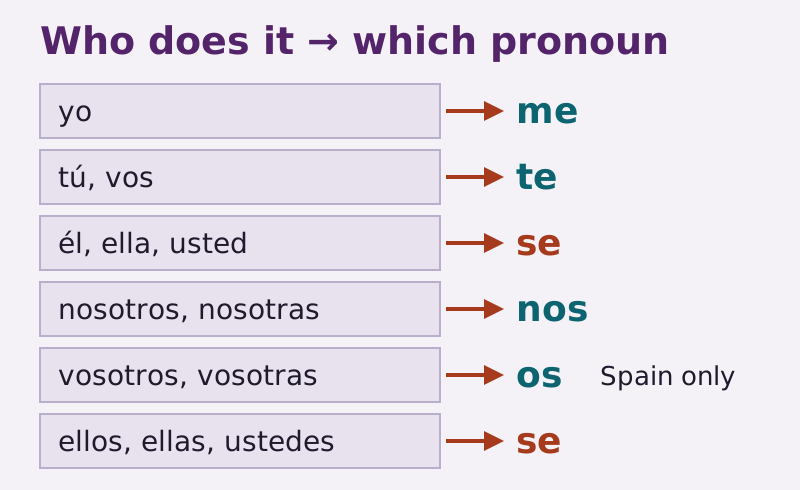
¡Chévere!, an open first-year Spanish course, says a reflexive verb shows the subject doing the action to itself. You can spot one in a word list by the se on the end, as in levantarse, to get up. When you use the verb, the se comes off the end and changes to match the subject.
"Who does the action, and the reflexive pronoun that goes with it" from Conversation Mile (https://conversationmile.com/grammar-in-use/spanish-reflexive-verbs/). CC BY 4.0 (creativecommons.org/licenses/by/4.0)
| Who | Pronoun | Say it |
|---|---|---|
| I | me | Me levanto a las 7:00. |
| you (familiar) | te | ¿A qué hora te levantas? |
| he, she, you (formal) | se | Él se levanta temprano. |
| first person plural | nos | nos levantamos |
| you all (Spain only, familiar) | os | os levantáis |
| they, you all | se | se levantan |
FSI's Spanish course from 1961 says the pronoun repeats the person of the subject. It also notes that se is the same for one person or many, and for men or women. ¡Chévere! adds a warning about nos. It's not a short form of nosotros.
The vosotros row is used only in Spain, ¡Chévere! says. In Argentina and Uruguay, vos is used for familiar "you," as Trayectos, an open course from COERLL, describes. The verb changes, and the pronoun stays te. Wiktionary lists levantás for vos and gives the vos command as levantate, with te on the end. Tatoeba has Disculpame, ¿cómo te llamás? ("Sorry, what's your name?"). Disculpame is a vos command too, so like levantate it has no written accent; Wiktionary gives discúlpame for tú. If the people you'll talk to use vos, copy their forms.
Say the first three rows again, then cover the last column and say each sentence from memory. If you use vos, say te levantás in the second row.
Which everyday verbs take se?
Many of them are about getting ready for the day: levantarse (get up), ducharse (take a shower), lavarse (wash), ponerse (put on), acostarse (go to bed). Two of them change more than the ending: Wiktionary gives me pongo and me acuesto for "I," so the drill below leaves them out. ¡Chévere! lists these with the same verbs used without se, and notes that the meaning changes. For most of them, without se you do it to someone or something else.
| Without se | With se |
|---|---|
| Él lava la bici cada semana. He washes the bike every week. | Me lavo las manos. I wash my hands. |
| Levanta la mano. Raise your hand. | Me levanto a las 7:00. I get up at 7:00. |
| Llamé a Tom. I called Tom up. | Me llamo Tom. Tom is my name. |
| Voy a la escuela. I'm going to school. | Me voy. I'm leaving. |
Look at the hands. Spanish says las manos, "the hands," where English says "my hands." FSI's course says Spanish often uses the reflexive pronoun where English uses "my" or "your." It names parts of the body and clothes as the usual case: Me pongo los pantalones. means I put on my trousers.
The last two rows show that se can make what is really a different verb. Ir is to go, and irse is to go away or leave. Llamar is to call, and llamarse is to be named. ¡Chévere! points out that Ella se llama Carmen. would be "she calls herself Carmen" word for word, but in English you'd say "her name is Carmen." Learn these as new words, not as "oneself."
What else can se mean?
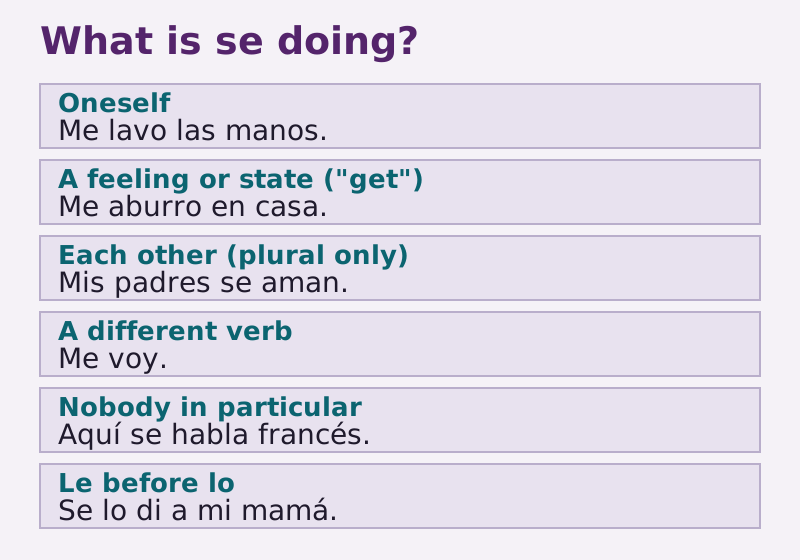
Here's where "oneself" stops working. Before you say a sentence with se, ask which of these jobs it's doing. The order of the questions is this site's own. Each answer comes from the sources named below.
"Six jobs that se and its partner pronouns do" from Conversation Mile (https://conversationmile.com/grammar-in-use/spanish-reflexive-verbs/). CC BY 4.0 (creativecommons.org/licenses/by/4.0)
A feeling or state. ¡Chévere! says some reflexive verbs show how someone feels, especially the start of a feeling or a physical state. English often says these with "get" plus a word like bored, angry or tired. Don't look for a Spanish word for "get." Say Me aburro en casa. (I get bored at home.), Me canso fácilmente. (I get tired easily.) and Ella se enojó. (She got angry.) The same verb without se puts the feeling on someone else: Esta novela me aburre. means the novel bores me. There, the novel is the subject, so me isn't reflexive at all.
Each other. With a plural subject, these pronouns can mean "each other." ¡Chévere! says this use is only for the plural, since it takes two or more people. Mis padres se aman. means my parents love each other. That looks just like "they love themselves," so Spanish can add a phrase to make it clear. Mutuamente or el uno al otro means each other, as in Tom y Mary se miraron mutuamente. A sí mismos means themselves, as in Los narcisistas se aman a sí mismos. With nos the same goes for a group you're in: Nos ayudamos mutuamente. says the people in it help each other.
A verb with no "oneself" in English. FSI's course gives quejarse, to complain, as a verb that's just as reflexive as sentarse even though English can't say "complain yourself": Nadie se quejó. (Nobody complained.) It also says that with some verbs, se adds no clear change in meaning. Its example is olvidar and olvidarse, both "to forget." Compare Me olvidé de llamarte. (I forgot to call you.) and Olvidé poner la alarma. (I forgot to set the alarm.) Notice the de after me olvidé in the first one, and keep it there. Learn each one as the whole sentence, small words included.
When does se mean nobody in particular?
Sometimes se has no person behind it. FSI's course uses this se when nobody cares to say who does the action. English often turns these into "is spoken," "are sold," or "you" and "they" in the general sense.
| Say it | Meaning |
|---|---|
| Aquí se habla francés. | French is spoken here. |
| Allí se venden flores. | Flowers are sold there. |
| Se necesita más tiempo. | More time is needed. |
The verb matches the thing after it, FSI says. One language, habla. Many flowers, venden. Say each line, then swap in a word you need: another language, or something sold near you. If you change one thing to many, change the verb too.
This shortcut has a limit. FSI's later volume warns that if the thing after the verb is a person or another creature that could do the action, the sentence reads as them doing it to themselves. So keep this pattern for things, places and languages until a tutor shows you the other ways to say it about people.
Why does se show up in se lo di?
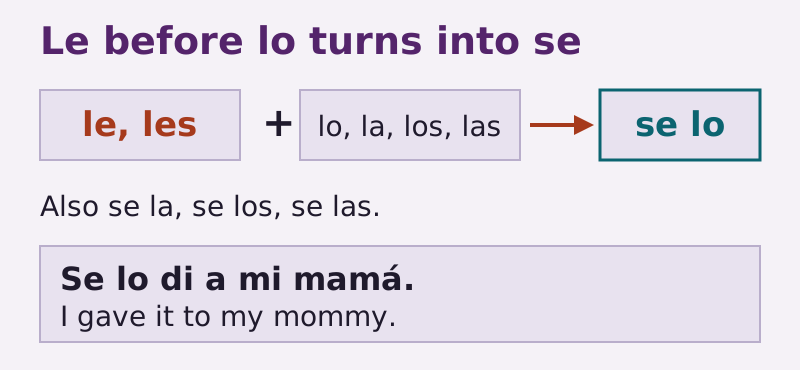
Here, se isn't reflexive at all. ¡Chévere! explains that le and les, "to him," "to her," "to you" with usted, "to them," change to se when lo, la, los or las comes right after. It says the change is for the sound, not the meaning. So instead of "le lo," you say Se lo di a mi mamá. (I gave it to my mommy.)
"Le and les turn into se before lo, la, los and las" from Conversation Mile (https://conversationmile.com/grammar-in-use/spanish-reflexive-verbs/). CC BY 4.0 (creativecommons.org/licenses/by/4.0)
Since se here can point to him, her, usted or them, ¡Chévere! suggests adding a phrase with a when it isn't clear who you mean. Se lo dije a Tom. says it was Tom. With context it can go without: Tu papá sabe todo sobre el vuelo, se lo dije ayer. (Your dad knows everything about the flight, I told (it to) him yesterday.) Familiar "you" doesn't change. It stays te, as in ¡Chévere!'s ¿Tu pasaporte? ¿No te lo devolví? (Your passport? Didn't I return it to you?)
Where does the pronoun go?
In a statement or a question, put it right before the conjugated verb. ¡Chévere! adds one choice. When an infinitive or an -ndo form follows, the pronoun can go first or be attached to the end of that form.
| Pronoun first | Pronoun attached |
|---|---|
| Ella se tiene que levantar temprano. | Ella tiene que levantarse temprano. |
| Ella se está levantando temprano. | Ella está levantándose temprano. |
Each row's two sentences mean the same. The first row is "she has to get up early," and the second is "she is getting up early." When you attach the pronoun to an -ndo form, ¡Chévere! warns you to add any written accent it needs, as in levantándose. The pronunciation page covers how a written accent marks stress. If you aren't sure of a form, check the verb in the conjugation lookup.
Commands follow their own rule, FSI's course says. When you tell someone to do it, the pronoun goes on the end: Levántate. (Get up.) Wiktionary writes the tú form with an accent, levántate, and the vos form without one, levantate. When you tell someone not to, the pronoun goes before the verb: No te levantes. (Don't stand up.) Both use levantarse; English says "get up" or "stand up." The verb form changes too, so learn No te levantes as a whole sentence instead of building it from levántate or levantate. For a vos speaker's version, listen to how they say it.
How do you practice this out loud?
Use two drills.
The person drill. Take levantarse, ducharse and lavarse las manos. Wiktionary gives all three the regular -ar endings, so you can move them through every person from the table. Say each one for I, familiar you, he, the first person plural and they: me levanto, te levantas, se levanta, nos levantamos, se levantan. If you use vos, Wiktionary gives te levantás, te duchás and te lavás. Then add a time: Me levanto a las 7:00. When you finish all three verbs, start again with a new time.
The pairs drill. Read one side of the "without se" table aloud, then say the other side from memory. Then go through the six jobs of se and say the sentence for each. Use "each other" only with a plural subject, since that's how ¡Chévere! limits it.
"How the 5, 10 and 20 Spoken Minute days split for this page" from Conversation Mile (https://conversationmile.com/grammar-in-use/spanish-reflexive-verbs/). CC BY 4.0 (creativecommons.org/licenses/by/4.0)
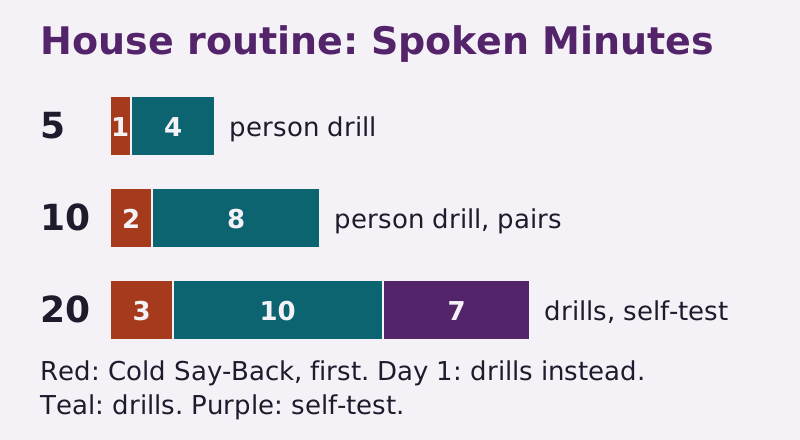
Count the time in Spoken Minutes. On a 5-minute day, spend 1 minute on yesterday's Cold Say-Back and 4 on the person drill. On a 10-minute day, it's 2 and 8, with the pairs drill in the 8. On a 20-minute day, it's 3, then 10 on both drills and 7 on the self-test below. Day 1 has nothing to say back, so the 1, 2 or 3 Cold Say-Back minutes go to the drills. The 7-minute self-test still runs on a 20-minute day. These splits are this site's House routine, untested with learners. Add the minutes to your Mile Log.
On a 20-minute day, say each line in Spanish before you read the hint.
- I get up at seven. (me, the person is I)
- I wash my hands. (me, and las manos)
- I'm leaving. (irse, a different verb)
- I get bored at home. (aburrirse, no "get")
- My parents love each other. (se, plural subject)
- French is spoken here. (se, nobody in particular)
- I told it to Tom. (se lo, le turns into se)
If you miss one, go back to that sentence on the page and say it three times. Don't reread the rule.
The same habit of sorting before you speak helps with ser and estar, por and para, the two past tenses and the subjunctive. If you're just starting, the Spanish starting plan shows where this fits.
Tomorrow, before you look at anything, run a Cold Say-Back: say that you get up at seven, that you're leaving, and that French is spoken here.
What this rests on
Checked against
- What a reflexive verb is, the daily-routine verbs, pairs with and without se, irse and llamarse, and where the pronoun goes Source 1
- Feelings that start, said with get in English; each other, only in the plural, and the phrases that tell it apart from themselves Source 2
- Le and les turning into se before lo, la, los and las, with usted among them; te staying te; and adding a phrase with a to make it clear Source 3
- The vosotros form used only in Spain Source 4
- The pronoun repeating the subject's person; se for any number or gender; quejarse; olvidar and olvidarse with no clear difference; me pongo el sombrero for my hat Source 5
- Se with no one named as the doer, and the verb agreeing with the noun after it Source 6
- With a command to do it, the pronoun on the end; with a command not to, the pronoun before the verb Source 7
- A se sentence about people reading as people doing it to themselves Source 8
- Vos as familiar you in Argentina and Uruguay Source 9
- The vos forms levantás, duchás and lavás; disculpame for vos and discúlpame for tú; me pongo and me acuesto; the command forms levántate and levantate with te on the end, and regular -ar endings for levantar, duchar and lavar Source 10
House routine
- The order of the questions in the chart, the person drill with three regular -ar verbs, the pairs drill, the 5, 10 and 20 Spoken Minute splits, the self-test, the Cold Say-Back, and day 1 giving its Cold Say-Back minutes to the drills
Sources
- Brown, Escudero, Montoya and Small. ¡Chévere! Introductory Spanish II, 1.7: Los verbos reflexivos. SUNY Oneonta via OER SUNY Open. Read: The whole page. License: CC BY 4.0.
- Brown, Escudero, Montoya and Small. ¡Chévere! Introductory Spanish II, 2.7: Verbos reflexivos con emociones. SUNY Oneonta via OER SUNY Open. Read: The whole page. License: CC BY 4.0.
- Brown, Escudero, Montoya and Small. ¡Chévere! Introductory Spanish II, 6.11: Pronombres de objeto indirecto y objeto directo usados juntos. SUNY Oneonta via OER SUNY Open. Read: The whole page. License: CC BY 4.0.
- Brown, Escudero, Montoya and Small. ¡Chévere! Introductory Spanish I, 2.12: Gramática, El verbo ser / Ser + de. SUNY Oneonta via OER SUNY Open. Read: The note that the vosotros form is used only in Spain. License: CC BY 4.0.
- Stockwell, Bowen and Silva-Fuenzalida. Spanish Basic Course: Units 16-30, Unit 24, section 24.21.1. Foreign Service Institute, U.S. Department of State, 1961 Open. Read: Section 24.21.1, the presentation and discussion of the pattern, from a scanned copy with some unreadable characters.
- Stockwell, Bowen and Silva-Fuenzalida. Spanish Basic Course: Units 16-30, Unit 26, section 26.21.2. Foreign Service Institute, U.S. Department of State, 1961 Open. Read: Section 26.21.2, presentation, notes and discussion, from a scanned copy with some unreadable characters.
- Stockwell, Bowen and Silva-Fuenzalida. Spanish Basic Course: Units 16-30, Unit 29, section 29.21.1, clitic pronouns with command forms. Foreign Service Institute, U.S. Department of State, 1961 Open. Read: Section 29.21.1, the presentation and notes, and the note in 24.21.2 that points to it, from a scanned copy with some unreadable characters.
- Trease and Ulsh. Spanish Basic Course: Units 46-55, Unit 51, notes on the passive voice. Foreign Service Institute, U.S. Department of State, 1982 Open. Read: The note on the reflexive se construction for the passive, from a scanned copy.
- Zapata. Trayectos, Volumen 2: Más sobre mí, Módulo 1, pp. 3 and 14. COERLL, University of Texas at Austin, 2022 Open. Read: The note on vos in Argentina on p. 3 and the table with tú/vos in Argentina and Uruguay on p. 14. License: CC BY-SA 4.0.
- Wiktionary contributors. Spanish conjugation of levantar, duchar and lavar. Wiktionary, as distributed by kaikki.org Open. Read: The present indicative forms of levantar, duchar and lavar in the local kaikki extract. License: CC BY-SA 4.0.
Sentence credits
- Me aburro en casa. Tatoeba sentence 1801442 by Shishir; English by DJ_Saidez. CC BY 2.0 FR.
- Me levanto a las 7:00. Tatoeba sentence 1289326 by marcelostockle; English by CK. CC BY 2.0 FR.
- ¿A qué hora te levantas? Tatoeba sentence 616193 by Dejo; English by CK. CC BY 2.0 FR.
- Él se levanta temprano. Tatoeba sentence 1023572 by jayefes65; English by CK. CC BY 2.0 FR.
- Disculpame, ¿cómo te llamás? Tatoeba sentence 1211919 by El_mas_capo; English by alec. CC BY 2.0 FR.
- Él lava la bici cada semana. Tatoeba sentence 856050 by heffeque; English by CK. CC BY 2.0 FR.
- Me lavo las manos. Tatoeba sentence 1305230 by Shishir; English by aandrusiak. CC BY 2.0 FR.
- Levanta la mano. Tatoeba sentence 456652 by lukaszpp; English by lukaszpp. CC BY 2.0 FR.
- Llamé a Tom. Tatoeba sentence 1365370 by marcelostockle; English by CK. CC BY 2.0 FR.
- Me llamo Tom. Tatoeba sentence 2351587 by Shishir; English by CK. CC BY 2.0 FR.
- Voy a la escuela. Tatoeba sentence 473450 by Shishir; English by CK. CC BY 2.0 FR.
- Me voy. Tatoeba sentence 1778434 by Shishir; English by human600. CC BY 2.0 FR.
- Me pongo los pantalones. Tatoeba sentence 445866 by Shishir; English by CK. CC BY 2.0 FR.
- Ella se llama Carmen. ¡Chévere! Introductory Spanish II, 1.7. CC BY 4.0.
- Me canso fácilmente. Tatoeba sentence 5864157 by arh; English by CK. CC BY 2.0 FR.
- Ella se enojó. Tatoeba sentence 1128004 by hayastan; English by CK. CC BY 2.0 FR.
- Esta novela me aburre. Tatoeba sentence 631152 by Leono; English by CK. CC BY 2.0 FR.
- Mis padres se aman. Tatoeba sentence 5027619 by don_ramon; English by Lindoula. CC BY 2.0 FR.
- Tom y Mary se miraron mutuamente. Tatoeba sentence 2383079 by Shishir; English by CK. CC BY 2.0 FR.
- Los narcisistas se aman a sí mismos. ¡Chévere! Introductory Spanish II, 2.7. CC BY 4.0.
- Nos ayudamos mutuamente. Tatoeba sentence 4991858 by Shishir; English by CK. CC BY 2.0 FR.
- Nadie se quejó. Tatoeba sentence 8258919 by fpp; English by CM. CC BY 2.0 FR.
- Me olvidé de llamarte. Tatoeba sentence 8195150 by arh; English by CK. CC BY 2.0 FR.
- Olvidé poner la alarma. Tatoeba sentence 9431179 by ignacio; English by espamatics. CC BY 2.0 FR.
- Aquí se habla francés. Tatoeba sentence 5755825 by arh; English by CK. CC BY 2.0 FR.
- Allí se venden flores. Tatoeba sentence 1548014 by marcelostockle; English by CM. CC BY 2.0 FR.
- Se necesita más tiempo. Tatoeba sentence 9192197 by hayastan; English by CK. CC BY 2.0 FR.
- Se lo di a mi mamá. Tatoeba sentence 1676576 by termito2nd; English by CM. CC BY 2.0 FR.
- Se lo dije a Tom. Tatoeba sentence 2624559 by Shishir; English by CK. CC BY 2.0 FR.
- Tu papá sabe todo sobre el vuelo, se lo dije ayer. ¡Chévere! Introductory Spanish II, 6.11. CC BY 4.0.
- ¿Tu pasaporte? ¿No te lo devolví? ¡Chévere! Introductory Spanish II, 6.11. CC BY 4.0.
- Ella se tiene que levantar temprano. ¡Chévere! Introductory Spanish II, 1.7. CC BY 4.0.
- Ella tiene que levantarse temprano. ¡Chévere! Introductory Spanish II, 1.7. CC BY 4.0.
- Ella se está levantando temprano. ¡Chévere! Introductory Spanish II, 1.7. CC BY 4.0.
- Ella está levantándose temprano. ¡Chévere! Introductory Spanish II, 1.7. CC BY 4.0.
- Levántate. Tatoeba sentence 868643 by ILDEFONSO; English by pauldhunt. CC BY 2.0 FR.
- No te levantes. Tatoeba sentence 1334148 by Shishir; English by CK. CC BY 2.0 FR.
Next stops
Cite this page
Spanish Reflexive Verbs and Why Se Is Not Always Oneself. Conversation Mile, 2026-11-10. https://conversationmile.com/grammar-in-use/spanish-reflexive-verbs/
Corrections
No corrections on this page. Spotted a language error? Please tell this site.