Pronunciation Workshop Reference
French Alphabet Names, Accents, and Spelling Aloud
Straight answer
French uses the same 26 letters as English, but many of the names sound different. Say the five vowel letters out loud now: A, E, I, O, U. In French, A is the vowel of la, E the vowel of le, I the vowel of si, O the vowel of tôt, and U the vowel of tu. Say them again with your lips and jaw still. By row 6 of the week below, you'll spell your own name aloud.
The English trap
Français interactif warns that English speakers tend to stretch vowels into two sounds, as in English I, out and boy. French vowels don't glide, so the vowel at the end of B or O has to stay still.
Say this today
Pouvez-vous l'épeler ?
Can you spell it?
What are the French letter names?
The names below come from Wiktionary, written in IPA. The words that show each vowel (la, le, si and so on) come from the symbol table in Français interactif, an open course from the University of Texas at Austin.
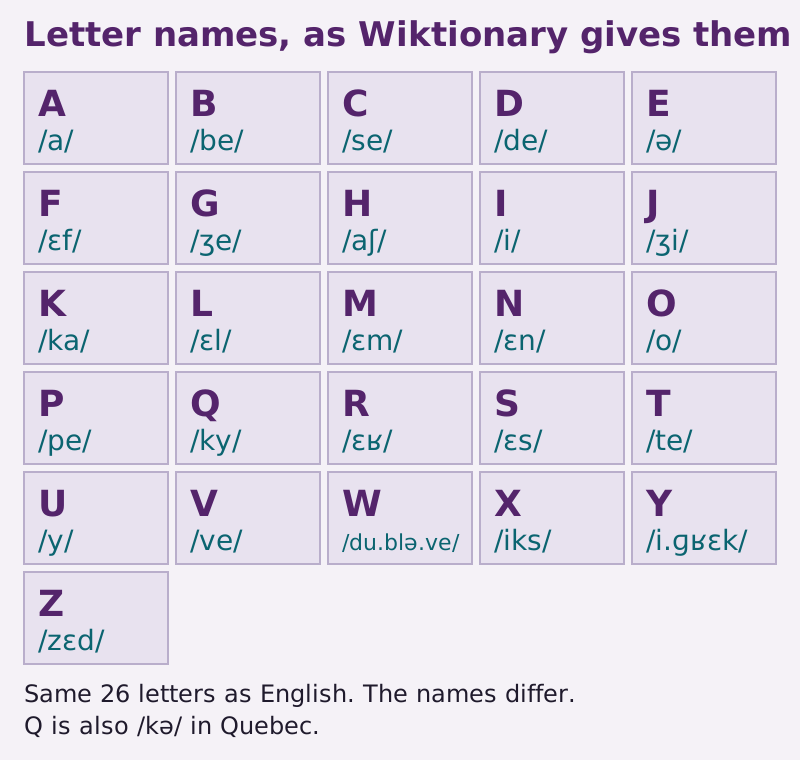
"French letter names, A to Z" from Conversation Mile (https://conversationmile.com/pronunciation/french-alphabet/). CC BY 4.0 (creativecommons.org/licenses/by/4.0)
| Letter | Name in IPA | Letter | Name in IPA |
|---|---|---|---|
| A | /a/ | N | /ɛn/ |
| B | /be/ | O | /o/ |
| C | /se/ | P | /pe/ |
| D | /de/ | Q | /ky/ |
| E | /ə/ | R | /ɛʁ/ |
| F | /ɛf/ | S | /ɛs/ |
| G | /ʒe/ | T | /te/ |
| H | /aʃ/ | U | /y/ |
| I | /i/ | V | /ve/ |
| J | /ʒi/ | W | /du.blə.ve/ |
| K | /ka/ | X | /iks/ |
| L | /ɛl/ | Y | /i.ɡʁɛk/ |
| M | /ɛm/ | Z | /zɛd/ |
A few notes on the table:
- Q has a second form in Quebec, /kə/, which Wiktionary lists next to /ky/.
- W is said as double plus the name of V.
- Y is called i grec.
- R uses the French r sound. The r and nasal vowels page shows how to make it.
This site has no recordings for this page. FREN 140, an open course from Palomar College, has a page with the letters and audio. Nobody here has listened to those clips, so use them to get the sounds in your ear, not as a test.
How can you learn 26 names fast?
Sort them into four groups. Many of the names share a vowel with their neighbors, and the table above shows which one.
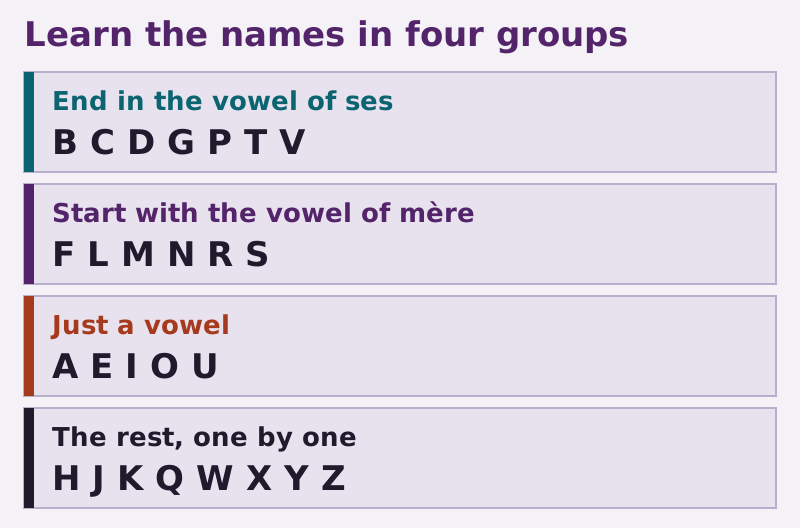
"The letter names in four groups" from Conversation Mile (https://conversationmile.com/pronunciation/french-alphabet/). CC BY 4.0 (creativecommons.org/licenses/by/4.0)
- B, C, D, G, P, T, V end in the vowel of ses, /e/.
- F, L, M, N, R, S start with the vowel of mère, /ɛ/.
- A, E, I, O, U are a vowel and nothing else.
- H, J, K, Q, W, X, Y, Z each need learning on their own.
Say one group at a time. Read it, cover it, and say it back.
Which names should you say side by side?
Three pairs. Each one holds two names that are easy to swap.
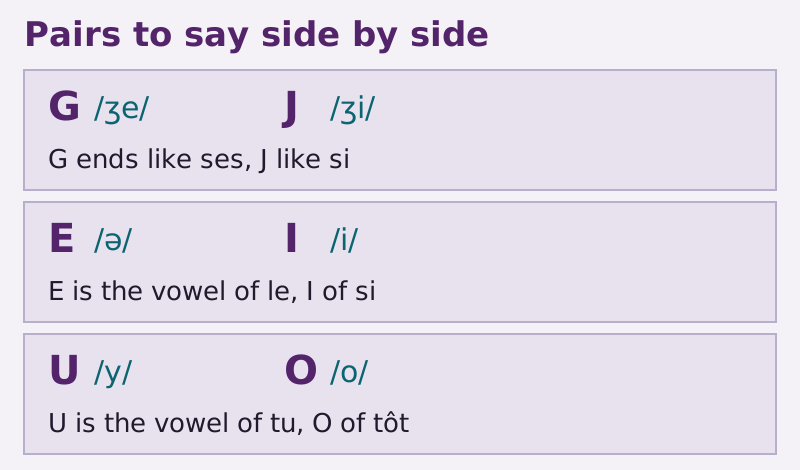
"Letter names to say side by side" from Conversation Mile (https://conversationmile.com/pronunciation/french-alphabet/). CC BY 4.0 (creativecommons.org/licenses/by/4.0)
- G and J. Both start with the same sound. G ends like ses and J ends like si.
- E and I. E is the vowel of le. I is the vowel of si.
- U and O. U is the vowel of tu, and O is the vowel of tôt. Français interactif puts the U sound with rounded lips and the tongue toward the front. The French pronunciation page and the minimal pairs tool have more on it.
Français interactif also says French vowels never slide into a second sound. So hold the end of B, D or O still, the way you held the vowels at the top of this page.
What are the accent marks called?
FREN 140 gives the names and a word for each. You'll need the names when you spell a word that has one.
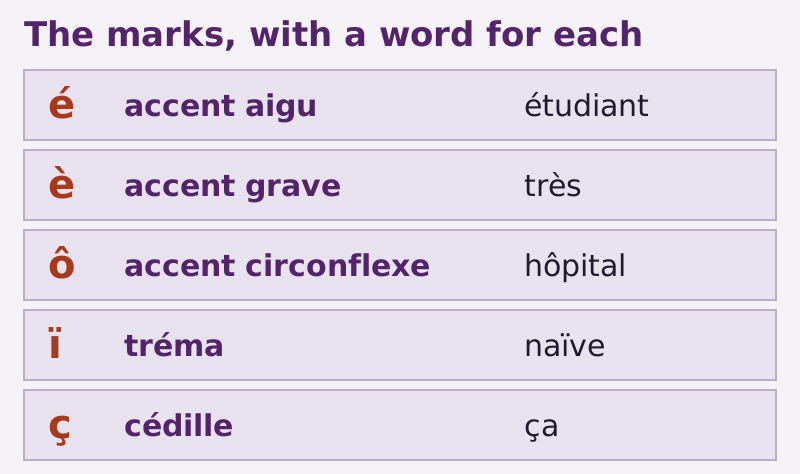
"Names of the French accent marks" from Conversation Mile (https://conversationmile.com/pronunciation/french-alphabet/). CC BY 4.0 (creativecommons.org/licenses/by/4.0)
| Mark | Name | Word | What it does |
|---|---|---|---|
| é | accent aigu | étudiant | Shows the vowel of ses, /e/, as in café |
| è | accent grave | très | On e, shows the vowel of mère, /ɛ/, as in père. On a or u, it only tells words apart: ou (or) and où (where) |
| ê, ô and others | accent circonflexe | hôpital | Can tell apart words that sound the same, such as mur (wall) and mûr (ripe), both /myʁ/. How ê sounds isn't covered here |
| ë, ï | tréma | naïve | The vowel is said on its own, not blended with the one next to it |
| ç | cédille | ça | The c sounds like s, not k |
Wiktionary gives the names this way: accent /ak.sɑ̃/, aigu /ɛ.ɡy/ or /e.ɡy/, grave /ɡʁav/, circonflexe /siʁ.kɔ̃.flɛks/, tréma /tʁe.ma/ and cédille /se.dij/. Say them that way for row 5.
FREN 140 also notes that people often leave the marks out in informal writing, such as texting.
The sources on this page name the marks. They don't show a set way to fit them into spelling aloud. This site's House routine is to say the letter, then the name of its mark: "E, accent aigu." If the person you're spelling for says it another way, copy them.
How do you spell a name out loud?
Letter by letter. Français interactif has a model for it. One person asks Kiblawi, ça s’écrit comment? (Kiblawi, how is that spelled?). The answer is K-I-B-L-A-W-I.
Here are lines you may hear, from the Tatoeba sentence collection:
| Say it | Meaning |
|---|---|
| Comment s'écrit votre nom ? | How is your name spelled? |
| Comment s'écrit ton nom ? | How is your name spelled? |
| Pouvez-vous l'épeler ? | Can you spell it? |
| Peux-tu l'épeler ? | Can you spell it? |
| Écrivez votre nom en majuscules. | Write your name in capitals. |
The votre and pouvez-vous lines use vous. Français interactif says tu is for friends, family and children, and vous is for polite and formal talk. Wiktionary also gives vous as "you all," so use it for more than one person, friends included. The ton and peux-tu lines are the tu forms.
A capital letter is a majuscule, /ma.ʒys.kyl/.
For an email address, Wiktionary gives arobase, /a.ʁɔ.baz/, for @. It gives tiret, /ti.ʁɛ/, for a dash, tiret bas, /ti.ʁɛ ba/, for an underscore and trait d'union for a hyphen. The sources here don't say how people read out the dot in an address, so ask, or listen to how the other person says theirs. Until you know, leave the dot out when you practice.
Start with your name: Je m'appelle Hugo. Put your own name in, then spell it.
How does the week run?
The week is seven rows, from the letters to spelling. How many rows you do in a day depends on your daily amount. The order and the minutes are this site's House routine, untested with learners. Count Spoken Minutes: the timer runs only while you're saying something.
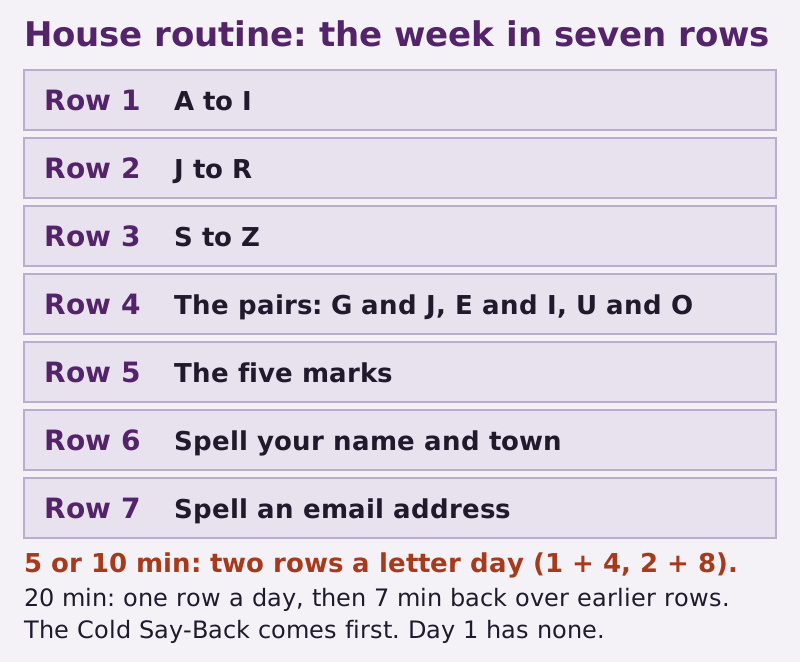
"One week with the French alphabet" from Conversation Mile (https://conversationmile.com/pronunciation/french-alphabet/). CC BY 4.0 (creativecommons.org/licenses/by/4.0)
| Daily amount | Cold Say-Back, first | Minutes on the rows | Going back over earlier rows |
|---|---|---|---|
| 5 | 1 | 4 minutes, two rows | None |
| 10 | 2 | 8 minutes, two rows | None |
| 20 | 3 | 10 minutes, one row | 7 |
On 5 or 10 Spoken Minutes, do two rows on each letter day: rows 1 and 2, then 3 and 4, then 5 and 6, then row 7 alone. On 20, do one row a day and spend the last 7 minutes going back over earlier rows, spelling words from this page out loud. On day 1, the Cold Say-Back minutes go to the new letters. If you're on the French starting plan, letter days come once every three days on 5 or 10 minutes. On that plan at 20 minutes, do one row in the 10-minute slot; the 7-minute slot goes to the day's other job.
Each letter day opens with a Cold Say-Back: say the rows from your last letter day with nothing in front of you, then check them. Day 1 has nothing to say back, so those minutes go to the new letters. Log the minutes in your Mile Log.
For row 6, spell your name and your town. Then answer the questions from the table above, out loud, by spelling your name. Use the vous lines as if a stranger asked, and the tu lines as if one friend did. Say the Écrivez line aloud; it's an instruction, not a question. For row 7, spell an email address, yours or a made-up one, including the @ and leaving out the dot.
When the week is done, go on to the sounds the letters make in words. French pronunciation covers the letters you stop saying, and the French starting plan shows where the alphabet fits in your first two weeks.
Tomorrow, before you look at anything, do a Cold Say-Back: say the rows you did today, in order, from memory. Once you've done row 6, spell your name too. Check against the table on this page.
Sources
- Wiktionary, entries for the French letters A to Z and for arobase, majuscule, mur, mûr, vous, accent, aigu, grave, circonflexe, tréma, cédille, point, tiret, tiret bas and trait d'union, via Wiktextract (kaikki.org extraction of 2026-10-30) Open. Read: Each entry's pronunciation and senses. License: CC BY-SA 4.0.
- Kelton, Karen, Nancy Guilloteau and Carl Blyth. "Phonétique," chapters 0, 2 and 6. Français interactif, COERLL and the University of Texas at Austin Open. Read: The pronunciation pages for chapter 0 (the alphabet), chapter 2 (the table of phonetic symbols) and chapter 6 (the vowels i, y and u), each read in full. License: CC BY 3.0.
- Kelton, Karen, Nancy Guilloteau and Carl Blyth. "Chapitre 1: Bonjour!" Français interactif, 4th ed., pp. 18-23. COERLL and the University of Texas at Austin, 2019 Open. Read: The vocabulary list (p. 18), the note on tu and vous (p. 22) and Exercice 5, Ça s'écrit comment? (p. 23). License: CC BY 3.0.
- Carrasco, William J., and Shahrzad Zahedi. "1.1: French Letters and Numbers." FREN 140: Basic French Pronunciation, Palomar College, LibreTexts Open. Read: The alphabet section of the page. It lists the 26 letters with a sample word each and has audio players; the audio was not listened to. License: CC BY.
- Carrasco, William J., and Shahrzad Zahedi. "2.1: Diacritical Marks." FREN 140: Basic French Pronunciation, Palomar College, LibreTexts Open. Read: The whole page. License: CC BY.
- Tatoeba, sentences 3006353, 3006354, 7745611, 948280, 333137 and 7851032 with their linked English translations Open. Read: Each sentence and its English translation, from the export files. License: CC BY 2.0 FR.
Sentence credits
- Pouvez-vous l'épeler ? Tatoeba sentence 3006353 by Julien_PDC; English by patgfisher. CC BY 2.0 FR.
- Kiblawi, ça s’écrit comment? Français interactif, Chapitre 1, Exercice 5. CC BY 3.0.
- Comment s'écrit votre nom ? Tatoeba sentence 7745611 by lbdx; English by CK. CC BY 2.0 FR.
- Comment s'écrit ton nom ? Tatoeba sentence 948280 by sacredceltic; English by CK. CC BY 2.0 FR.
- Peux-tu l'épeler ? Tatoeba sentence 3006354 by Julien_PDC; English by patgfisher. CC BY 2.0 FR.
- Écrivez votre nom en majuscules. Tatoeba sentence 333137 by sysko; English by CK. CC BY 2.0 FR.
- Je m'appelle Hugo. Tatoeba sentence 7851032 by theachaean; English by rul. CC BY 2.0 FR.
Next stops
Cite this page
French Alphabet Names, Accents, and Spelling Aloud. Conversation Mile, 2026-11-10. https://conversationmile.com/pronunciation/french-alphabet/
Corrections
No corrections on this page. Spotted a language error? Please tell this site.