Your First 90 Days Plan
How to Learn French When Spelling Hides the Sound
Straight answer
French spelling holds many letters you don't say, so learn each new word by its sound first. Say this out loud now: Les enfants dorment. (The kids are asleep.) The s of les joins the next word as a z sound. The t and s of enfants are silent, both of its vowels are nasal, /ɑ̃.fɑ̃/, and dorment ends on the m. Say it again without looking. That line is a first taste: in the plan below, silent endings get their own practice after day 14. This page covers what's particular to French in your first two weeks. The day-by-day structure lives on the main plan page.
The English trap
FREN 140 says written French can look a lot like English and still sound very different. For an English speaker, a big part of the work is knowing which letters you see on the page and don't say.
Say this today
Je ne sais pas.
I don't know.
What goes into your first two weeks?
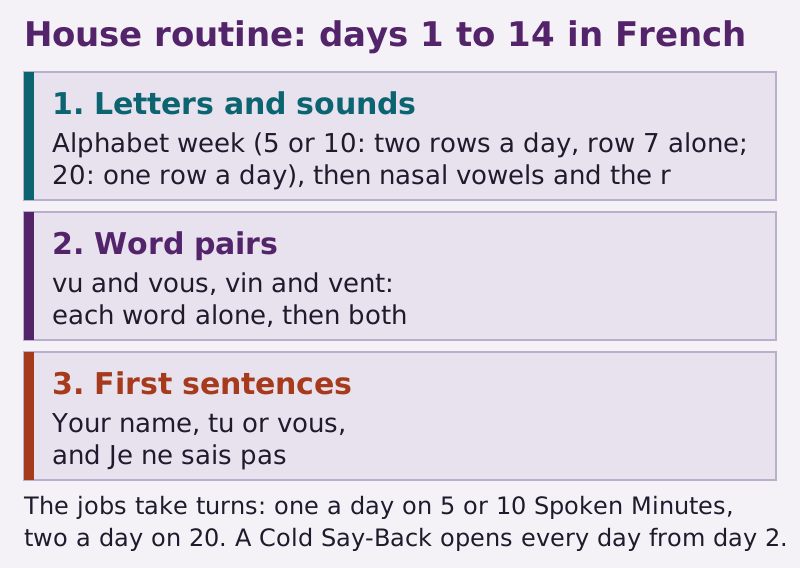
The same three jobs as any language, filled with French. They take turns. If you pick French, the planner on the main plan page, under "Lay out your 90 days," lays out the dates.
"Days 1 to 14 in French" from Conversation Mile (https://conversationmile.com/start/how-to-learn-french/). CC BY 4.0 (creativecommons.org/licenses/by/4.0)
| Daily amount | Cold Say-Back, first | First job | Second job |
|---|---|---|---|
| 5 | 1 | 4 | None |
| 10 | 2 | 8 | None |
| 20 | 3 | 10 | 7 |
These splits are a House routine, untested with learners. Each day opens with a Cold Say-Back: say something from an earlier day with nothing in front of you, then check it. Day 1 has nothing to say back, so those minutes go to the first job. Log the minutes in the Mile Log.
Here's how the first days could run at 10 Spoken Minutes:
- Day 1, letters and sounds. The first two rows of the French alphabet week, A to I and J to R, all 10 minutes.
- Day 2, word pairs. 2 minutes saying A to R from memory, then 8 on vu (seen) and vous (you). They have different vowels. Vu, /vy/, has the vowel of tu: round your lips and keep your tongue forward. Vous, /vu/, keeps the lips round and pulls the tongue back. Say each word alone, then both. The French pronunciation page has the lip guide. The minimal pairs tool has more French pairs, such as vin (wine) and vent (wind).
- Day 3, first sentences. 2 minutes on the pair, cold, then 8 on your name and the two ways to ask someone else's, below.
- Day 4 starts the turn again with the next two rows of the alphabet week.
At 5 or 10 minutes, the seven rows of the alphabet week fill the letter days 1, 4, 7 and 10: rows 1 and 2, then 3 and 4, then 5 and 6, then row 7. Nasal vowels and the r come after it. At 20 minutes, a letter job is one row in the 10-minute slot, and the 7-minute slot goes to the day's other job. Silent endings, linking and stress wait until after day 14, one fix at a time. That order is a House routine.
If you're learning Spanish or German instead, their first weeks have their own pages: Spanish and German.
Which letters do you stop saying?
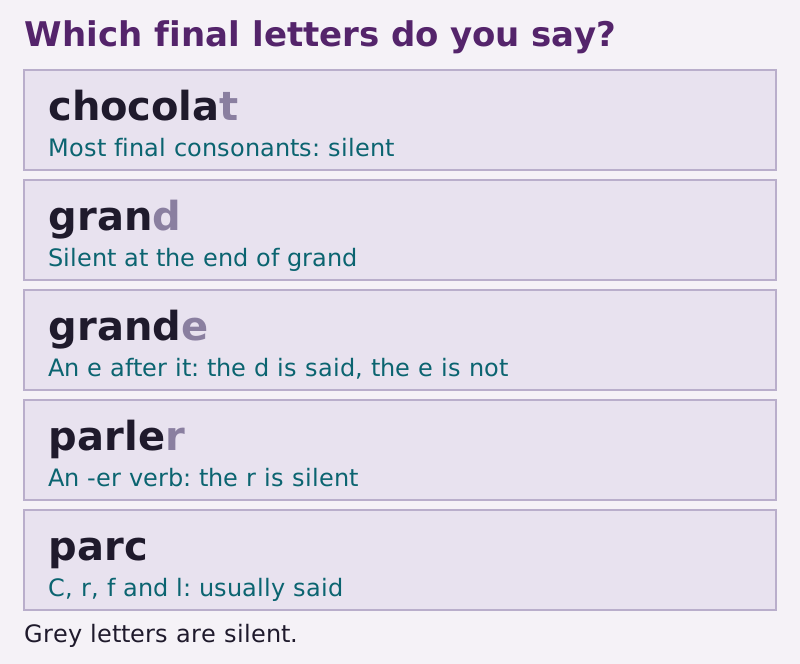
Most consonants at the end of a word. FREN 140, an open pronunciation course from Palomar College, says most final consonants are silent. A final e with no accent mark is usually silent in longer words, but FREN 140 says the e of a one-syllable word such as je, le, de or ne is said. For now, take this as a preview; the timed practice for endings comes after day 14. Say this pair and listen for the d:
| Say it | Meaning |
|---|---|
| Il est grand. | He is tall. |
| Elle est grande. | She's tall. |
In both lines, the t of est is silent. In grand, /ɡʁɑ̃/, the d is silent. In grande, /ɡʁɑ̃d/, the e after it is silent, and that e is why the d is said.
"Final letters said and silent" from Conversation Mile (https://conversationmile.com/start/how-to-learn-french/). CC BY 4.0 (creativecommons.org/licenses/by/4.0)
FREN 140 gives a memory word for the consonants that are usually said at the end: CaReFuL, for c, r, f and l. It's a shortcut with holes. The r of an -er verb such as parler (to speak) is silent, and so is the r of most longer words ending in -er. Some words break the rule in both directions, so when a new word ends in a consonant, check how it's said before you learn it. FREN 140 also notes that in some southern French cities, such as Marseille, the final e is said.
The French pronunciation page has the full set, with the exceptions.
How do French words run together?
Often with no break. A silent final consonant can come back when the next word starts with a vowel sound. This is called a liaison. In Vous avez raison. (You're right.), the s of vous is said as a z, joined to avez.
FREN 140 says some liaisons are required, some are optional, and some are never made. Two rules cover your first sentences:
- After les and before a noun that starts with a vowel, always make it, as in les enfants.
- Between a pronoun such as vous or nous and a verb that starts with a vowel, always make it: a z in vous avez, none in vous parlez. Between a noun and its verb, never: in FREN 140's example les étudiants aiment (the students like), there's still a z between les and étudiants, but none before aiment.
An h needs care. FREN 140 says a mute h counts as a vowel, so you link in les hôtels. An aspirated h doesn't: no z in les héros, and it's le héros, not l'héros. The French pronunciation page has more.
The rest you can pick up line by line. This site's House routine is to learn each liaison inside the whole sentence you met it in, not as a rule on its own.
Some short words also lose their e. Je plus ai is written j'ai. In speech, some speakers drop more. FREN 140 says Je ne sais pas. (I don't know.) can come out with no e in je or ne, depending on the region, how formal the talk is and the speaker's diction. In Marseille, it says, that e is said. Say the full form while you're starting, and notice the short one when you hear it.
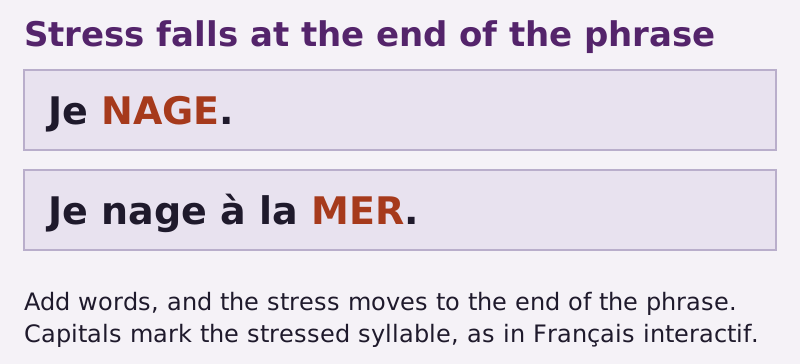
French also puts the stress at the end. Français interactif, an open course from the University of Texas at Austin, says the stress falls on the last syllable of the whole phrase, not of each word. FREN 140 adds that speakers can still stress another word to make a point.
"Stress at the end of the phrase" from Conversation Mile (https://conversationmile.com/start/how-to-learn-french/). CC BY 4.0 (creativecommons.org/licenses/by/4.0)
Say Je nage. (I swim.), then Je nage à la mer. (I swim in the sea.), with the beat on nage the first time and on mer the second.
What about nasal vowels and the r?
Both need their own practice, and the r and nasal vowels page gives it. Here is the short version from FREN 140:
- Nasal vowels. When a vowel is followed by n or m at the end of a word, or before another consonant, the vowel is nasal and you don't say a separate n or m. So vin has no n sound. When a vowel follows the n or m in the same word, you say it, as in bonne. Links between words and odd words such as ennui are on the r and nasal vowels page. FREN 140 says speakers in the north of France hear three nasal vowels, while the south of France and Quebec keep a fourth.
- The r. It's made far back, a bit like gargling, with the tip of your tongue touching your bottom teeth. FREN 140 teaches the Paris r. It also says the rolled r, made with the tongue tip, was once common in southern France and Quebec and is now heard mostly from older and rural speakers there.
Which French to copy depends on who you'll talk to. This site uses the standard French of France as its model and notes other regions where its sources do. If your tutor or friends speak the French of Quebec or southern France, copy them.
Should you say tu or vous?
Both mean "you." Français interactif says tu is for friends, family and children, and vous shows politeness, formality and distance. It's the form for any formal situation. Wiktionary gives tu as "you" for one person and vous also as "you all," so for more than one person, friends included, use vous. Learn the question both ways:
| Say it | Meaning |
|---|---|
| Comment vous appelez-vous? | What's your name? (formal) |
| Comment tu t’appelles? | What's your name? (informal) |
Answer with your own name: Je m'appelle Hugo. When you're not sure which one fits, this site's House routine is to start with vous.
For the first conversation on day 30, the main plan has you prepare three sentences about yourself. These lines are a start. Say them cold in the days before.
What can wait until later?
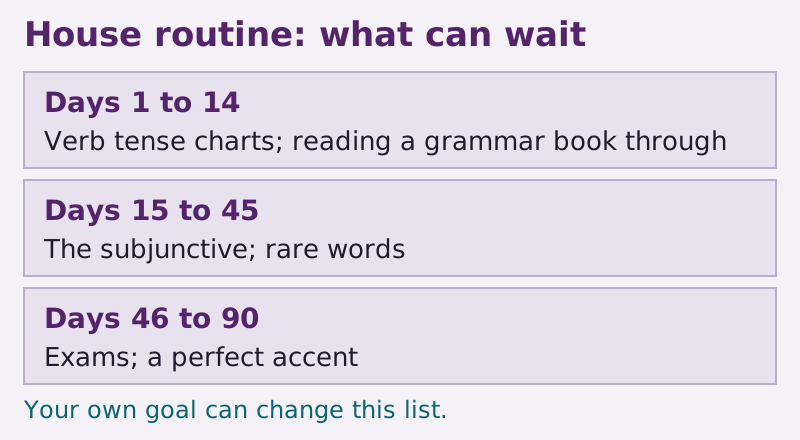
The charts. You'll meet French grammar from day one, inside whole sentences, and that's enough for the first two weeks.
"What can wait in French" from Conversation Mile (https://conversationmile.com/start/how-to-learn-french/). CC BY 4.0 (creativecommons.org/licenses/by/4.0)
- Verb tables. Say je m'appelle and vous avez as whole lines for now. When you want the full set, the conjugation lookup has it.
- Articles. Little words like du and de la will turn up in your sentence cards from days 15 to 45. Learn them inside the line, and read French articles when you want the rules.
- The two past tenses. From day 46, the plan has you work on one grammar point at a time. The choice between passé composé and imparfait is a good first one.
- The subjunctive. The plan holds it until late, and the French subjunctive page is there when you get to it.
Leaving these out isn't a claim that they don't matter. Some tables do need memorizing later. If you need to read French for work, or you have an exam date, your list will look different.
Tomorrow, before you look at anything, do a Cold Say-Back of today's job: the letter rows, vu and vous, or the two ways to ask a name. Skip anything you haven't done yet. Check them against this page and the alphabet page.
What this rests on
Checked against
- Knowing which written letters not to say as a main challenge for English speakers Source 1
- Most final consonants silent; c, r, f and l usually said; the r of -er verbs silent; a d said once an e follows; a final unaccented e silent, though said in cities such as Marseille Source 2
- The e said in one-syllable words such as je, le, de and ne Source 4
- Speakers stressing another word to make a point Source 5
- The e of je, ne and similar words dropped by some speakers, depending on region, register and diction; mute h linking in les hôtels and aspirated h in le héros and les héros Source 3
- The r made far back, with the tip of the tongue at the bottom teeth, on a Parisian model; the trilled r in southern France and Quebec, now mostly older and rural speakers Source 6
- A vowel before n or m at the end of a word or before a consonant is nasal; before a vowel, the n is said; three nasal vowels in the north of France and a fourth in the south and in Quebec Source 7
- Je and ai joining as j'ai Source 8
- Liaison: an s said as z before a vowel sound, always after les and between a pronoun and its verb when the next word starts with a vowel sound, never between a noun subject and its verb Source 9
- Stress on the last syllable of the phrase, the vowels of vu and tu, and the lips and tongue for them Source 10
- Tu for friends, family and children, vous for polite and formal talk, and the two ways to ask a name Source 11
- The IPA for grand, grande, enfants, dorment, vu, vous, vin and vent; tu as you for one person and vous as you all Source 12
- All first-tier French example sentences Source 13
House routine
- Learning each new word by its sound first, the French items that fill the three jobs of days 1 to 14, two alphabet rows per letter day on 5 and 10 minutes and one row in the 10-minute slot on 20, silent endings and the other fixes after day 14, learning liaisons inside whole lines, starting with vous when unsure, and the 5, 10 and 20 Spoken Minute splits with the Cold Say-Back first and its minutes going to the first job on day 1
- Which grammar waits for which stage, and the leave-for-later list
Sources
- Carrasco, William J., and Shahrzad Zahedi. "1.3: Differences between French and English." FREN 140: Basic French Pronunciation, Palomar College, LibreTexts Open. Read: The paragraph on what is hardest for English speakers; the history and cognate parts were not used. License: CC BY.
- Carrasco, William J., and Shahrzad Zahedi. "2.2: Silent Letters at the End of Words." FREN 140: Basic French Pronunciation, Palomar College, LibreTexts Open. Read: The whole page. License: CC BY.
- Carrasco, William J., and Shahrzad Zahedi. "2.3: Other Silent Letters (Silent H and Lapsed E)." FREN 140: Basic French Pronunciation, Palomar College, LibreTexts Open. Read: The whole page. License: CC BY.
- Carrasco and Zahedi. FREN 140: Basic French Pronunciation, 7.1: The Silent E. Palomar College, via LibreTexts Open. Read: The whole page. License: CC BY.
- Carrasco and Zahedi. FREN 140: Basic French Pronunciation, 14.1: Stress and Rhythm. Palomar College, via LibreTexts Open. Read: The whole page. License: CC BY.
- Carrasco, William J., and Shahrzad Zahedi. "3.2: The Letter R." FREN 140: Basic French Pronunciation, Palomar College, LibreTexts Open. Read: The whole page; the audio was not listened to. License: CC BY.
- Carrasco, William J., and Shahrzad Zahedi. "10.1: Nasal Vowels - Introduction." FREN 140: Basic French Pronunciation, Palomar College, LibreTexts Open. Read: The whole page; the audio was not listened to. License: CC BY.
- Carrasco, William J., and Shahrzad Zahedi. "12.1: Linking Consonants and Vowels." FREN 140: Basic French Pronunciation, Palomar College, LibreTexts Open. Read: The whole page. License: CC BY.
- Carrasco, William J., and Shahrzad Zahedi. "13.1: How silent consonants are pronounced in liaisons, and 13.2: Types of Liaisons." FREN 140: Basic French Pronunciation, Palomar College, LibreTexts Open. Read: Both pages in full. License: CC BY.
- Kelton, Karen, Nancy Guilloteau and Carl Blyth. "Phonétique," chapters 3 and 6. Français interactif, COERLL and the University of Texas at Austin Open. Read: The pronunciation pages for chapter 3 (stress and intonation) and chapter 6 (the vowels i, y and u), read in full; the audio was not listened to. License: CC BY 3.0.
- Kelton, Karen, Nancy Guilloteau and Carl Blyth. "Chapitre 1: Bonjour!" Français interactif, 4th ed., pp. 18 and 22. COERLL and the University of Texas at Austin, 2019 Open. Read: The vocabulary list (p. 18) and the note on tu and vous (p. 22). License: CC BY 3.0.
- Wiktionary, entries for grand, grande, enfants, dorment, tu, vu, vous, vin and vent, via Wiktextract (kaikki.org extraction of 2026-10-30) Open. Read: Each entry's pronunciation and first senses. License: CC BY-SA 4.0.
- Tatoeba, sentences 2310538, 1627779, 8781258, 2071330, 7851032 and 3100 with their linked English translations Open. Read: Each sentence and its English translation, from the export files. License: CC BY 2.0 FR.
Sentence credits
- Je ne sais pas. Tatoeba sentence 3100 by Sprachprofi; English by fatih. CC BY 2.0 FR.
- Les enfants dorment. Tatoeba sentence 2310538 by Joelle; English by CK. CC BY 2.0 FR.
- Il est grand. Tatoeba sentence 1627779 by rmdas; English by marloncori. CC BY 2.0 FR.
- Elle est grande. Tatoeba sentence 8781258 by felix63; English by frpzzd. CC BY 2.0 FR.
- Vous avez raison. Tatoeba sentence 2071330 by Amastan; English by Alkrasnov. CC BY 2.0 FR.
- Je nage. Français interactif, Phonétique, Chapitre 3. CC BY 3.0.
- Je nage à la mer. Français interactif, Phonétique, Chapitre 3. CC BY 3.0.
- Comment vous appelez-vous? Français interactif, Chapitre 1, Vocabulaire. CC BY 3.0.
- Comment tu t’appelles? Français interactif, Chapitre 1, Vocabulaire. CC BY 3.0.
- Je m'appelle Hugo. Tatoeba sentence 7851032 by theachaean; English by rul. CC BY 2.0 FR.
Next stops
Cite this page
How to Learn French When Spelling Hides the Sound. Conversation Mile, 2026-11-10. https://conversationmile.com/start/how-to-learn-french/
Corrections
No corrections on this page. Spotted a language error? Please tell this site.