Pronunciation Workshop How-to
French Nasal Vowels and the R, With Spellings and Pairs
Straight answer
A French nasal vowel ends with no n sound, even when the spelling shows an n. Say this out loud: Prends ton temps. It means "Take your time." It has three nasal vowels: ɑ̃ twice, in prends and temps, and ɔ̃ in ton, and you don't say an n or m in any of them.
The English trap
Français interactif points out that English sing and impossible have vowels that sound nasal, but you still say the n or m. In a French nasal vowel, you don't.
Say this today
Prends ton temps.
Take your time.
The d and s of prends, /pʁɑ̃/, and the p and s of temps, /tɑ̃/, are silent too. There's also an r, right after the p of prends. This page covers both. This site's plan puts them in your first two weeks, which is a House routine.
How do you make the French r?
The French r is made far back in the throat. FREN 140, an open pronunciation course from Palomar College, says it's made the way you gargle. It gives two descriptions of the tongue. In one, the sound comes from the back of the throat while the tongue touches the bottom teeth. In the other, the tip of the tongue sinks to touch the bottom teeth while the back of the tongue arches up. Wiktionary writes this r as ʁ, as in rue, ʁy.
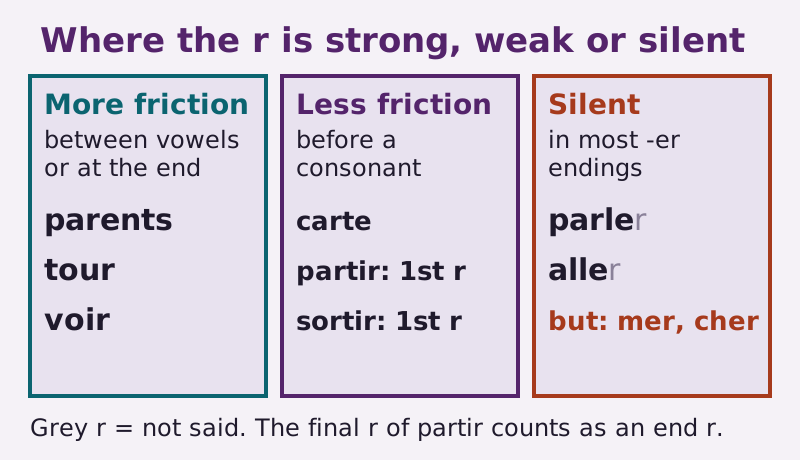
"Where the French r is strong, weak or silent" from Conversation Mile (https://conversationmile.com/pronunciation/french-r-and-nasal-vowels/). CC BY 4.0 (creativecommons.org/licenses/by/4.0)
The r doesn't sound the same everywhere in a word. FREN 140 says it has more friction between two vowels, as in parents and girafe, or at the end of a word, as in tour and voir. It has less before a consonant, as in carte and the first r of partir; the r at the end of partir counts as an end r. In most words ending in -er, like parler and aller, you don't say it at all. Mer, cher, hier and fier are exceptions. They keep it.
Try it now. Say Rentre chez toi. ("Go back home.") The r of rentre starts the word, and the second one sits after a t. Then say Je pars tout de suite. ("I'm leaving immediately.") Let the r of pars be the last sound of that word; the s is silent.
Not every French speaker uses this r. FREN 140 says a tongue-tip trill was still common in southern France and Quebec in the early 1900s. It has since given way to the back-of-the-throat r, and the trill is now mostly heard from older and rural speakers there. FREN 140 adds that French speakers in some other countries roll their r, with an example from Cameroon, and that singers often trill it. This page teaches the back r because it's the one these courses teach.
What makes a vowel nasal?
A nasal vowel lets air out through your nose as well as your mouth. Français interactif, an open French course from the University of Texas at Austin, sets oral and nasal vowels side by side. Say each pair: the first word is oral, the second nasal. Look at the IPA too: the vowel symbol itself changes, not only the nasal mark.
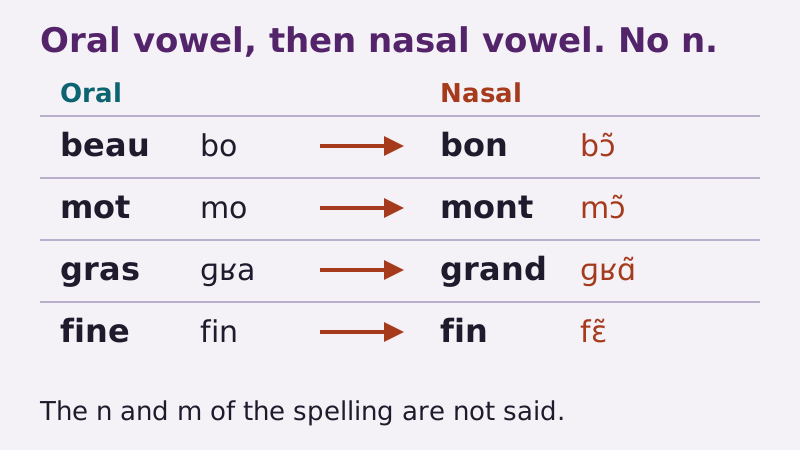
"Oral and nasal vowels side by side" from Conversation Mile (https://conversationmile.com/pronunciation/french-r-and-nasal-vowels/). CC BY 4.0 (creativecommons.org/licenses/by/4.0)
| Oral | Nasal |
|---|---|
| beau bo | bon bɔ̃ |
| mot mo | mont mɔ̃ |
| gras ɡʁa | grand ɡʁɑ̃ |
| fine fin | fin fɛ̃ |
The trap is the English habit. Français interactif notes that the vowel in English "sing" sounds nasal too, but you still say the n or m. In French, the n or m is swallowed into the vowel, and you don't say a separate n or m after it. So bon ends on the vowel, with no n after it.
FREN 140 suggests a feel for it: close your mouth and hum through your nose. It says French nasal sounds are almost like that. Now say Il a un chien. ("He has a dog.") and stop on the vowel in un and in chien.
Which spellings give which nasal vowel?
A vowel letter followed by n or m is the usual sign. FREN 140 lists these spellings for each sound.
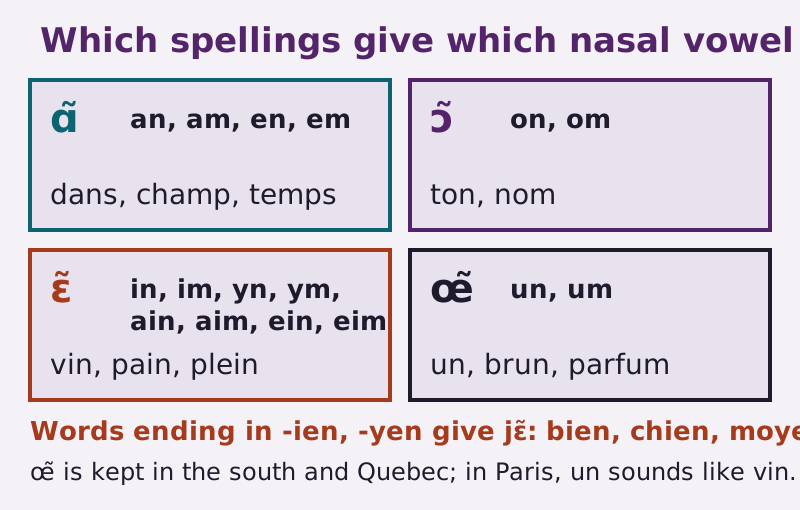
"Spellings of the four nasal vowels" from Conversation Mile (https://conversationmile.com/pronunciation/french-r-and-nasal-vowels/). CC BY 4.0 (creativecommons.org/licenses/by/4.0)
The one that catches people is en. Usually it sounds like an, as in temps and enfants. But in the endings -ien and -yen, as in bien, chien and moyen, FREN 140 says it's jɛ̃, with the vowel of vin.
That doesn't hold for every en after an i. Wiktionary gives patient as pa.sjɑ̃ and science as sjɑ̃s, with the vowel of an. Check a word like that before you learn it. The ym of gym isn't nasal, as the section on non-nasal vowels says.
A few common words don't follow the chart at all. Wiktionary gives monsieur as /mə.sjø/ and automne as /o.tɔn/ or /ɔ.tɔn/, with no nasal vowel in either.
Say Mon oncle a trois enfants. ("My uncle has three children.") Find the nasal vowels as you go: oncle and both syllables of enfants. The mon before oncle can go either way, as the section "When is the vowel not nasal?" below shows. Link the s of trois to enfants as a z: FREN 140 requires that link after a number.
Then say the Français interactif line Il chante une chanson marrante. ("He is singing a funny song.") The une isn't nasal: a vowel follows the n, as the section "When is the vowel not nasal?" below explains. Listen for the ɑ̃ in chante, chanson and marrante, and the ɔ̃ at the end of chanson.
Are there three nasal vowels or four?
It depends on where the speaker is from. Both courses list four, but the fourth, written un or um, is fading in some places.
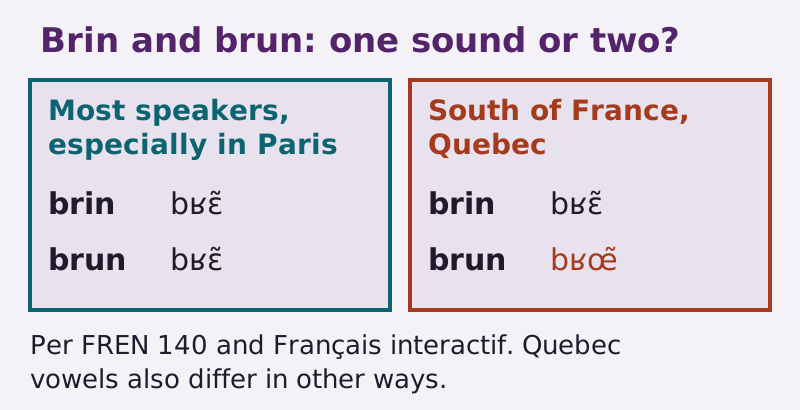
"Three nasal vowels or four" from Conversation Mile (https://conversationmile.com/pronunciation/french-r-and-nasal-vowels/). CC BY 4.0 (creativecommons.org/licenses/by/4.0)
Français interactif says most speakers, especially Parisians and younger people, say un with the same vowel as vin. FREN 140 says the same of northern France and Parisian French. It adds that the south of France and Quebec keep the fourth vowel. Wiktionary gives brun as bʁœ̃, with bʁɛ̃ marked for northern France and Paris. That second form is the same as brin (a blade of grass), bʁɛ̃.
FREN 140 notes two more regional differences. Quebec nasal vowels sound different from those in France. In the south of France, it says, a nasal vowel at the end of a word is said with a consonant sound after it, written ŋ, as in demain.
Say Le pain est brun. ("The bread is brown.") If you follow the Paris pattern, pain and brun end with the same vowel. If the people you'll talk to keep them apart, copy them. As a House routine, start with three and add the fourth if your speakers use it.
When is the vowel not nasal?
Inside one word, a nasal spelling stops being nasal when a vowel follows the n or m, or when the n or m is doubled, with exceptions such as ennui below. Then the vowel is oral and you do say the n or m. FREN 140 pairs these to show it.
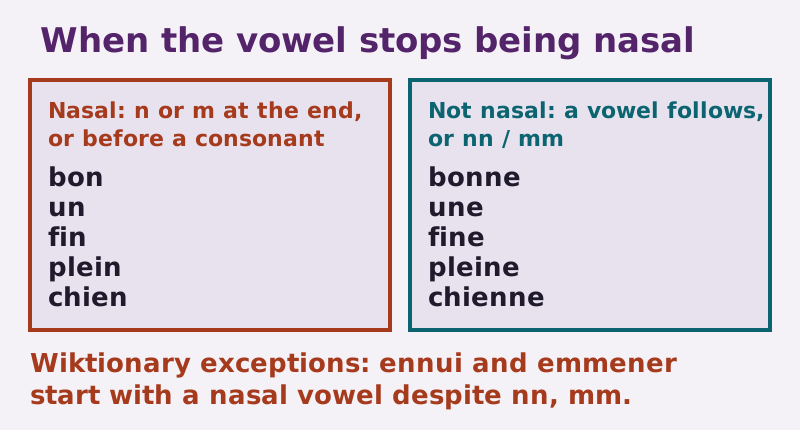
"When a nasal spelling loses its nasal vowel" from Conversation Mile (https://conversationmile.com/pronunciation/french-r-and-nasal-vowels/). CC BY 4.0 (creativecommons.org/licenses/by/4.0)
Say each pair: bon and bonne, un and une, fin and fine, chien and chienne. In each second word, you say the n. Then say Elle est bonne en tennis. ("She's good at tennis.") The bonne has an oral vowel, which Wiktionary writes ɔ, and a clear n. The en after it is nasal.
FREN 140 calls this a general rule, and it has exceptions. Wiktionary gives ennui as ɑ̃.nɥi and emmener as ɑ̃.m(ə).ne; both start with a nasal vowel even though the letter is doubled. FREN 140 also notes that the ym of gym isn't nasal. The rule tells you only that the vowel is oral, not which vowel: Wiktionary gives femme as fam. When a word looks odd, check it.
The n can also come back between words. In liaison, a silent n links to a following vowel: FREN 140 writes un arbre as ɛ̃ naʁbʁ, with the nasal vowel and then an n. That ɛ̃ is the merged vowel of northern France and Paris, from the section on three or four nasal vowels above. Wiktionary gives mon before a vowel two ways, with the vowel still nasal or not. So in mon oncle you'll hear an n. This site's House routine is to keep the nasal vowel and add the n; you'll hear the other way too. French pronunciation and the silent letters covers liaison in full.
How do you practice this?
The r and the nasal vowels belong in your first two weeks, along with the other vowels. Practice word pairs before sentences. This order is a House routine.
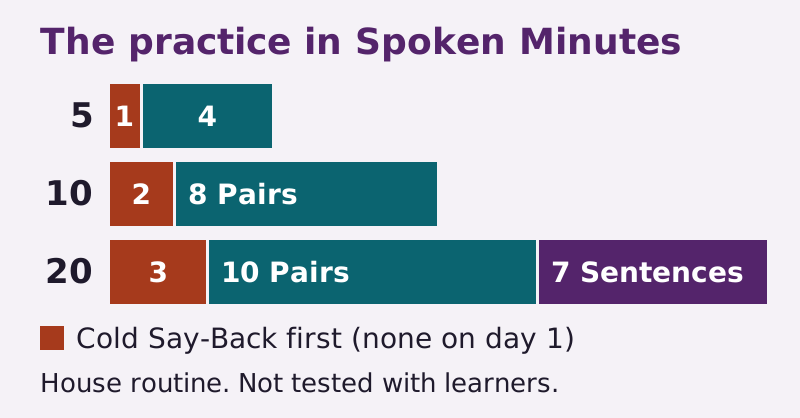
"How r and nasal practice fills 5, 10 or 20 Spoken Minutes" from Conversation Mile (https://conversationmile.com/pronunciation/french-r-and-nasal-vowels/). CC BY 4.0 (creativecommons.org/licenses/by/4.0)
Count only the time you speak, in Spoken Minutes. On a 5-minute day, spend 1 minute on yesterday's Cold Say-Back and 4 on pairs from this page, such as beau and bon, or bon and bonne. On a 10-minute day, it's 2 and 8. On a 20-minute day, it's 3, then 10 on pairs and 7 on the sentences here.
On the first day of the whole plan there's nothing to test yet, so give those minutes to the pairs; after that, say back yesterday's letters or pairs. This split is a House routine, untested with learners.
Record yourself once a week and listen for an English-style n at the end of bon. The southern ŋ is a regional sound, not this mistake. Log the minutes in your Mile Log.
The minimal pairs tool has more pairs to test one contrast at a time. For silent letters, liaison and stress, go to French pronunciation. For letter names when you spell aloud, see the French alphabet. The French starting plan shows where these two weeks fit.
To hear it. This site has no recordings for this page yet. FREN 140 has audio on its pages on the letter R and nasal vowels, and Français interactif has audio on its nasal vowel page. No one on this site has checked these clips, so use them to get used to the sounds, not as a test.
Tomorrow, before you look at anything, run a Cold Say-Back: say "Take your time" in French. Then say bon and bonne and name which one has an n you can hear. Check against this page.
What this rests on
Checked against
- Where the r is made, the two tongue descriptions, more friction between vowels and at the end, less before a consonant, silent in most -er endings with mer and cher as exceptions, the older trilled r, speakers in some other countries, such as Cameroon, who roll it, and singers who trill it Source 1
- Air through nose and mouth, the n or m not said, English sing as the contrast, four nasal vowels, un said as ɛ̃ by most speakers, the oral and nasal pairs Source 9
- Four nasal vowels in the south and Quebec, three in the north and in Paris, the ŋ ending in the south, a vowel after the n or m ending the nasal Source 2
- Spellings an, am, en, em; -ien and -yen Source 3
- Spellings on and om; doubled n or m Source 4
- Spellings in, im, yn, ym, ain, aim, ein, eim, un and um Source 5
- Nasal and non-nasal pairs such as bon and bonne Source 6
- The n heard in un arbre Source 7
- The required link after a number, as in trois enfants Source 8
- Transcriptions, brun as bʁɛ̃ in Paris and brin with its sense of a blade of grass, ennui and emmener, patient and science with ɑ̃, monsieur and automne with no nasal vowel, bonne and femme, and mon before a vowel Source 10
House routine
- Practicing r and nasals in the first two weeks, pairs before sentences, the 5, 10 and 20 Spoken Minute splits with the Cold Say-Back first, learning three nasal vowels first, keeping mon nasal before oncle, and recording yourself
Sources
- Carrasco and Zahedi. FREN 140: Basic French Pronunciation, 3.2: The Letter R. Palomar College, via LibreTexts Open. Read: The whole page; audio and videos not played. License: CC BY.
- Carrasco and Zahedi. FREN 140: Basic French Pronunciation, 10.1: Nasal Vowels - Introduction. Palomar College, via LibreTexts Open. Read: The whole page; audio and videos not played. License: CC BY.
- Carrasco and Zahedi. FREN 140: Basic French Pronunciation, 10.2: The Vowel [ɑ̃] - AN, EN, AM, EM. Palomar College, via LibreTexts Open. Read: The whole page; audio and videos not played. License: CC BY.
- Carrasco and Zahedi. FREN 140: Basic French Pronunciation, 10.3: The Vowel [ɔ̃] - ON, OM. Palomar College, via LibreTexts Open. Read: The whole page; audio and videos not played. License: CC BY.
- Carrasco and Zahedi. FREN 140: Basic French Pronunciation, 10.4: The Vowel [ɛ̃] and [œ̃]. Palomar College, via LibreTexts Open. Read: The whole page; audio and videos not played. License: CC BY.
- Carrasco and Zahedi. FREN 140: Basic French Pronunciation, 10.5: Non-nasalization. Palomar College, via LibreTexts Open. Read: The whole page; audio and videos not played. License: CC BY.
- Carrasco and Zahedi. FREN 140: Basic French Pronunciation, 12.1: Linking Consonants and Vowels. Palomar College, via LibreTexts Open. Read: The whole page; audio and videos not played. License: CC BY.
- Carrasco and Zahedi. FREN 140: Basic French Pronunciation, 13.2: Types of Liaisons. Palomar College, via LibreTexts Open. Read: The whole page. License: CC BY.
- Blyth, Guilloteau and Kelton. Français interactif, Chapitre 10, Phonétique: les voyelles nasales. COERLL and the University of Texas at Austin Open. Read: The whole page; audio not played. License: CC BY 3.0.
- Wiktionary, French entries, via Wiktextract and kaikki.org Open. Read: The pronunciation lines of rue, bon, beau, mot, mont, gras, grand, fin, fine, brin, brun, un, chien, ennui, emmener, mon, patient, science, monsieur, automne, bonne, femme, prends, temps and the other example words. License: CC BY-SA 4.0.
Sentence credits
- Prends ton temps. Tatoeba sentence 136638 by superbolo; English by CK. CC BY 2.0 FR.
- Rentre chez toi. Tatoeba sentence 7166299 by Micsmithel; English by CK. CC BY 2.0 FR.
- Je pars tout de suite. Tatoeba sentence 13649474 by felix63; English by dnswrsrx. CC BY 2.0 FR.
- Il a un chien. Tatoeba sentence 377224 by Pharamp; English by CK. CC BY 2.0 FR.
- Mon oncle a trois enfants. Tatoeba sentence 7717 by qdii; English by CK. CC BY 2.0 FR.
- Il chante une chanson marrante. Français interactif, Phonétique, Chapitre 10. CC BY 3.0.
- Le pain est brun. Tatoeba sentence 1598949 by martin9; English by kerbear407. CC BY 2.0 FR.
- Elle est bonne en tennis. Tatoeba sentence 1102405 by sacredceltic; English by CK. CC BY 2.0 FR.
Next stops
Cite this page
French Nasal Vowels and the R, With Spellings and Pairs. Conversation Mile, 2026-11-10. https://conversationmile.com/pronunciation/french-r-and-nasal-vowels/
Corrections
No corrections on this page. Spotted a language error? Please tell this site.