Pronunciation Workshop How-to
French Pronunciation and the Letters You Stop Saying
Straight answer
French spelling keeps letters that you don't say. Say this out loud: Les enfants sont bruyants. It means "The children are noisy." You don't say the s and t at the end of enfants, the t of sont or the ts of bruyants. But the s of les does come back as a z, because enfants starts with a vowel. The r and the nasal vowels have their own page; the rest starts here, with the ends of words.
The English trap
FREN 140, an open pronunciation course, says written French often looks like English, and that a big challenge for English speakers is knowing when not to say the letters they see.
Say this today
Les enfants sont bruyants.
The children are noisy.
Which final letters do you stop saying?
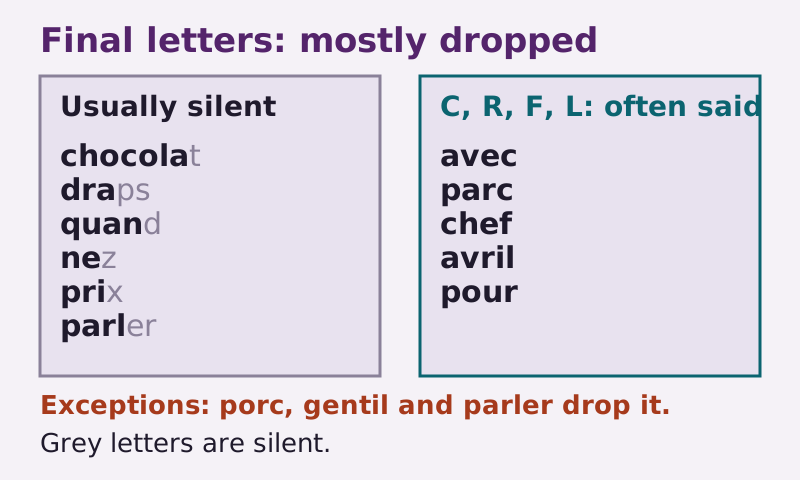
Most consonants at the end of a French word are silent. FREN 140, an open pronunciation course from Palomar College, lists d, p, s, t, x and z as letters that are generally silent there, as in quand, trop, draps, chocolat, prix and nez. A plural s stays silent too.
"Final letters that go silent, and the C, R, F, L ones that are often said" from Conversation Mile (https://conversationmile.com/pronunciation/french-pronunciation/). CC BY 4.0 (creativecommons.org/licenses/by/4.0)
Four letters often stay. Both FREN 140 and Français interactif, an open French course from the University of Texas at Austin, use the English word "careful" to help you remember them: c, r, f and l. Say avec, parc, chef and avril, and you say the last letter each time.
"Often" is the key word. Both books list exceptions:
- A c can go silent, as in porc, tabac and franc.
- The r of an -er verb is silent: parler, /paʁ.le/, ends on the vowel of nez. FREN 140 adds nouns and adjectives such as premier and escalier. But mer, cher and hiver keep their r.
- An l can go silent in some longer words, such as gentil and outil.
- Some letters that are usually silent are said anyway. FREN 140's examples include sud and autobus.
An e with no accent at the end of a longer word is usually silent, as in plage and danse. In a one-syllable word like le, je or de, you say it. FREN 140 notes that in some southern French cities, such as Marseille, people say the final e.
That silent e still does a job. FREN 140 says a final d, p, s or t that is normally silent is said when an e follows it. So petit is /pə.ti/, but petite is /p(ə).tit/ (the ə in brackets can drop), and danse ends on an s sound, /dɑ̃s/.
Some numbers don't fit the rule. Wiktionary gives sept as /sɛt/. For huit, six and dix it lists more than one form, including /ɥit/, /sis/ and /dis/ with the last sound said, so check them first.
Now say Il est petit. ("He is small.") Leave off the t of est and the t of petit.
When does a silent letter come back?
A silent final consonant can come back when the next word starts with a vowel sound. This is called liaison. In les enfants, the s comes back as a z sound. FREN 140 lists the sounds it can take: s, x and z come out as z, t and d as t, n as n, and the f of neuf as v.
"Liaison: always, never, and where the sources differ" from Conversation Mile (https://conversationmile.com/pronunciation/french-pronunciation/). CC BY 4.0 (creativecommons.org/licenses/by/4.0)
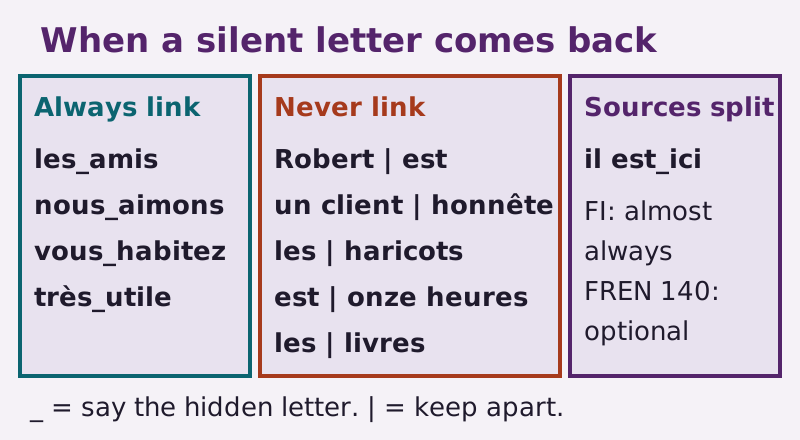
Both books sort liaison into three groups: required, forbidden and optional.
Required. When the next word starts with a vowel sound or a mute h (an aspirated h doesn't count; see below), link after words like les, des and un before a noun, and after a subject pronoun before its verb. Before a consonant there's no link: the s stays silent in les livres and nous parlons.
Say Nous aimons la musique. with a z between nous and aimons. Then say Ils ont peur. ("They're scared.") with a z in ils ont.
Both books also require it after a short adverb, as in très utile. Français interactif adds an adjective before its noun, as in les grands écrivains: the s of grands links as a z, and the d stays silent. A silent h, which FREN 140 calls mute, counts as a vowel, so you link in Vous habitez au Caire. ("You live in Cairo."): the s of vous comes back as a z before habitez.
Forbidden. Don't link after a person's name: in Robert est anglais. ("Robert is English."), the t of Robert stays silent before est; the t of est falls under the split described below. Don't link a noun to the describing word that follows it, as in Français interactif's un client honnête. FREN 140 is less strict after a plural noun: it lists des fenêtres ouvertes as an optional link.
Don't link before an h that FREN 140 calls aspirated, as in les haricots, or after et. And don't link before onze: say Il est onze heures moins dix. ("It is ten minutes before eleven.") with no t sound between est and onze. Wiktionary gives onze as /ɔ̃z/, with the z said.
Where the books differ. Français interactif says liaison after être is almost always required, as in Il est ici. ("He is here.") FREN 140 puts liaison after est and sont in its optional group and says French speakers often skip it. Both versions exist, so copy the people you talk to. FREN 140 also warns that speakers don't always follow these guidelines.
Mute or aspirated, h is silent, so learn which kind each word has. The difference is what happens before it. FREN 140 gives l'horloge and les hôtels for the mute h, with the vowel dropped or the s linked, and les héros for the aspirated h, with no link. In FREN 140, only the mute h drops the vowel before it: le héros, not l'héros.
Why do words run together?
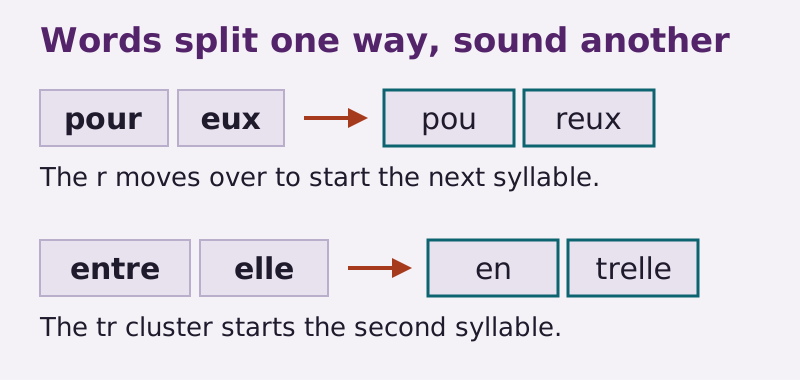
In speech, a consonant usually joins the vowel after it, even across a word break. FREN 140 shows the r of pour eux moving over to start the second syllable, and the tr of entre elle doing the same. Français interactif says French syllables tend to start with a consonant and end with a vowel, while English syllables tend to end with a consonant.
"Consonants join the next vowel" from Conversation Mile (https://conversationmile.com/pronunciation/french-pronunciation/). CC BY 4.0 (creativecommons.org/licenses/by/4.0)
Say Je vais à la bibliothèque pour étudier. ("I'm going to the library to study.") and let the r of pour run straight into étudier.
Where does the stress go?
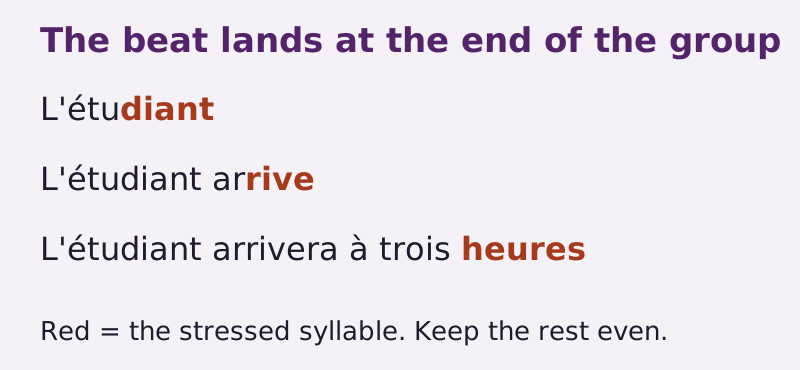
French stresses the last syllable of a word group, not of each word. When words join into a phrase, only the end of the phrase gets the beat.
"Stress moves to the last syllable as the phrase grows" from Conversation Mile (https://conversationmile.com/pronunciation/french-pronunciation/). CC BY 4.0 (creativecommons.org/licenses/by/4.0)
FREN 140 builds a sentence one piece at a time to show this. Say L'étudiant with the beat on the last syllable. Then add words until you reach L'étudiant arrivera à trois heures. ("The student will arrive at three o'clock."), with a z linking trois to heures, since FREN 140 requires a link after a number. The beat moves to heures, and the other syllables stay even. FREN 140 says a stressed French vowel is longer, and that speakers can still stress another word to make a point.
Which e can you drop?
An e in the middle of a word or phrase is often dropped in speech, but not always. Français interactif gives a rule of thumb. If only one consonant comes before the e, it's usually dropped, as in rapidement or sous le bureau. If two consonants come before it, it stays, so that three consonants don't pile up, as in simplement and mercredi.
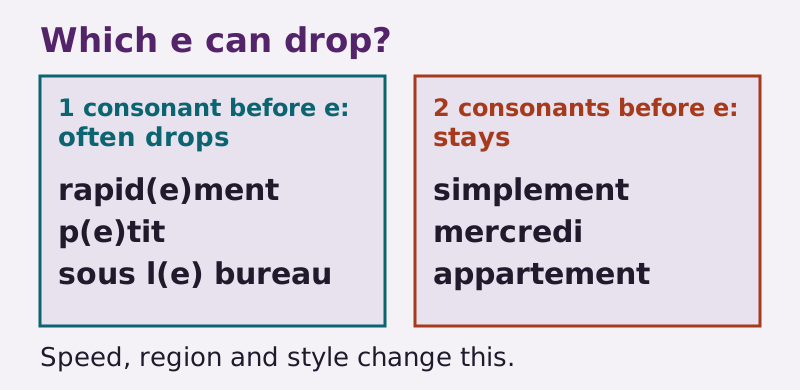
"When the e in the middle can drop" from Conversation Mile (https://conversationmile.com/pronunciation/french-pronunciation/). CC BY 4.0 (creativecommons.org/licenses/by/4.0)
Both books say it depends on how you're speaking. Français interactif names speed and emphasis; FREN 140 names region, register and diction. FREN 140 says some people drop the e in petit and others don't, and that people in Marseille say it. Short words like je, ne, me and de often lose their e in a row of words.
Say Je ne sais pas. ("I do not know.") with every e. Then say it the way FREN 140 writes one casual form, Je n'sais pas, with no e in ne. Both are French. Start with the full form, and copy the shorter one when you hear it.
How do you tell u from ou?
French u and ou are two different vowels, and mixing them up changes the word. FREN 140 pairs vu ("seen") with vous ("you") and pue ("stinks") with poux ("lice").
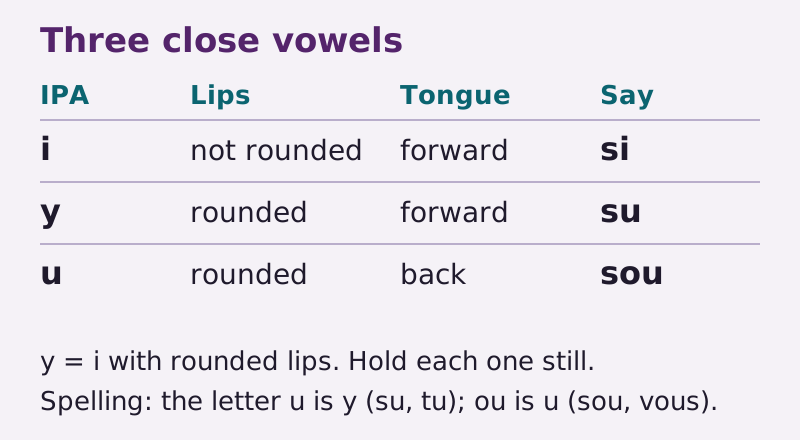
"Lips and tongue for i, y and u" from Conversation Mile (https://conversationmile.com/pronunciation/french-pronunciation/). CC BY 4.0 (creativecommons.org/licenses/by/4.0)
Français interactif's table shows how to get there. In IPA, y is the French letter u, and u is the sound spelled ou. For i in si, the lips aren't rounded and the tongue is forward. For y in su, keep the tongue forward and round your lips. For u in sou, keep the lips round and pull the tongue back. FREN 140 puts the u another way: round your lips as if to blow out a candle, then say "ee."
Say si, su, sou in a row. Then say J'ai bu du lait. ("I drank some milk.") Both bu and du have the rounded-front y. The vous of vous habitez has u.
Français interactif also warns that English speakers tend to let vowels slide into a glide. Keep your lips, tongue and jaw still for the whole vowel. Put a hand under your jaw and feel for any movement at the end; that check is a House routine.
How do you practice this?
Start with vowels and the r for the first two weeks. That means u and ou from this page, plus the French r and the nasal vowels. After that, take one fix at a time: silent final letters, then liaison, then the dropped e, then stress. The order is a House routine.
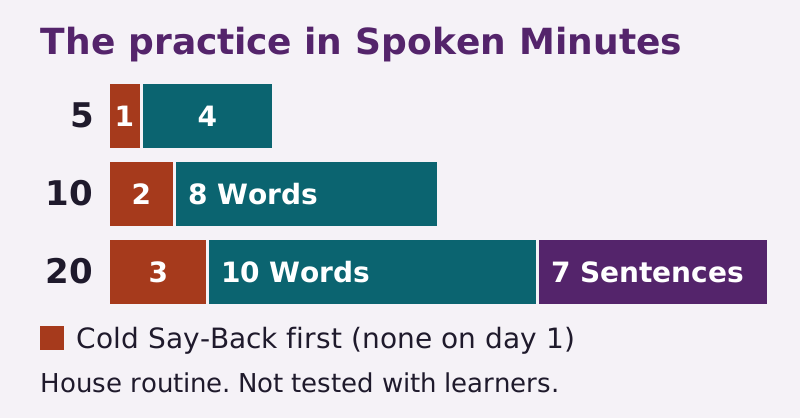
"How pronunciation practice fills 5, 10 or 20 Spoken Minutes" from Conversation Mile (https://conversationmile.com/pronunciation/french-pronunciation/). CC BY 4.0 (creativecommons.org/licenses/by/4.0)
Count only the time you speak, in Spoken Minutes. On a 5-minute day, spend 1 minute on yesterday's Cold Say-Back and 4 on words for today's fix. On a 10-minute day, it's 2 and 8. On a 20-minute day, it's 3, then 10 on words and 7 on the sentences on this page. On the first day of the whole plan there's nothing to test yet, so give those minutes to the words. This split is a House routine, untested with learners. Log the minutes in your Mile Log.
Use the minimal pairs tool to test one contrast at a time. The French alphabet has the letter names, and the French starting plan puts these fixes in order. And French articles will give you plenty of les and des to link.
To hear it. This site has no recordings for this page yet. Français interactif has audio on its pages on liaison, the dropped e and stress and intonation. FREN 140 has audio on its page on types of liaison. These are clips no one on this site has checked, so use them to get used to the sounds, not as a test.
Tomorrow, before you look at anything, run a Cold Say-Back. In your first two weeks, say si, su, sou, then vu and vous. Once you're on silent endings, say "The children are noisy" in French and name the letters you didn't say. Check against this page.
What this rests on
Checked against
- Most final consonants silent; c, r, f and l often said, with exceptions such as porc, gentil and -er verbs; final unaccented e silent; plural s silent Source 2
- The careful rule and its exceptions Source 11
- The letter h never said; mute and aspirated h; the e in the middle that can drop Source 3
- Final e said in one-syllable words like le and je; an added e making the consonant before it said, as in petite Source 4
- When the middle e drops and when it stays Source 13
- Liaison that is required, forbidden or optional, with est given as almost always required, and an adjective before its noun required Source 14
- Liaison sounds such as z, t, n and v Source 7
- Required, forbidden and optional liaison, with est and sont given as optional, and a plural noun before its adjective as optional Source 8
- A consonant joins the next vowel; pour eux and entre elle Source 6
- Stress on the last syllable of the phrase Source 10
- Stress on the last syllable, with longer stressed vowels; the growing sentence Source 9
- Lips and tongue for i, y and u; English speakers sliding vowels Source 12
- U against ou, as in vu and vous Source 5
- Knowing when not to say letters as the big challenge Source 1
- Transcriptions of the example words, including parler, sept, huit, six and dix Source 15
House routine
- The order of the fixes, vowels and r in the first two weeks, one fix at a time after that, the 5, 10 and 20 Spoken Minute splits with the Cold Say-Back first, and the hand on the jaw
Sources
- Carrasco and Zahedi. FREN 140: Basic French Pronunciation, 1.3: Differences between French and English. Palomar College, via LibreTexts Open. Read: The whole page. License: CC BY.
- Carrasco and Zahedi. FREN 140: Basic French Pronunciation, 2.2: Silent Letters at the End of Words. Palomar College, via LibreTexts Open. Read: The whole page. License: CC BY.
- Carrasco and Zahedi. FREN 140: Basic French Pronunciation, 2.3: Other Silent Letters (Silent H and Lapsed E). Palomar College, via LibreTexts Open. Read: The whole page. License: CC BY.
- Carrasco and Zahedi. FREN 140: Basic French Pronunciation, 7.1: The Silent E. Palomar College, via LibreTexts Open. Read: The whole page. License: CC BY.
- Carrasco and Zahedi. FREN 140: Basic French Pronunciation, 8.4: The Challenging Vowel U. Palomar College, via LibreTexts Open. Read: The whole page. License: CC BY.
- Carrasco and Zahedi. FREN 140: Basic French Pronunciation, 12.1: Linking Consonants and Vowels. Palomar College, via LibreTexts Open. Read: The whole page. License: CC BY.
- Carrasco and Zahedi. FREN 140: Basic French Pronunciation, 13.1: How silent consonants are pronounced in liaisons. Palomar College, via LibreTexts Open. Read: The whole page. License: CC BY.
- Carrasco and Zahedi. FREN 140: Basic French Pronunciation, 13.2: Types of Liaisons. Palomar College, via LibreTexts Open. Read: The whole page. License: CC BY.
- Carrasco and Zahedi. FREN 140: Basic French Pronunciation, 14.1: Stress and Rhythm. Palomar College, via LibreTexts Open. Read: The whole page. License: CC BY.
- Blyth, Guilloteau and Kelton. Français interactif, Chapitre 3, Phonétique: l'accentuation; l'intonation. COERLL and the University of Texas at Austin Open. Read: The whole page. License: CC BY 3.0.
- Blyth, Guilloteau and Kelton. Français interactif, Chapitre 5, Phonétique: les syllabes; les consonnes finales. COERLL and the University of Texas at Austin Open. Read: The whole page. License: CC BY 3.0.
- Blyth, Guilloteau and Kelton. Français interactif, Chapitre 6, Phonétique: Les voyelles /i/ /y/ /u/. COERLL and the University of Texas at Austin Open. Read: The whole page. License: CC BY 3.0.
- Blyth, Guilloteau and Kelton. Français interactif, Chapitre 11, Phonétique: le e muet. COERLL and the University of Texas at Austin Open. Read: The whole page. License: CC BY 3.0.
- Blyth, Guilloteau and Kelton. Français interactif, Chapitre 12, Phonétique: la liaison. COERLL and the University of Texas at Austin Open. Read: The whole page. License: CC BY 3.0.
- Wiktionary, French entries, via Wiktextract and kaikki.org Open. Read: The pronunciation lines of the example words on this page, such as chocolat, parc, porc, gentil, petit, rapidement, mercredi, vu, vous, pue and poux. License: CC BY-SA 4.0.
Sentence credits
- Les enfants sont bruyants. Tatoeba sentence 8245315 by felix63; English by francaisr0wlet. CC BY 2.0 FR.
- Il est petit. Tatoeba sentence 8660251 by Julien_PDC; English by shekitten. CC BY 2.0 FR.
- Nous aimons la musique. Tatoeba sentence 2551621 by Amastan; English by CK. CC BY 2.0 FR.
- Ils ont peur. Tatoeba sentence 2069943 by Amastan; English by CK. CC BY 2.0 FR.
- Vous habitez au Caire. Tatoeba sentence 2326065 by Amastan; English by cazort. CC BY 2.0 FR.
- Robert est anglais. FREN 140: Basic French Pronunciation, 13.2. CC BY.
- Il est onze heures moins dix. Tatoeba sentence 427643 by Archibald; English by CK. CC BY 2.0 FR.
- Il est ici. Français interactif, Phonétique, Chapitre 12. CC BY 3.0.
- Je vais à la bibliothèque pour étudier. Tatoeba sentence 8442846 by Aiji; English by CK. CC BY 2.0 FR.
- L'étudiant arrivera à trois heures. FREN 140: Basic French Pronunciation, 14.1. CC BY.
- Je ne sais pas. Tatoeba sentence 3100 by Sprachprofi; English by _undertoad. CC BY 2.0 FR.
- J'ai bu du lait. Tatoeba sentence 2231522 by Amastan; English by CK. CC BY 2.0 FR.
Next stops
Cite this page
French Pronunciation and the Letters You Stop Saying. Conversation Mile, 2026-11-10. https://conversationmile.com/pronunciation/french-pronunciation/
Corrections
No corrections on this page. Spotted a language error? Please tell this site.