Grammar in Use Grammar
French Articles: When un, du, and des Change to de
Straight answer
Most French nouns need a small word in front, even where English uses none. Say this out loud: Je bois du café tous les matins. It means "I drink coffee every morning." English says just "coffee." French says du café, some coffee. That little du is called a partitive article. Below: when you need it, and when it shrinks to de.
The English trap
Tex's French Grammar points out that English often drops the article where French can't. English says I like coffee and I drink coffee with no article at all; French needs le in the first and du in the second.
Say this today
Je bois du café tous les matins.
I drink coffee every morning.
Which articles does French have?
Tex's French Grammar, an open grammar from the University of Texas at Austin, sorts them into three sets. Each one changes with the noun's gender and number.
| Kind | Masculine | Feminine | Before a vowel | Plural |
|---|---|---|---|---|
| Definite (the) | le | la | l' | les |
| Indefinite (a, some) | un | une | un, une | des |
| Partitive (some of a thing you don't count) | du | de la | de l' |
Le and la become l' before a vowel and before most words that start with h: l'eau, l'homme. Tex notes that some words with h don't do this: before them, le and la stay whole and the s of les isn't linked. Tex calls this an aspirate h, and dictionaries mark it. Check a new h word in a dictionary.
Before a vowel, the s of les is said as a z sound: les animaux. Tex shows des linking the same way: des écureuils. French pronunciation covers that linking.
Two more habits from Tex. Un and une can also mean "one," not just "a." And in a list, French usually repeats the article before each noun. Where English says "the plates, knives and glasses," French says les assiettes, les couteaux, les verres. Say that list now, with all three les.
When do you need du, de la or de l'?
Use them for an amount of something you don't count, like coffee, water or meat. Tex says English often leaves out "some" here. French doesn't.
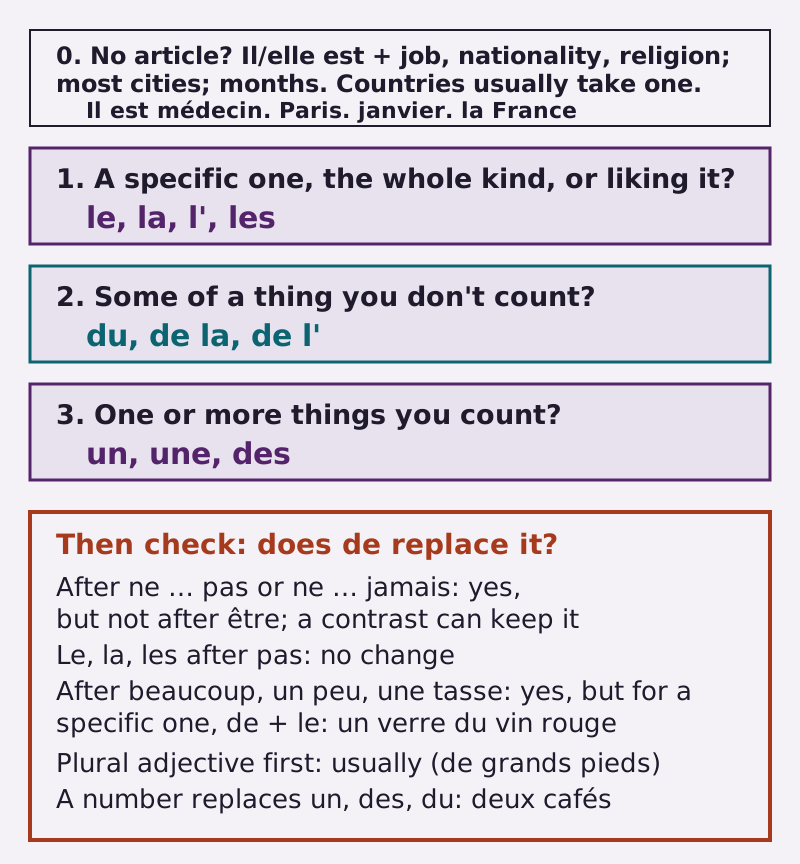
"Choosing a French article" from Conversation Mile (https://conversationmile.com/grammar-in-use/french-articles/). CC BY 4.0 (creativecommons.org/licenses/by/4.0)
| Article | Say it | Meaning |
|---|---|---|
| du | Je bois du thé. | I'm drinking tea. |
| de la | Le chien mange de la viande. | The dog is eating meat. |
| de l' | Il veut de l'eau. | He wants water. |
| des (things you count) | J'ai des questions. | I have questions. |
Tex adds that where English drops "some," French still says des. The cases where it turns into de come further down.
The same noun can take any of the three, depending on what you mean. Français interactif, the open course that goes with Tex, shows du café for some coffee and deux cafés for two cups of it. With a number, as in deux cafés, the number takes the place of un, des or du. Tex's version: the definite article means the thing as a whole, and the partitive means a part of it. Say these three about coffee.
| What you mean | Say it | Meaning |
|---|---|---|
| Some coffee | Je bois du café tous les matins. | I drink coffee every morning. |
| This particular coffee | Le café est chaud. | The coffee is hot. |
| Coffee in general, and liking it | J'aime le café. | I like coffee. |
Why does "I like coffee" take le?
Tex says French uses the definite article for things in general, and with verbs of liking such as aimer, adorer, préférer and détester. English uses no article there, which is the trap at the top of this page.
The general use isn't only about liking. Tex's example L'amour et la santé sont plus importants! means "Love and health are more important!" English says "love" and "health" bare. French gives each one its article.
| Say it | Meaning |
|---|---|
| J'adore les fraises ! | I love strawberries! |
| Je n'aime pas le fromage. | I don't like cheese. |
Notice the second one. It's negative, and it still says le. The change to de in the next section applies to un, une, des and the partitive. Tex's own example keeps le after a negative: Tammy n'aime pas le café.
When do du, de la and des turn into de?
After a negative. Tex and Français interactif both say that after ne … pas, the indefinite and partitive articles become de, or d' before a vowel.
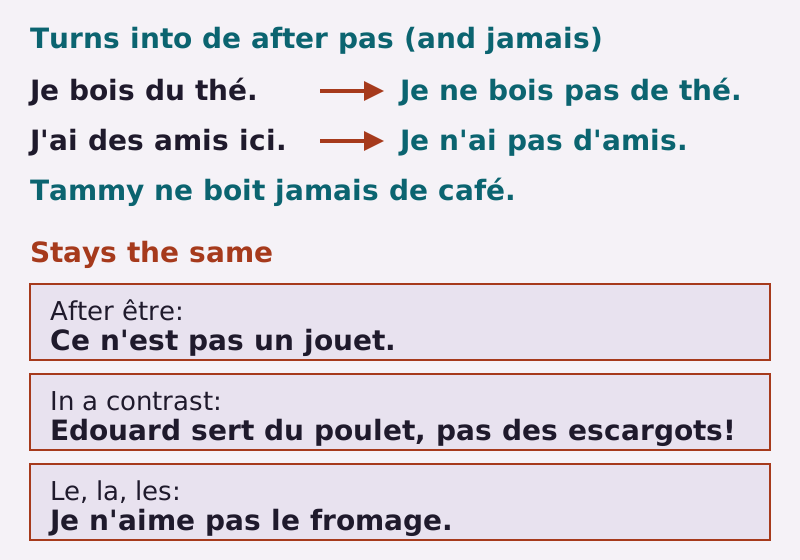
"Articles after pas" from Conversation Mile (https://conversationmile.com/grammar-in-use/french-articles/). CC BY 4.0 (creativecommons.org/licenses/by/4.0)
| Yes | No |
|---|---|
| Je bois du thé. I'm drinking tea. | Je ne bois pas de thé. I don't drink tea. |
| J'ai des amis ici. I have friends here. | Je n'ai pas d'amis. I don't have any friends. |
| Il y a de l'eau. There is water. | Il n'y a pas d'eau. There is no water. |
Tex's examples use ne … jamais the same way: Tammy ne boit jamais de café. (Tammy never drinks coffee.)
This rule has two edges. Both come from Tex. After être, the article stays: Ce n'est pas un jouet. (It's not a toy.) Ce ne sont pas des criminels. (They're not criminals.) And when you deny one thing to name another, the article can stay too: Ce n'est pas de l'hébreu. C'est du yiddish. (This is not Hebrew. It's Yiddish.) That one also has être, so here is Tex's own contrast without it: Edouard sert du poulet, pas des escargots! (Edouard serves chicken, not snails!)
After a word of quantity. Tex says beaucoup, un peu, assez, trop and measures like a cup or a glass are followed by de alone. Français interactif says the same.
| Say it | Meaning |
|---|---|
| Il gagne beaucoup d'argent. | He earns a lot of money. |
| Ajoute un peu de lait. | Add a little milk. |
| Elle a bu une tasse de café. | She drank a cup of coffee. |
| Voulez-vous un verre d'eau ? | Do you want a glass of water? |
The edge here: when you mean a specific thing, Tex uses the definite article after the de, so de and le join as du. Its example is un verre du vin rouge, pas du blanc, a glass of the red wine, not the white. Tex also notes that these quantity words stay the same after a negative: On ne prépare jamais trop de crêpes. (One never prepares too many crepes.)
Before a plural adjective. Tex says des usually becomes de when a plural adjective comes before the noun: Il a de grands pieds. (He has big feet.) J’ai de grands espoirs. (I have high hopes.) When the adjective comes after the noun, des stays: Ce monsieur pose des questions intéressantes. (This gentleman asks interesting questions.)
When is du not "some"?
Sometimes du is just de plus le. Tex lists four joined forms. Français interactif has the same table. Then "of the" or "near the" comes out as du, with no idea of "some."
| Parts | Joined | Say it | Meaning |
|---|---|---|---|
| de + le | du | Je vis près du barrage. | I live near the dam. |
| de + la | stays de la | La poste est près de la librairie. | The post office is near the bookstore. |
| à + le | au | Tom va au marché. | Tom goes to the market. |
| de + les | des | Sami rêvait d'une vie près des montagnes. | Sami dreamed of a life near the mountains. |
| à + les | aux | J'ai parlé aux propriétaires. | I talked to the owners. |
La and l' don't join. So when you see du or des after a word like près, read it as "of the."
When does French use no article?
Tex names a few places. After être or devenir with a subject like il or elle, a job, nationality or religion takes no article, and Tex keeps it bare in the negative too: il n'est pas catholique. This page doesn't cover c'est with a job, other persons, or the plural, so don't build those from this rule.
| Say it | Meaning |
|---|---|
| Il est médecin. | He is a doctor. |
| Elle est professeur. | She is a professor. |
Cities usually take no article, and months never do. Countries go the other way: Tex says continents, countries, states and regions usually take one, as in la France and le Texas. Its exceptions are a few places, mostly islands, such as Haïti and Madagascar. This page doesn't teach how to say "in France" or "to Texas," so don't build place phrases from la France.
Days of the week take le for something that happens every week: Tex's example is le lundi for "on Mondays." This page doesn't cover a single Monday.
How do you practice it today?
Use four drinks whose gender you know: café, thé and lait are masculine, and eau is feminine and starts with a vowel. Put one drink through four frames, then the next drink.
| Frame | With café | With eau |
|---|---|---|
| Liking | J'aime le café. | J'aime l'eau. |
| Some | Je bois du café. | Je bois de l'eau. |
| Not | Je ne bois pas de café. | Je ne bois pas d'eau. |
| A lot | Je bois beaucoup de café. | Je bois beaucoup d'eau. Built by this site to show the contrast |
Stick to these four drinks and these frames. A new noun brings a gender you'd have to check first.
Count it in Spoken Minutes. On a 5-minute day, spend 1 minute on yesterday's Cold Say-Back and 4 on the frames. On a 10-minute day, it's 2 and 8. On a 20-minute day, it's 3, then 10 on the frames and 7 on the edges: say the pairs from the "turn into de" section, both sides, and the Ce n'est pas un jouet sentence. On the first day of the whole 90-day plan there's nothing to say back, so give those minutes to the frames; after that, the Cold Say-Back stays first. The drill and the split are this site's House routine, untested with learners. Log the minutes in your Mile Log.
Passé composé vs imparfait is a good next page, and the French subjunctive comes after. The French starting plan shows where grammar like this fits in your first weeks.
Tomorrow, with nothing in front of you, run a Cold Say-Back: say "I drink coffee every morning" and "I don't drink tea" in French, then check them here.
What this rests on
Checked against
- Most nouns need an article; the definite forms and elision; the definite article for a specific thing, for things in general and after verbs of liking; no article for cities and months, but usually one for countries; aspirate h as the exception to elision and liaison Source 1
- The indefinite forms; des always said where English drops some; un, une and des turning into de after a negative but not after être; des usually becoming de before a plural adjective placed before the noun; no article for a profession, nationality or religion after être or devenir Source 2
- Du, de la and de l' for things you don't count; the whole versus a part; one noun taking all three kinds of article; de after a negative, and the exception for a contrast, with the example Edouard sert du poulet, pas des escargots; ne … jamais with de Source 3
- De after words of quantity, unchanged after a negative, and a definite article when it's a specific item; the example On ne prépare jamais trop de crêpes Source 4
- De and à joining with le and les; la and l' not joining Source 5
- Countable and uncountable, the whole and a part, de after a negative, and de after a quantity, checked in the course book Source 6
- Du, des, au and aux as contractions, checked in the course book Source 7
House routine
- The four-frame drill with drinks, rotating the noun and then the frame, the 5, 10 and 20 Spoken Minute splits, and the Cold Say-Back
Sources
- Tex's French Grammar, definite articles. COERLL, University of Texas at Austin Open. Read: The whole page. License: CC BY 3.0.
- Tex's French Grammar, indefinite articles. COERLL, University of Texas at Austin Open. Read: The whole page. License: CC BY 3.0.
- Tex's French Grammar, partitive articles. COERLL, University of Texas at Austin Open. Read: The whole page. License: CC BY 3.0.
- Tex's French Grammar, expressions of quantity. COERLL, University of Texas at Austin Open. Read: The whole page. License: CC BY 3.0.
- Tex's French Grammar, contractions of à and de with the definite article. COERLL, University of Texas at Austin Open. Read: The whole page. License: CC BY 3.0.
- Kelton, Guilloteau and Blyth. Français interactif, 4th ed., Chapitre 5, sections 5.1 and 5.2, partitive articles and expressions of quantity. COERLL, University of Texas at Austin, 2019 Open. Read: Pages 114, 115, 118 and 121. License: CC BY 3.0.
- Kelton, Guilloteau and Blyth. Français interactif, 4th ed., Chapitre 6, section 6.2, contractions with à and de. COERLL, University of Texas at Austin, 2019 Open. Read: Page 147 (6.2 margin summary). License: CC BY 3.0.
Sentence credits
- Je bois du café tous les matins. Tatoeba sentence 6820103 by Rockaround; English by CK. CC BY 2.0 FR.
- Je bois du thé. Tatoeba sentence 8718714 by Micsmithel; English by CK. CC BY 2.0 FR.
- Le chien mange de la viande. Tatoeba sentence 8883849 by felix63; English by tieguy. CC BY 2.0 FR.
- Il veut de l'eau. Tatoeba sentence 2497668 by Amastan; English by shekitten. CC BY 2.0 FR.
- J'ai des questions. Tatoeba sentence 4592177 by sacredceltic; English by CK. CC BY 2.0 FR.
- Le café est chaud. Tatoeba sentence 7334760 by pititnatole; English by CM. CC BY 2.0 FR.
- J'aime le café. Tatoeba sentence 916677 by Scott; English by robbieheslop. CC BY 2.0 FR.
- L'amour et la santé sont plus importants! Tex's French Grammar, definite articles. CC BY 3.0.
- J'adore les fraises ! Tatoeba sentence 6016336 by saraly2; English by mailohilohi. CC BY 2.0 FR.
- Je n'aime pas le fromage. Tatoeba sentence 2286571 by Amastan; English by Theocracy. CC BY 2.0 FR.
- Je ne bois pas de thé. Tatoeba sentence 1486409 by martin9; English by eeyinn. CC BY 2.0 FR.
- J'ai des amis ici. Tatoeba sentence 9159593 by Julien_PDC; English by CK. CC BY 2.0 FR.
- Je n'ai pas d'amis. Tatoeba sentence 478654 by sacredceltic; English by CK. CC BY 2.0 FR.
- Il y a de l'eau. Tatoeba sentence 8701685 by Micsmithel; English by mccarras. CC BY 2.0 FR.
- Il n'y a pas d'eau. Tatoeba sentence 1444289 by Micsmithel; English by CK. CC BY 2.0 FR.
- Tammy ne boit jamais de café. Tex's French Grammar, partitive articles. CC BY 3.0.
- Ce n'est pas un jouet. Tatoeba sentence 8501420 by Aiji; English by Hybrid. CC BY 2.0 FR.
- Ce ne sont pas des criminels. Tatoeba sentence 2927804 by Elliv; English by CK. CC BY 2.0 FR.
- Ce n'est pas de l'hébreu. C'est du yiddish. Tatoeba sentence 1972723 by nimfeo; English by Amastan. CC BY 2.0 FR.
- Edouard sert du poulet, pas des escargots! Tex's French Grammar, partitive articles. CC BY 3.0.
- Il gagne beaucoup d'argent. Tatoeba sentence 3258987 by nimfeo; English by CM. CC BY 2.0 FR.
- Ajoute un peu de lait. Tatoeba sentence 786414 by U2FS; English by CK. CC BY 2.0 FR.
- Elle a bu une tasse de café. Tatoeba sentence 2338400 by Amastan; English by patgfisher. CC BY 2.0 FR.
- Voulez-vous un verre d'eau ? Tatoeba sentence 3008450 by Blabla; English by CK. CC BY 2.0 FR.
- On ne prépare jamais trop de crêpes. Tex's French Grammar, expressions of quantity. CC BY 3.0.
- Il a de grands pieds. Tatoeba sentence 3349905 by Blabla; English by Hybrid. CC BY 2.0 FR.
- J’ai de grands espoirs. Tatoeba sentence 9932294 by felix63; English by sundown. CC BY 2.0 FR.
- Ce monsieur pose des questions intéressantes. Tatoeba sentence 1084938 by nimfeo; English by belgavox. CC BY 2.0 FR.
- Je vis près du barrage. Tatoeba sentence 11045850 by Aiji; English by AlanF_US. CC BY 2.0 FR.
- La poste est près de la librairie. Tatoeba sentence 3259916 by Aiji; English by CM. CC BY 2.0 FR.
- Tom va au marché. Tatoeba sentence 6561968 by felix63; English by Eccles17. CC BY 2.0 FR.
- Sami rêvait d'une vie près des montagnes. Tatoeba sentence 6372620 by Scorpionvenin14; English by OsoHombre. CC BY 2.0 FR.
- J'ai parlé aux propriétaires. Tatoeba sentence 11252157 by lbdx; English by CM. CC BY 2.0 FR.
- Il est médecin. Tatoeba sentence 342052 by pierrephi; English by CK. CC BY 2.0 FR.
- Elle est professeur. Tatoeba sentence 545019 by sacredceltic; English by MTC. CC BY 2.0 FR.
- J'aime l'eau. Tatoeba sentence 5545314 by sacredceltic; English by Hybrid. CC BY 2.0 FR.
- Je bois du café. Tatoeba sentence 1077505 by jeo; English by CK. CC BY 2.0 FR.
- Je bois de l'eau. Tatoeba sentence 2724289 by Rovo; English by pinkfreud. CC BY 2.0 FR.
- Je ne bois pas de café. Tatoeba sentence 457318 by sacredceltic; English by lukaszpp. CC BY 2.0 FR.
- Je ne bois pas d'eau. Tatoeba sentence 843381 by Julien_PDC; English by weihaiping. CC BY 2.0 FR.
- Je bois beaucoup de café. Tatoeba sentence 11142816 by carlosalberto; English by carlosalberto. CC BY 2.0 FR.
Next stops
Cite this page
French Articles: When un, du, and des Change to de. Conversation Mile, 2026-11-10. https://conversationmile.com/grammar-in-use/french-articles/
Corrections
No corrections on this page. Spotted a language error? Please tell this site.