Grammar in Use Grammar
Passé Composé vs Imparfait: One Story, Two Past Tenses
Straight answer
Use the passé composé for what happened, and usually the imparfait for what was going on around it. Say this out loud: Quand je suis arrivé, personne n'était là. It means "When I arrived, there was no one there." Arriving is the event, so je suis arrivé is in the passé composé. Nobody being there is the scene, so n'était is in the imparfait. If you're a woman, the participle takes an extra -e: Quand je suis arrivée, personne n'était là.
The English trap
Tex's French Grammar warns that English can translate the imparfait with a plain past form. Tom called Mary every day is a past habit, so French uses the imparfait, even though called looks like a single finished event.
Say this today
Quand je suis arrivé, personne n'était là.
When I arrived, there was no one there.
What does each tense do in a story?
Tex's French Grammar, an open grammar from the University of Texas at Austin, gives two questions. The passé composé answers "What happened?" The imparfait usually answers "What was going on when something else happened?"
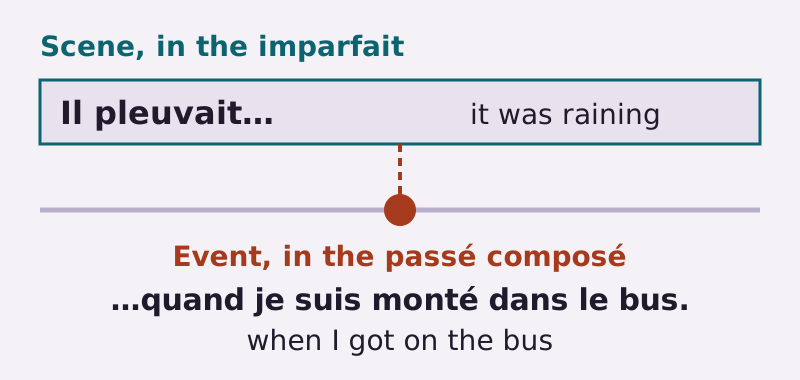
"A scene and an event in one sentence" from Conversation Mile (https://conversationmile.com/grammar-in-use/passe-compose-vs-imparfait/). CC BY 4.0 (creativecommons.org/licenses/by/4.0)
A story needs both. The French course that goes with Tex, Français interactif, puts it this way: the passé composé carries the plot, the events in the order they happened. The imparfait gives the background, which isn't in strict order: the setting, actions in progress, and habits.
| Say it | Which part is scene, which is event |
|---|---|
| Il pleuvait quand je suis monté dans le bus ce matin. It was raining when I got on the bus this morning. (A woman says montée.) | The rain is the scene. Getting on the bus is the event. |
| Je lisais une lettre quand il est entré. I was reading a letter when he entered. | The reading was in progress. His coming in cut into it. |
| Quand je suis rentrée, j'avais très faim. When I got home, I was very hungry. (Said by a woman; a man says rentré.) | Getting home is the event. Being hungry is a state. |
Français interactif gives a quick test: cover every imparfait sentence in a story. The passé composé sentences that are left should still tell the events in order.
The imparfait does a second job. It states habits, the things you used to do. Say these two: Quand j'étais petit, je collectionnais les timbres. (When I was little, I collected stamps.) and Quand j'étais petit, je me levais toujours tôt. (When I was a boy, I always got up early.) A woman says petite in both; the English "a boy" fits petit only.
The English trap above is about this job. English often says "collected," not "used to collect," but French still needs the imparfait for a habit: Tom appelait Mary tous les jours. (Tom called Mary every day.)
Which time words point to which tense?
Tex lists words that often go with each tense. They are hints, not rules.
| Often with the imparfait | Often with the passé composé |
|---|---|
| tous les jours, chaque matin (every day, each morning) | un jour, un matin (one day, one morning) |
| d'habitude, en général (usually) | soudain, tout à coup (suddenly) |
| autrefois, à l'époque (in the past, at the time) | tout de suite (right away) |
| toujours, souvent, rarement (always, often, rarely) | d'abord, puis, enfin (first, then, finally) |
What decides, Tex says plainly, is the whole context, not the time word. Tex shows un jour with both tenses. Say these two and listen to the first verb in each: vendait is in the imparfait, and ont expulsé is in the passé composé.
| Tense of the first verb | Say it | Meaning |
|---|---|---|
| Imparfait, a scene that gets cut into | Un jour, Tex vendait des T-shirts à Paris quand il a été arrêté pour activité illégale. | One day, Tex was selling T-shirts in Paris when he was arrested for illegal activity. |
| Passé composé, an event | Un jour, les autorités françaises ont expulsé Tex. | One day, the French authorities deported Tex. |
Treat the table as a first guess. Then ask the two questions again: did it happen, or was it going on?
Why are être and avoir usually in the imparfait?
Tex says that in a story, verbs like être, avoir, pouvoir, vouloir and savoir usually go in the imparfait, because they mostly describe a state: J'avais peur. (I was afraid.) Je voulais te parler. (I wanted to talk to you.)
When these verbs do go in the passé composé, Tex says they mark a change of state. Its own pair uses avoir for age. Say both and listen for j'avais against j'ai eu.
| Tense | Say it | Meaning |
|---|---|---|
| Imparfait: the age you were | Quand j'avais 15 ans, j'habitais à Fort Worth. | When I was 15, I used to live in Fort Worth. |
| Passé composé: the birthday | Quand j'ai eu 18 ans, j'ai déménagé à Austin. | When I turned 18, I moved to Austin. |
A second clue from Tex: a stretch of time with a clear start and end usually takes the passé composé, even when it lasted years. An open-ended "back then" takes the imparfait.
| Set length: passé composé | Open-ended: imparfait |
|---|---|
| Elle a conduit cette voiture pendant dix ans. She drove this car for 10 years. | Avant, Tammy habitait à Fort Worth. Before, Tammy lived in Fort Worth. |
| J'ai été marié pendant trois ans. I was married for three years. |
A woman says mariée: that word describes the subject, so it takes the -e. The été doesn't change, and neither does the conduit of Elle a conduit. And with avoir and an object after the verb, a woman says j'ai sorti les poubelles too: no -e. Going out is different: that's je suis sortie.
How do you build the passé composé?
The passé composé has two parts: the present tense of a helper verb, avoir or être, and a past participle. Most verbs use avoir. Regular verbs make the participle like this, according to Tex:
| Infinitive ending | Participle | Example |
|---|---|---|
| -er | -é | parler → j'ai parlé |
| -ir (regular) | -i | finir → j'ai fini |
| -re (regular) | -u | perdre → j'ai perdu |
Many common verbs break the pattern. Tex's list includes avoir → eu, être → été, faire → fait, prendre → pris, voir → vu and boire → bu, and Wiktionary gives conduire → conduit, as in Elle a conduit above.
Verbs on the être list break it too, but only a few. Tex gives venir → venu, devenir → devenu, revenir → revenu, naître → né and mourir → mort, and says the other être verbs follow the pattern, as in aller → allé and partir → parti. Check others in the conjugation lookup. Say J'ai fait la vaisselle. (I washed the dishes.) and J'ai perdu mes papiers. (I lost my papers.)
With avoir, the participle doesn't change for the subject. Tex's tables keep parlé for every person. It can change when an object pronoun like la or les comes before the verb. Tex covers that rule on its page on direct object pronouns.
To say "not," put ne and pas around the helper verb: Je ne suis pas sorti dimanche dernier. (I didn't go out last Sunday. A woman says sortie.) Before a vowel, ne becomes n', so with avoir it's je n'ai pas parlé.
Which verbs take être, and what changes?
A smaller group uses être. Tex describes many of them as verbs of coming and going that take no direct object, plus being born and dying.
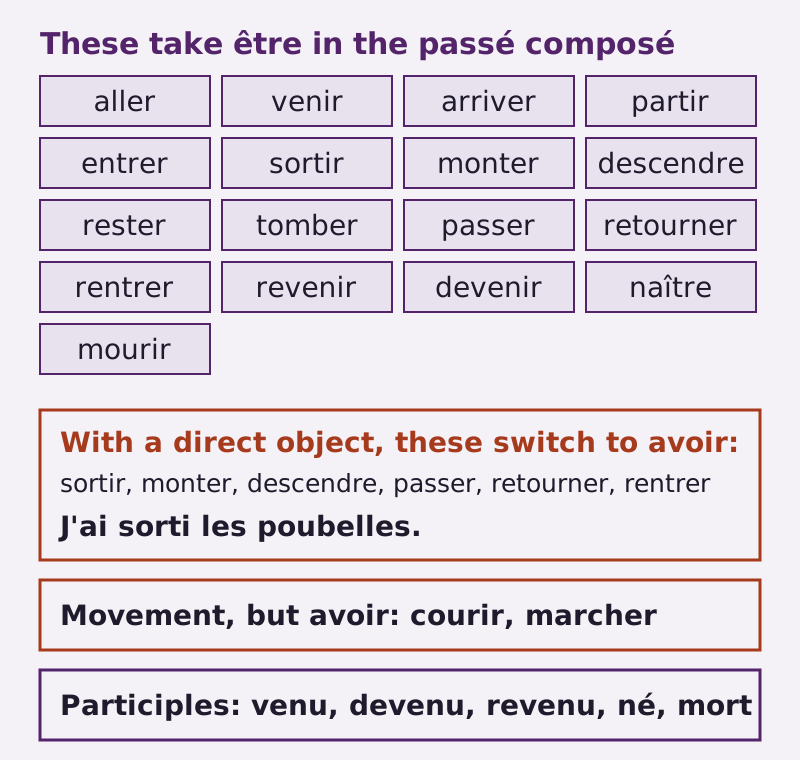
"Verbs that take être, and the exceptions" from Conversation Mile (https://conversationmile.com/grammar-in-use/passe-compose-vs-imparfait/). CC BY 4.0 (creativecommons.org/licenses/by/4.0)
For the verbs on this list, the participle agrees with the subject. Add -e for a feminine subject, -s for a plural one, and -es for a feminine plural one.
| Subject | Say it | Meaning |
|---|---|---|
| I, said by a man | Je suis sorti. | I went out. |
| She | Elle est arrivée en retard. | She arrived late. |
| They (ils) | Ils sont partis hier soir. | They left last night. |
The list has edges. Tex says monter, descendre, sortir, passer and retourner can take a direct object, and then they switch to avoir. Compare Je suis sorti with J'ai sorti les poubelles. (I took out the trash.)
Not every movement verb is on the list: courir (to run) and marcher (to walk) take avoir, as in J'ai marché. (I walked.) Wiktionary gives the participle of courir as couru.
Tex adds that reflexive verbs, the ones with se, also take être. Don't build the passé composé of a se verb from this page. The agreement table above doesn't apply to them, and leaving the ending off isn't the rule either; check a verb table when you need one.
Wiktionary lists rentrer with both helpers, too, and with an object it means "to bring in." Treat it like the five verbs above: je suis rentré (I came home), but with an object, avoir.
How do you build the imparfait?
Take the nous form of the present and drop -ons: nous parlons gives parl-, nous finissons gives finiss-. Tex names one verb that breaks this: être, whose stem is ét-. Then add the endings.
| Person | danser | être |
|---|---|---|
| je | dansais | étais |
| tu | dansais | étais |
| il, elle, on | dansait | était |
| nous | dansions | étions |
| vous | dansiez | étiez |
| ils, elles | dansaient | étaient |
Tex points out that -ais, -ait and -aient all sound the same, so four of the six forms sound alike. One spelling detail: verbs like voyager and commencer keep their soft sound with an added e or a ç before endings that start with a: je voyageais, je commençais. The nous and vous forms don't need it, so drop the e or ç there: nous voyagions, nous commencions.
How do you practice it today?
Use one scene and one event, and change one piece at a time. Start from Quand je suis rentré, j'avais très faim. A woman says rentrée here and adds -e to every participle below. In round 1, keep Quand je suis rentré and change the state. In round 2, keep j'avais très faim and change the event.
| Change | You say |
|---|---|
| The state, round 1 | Quand je suis rentré, j'avais très froid. Built by this site to show the contrast |
| Quand je suis rentré, j'avais très peur. Built by this site to show the contrast | |
| The event, round 2 | Quand je suis arrivé, j'avais très faim. Built by this site to show the contrast |
| Quand je suis sorti, j'avais très faim. Built by this site to show the contrast |
All three event verbs are on the être list, so keep je suis; don't swap in a verb from outside the list without checking which helper it takes.
Count it in Spoken Minutes. On a 5-minute day, spend 1 minute on yesterday's Cold Say-Back and 4 on the swaps. On a 10-minute day, it's 2 and 8. On a 20-minute day, it's 3, then 10 on the swaps and 7 on a four-sentence story about last weekend: two scene sentences in the imparfait, two events in the passé composé. Then run the Français interactif test: drop the scene sentences and check that the events still come in order.
On the first day of the whole 90-day plan there's nothing to say back, so give those minutes to the swaps; after that, the Cold Say-Back stays first. The drill and the split are this site's House routine, untested with learners. Log the minutes in your Mile Log.
If -ais and -ait blur together, that's expected; French pronunciation covers the letters you stop saying at the ends of words. French articles is a good next page, and the French subjunctive comes after. The French starting plan shows where the past tenses fit.
Tomorrow, with nothing in front of you, run a Cold Say-Back: say "When I arrived, there was no one there" and "It was raining when I got on the bus this morning" in French, then check them here. A woman says arrivée and montée.
What this rests on
Checked against
- The passé composé answers what happened and the imparfait usually answers what was going on; foreground and background; time words as hints only, with un jour going either way; states usually in the imparfait and a change of state in the passé composé; a set length of time in the passé composé Source 5
- The imparfait for description, states and past habits, and English rendering it with used to, would or a plain past Source 4
- Plot events in their order in the passé composé, background not strictly ordered in the imparfait, and deleting the imparfait sentences to check the order Source 9
- The two main uses of the imparfait Source 8
- Avoir plus a past participle, the regular -é, -i and -u participles, irregular ones, ne and pas around the helper verb, with n' before a, as in n'a pas mangé Source 1
- Verbs that take être, the participle agreeing with the subject, avoir when sortir and similar verbs take a direct object, courir and marcher with avoir, pronominal verbs with être, and the participles venu, devenu, revenu, né and mort, with the other être verbs regular Source 2
- Couru and conduit as participles, petite as the feminine of petit, and rentrer listed with both helpers and an object sense Source 10
- The list of verbs that take être Source 7
- A participle after avoir agreeing with a direct object that comes before it Source 6
- The imparfait stem from the nous form, ét- for être, the endings, four endings that sound alike, and the spelling of -ger and -cer verbs Source 3
House routine
- The two-sentence drill with one scene and one event, swapping the state and then the event verb, the four-sentence story on 20-minute days, the 5, 10 and 20 Spoken Minute splits, and the Cold Say-Back
Sources
- Tex's French Grammar, passé composé with avoir. COERLL, University of Texas at Austin Open. Read: The whole page. License: CC BY 3.0.
- Tex's French Grammar, passé composé with être. COERLL, University of Texas at Austin Open. Read: The whole page; the picture of the être verbs was not read. License: CC BY 3.0.
- Tex's French Grammar, imparfait: formation. COERLL, University of Texas at Austin Open. Read: The whole page. License: CC BY 3.0.
- Tex's French Grammar, imparfait: states of being, habitual actions. COERLL, University of Texas at Austin Open. Read: The whole page. License: CC BY 3.0.
- Tex's French Grammar, narration: passé composé vs. imparfait. COERLL, University of Texas at Austin Open. Read: The whole page. License: CC BY 3.0.
- Tex's French Grammar, direct object pronouns. COERLL, University of Texas at Austin Open. Read: The section on agreement of the past participle. License: CC BY 3.0.
- Kelton, Guilloteau and Blyth. Français interactif, 4th ed., Chapitre 6, vocabulary list of verbs that take être and section 6.5. COERLL, University of Texas at Austin, 2019 Open. Read: Page 139 (the list of verbs that take être) and page 157 (6.5). License: CC BY 3.0.
- Kelton, Guilloteau and Blyth. Français interactif, 4th ed., Chapitre 7, section 7.5, imparfait. COERLL, University of Texas at Austin, 2019 Open. Read: Page 183 (7.5 margin summary). License: CC BY 3.0.
- Kelton, Guilloteau and Blyth. Français interactif, 4th ed., Chapitre 9, section 9.6, narration: passé composé vs imparfait. COERLL, University of Texas at Austin, 2019 Open. Read: Pages 222 to 224 (9.6). License: CC BY 3.0.
- Wiktionary, French entries and conjugation tables for courir, conduire, petit and rentrer, via Wiktextract and kaikki.org (this site's verb data, data/conjugation-fr.json) Open. Read: The past participles of courir and conduire, the feminine petite, the auxiliaries listed for rentrer, and the senses of rentrer marked transitive. License: CC BY-SA 4.0.
Sentence credits
- Quand je suis arrivé, personne n'était là. Tatoeba sentence 10297511 by Rovo; English by sundown. CC BY 2.0 FR.
- Quand je suis arrivée, personne n'était là. Tatoeba sentence 10297512 by Rovo; English by sundown. CC BY 2.0 FR.
- Il pleuvait quand je suis monté dans le bus ce matin. Tatoeba sentence 4705515 by Cupie; English by CK. CC BY 2.0 FR.
- Je lisais une lettre quand il est entré. Tatoeba sentence 1587822 by RoiOfTheSuisse; English by Nevado. CC BY 2.0 FR.
- Quand je suis rentrée, j'avais très faim. Tatoeba sentence 334525 by TRANG; English by CK. CC BY 2.0 FR.
- Quand j'étais petit, je collectionnais les timbres. Tatoeba sentence 6876680 by Micsmithel; English by kaiperkins271. CC BY 2.0 FR.
- Quand j'étais petit, je me levais toujours tôt. Tatoeba sentence 5919827 by Aiji; English by AlanF_US. CC BY 2.0 FR.
- Tom appelait Mary tous les jours. Tatoeba sentence 5396453 by Aiji; English by CK. CC BY 2.0 FR.
- Un jour, Tex vendait des T-shirts à Paris quand il a été arrêté pour activité illégale. Tex's French Grammar, narration: passé composé vs. imparfait. CC BY 3.0.
- Un jour, les autorités françaises ont expulsé Tex. Tex's French Grammar, narration: passé composé vs. imparfait. CC BY 3.0.
- J'avais peur. Tatoeba sentence 2069873 by Amastan; English by CK. CC BY 2.0 FR.
- Je voulais te parler. Tatoeba sentence 7721084 by Aiji; English by CK. CC BY 2.0 FR.
- Quand j'avais 15 ans, j'habitais à Fort Worth. Tex's French Grammar, narration: passé composé vs. imparfait. CC BY 3.0.
- Quand j'ai eu 18 ans, j'ai déménagé à Austin. Tex's French Grammar, narration: passé composé vs. imparfait. CC BY 3.0.
- Elle a conduit cette voiture pendant dix ans. Tatoeba sentence 4601744 by Amastan; English by Anskora. CC BY 2.0 FR.
- Avant, Tammy habitait à Fort Worth. Tex's French Grammar, narration: passé composé vs. imparfait. CC BY 3.0.
- J'ai été marié pendant trois ans. Tatoeba sentence 7815782 by Aiji; English by CK. CC BY 2.0 FR.
- J'ai fait la vaisselle. Tatoeba sentence 2073590 by Amastan; English by CK. CC BY 2.0 FR.
- J'ai perdu mes papiers. Tatoeba sentence 6060072 by christian63; English by colwem. CC BY 2.0 FR.
- Je ne suis pas sorti dimanche dernier. Tatoeba sentence 7267 by sysko; English by CK. CC BY 2.0 FR.
- Je suis sorti. Tatoeba sentence 2300122 by sysko; English by sundown. CC BY 2.0 FR.
- Elle est arrivée en retard. Tatoeba sentence 8898094 by Julien_PDC; English by tieguy. CC BY 2.0 FR.
- Ils sont partis hier soir. Tatoeba sentence 8790543 by Julien_PDC; English by CK. CC BY 2.0 FR.
- J'ai sorti les poubelles. Tatoeba sentence 2317018 by Amastan; English by CK. CC BY 2.0 FR.
- J'ai marché. Tatoeba sentence 2928463 by Amastan; English by Joseph. CC BY 2.0 FR.
- Quand je suis rentré, j'avais très faim. Tatoeba sentence 1314443 by Scott; English by CK. CC BY 2.0 FR.
Next stops
Cite this page
Passé Composé vs Imparfait: One Story, Two Past Tenses. Conversation Mile, 2026-11-10. https://conversationmile.com/grammar-in-use/passe-compose-vs-imparfait/
Corrections
No corrections on this page. Spotted a language error? Please tell this site.