Grammar in Use Grammar
French Subjunctive Starts With the Phrases That Call for It
Straight answer
The French subjunctive is a verb form that follows certain phrases, so learn the phrases first. Say this out loud: Il faut que je parte. It means "I have to leave," and il faut que calls for the form parte. Every trigger phrase on this page comes from Tex's French Grammar, an open grammar from the University of Texas at Austin.
The English trap
Tex's French Grammar notes that French uses the subjunctive more often than English does. Its own translation of a doubt sentence reads "I don't believe that Edouard is at MacDonald's," with a plain is, so the English gives you no warning.
Say this today
Je veux que tu viennes.
I want you to come.
What does the pattern look like?
A first verb or phrase sets off the subjunctive. Then que links the two parts of the sentence. A new subject follows, and that subject's verb is in the subjunctive.
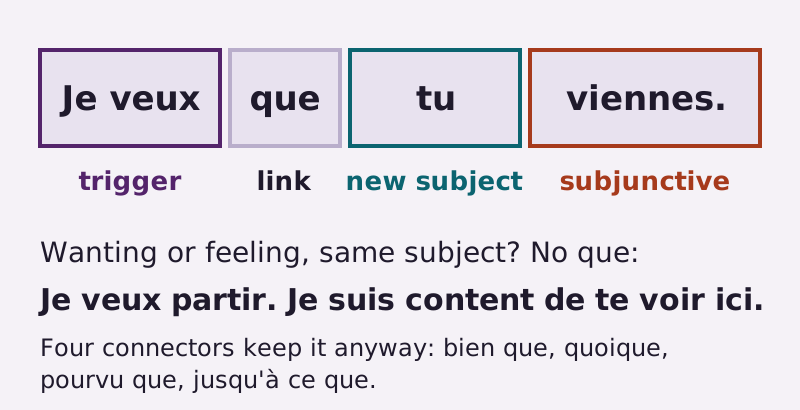
"The subjunctive frame in French" from Conversation Mile (https://conversationmile.com/grammar-in-use/french-subjunctive/). CC BY 4.0 (creativecommons.org/licenses/by/4.0)
Say Je veux que tu viennes. (I want you to come.) Now say Je veux partir. (I want to go.) In the second sentence, the one who wants and the one who goes are the same person. For wanting and feeling, Tex says that with only one subject, the verb is followed by an infinitive, the "to" form of the verb, and no subjunctive. Verbs like vouloir take it straight. Feelings such as être content and phrases like il est important put de first. Four connectors are the exception: bien que, quoique, pourvu que and jusqu'à ce que keep the subjunctive even with one subject. Tex gives doubt only with two different subjects, so this page doesn't cover doubt with one.
Starting with the phrases and not with tables is this site's choice, not a rule from Tex.
Which "it is" phrases call for it?
Il faut que (it is necessary that) is one of the most frequent of these, and Tex says it is always followed by the subjunctive. Tex lists more phrases of necessity, and the Français interactif textbook gives the same list: il est important que, il est nécessaire que, il est essentiel que, il est inévitable que, il vaut mieux que, il est préférable que, il est indispensable que.
| Say it | Meaning |
|---|---|
| Il faut que tu manges. | You have to eat. |
| Il faut que Tom vienne. | Tom needs to come. |
| Il est important que tu répondes. | It's important that you answer. |
| Il est nécessaire que tu partes. | It's necessary for you to go. |
| Il vaut mieux que tu saches la vérité. | It's better for you to know the truth. |
| Il est dommage que vous ne puissiez pas venir. | It's a pity that you can't come. |
The last row is an opinion phrase. Tex lists il est bon que, il est utile que, il est juste que, il est urgent que, il est dommage que and il est logique que, and says there are many more.
If no person is named, drop que and use the infinitive. The Français interactif textbook shows il faut and il vaut mieux going straight to it, as in Il faut étudier pour l'examen. (You have to study for the exam.) The il est phrases add de first: Il est important de lire des livres. (It's important to read books.)
Which verbs of wanting and feeling call for it?
Tex gives two lists. Wanting: vouloir que, aimer que, préférer que, souhaiter que, exiger que and others. Feeling: être content que, être heureux que, être désolé que, regretter que, avoir peur que, craindre que and others. Tex marks the adjectives as matching the person who has the feeling, so a woman says contente and heureuse, not content and heureux.
| Say it | Meaning |
|---|---|
| Je préfère que tu restes ici. | I'd prefer it if you stayed here. |
| Je suis content que tu sois là. | I'm glad you're here. |
| J'ai peur que tu te perdes. | I'm afraid you'll get lost. |
| Je suis content de te voir ici. | I am happy to see you here. |
The third row says "you'll" in English. Tex points out that the subjunctive sometimes has a future meaning, and only context tells you which. The last row has one subject, so Tex uses de plus the infinitive.
One verb breaks the pattern. Tex says espérer (to hope) takes the indicative: J'espère que tu vas bien. (I hope you're OK.) and J'espère que tout se passera bien. (I hope everything goes well.)
When does doubt call for it?
Doubt calls for the subjunctive. Certainty calls for the indicative. Tex and the Français interactif textbook list these doubt phrases: il est possible que, il est impossible que, il est incroyable que, il est douteux que (only Tex lists this one) and douter que.
Phrases of certainty like croire que (to believe), penser que (to think) and être sûr que (to be sure) take the indicative. Add ne… pas and they express doubt, so the subjunctive follows. Negate douter que and you express certainty, so the indicative comes back: je ne doute pas que.
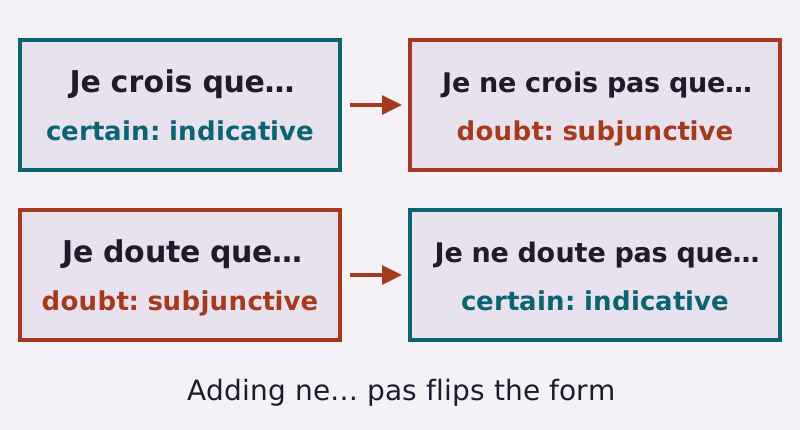
"Negation flips certainty and doubt" from Conversation Mile (https://conversationmile.com/grammar-in-use/french-subjunctive/). CC BY 4.0 (creativecommons.org/licenses/by/4.0)
Say each pair and listen for the verb that changes: est to soit, comprends to comprennes twice, and viendra to vienne. In the last row the indicative is the future, and the ne … pas sits on the indicative side, because negating douter brings the indicative back.
| Certain: indicative | Doubt: subjunctive |
|---|---|
| Je crois que c'est vrai. I believe it to be true. | Je ne crois pas que ce soit vrai. I don't believe that's true. |
| Je pense que tu comprends. Built by this site to show the contrast I think you understand. | Je ne pense pas que tu comprennes. I don't think you understand. |
| Je suis sûr que tu comprends. I'm sure you understand. | Je ne suis pas sûr que tu comprennes. Built by this site to show the contrast I'm not sure you understand. |
| Je ne doute pas qu'il viendra. I don't doubt he'll come. | Je doute qu'il vienne. I doubt if he will come. |
Two "it is" phrases sit on opposite sides. Il est clair que is on Tex's certainty list, so it takes the indicative: Il est clair que tu as tort. (It's clear that you're wrong.) Il est possible que is on its doubt list, so it takes the subjunctive: Il est possible que Tom soit un génie. (It's possible that Tom is a genius.)
Sûr matches the speaker, like content: a woman says sûre.
When croire, penser or être sûr becomes a question, Tex treats it as doubt too, as in Crois-tu que Tom soit innocent ? (Do you believe Tom is innocent?) Tex puts il est probable que (it is probable that) with the certainty phrases, so it takes the indicative.
Which connectors always call for it?
Tex says the subjunctive always follows these connectors when one of them brings in a new subject. For a purpose: pour que, afin que (so that). For fear: de crainte que, de peur que (for fear that). For time: avant que (before), en attendant que (while waiting for), jusqu'à ce que (until). For an obstacle: bien que, quoique (although), à moins que (unless). For a condition: à condition que, pourvu que (provided that), sans que (without).
| Say it | Meaning |
|---|---|
| Je dis cela afin que tu comprennes. | I say this so that you understand. |
| Je travaille pour que tu puisses apprendre le quechua. | I am working so that you can learn Quechua. |
| Je lui téléphonerai avant qu'il sorte. | I'll call him before he goes out. |
| Je reste ici jusqu'à ce que tu reviennes. | I'll stay here till you get back. |
| Il l'a fait sans que je le sache. | He did it unbeknownst to me. |
| Je viendrai, à condition que tu conduises lentement. | I'll come provided you drive slowly. |
| Ne dis rien, à moins que ce ne soit important ! | Don't say anything unless it's important. |
The last row has a ne that doesn't make the verb negative. Tex marks this ne as optional, added for style, in its examples with de crainte que and avant que. This page's line has it after à moins que. Tex's de peur que example has none. Don't add it after other connectors. It's the one in ce ne soit, not the Ne of Ne dis rien, which you keep. Without it, the line is Ne dis rien, à moins que ce soit important.
Four connectors keep the subjunctive even when the subject stays the same: bien que, quoique, pourvu que and jusqu'à ce que. Say Bien qu'il soit pauvre, il est heureux. (Even though he's poor, he's happy.)
Not every connector is on the list. Tex puts quand (when), pendant que (while) and parce que (because) with the ordinary connectors.
What do you say when there's only one subject?
For many of the other connectors, Tex shows a way around the subjunctive when both parts have the same subject: you can often switch to a preposition plus the infinitive. Avant que becomes avant de, pour que becomes pour, and sans que becomes sans. In à moins que, afin que, à condition que, de peur que, de crainte que and en attendant que, que becomes de.
| Two subjects | One subject |
|---|---|
| Faisons ça avant qu'il fasse chaud. Let's do this before it gets hot. | Elle a embrassé ses parents avant de partir. She hugged her parents before she left. |
| Je dis cela afin que tu comprennes. I say this so that you understand. | Je suis venu ici pour apprendre. I came here to learn. (A woman says venue.) |
Which endings do you need?
Tex gives the same endings for all verbs except avoir and être, which come further down: -e, -es, -e, -ions, -iez, -ent. For most verbs, take the ils form of the present, drop -ent, and add them.
| Person | parler | finir | attendre |
|---|---|---|---|
| je | que je parle | que je finisse | que j'attende |
| tu | que tu parles | que tu finisses | que tu attendes |
| il, elle, on | qu'il parle | qu'il finisse | qu'il attende |
| nous | que nous parlions | que nous finissions | que nous attendions |
| vous | que vous parliez | que vous finissiez | que vous attendiez |
| ils, elles | qu'ils parlent | qu'ils finissent | qu'ils attendent |
Before a vowel, que je becomes que j', as in que j'attende.
Tex notes that for regular -er verbs, the je, tu, il and ils forms look and sound like the present. Many verbs that are irregular in the present still follow this recipe, such as dormir (dorme) and dire (dise).
Some verbs have two stems. Tex says the nous and vous forms take their stem from the nous form of the present.
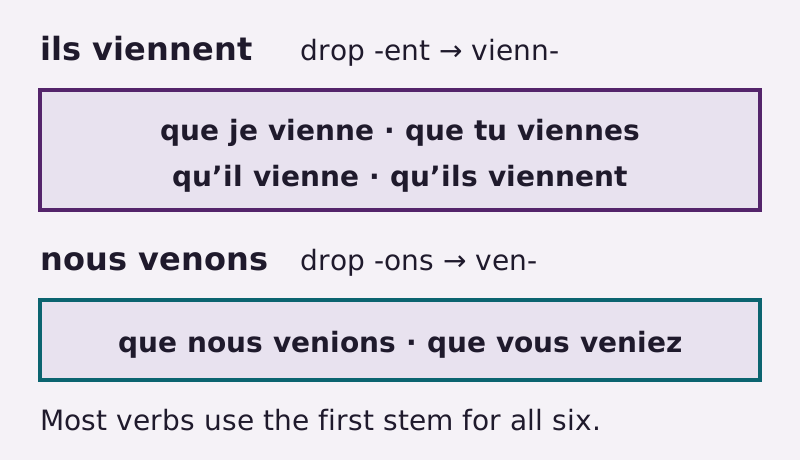
"Where the subjunctive stems come from" from Conversation Mile (https://conversationmile.com/grammar-in-use/french-subjunctive/). CC BY 4.0 (creativecommons.org/licenses/by/4.0)
| Verb | je | nous |
|---|---|---|
| venir | que je vienne | que nous venions |
| aller | que j'aille | que nous allions |
| prendre | que je prenne | que nous prenions |
| vouloir | que je veuille | que nous voulions |
| boire | que je boive | que nous buvions |
| voir | que je voie | que nous voyions |
Two of these don't follow the ils-form recipe for their first stem. Wiktionary gives the present ils vont and ils veulent, but the subjunctive is aille and veuille, so learn those two as they are. Tex adds that -er verbs whose stem changes in the present, such as appeler and acheter, keep both stems: que j'appelle but que nous appelions. Don't build their nous and vous forms from the ils form. Check the conjugation lookup.
Five verbs you just learn whole. A few forms of each: être (que je sois, que nous soyons), avoir (que j'aie, que tu aies, qu'il ait, que nous ayons), faire (que je fasse), savoir (que je sache) and pouvoir (que je puisse).
There's also a past subjunctive for an action that came before the main verb: Je suis content que tu aies appelé. (I'm glad you called.) Tex builds it from the subjunctive of avoir or être plus the past participle. The participle is the one from the passé composé, but the helper is subjunctive: tu aies, not tu as. Leave it for later.
How do you practice it today?
Pick 3 phrases that take the subjunctive, such as il faut que, je veux que and je doute que. Leave out espérer, il est probable que and je ne doute pas que: those take the indicative. Croire, penser and être sûr take the indicative only when they're positive. Save their negative forms for the doubt pairs on 20-minute days. Leave the connectors out of this drill too.
Keep the phrase the same and change the person after que. After je veux que or je doute que, use tu, il, elle, on, nous, vous, ils or elles, never je. To talk about yourself with vouloir, say Je veux partir. With douter, just skip je in this drill. The il of il faut que isn't a person, so any person can follow it, as in Il faut que je parte. The ending follows the new person, and some verbs change stem, so check the tables above as you go.
| Person after que | Say it | Meaning |
|---|---|---|
| tu | Je veux que tu viennes. | I want you to come. |
| il | Je veux qu'il vienne. | I want him to come. |
| vous (formal, or more than one) | Je veux que vous veniez. Built by this site to show the contrast | I want you to come. |
| vous, new verb | Je veux que vous partiez. | I want you to go. |
The vous row with venir uses the second stem, ven-. Go through your list of people with the first phrase, then the second and third. When you reach the end, change the verb, say from venir to partir, and go round again. Partir keeps one stem for every person: que je parte, que nous partions. Before il, elle, on, ils and elles, que becomes qu'.
Count it in Spoken Minutes. On a 5-minute day, spend 1 minute on yesterday's Cold Say-Back and 4 on the phrases. On a 10-minute day, it's 2 and 8. On a 20-minute day, it's 3, then 10 on the phrases and 7 on the doubt pairs. On the first day of the whole 90-day plan there's nothing to say back, so give those minutes to the phrases. After that, the Cold Say-Back stays first. This split is this site's House routine, untested with learners. Log the minutes in your Mile Log.
If parle and parlent sound alike to you, that's right: French pronunciation covers the endings you don't say. French articles is a good next grammar stop, and the French starting plan holds advanced grammar like this for later.
Tomorrow, with nothing in front of you, run a Cold Say-Back: say "I want you to come" and "I don't believe that's true" in French, then check them here.
What this rests on
Checked against
- Endings -e, -es, -e, -ions, -iez, -ent; the stem from the ils form minus -ent; -er boot forms sounding like the present; que j' and qu'il before a vowel; stem-changing -er verbs such as appeler keeping two stems Source 1
- Two-stem verbs taking nous and vous from the nous form; avoir, être, faire, savoir and pouvoir Source 2
- Il faut que and the six other phrases of necessity, two different subjects Source 3
- Doubt phrases; certainty phrases taking the indicative until negated or questioned; ne pas douter taking the indicative; il est probable que among the certainty phrases Source 4
- Verbs of will and emotion, opinion phrases, espérer as the exception, a future meaning, two different subjects for the subjunctive, and an infinitive or de plus an infinitive with one subject Source 5
- Connectors that take it, the optional ne in the de crainte que and avant que examples, and four that keep it with the same subject Source 6
- The past subjunctive for an earlier action Source 7
- Connectors swapped for a preposition plus an infinitive with one subject Source 8
- Quand and parce que among the ordinary connectors Source 9
- Il faut and il vaut mieux straight before an infinitive, il est phrases with de Source 10
- The same list of necessity phrases and the same endings table Source 11
- The same list of doubt phrases Source 12
- The verb forms in the tables and figures, including the present ils vont and ils veulent, one stem for partir, and sûre, contente and heureuse as feminine forms Source 13
House routine
- Learning the phrases before the endings, the order of this page, 3 phrases a day with the person changing and then the verb, the 5, 10 and 20 Spoken Minute splits, and the Cold Say-Back
Sources
- Tex's French Grammar, regular subjunctive. COERLL and the University of Texas at Austin Open. Read: The whole page. License: CC BY 3.0.
- Tex's French Grammar, irregular subjunctive. COERLL and the University of Texas at Austin Open. Read: The whole page. License: CC BY 3.0.
- Tex's French Grammar, subjunctive usage: obligation. COERLL and the University of Texas at Austin Open. Read: The whole page. License: CC BY 3.0.
- Tex's French Grammar, subjunctive usage: doubt. COERLL and the University of Texas at Austin Open. Read: The whole page. License: CC BY 3.0.
- Tex's French Grammar, subjunctive usage: will, emotion, desire. COERLL and the University of Texas at Austin Open. Read: The whole page. License: CC BY 3.0.
- Tex's French Grammar, conjunctions that take the subjunctive. COERLL and the University of Texas at Austin Open. Read: The whole page. License: CC BY 3.0.
- Tex's French Grammar, past subjunctive. COERLL and the University of Texas at Austin Open. Read: The whole page. License: CC BY 3.0.
- Tex's French Grammar, ways to avoid the subjunctive. COERLL and the University of Texas at Austin Open. Read: The whole page. License: CC BY 3.0.
- Tex's French Grammar, subordinating conjunctions. COERLL and the University of Texas at Austin Open. Read: The whole page. License: CC BY 3.0.
- Kelton, Guilloteau and Blyth. Français interactif, 4th ed., Chapter 10, 10.3, impersonal verbs and expressions. COERLL and the University of Texas at Austin, 2019 Open. Read: The 10.3 margin note and its exercises. License: CC BY 3.0.
- Kelton, Guilloteau and Blyth. Français interactif, 4th ed., Chapter 11, 11.4 regular subjunctive and 11.6 subjunctive usage: obligation. COERLL and the University of Texas at Austin, 2019 Open. Read: The 11.4 and 11.6 margin notes and their exercises. License: CC BY 3.0.
- Kelton, Guilloteau and Blyth. Français interactif, 4th ed., Chapter 12, 12.1 subjunctive usage: doubt. COERLL and the University of Texas at Austin, 2019 Open. Read: The 12.1 margin note and its exercises. License: CC BY 3.0.
- Wiktionary, French conjugation tables for the verbs in this page's tables, via Wiktextract and kaikki.org (this site's verb data, data/conjugation-fr.json) Open. Read: The present subjunctive rows of parler, finir, attendre, venir, aller, prendre, vouloir, boire, voir, être, avoir, faire, savoir, pouvoir, dormir, partir, dire and mettre in this site's verb data, and the kaikki entries for sûre, contente and heureuse. License: CC BY-SA 4.0.
Sentence credits
- Je veux que tu viennes. Tatoeba sentence 9554572 by Julien_PDC; English by CK. CC BY 2.0 FR.
- Il faut que je parte. Tatoeba sentence 7862354 by felix63; English by CK. CC BY 2.0 FR.
- Je veux partir. Tatoeba sentence 1978617 by sacredceltic; English by Spamster. CC BY 2.0 FR.
- Il faut que tu manges. Tatoeba sentence 4594499 by Amastan; English by CK. CC BY 2.0 FR.
- Il faut que Tom vienne. Tatoeba sentence 4598662 by Amastan; English by CK. CC BY 2.0 FR.
- Il est important que tu répondes. Tatoeba sentence 2838761 by nimfeo; English by moxy. CC BY 2.0 FR.
- Il est nécessaire que tu partes. Tatoeba sentence 1347206 by sacredceltic; English by CK. CC BY 2.0 FR.
- Il vaut mieux que tu saches la vérité. Tatoeba sentence 2838705 by nimfeo; English by monahxo. CC BY 2.0 FR.
- Il est dommage que vous ne puissiez pas venir. Tatoeba sentence 477453 by sacredceltic; English by CK. CC BY 2.0 FR.
- Il faut étudier pour l'examen. Français interactif, 4th ed., Chapter 10, 10.3. CC BY 3.0.
- Il est important de lire des livres. Tatoeba sentence 1441111 by sacredceltic; English by CK. CC BY 2.0 FR.
- Je préfère que tu restes ici. Tatoeba sentence 8695579 by Julien_PDC; English by Lebensfreude. CC BY 2.0 FR.
- Je suis content que tu sois là. Tatoeba sentence 2053720 by sacredceltic; English by CK. CC BY 2.0 FR.
- J'ai peur que tu te perdes. Tatoeba sentence 931339 by sacredceltic; English by CK. CC BY 2.0 FR.
- Je suis content de te voir ici. Tatoeba sentence 2005015 by sacredceltic; English by CK. CC BY 2.0 FR.
- J'espère que tu vas bien. Tatoeba sentence 669693 by qdii; English by CK. CC BY 2.0 FR.
- J'espère que tout se passera bien. Tatoeba sentence 6850447 by Blabla; English by CK. CC BY 2.0 FR.
- Je crois que c'est vrai. Tatoeba sentence 427234 by slist; English by CK. CC BY 2.0 FR.
- Je ne crois pas que ce soit vrai. Tatoeba sentence 2420693 by sacredceltic; English by CK. CC BY 2.0 FR.
- Je ne pense pas que tu comprennes. Tatoeba sentence 2137649 by sacredceltic; English by CK. CC BY 2.0 FR.
- Je suis sûr que tu comprends. Tatoeba sentence 10008515 by felix63; English by CK. CC BY 2.0 FR.
- Je ne doute pas qu'il viendra. Tatoeba sentence 1504048 by martin9; English by rul. CC BY 2.0 FR.
- Je doute qu'il vienne. Tatoeba sentence 334296 by sysko; English by CK. CC BY 2.0 FR.
- Il est clair que tu as tort. Tatoeba sentence 477504 by sacredceltic; English by CK. CC BY 2.0 FR.
- Il est possible que Tom soit un génie. Tatoeba sentence 5660120 by Scorpionvenin14; English by CK. CC BY 2.0 FR.
- Crois-tu que Tom soit innocent ? Tatoeba sentence 5290935 by Aiji; English by CK. CC BY 2.0 FR.
- Je dis cela afin que tu comprennes. Tatoeba sentence 2965267 by Wakano; English by kerbear407. CC BY 2.0 FR.
- Je travaille pour que tu puisses apprendre le quechua. Tatoeba sentence 7051942 by Micsmithel; English by marloncori. CC BY 2.0 FR.
- Je lui téléphonerai avant qu'il sorte. Tatoeba sentence 1730800 by Aiji; English by pne. CC BY 2.0 FR.
- Je reste ici jusqu'à ce que tu reviennes. Tatoeba sentence 9067 by trotter; English by CK. CC BY 2.0 FR.
- Il l'a fait sans que je le sache. Tatoeba sentence 1184683 by rene1596; English by sundown. CC BY 2.0 FR.
- Je viendrai, à condition que tu conduises lentement. Tatoeba sentence 1974976 by nimfeo; English by CM. CC BY 2.0 FR.
- Ne dis rien, à moins que ce ne soit important ! Tatoeba sentence 2289827 by sacredceltic; English by CK. CC BY 2.0 FR.
- Bien qu'il soit pauvre, il est heureux. Tatoeba sentence 793278 by Cocorico; English by Jesse. CC BY 2.0 FR.
- Faisons ça avant qu'il fasse chaud. Tatoeba sentence 7553014 by Aiji; English by CK. CC BY 2.0 FR.
- Elle a embrassé ses parents avant de partir. Tatoeba sentence 3258753 by Aiji; English by CM. CC BY 2.0 FR.
- Je suis venu ici pour apprendre. Tatoeba sentence 5569211 by sacredceltic; English by CM. CC BY 2.0 FR.
- Je suis content que tu aies appelé. Tatoeba sentence 5906501 by Aiji; English by CK. CC BY 2.0 FR.
- Je veux qu'il vienne. Tatoeba sentence 9554573 by Julien_PDC; English by rul. CC BY 2.0 FR.
- Je veux que vous partiez. Tatoeba sentence 9033 by sacredceltic; English by CK. CC BY 2.0 FR.
Next stops
Cite this page
French Subjunctive Starts With the Phrases That Call for It. Conversation Mile, 2026-11-10. https://conversationmile.com/grammar-in-use/french-subjunctive/
Corrections
No corrections on this page. Spotted a language error? Please tell this site.